
Local
Kameny house wins D.C. landmark status
Designation is a first for gay-related site in city
The D.C. Historic Preservation Review Board voted unanimously Thursday to designate the home of veteran gay rights leader Franklin Kameny as an historic landmark — the first time a gay-related site has been approved for landmark status in the nation’s capital.
The Rainbow History Project, a local gay organization, nominated Kameny’s home at 5020 Cathedral Ave., N.W., for the status. The group submitted a detailed application to the board describing Kameny’s use of his house as an office and center for carrying out his widely recognized role as local founder and national pioneer of the modern gay rights movement beginning in the early 1960s.
“Historians consider him a landmark figure in articulating and achieving gay civil rights in federal employment, criminal law, security clearances cases, and in reversing the medical community’s views on homosexuality,” said the Rainbow History Project in its application to the board.
Kameny, 83, still lives in the house. He said he has lived there since 1962, initially as a tenant. He purchased the home in 1984.
“I coined the slogan ‘Gay is Good’ in this house in 1968,” Kameny told the Blade after learning Thursday about the board’s decision. “Today’s action represents official endorsement of that. Gay is good, and that has now become official truth.”
The Rainbow History Project said Kameny’s home “served as a meeting place [and] de facto headquarters of the Mattachine Society of Washington, D.C., and the planning center for much local and national gay civil rights activism, primarily from 1961 to 1971.”
The Mattachine Society, one of the nation’s first gay organizations, had been in existence in other cities since the early 1950s. Nearly all of the group’s members concealed their names and worked quietly behind the scenes to make gays more socially accepted.
Kameny, who founded the group’s local chapter in 1961, is credited with pushing to transform the organization into a far more aggressive and activist civil rights organization. He coordinated the first gay protest demonstrations at the White House and Pentagon.
Tersh Boasberg, chair of the D.C. Historic Preservation Review Board, said shortly before the board voted on the application that Kameny’s case was “highly unusual” because historic landmark status is rarely, if ever, given to a site associated with a living person.
But he said the Rainbow History Project’s detailed and “scholarly” application, along with endorsements from respected historians and preservationist organizations, provided a convincing case for approving the application.
The D.C. Preservation League signed on as a co-sponsor to the application.
The selection of Kameny’s house also is unusual because its modest, 1950s colonial style was not considered distinctive architecturally. Most homes and buildings selected for historic landmark status in D.C. are chosen, in part, because of their architectural distinction as well as their historic significance.
The designation of the Kameny house as a historic landmark in D.C. qualifies the house to be considered for placement on the federal government’s National Register of Historic Places.
If approved by the National Park Service, the Kameny site would be only the second gay-related site recognized on the national register, according to the Rainbow History Project.
New York City’s Stonewall Inn, the gay bar where a police raid sparked the 1969 Stonewall riots, so far has been the only gay-related site recognized in the National Register of Historic Places, Meinke said.
He said only a “handful” of other gay related sites have been recognized by cities or states as historic landmarks. Among them are Harvey Milk’s camera shop and home in San Francisco, the home of early gay rights leader Henry Gerber in Chicago and the Stonewall Inn.





District of Columbia
Taste of Point returns at critical time for queer students
BIPOC scholar to speak at Room & Board event on May 2

The Point Foundation will kick off May with its annual Taste of Point DC event. The event will be hosted at Room & Board on 14th Street and feature a silent auction, food tastings, a speech from a scholar, and more.
Point’s chief of staff, Kevin Wright, said that at Taste of Point, the scholars are the star of the show.
“People never come to an event to hear Point staff speak, they come to hear from the people most impacted by the program,” he said. “At its core Taste of Point is designed to center and highlight our scholars’ voices and experiences.”
This year, a Point BIPOC Scholar, Katherine Guerrero Rivera will speak at the event.
“It is a great opportunity to highlight the scholars out there on the front lines making impacts in almost every sector and job field,” Wright said.
Wright pointed out that this year especially is a pivotal time for LGBTQ students.
“In 2023, there were 20 states that passed anti-LGBTQ legislation,” he said. “By this point in [2024] we already have more.”
Wright said the impacts of those legislative attacks are far reaching and that Point is continuously monitoring the impact they have on students on the ground.
Last month, The Washington Post reported that states with anti-LGBTQ laws in place saw school hate crimes quadruple. This report came a month after a non-binary student, Nex Bennedict, died after being attacked at school.
“So, we see this as a critical moment to really step up and help students who are facing these challenges on their campus,” Wright said. “Our mission is to continue to empower our scholars to achieve their full academic and leadership potential.”
This year Point awarded nearly 600 LGBTQ students with scholarships. These include the flagship scholarship, community college scholarship and the BIPOC scholarship. When the foundation started in 2002, there were only eight scholarships awarded.
Dr. Harjant Gill is one of those scholars who said the scholarship was pivotal for him. Gill said he spent his undergraduate years creating films and doing activism for the LGBTQ community.
As a result, his academic record wasn’t stellar and although he was admitted into American University’s graduate program he had no clue how he would fund it.
Upon arrival to American he was told to apply for a Point scholarship and the rest was history.
“It ended up being the one thing that kept me going otherwise I would have dropped out,” he said. “Point was incredibly instrumental in my journey to becoming an academic and a professor.”
More than a decade later, Gill serves on the host committee for Taste of Point and is a mentor to young Point scholars. He said that he donates money yearly to Point and that when he is asked what he wants for a gift he will often tell his friends to donate too.
To attend the event on Wednesday, May 2, purchase tickets at the Point website. If you can’t attend this year’s Taste of Point DC event but would like to get involved, you can also donate online.
District of Columbia
Three of five LGBTQ candidates win race for DNC delegate from D.C.
32 candidates competed for 13 elected seats in party caucus

Three out of five known LGBTQ candidates running for election as delegates from D.C. to the Democratic National Convention won their races at an April 20 Democratic Party caucus election held at D.C.’s Walter Washington Convention Center.
Ward 2 gay Democratic activist John Fanning finished in first place with 140 votes and Ward 8 gay Democratic activist David Meadows finished in second place with 127 votes in a race in which six male candidates committed to supporting President Biden were competing for three male seats in a section of the city designated as Congressional District 1, which included registered Democratic voters in Wards 1, 2, 6, and 8.
Ward 7 gay Democratic activist Jimmie Williams won his race, finishing in third place with 200 votes in a race in which eight male candidates committed to President Biden competed for four male seats in the Congressional District 2 section of the city that included Wards 3, 4, 5, and 7.
Gay Democratic activist Felipe Afanador lost his race, finishing in sixth place with 47 votes in the Congressional District 2 election for male candidates backing Biden. It couldn’t immediately be determined which of the four wards in District 2 he is from.
The Washington Blade didn’t learn about Afanador’s status as an LGBTQ candidate until the Capital Stonewall Democrats announced it one day before the April 20 party election in an email statement.
In the Congressional District 2 race among female candidates, in which eight candidates competed for three female seats, transgender rights advocate and Ward 3 Democratic Party activist Monika Nemeth lost her race, finishing in sixth place with 49 votes.
The five LGBTQ candidates were among 32 candidates competing for just 13 elected delegate positions in D.C. D.C. will have a total of 51 delegates to the Democratic Convention, but the other 38 include elected officials and party leaders who are considered “automatic” or appointed delegates. The Democratic Convention will be held in Chicago Aug. 19-23.
Observers familiar with the April 20 party caucus election said Fanning, Meadows, and Williams had participated in local D.C. Democratic Party events and activities for a longer period than Nemeth and Afanador and appear to have been better known among Democratic voters in their respective wards as well as other wards. Those factors contributed to their receiving significantly more votes than most other candidates, observers have said.
In his candidacy statement posted on the D.C. Democratic Party website, Afanador said he worked on the 2020 Biden presidential election campaign in Pennsylvania. His LinkedIn page says in 2022 he began work in Washington for the Biden administration as an official in the U.S. Department of Agriculture.
Nemeth is a past president of D.C.’s Capital Stonewall Democrats, the city’s largest LGBTQ local political group, and has been an active member of the D.C. Democratic State Committee, the local party governing body. She served as a Biden delegate at the 2020 Democratic National Convention.
“It is important for our D.C. delegation to have strong LGBTQ representation,” Capital Stonewall Democrats said in its April 19 statement. “There are five LGBQ candidates running to be delegate, and Capital Stonewall Democrats asks that our members support each one,” the statement says.
“Unfortunately, they fell short, but they and all queer Democrats are welcome to attend and participate in convention events and activities sponsored by the national and local party,” Meadows told the Blade in referring to Nemeth and Afanador. “Our shared goal is to unite behind the Biden-Harris ticket to protect our LGBTQ rights from being dismantled by Donald Trump and the GOP,” Meadows said.
“Running for District Delegate is one of the most grassroots efforts,” Fanning told the Blade. “It’s very beneficial to align yourself on a slate with community leaders that have either previously run for District Delegate or have developed a constituency in their community from other civic engagements,” he said, referring to possible reasons for his, Meadows, and Williams’s election victory.
Aside from the D.C. elected LGBTQ delegates, two prominent D.C. LGBTQ Democratic leaders will be appointed as delegates to the 2024 Democratic National Convention in their role as members of the Democratic National Committee from D.C. They are Claire Lucas, a highly acclaimed Democratic Party and LGBTQ rights advocate and party fundraiser; and Earl Fowlkes, one of the lead organizers of D.C.’s annual Black LGBTQ Pride celebration and former president of the Capital Stonewall Democrats. Both are committed to supporting President Biden as the Democratic nominee for re-election.
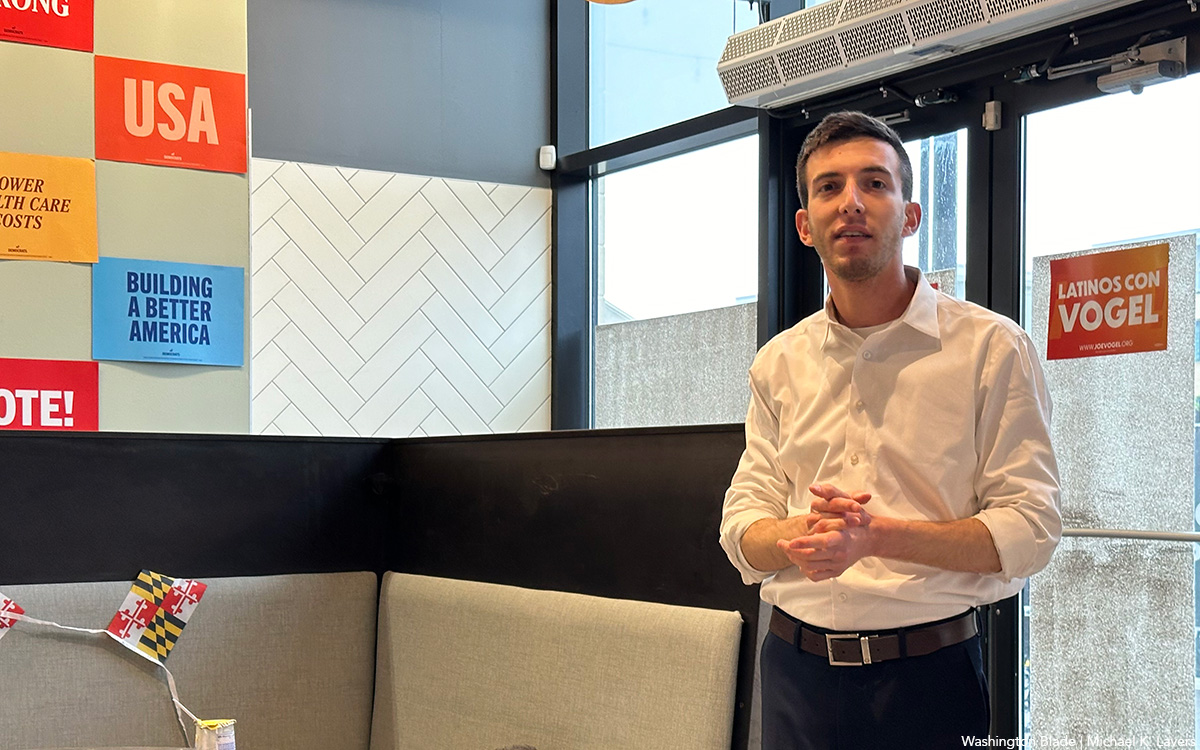
GAITHERSBURG, Md. — Maryland state Del. Joe Vogel (D-Montgomery County) on Friday held a “Big Gay Canvass Kickoff” event at his congressional campaign’s headquarters.
LGBTQ+ Victory Fund Vice President of Outreach and Engagement Marty Rouse and John Klenert, a member of the DC Vote and Victory Fund Campaign board of directors, are among those who participated alongside members of Equality PAC. Vogel spoke before Rouse, Klenert and others canvassed for votes in the area.
“Joe brings a fresh new perspective to politics,” said Gabri Kurtzer-Ellenbogen, deputy field director for Vogel’s campaign.
Vogel, 27, is among the Democrats running for Congressman David Trone’s seat.
Trone last May announced his bid to succeed retiring U.S. Sen. Ben Cardin (D-Md.) in the U.S. Senate.
The Democratic primary is on May 14. Vogel would be the first Latino, the first gay man and first Gen Zer elected to Congress from Maryland if he were to win in November.
“We need a new generation of leadership with new perspectives, new ideas, and the courage to actually deliver for our communities if we want things to get better in this country,” Vogel told the Washington Blade last month during an interview in D.C.

Taste of Point returns at critical time for queer students

State Department releases annual human rights report

Dominica High Court of Justice strikes down sodomy law

Smithsonian staff concerned about future of LGBTQ programming amid GOP scrutiny

Upcoming Ugandan Census will not count intersex people

Daniel Zamudio murderer’s parole request denied

Montgomery County police chief discusses arrest of trans student charged with planned school shooting

World ‘isn’t much different today’

‘Amm(i)gone’ explores family, queerness, and faith

Sport haulers: Jeep Grand Cherokee, Mercedes GLE-Class
-
 South America3 days ago
Daniel Zamudio murderer’s parole request denied
-
 Maryland4 days ago
Montgomery County police chief discusses arrest of trans student charged with planned school shooting
-
 Commentary5 days ago
World ‘isn’t much different today’
-
 Theater3 days ago
‘Amm(i)gone’ explores family, queerness, and faith