
National
Senate panel approves DP bill, takes OPM to task
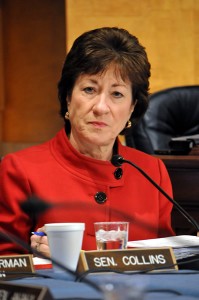
Sen. Susan Collins (R-Maine) praised the Domestic Partnership Benefits & Obligations Act as a way for the federal government to compete with the private sector in attracting the most qualified workers. (DC Agenda photo by Michael Key)
A Senate panel approved legislation last week that would provide domestic partner benefits to LGBT federal workers, but not before criticizing the Obama administration for allegedly not providing information on how to offset costs for the bill.
The Senate Homeland Security & Governmental Affairs Committee reported out the legislation — known as the Domestic Partnership Benefits & Obligations Act — on an 8-1 vote. The lone vote of dissent during the markup was Sen. Robert Bennett (R-Utah).
Counting the votes of senators who didn’t attend the markup and voted by proxy, the legislation was reported from the committee, 10-6.
The legislation, S. 1102, would make available to the same-sex partners of LGBT federal workers benefits afforded to the spouses of straight employees, including health and pension benefits.
Joe Solmonese, president of the Human Rights Campaign, said in a statement that the committee’s approval of the bill “is an important step toward guaranteeing equal compensation for lesbian and gay workers serving our government at home and abroad.”
But key supporters of the bill criticized the U.S. Office of Personnel Management during the markup for not explicitly providing information on how to offset the cost of the legislation — an estimated $63 million each year — and said a Senate floor vote wouldn’t take place until that data is provided.
Sen. Joseph Lieberman (I-Conn.), chair of the committee and sponsor of the bill, said he earlier asked OPM to provide information on costs offsets, but received no information by the time of the markup.
“We’re willing to do this and finance it within offsets from the existing OPM budget,” Lieberman said. “They were unable, for some reason, to get that information across to us this morning.”
Lieberman pledged that a Senate floor vote wouldn’t take place until OPM provides the information to senators. He had said earlier during an October committee hearing that he expected a floor vote on the bill early next year.
In a statement, OPM director John Berry, who is gay, responded to the comments from Lieberman and others by praising the committee for approving the legislation and promising to work with senators as the legislation progresses.
“I am confident that we will be able to work with [the Office of Management & Budget] and the Committee to address the concerns raised today so that forward progress can continue,” he said.
Both Lieberman and Sen. Susan Collins (R-Maine) praised the bill as a way for the federal government to compete with the private sector in attracting the most qualified workers.
Collins said the legislation would be particularly effective in attracting younger people to the federal workforce.
“It matters to them — whether they are straight or gay,” she said. “It matters to them because they view it as part of the offer that any good employer would provide.”
CPAC retains gay group as sponsor, despite boycott threats
A prominent, conservative convention is letting a gay group remain a co-sponsor despite threats from others who say they might boycott the event.
Organizers of the national Conservative Political Action Conference, set to take place in D.C. in February, are allowing GOProud, a gay conservative group, to continue as a co-sponsor in the face of calls to exclude it from the event.
Asked about the boycott threats, a CPAC spokesperson deferred to a statement from event director Lisa de Pasquale that was published this week in Hot Air, a conservative publication.
“After talking with their leadership and reviewing their web site, I am satisfied that they do not represent a ‘radical leftist agenda,’ as some have stated, and should not be rejected as a CPAC cosponsor,” she was quoted as saying.
On the agenda for GOProud, according to the organization’s web site, is repeal of “Don’t Ask, Don’t Tell” and opposition to the Federal Marriage Amendment. It supports gun ownership rights and privatization of Social Security and favors repealing the estate tax. The group was among those that opposed the nomination of U.S. Associate Justice Sonia Sotomayor.
Jimmy LaSalvia, executive director of GOProud, said he’s “excited” his organization will take part in the event, which some consider the most important annual gathering for conservatives.
“I just think that we’re excited to be a part of it,” he said. “I don’t have anything more to add to that. We’re just moving ahead and looking forward to being part of that important event.”
Although GOProud contributed $4,000 to co-sponsor CPAC, LaSalvia said a decision hasn’t been made yet on whether the group would have a speaking role at the event. He said more details would become known after a meeting in January. — By Chris Johnson





Federal Government
Lambda Legal praises Biden-Harris administration’s finalized Title IX regulations
New rules to take effect Aug. 1

The Biden-Harris administration’s revised Title IX policy “protects LGBTQ+ students from discrimination and other abuse,” Lambda Legal said in a statement praising the U.S. Department of Education’s issuance of the final rule on Friday.
Slated to take effect on Aug. 1, the new regulations constitute an expansion of the 1972 Title IX civil rights law, which prohibits sex-based discrimination in education programs that receive federal funding.
Pursuant to the U.S. Supreme Court’s ruling in the landmark 2020 Bostock v. Clayton County case, the department’s revised policy clarifies that discrimination on the basis of sexual orientation and gender identity constitutes sex-based discrimination as defined under the law.
“These regulations make it crystal clear that everyone can access schools that are safe, welcoming and that respect their rights,” Education Secretary Miguel Cardona said during a call with reporters on Thursday.
While the new rule does not provide guidance on whether schools must allow transgender students to play on sports teams corresponding with their gender identity to comply with Title IX, the question is addressed in a separate rule proposed by the agency in April.
The administration’s new policy also reverses some Trump-era Title IX rules governing how schools must respond to reports of sexual harassment and sexual assault, which were widely seen as imbalanced in favor of the accused.
Jennifer Klein, the director of the White House Gender Policy Council, said during Thursday’s call that the department sought to strike a balance with respect to these issues, “reaffirming our longstanding commitment to fundamental fairness.”
“We applaud the Biden administration’s action to rescind the legally unsound, cruel, and dangerous sexual harassment and assault rule of the previous administration,” Lambda Legal Nonbinary and Transgender Rights Project Director Sasha Buchert said in the group’s statement on Friday.
“Today’s rule instead appropriately underscores that Title IX’s civil rights protections clearly cover LGBTQ+ students, as well as survivors and pregnant and parenting students across race and gender identity,” she said. “Schools must be places where students can learn and thrive free of harassment, discrimination, and other abuse.”
Michigan
Mich. Democrats spar over LGBTQ-inclusive hate crimes law
Lawmakers disagree on just what kind of statute to pass

Michigan could soon become the latest state to pass an LGBTQ-inclusive hate crime law, but the state’s Democratic lawmakers disagree on just what kind of law they should pass.
Currently, Michigan’s Ethnic Intimidation Act only offers limited protections to victims of crime motivated by their “race, color, religion, gender, or national origin.” Bills proposed by Democratic lawmakers expand the list to include “actual or perceived race, color, religion, gender, sexual orientation, gender identity or expression, ethnicity, physical or mental disability, age, national origin, or association or affiliation with any such individuals.”
Democratic Gov. Gretchen Whitmer and Attorney General Dana Nessel have both advocated for a hate crime law, but house and senate Democrats have each passed different hate crimes packages, and Nessel has blasted both as being too weak.
Under the house proposal that passed last year (House Bill 4474), a first offense would be punishable with a $2,000 fine, up to two years in prison, or both. Penalties double for a second offense, and if a gun or other dangerous weapons is involved, the maximum penalty is six years in prison and a fine of $7,500.
But that proposal stalled when it reached the senate, after far-right news outlets and Fox News reported misinformation that the bill only protected LGBTQ people and would make misgendering a trans person a crime. State Rep. Noah Arbit, the bill’s sponsor, was also made the subject of a recall effort, which ultimately failed.
Arbit submitted a new version of the bill (House Bill 5288) that added sections clarifying that misgendering a person, “intentionally or unintentionally” is not a hate crime, although the latest version (House Bill 5400) of the bill omits this language.
That bill has since stalled in a house committee, in part because the Democrats lost their house majority last November, when two Democratic representatives resigned after being elected mayors. The Democrats regained their house majority last night by winning two special elections.
Meanwhile, the senate passed a different package of hate crime bills sponsored by state Sen. Sylvia Santana (Senate Bill 600) in March that includes much lighter sentences, as well as a clause ensuring that misgendering a person is not a hate crime.
Under the senate bill, if the first offense is only a threat, it would be a misdemeanor punishable by one year in prison and up to $1,000 fine. A subsequent offense or first violent hate crime, including stalking, would be a felony that attracts double the punishment.
Multiple calls and emails from the Washington Blade to both Arbit and Santana requesting comment on the bills for this story went unanswered.
The attorney general’s office sent a statement to the Blade supporting stronger hate crime legislation.
“As a career prosecutor, [Nessel] has seen firsthand how the state’s weak Ethnic Intimidation Act (not updated since the late 1980’s) does not allow for meaningful law enforcement and court intervention before threats become violent and deadly, nor does it consider significant bases for bias. It is our hope that the legislature will pass robust, much-needed updates to this statute,” the statement says.
But Nessel, who has herself been the victim of racially motivated threats, has also blasted all of the bills presented by Democrats as not going far enough.
“Two years is nothing … Why not just give them a parking ticket?” Nessel told Bridge Michigan.
Nessel blames a bizarre alliance far-right and far-left forces that have doomed tougher laws.
“You have this confluence of forces on the far right … this insistence that the First Amendment protects this language, or that the Second Amendment protects the ability to possess firearms under almost any and all circumstances,” Nessel said. “But then you also have the far left that argues basically no one should go to jail or prison for any offense ever.”
The legislature did manage to pass an “institutional desecration” law last year that penalizes hate-motivated vandalism to churches, schools, museums, and community centers, and is LGBTQ-inclusive.
According to data from the U.S. Department of Justice, reported hate crime incidents have been skyrocketing, with attacks motivated by sexual orientation surging by 70 percent from 2020 to 2022, the last year for which data is available.
Twenty-two states, D.C., Puerto Rico, and the U.S. Virgin Islands have passed LGBTQ-inclusive hate crime laws. Another 11 states have hate crime laws that include protections for “sexual orientation” but not “gender identity.”
Michigan Democrats have advanced several key LGBTQ rights priorities since they took unified control of the legislature in 2023. A long-stalled comprehensive anti-discrimination law was passed last year, as did a conversion therapy ban. Last month the legislature updated family law to make surrogacy easier for all couples, including same-sex couples.
A bill to ban the “gay panic” defense has passed the state house and was due for a Senate committee hearing on Wednesday.
Indiana
Drag queen announces run for mayor of Ind. city
Branden Blaettne seeking Fort Wayne’s top office
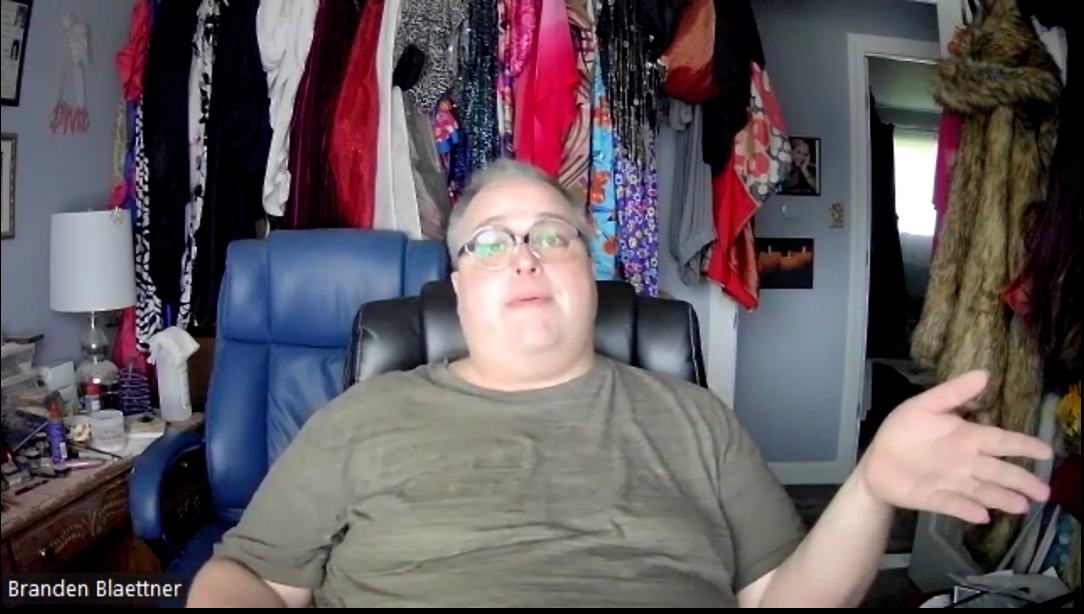
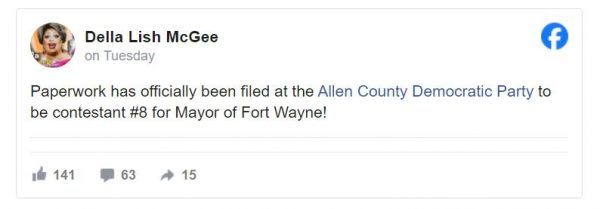
In a Facebook post Tuesday, a local drag personality announced he was running for the office of mayor once held by the late Fort Wayne Mayor Tom Henry, who died last month just a few months into his fifth term.
Henry was recently diagnosed with late-stage stomach cancer and experienced an emergency that landed him in hospice care. He died shortly after.
WPTA, a local television station, reported that Fort Wayne resident Branden Blaettne, whose drag name is Della Licious, confirmed he filed paperwork to be one of the candidates seeking to finish out the fifth term of the late mayor.
Blaettner, who is a community organizer, told WPTA he doesn’t want to “get Fort Wayne back on track,” but rather keep the momentum started by Henry going while giving a platform to the disenfranchised groups in the community. Blaettner said he doesn’t think his local fame as a drag queen will hold him back.
“It’s easy to have a platform when you wear platform heels,” Blaettner told WPTA. “The status quo has left a lot of people out in the cold — both figuratively and literally,” Blaettner added.
The Indiana Capital Chronicle reported that state Rep. Phil GiaQuinta, who has led the Indiana House Democratic caucus since 2018, has added his name to a growing list of Fort Wayne politicos who want to be the city’s next mayor. A caucus of precinct committee persons will choose the new mayor.
According to the Fort Wayne Journal Gazette, the deadline for residents to file candidacy was 10:30 a.m. on Wednesday. A town hall with the candidates is scheduled for 6 p.m. on Thursday at Franklin School Park. The caucus is set for 10:30 a.m. on April 20 at the Lincoln Financial Event Center at Parkview Field.
At least six candidates so far have announced they will run in the caucus. They include Branden Blaettne, GiaQuinta, City Councilwoman Michelle Chambers, City Councilwoman Sharon Tucker, former city- and county-council candidate Palermo Galindo, and 2023 Democratic primary mayoral candidate Jorge Fernandez.

Walking the pathway to national cannabis legalization

The Rare Book Fair is coming to D.C.

Montgomery County police chief discusses arrest of trans student charged with planned school shooting

Calendar: April 19-25

Lambda Legal praises Biden-Harris administration’s finalized Title IX regulations

Congolese lawmaker introduces anti-homosexuality bill

Reenactment of first gay rights picket at White House draws interest of tourists

New D.C. LGBTQ+ bar Crush set to open April 19

Ariz. governor vetoes anti-transgender, Ten Commandments bill

Ugandan activists appeal ruling that upheld Anti-Homosexuality Act
-
 Africa5 days ago
Congolese lawmaker introduces anti-homosexuality bill
-
 District of Columbia2 days ago
Reenactment of first gay rights picket at White House draws interest of tourists
-
 District of Columbia1 day ago
New D.C. LGBTQ+ bar Crush set to open April 19
-
 Arizona2 days ago
Ariz. governor vetoes anti-transgender, Ten Commandments bill