
Local
D.C. police add 23 ‘affiliate’ officers to gay liaison unit
In a little-noticed development, a D.C. police official last week released the names of 23 officers assigned as “affiliate” members of the department’s Gay & Lesbian Liaison Unit.
The affiliate officers, who are based in the department’s seven police districts, represent the culmination of Police Chief Cathy Lanier’s long-awaited plan to expand and decentralize the GLLU and three other special liaison units.
“The Metropolitan Police Department is pleased to announce the expansion of the Special Liaison Unit to better serve the needs of the community,” said Capt. Edward Delgado, supervisor of the SLU, which oversees the individual liaison units, in a Jan. 13 announcement.
In addition to the GLLU, the special liaison units include the Latino Liaison Unit, Asian Liaison Unit, and Deaf & Hard of Hearing Liaison Unit.
Delgado issued his announcement through an online listserve group created by the SLU to communicate with civic activists and members of citizen advisory councils linked to each of the seven police districts.
In his announcement, Delgado included a list of 50 affiliate officers and the individual liaison unit to which they are assigned. It shows that nearly half of the offers — 23 — are assigned to the GLLU. Sixteen affiliate officers are assigned to the Latino Liaison Unit and five each are assigned to the Asian and Deaf & Hard of Hearing liaison units.
Delgado told DC Agenda on Thursday that upon completing an SLU training course, officers were allowed to choose the specific liaison unit to which they would be assigned, and the GLLU was a popular choice.
“I was totally shocked that almost half of them wanted to be GLLU members,” he said. “I thought not that many would want to be dealing with some of the issues within the gay community. But the feedback that I’ve gotten from the officers has been all positive as it relates to working in the community. They’re on target and they have done an excellent job.”
Although his announcemt about the affiliate officers came Jan. 13, he said all of the affiliates started in their posts in the first and second week of December.
Delgado’s announcement did not discuss the status of the GLLU’s headquarters office in Dupont Circle, which has decreased from seven full-time officers three years ago to just one in November.
Assistant Police Chief Diane Groomes told DC Agenda in an e-mail Wednesday that the department has designated four officers and three supervisors to the GLLU’s central or headquarters unit.
Groomes noted that it would be up to the individual GLLU members to disclose their own sexual orientation and the department would not say which members, if any, are gay.
Groomes said the headquarters unit consists of Officers Joe Morquecho, Juanita Foreman, Zunnobia Hakir and Kevin Johnson. She said Delgado, along with Sgt. Carlos Mejia, supervisor of the GLLU and the Latino Liaison Unit, and Lt. Allan Thomas are designated as GLLU supervisory members.
Lanier has told LGBT activists in the past that GLLU headquarters staff decreased due to attrition as officers sought new assignments or left the department. She told activists that a reduced police budget and urgent deployment needs in high-crime areas of the city prevented her from filling the vacant positions.
In recent years, Lanier said she was holding off filling the vacant posts while she arranged for the expanded and decentralized liaison units that went into effect last week.
Officials with Gays & Lesbians Opposing Violence had complained that Lanier effectively “dismantled” the GLLU before she put in place the decentralized units with the affiliate officers. Chris Farris, co-chair of GLOV, could not be immediately reached for comment on the department’s latest expansion of the GLLU.
In announcing the 50 affiliate officers for the liaison units, Delgado also provided advice on how people should contact the units.
“In case of emergency, or for immediate police response, always call 911,” he said. “Once police are on the scene, you may request that an on-duty affiliate or liaison officer be contacted.”
He said that for other police-related services, such as requests for an affiliate or liaison officer to attend a meeting or for other non-emergency issues, the individual liaison offices can be contacted directly. The number for the GLLU is 202-727-5427.


Maryland
Montgomery County police chief discusses arrest of trans student charged with planned school shooting
County executive tells news conference student’s trans identity is irrelevant to criminal charge
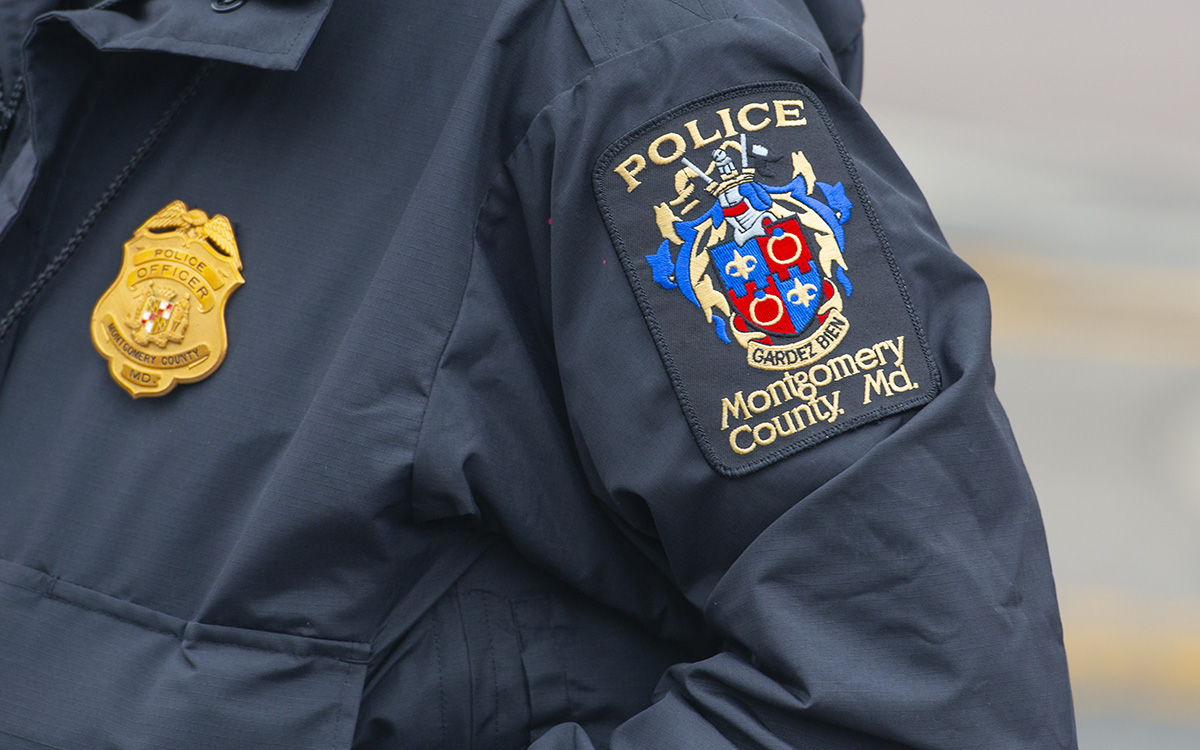
Montgomery County, Md., Police Chief Marcus Jones joined other county and law enforcement officials at a news conference on Friday, April 19, to provide details of the police investigation and arrest of an 18-year-old high school student charged two days earlier with threats of mass violence based on information that he allegedly planed a mass shooting at the high school and elementary school he attended in Rockville, Md.
In charging documents and in a press released issued on April 18, Montgomery County Police identified the arrested student as “Andrea Ye, of Rockville, whose preferred name is Alex Ye.”
One of the charging documents states that a friend of Ye, who police say came forward as a witness who played a crucial role in alerting authorities to Ye’s threats of a school shooting, noted that Ye told the witness that Ye identified as the transgender student he wrote about as a character in a 129-page manifesto outlining plans for a school shooting. Police have said Ye told them the manifesto was a fictional story he planned to publish.
At the news conference on Friday, Police Chief Jones and other law enforcement officials, including an FBI official and Montgomery County Executive Marc Elrich, referred to the student as Alex Ye and Mr. Ye. None of the officials raised the issue of whether Ye identified as a transgender man, seven though one of the police documents identifies Ye as a “biological female.”
County Executive Elrich appeared to express the views of the public officials at the news conference when one of the media reporters, during a question-and-answer period, asked Elrich why he and the others who spoke at the news conferment failed to “admit that this individual was transgender.”
“Because it’s not a lead,” Elrich replied, asking if the press and law enforcement authorities should disclose that someone arrested for murder is “a white Christian male who’s heterosexual.” Elrich stated, “No, you don’t – You never publish somebody’s sexual orientation when we talk about this. Why you are focusing on this being a transgender is beyond me. It’s not a news story. It is not a crime to be transgender.”
The reporter attempted to respond but was cut off by the press conference moderator, who called on someone else to ask the next question.
In his remarks at the press conference Chief Jones praised the so far unidentified witness who was the first to alert authorities about Ye’s manifesto appearing to make threats of a mass school shooting.
“Now, this is a situation that highlights the critical importance of vigilance and community involvement in preventing potential tragedies,” Jones said. “I commend the collaborative efforts of the Montgomery County Police Department, the Federal Bureau of Investigation, the Rockville City Police Department, and the Montgomery County Public Schools, as well as Montgomery County Health and Human Services,” he told the gathering.
“Thanks to their swift action and cooperation a potentially catastrophic event was prevented,” Jones said.
Jones pointed out that during the current school year, police have received reports of 140 threats to the public schools in Montgomery County. He said after a thorough investigation, none of them rose to the level where an arrest was made. Instead, police and school officials took steps to arrange for the student making the threats and their parents to take remedial action, including providing mental health services.
“But this case is different,” Jones said. “This case is entirely different that takes it to a different level. It was a concerned witness who brought this matter to light by rereporting the suspect’s manifesto to the authorities. This underscores the value of community engagement and the ‘see something say something’ approach,” he said.
Jones mentioned at the press conference that Ye was being held without bond since the time of his arrest but was scheduled to appear in court for a bond hearing on Friday shortly after the press conference took place to determine whether he should be released while awaiting trial or continue to be held.
In his manifesto obtained by police, Ye writes about committing a school shooting, and strategizes how to carry out the act. Ye also contemplates targeting an elementary school and says that he wants to be famous.
In charging documents reported on by WJLA 7 and WBAL 11, the 129-page document, which Ye has referred to as a book of fiction, included writings that said, in part:
“I want to shoot up a school. I’ve been preparing for months. The gun is an AR-15. This gun is going to change lives tomorrow … As I walk through the hallways, I cherry pick the classrooms that are the easiest targets. I need to figure out how to sneak the gun in. I have contemplated making bombs. The instructions to make them are surprisingly available online. I have also considered shooting up my former elementary school because little kids make easier targets. High school’s the best target; I’m the most familiar with the layout. I pace around my room like an evil mastermind. I’ve put so much effort into this. My ultimate goal would be to set the world record for the most amount of kills in a shooting. If I have time, I’ll try to decapitate my victims with a knife to turn the injuries into deaths.”
Maryland
Rockville teen charged with plotting school shooting after FBI finds ‘manifesto’
Alex Ye charged with threats of mass violence
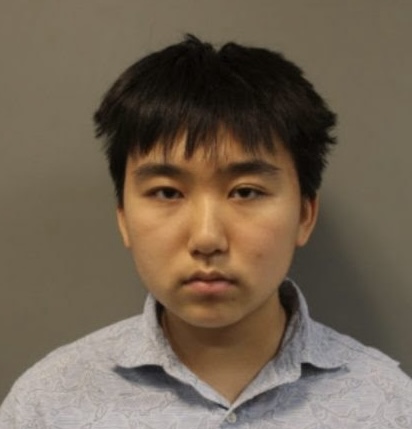
BY BRETT BARROUQUERE | A Montgomery County high school student is charged with what police describe as plans to commit a school shooting.
Andrea Ye, 18, of Rockville, whose preferred name is Alex Ye, is charged with threats of mass violence. Montgomery County Police and the FBI arrested Ye Wednesday.
The rest of this article can be found on the Baltimore Banner’s website.
District of Columbia
New D.C. LGBTQ+ bar Crush set to open April 19
An ‘all-inclusive entertainment haven,’ with dance floor, roof deck
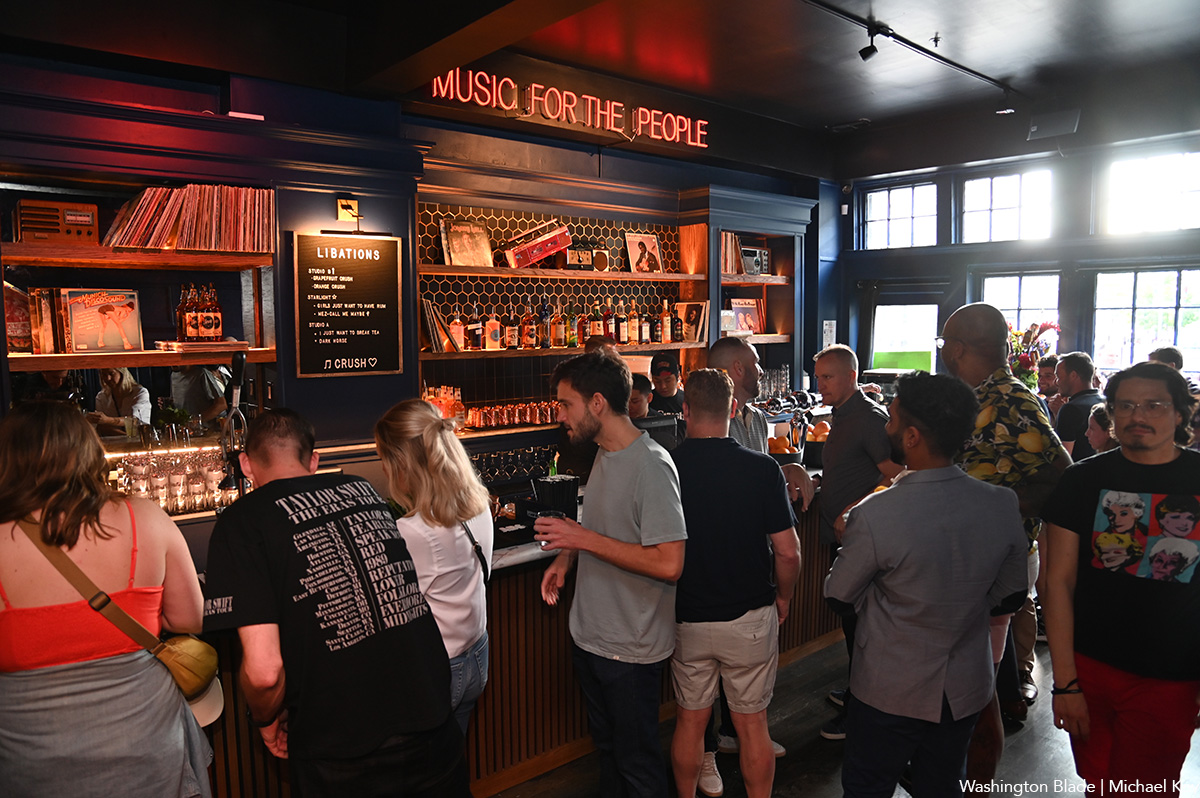
D.C.’s newest LGBTQ+ bar called Crush is scheduled to open for business at 4 p.m. on Friday, April 19, in a spacious, two-story building with a dance floor and roof deck at 2007 14th St., N.W. in one of the city’s bustling nightlife areas.
A statement released by co-owners Stephen Rutgers and Mark Rutstein earlier this year says the new bar will provide an atmosphere that blends “nostalgia with contemporary nightlife” in a building that was home to a popular music store and radio supply shop.
Rutgers said the opening comes one day after Crush received final approval of its liquor license that was transferred from the Owl Room, a bar that operated in the same building before closing Dec. 31 of last year. The official opening also comes three days after Crush hosted a pre-opening reception for family, friends, and community members on Tuesday, April 16.
Among those attending, Rutgers said, were officials with several prominent local LGBTQ organizations, including officials with the DC Center for the LGBTQ Community, which is located across the street from Crush in the city’s Reeves Center municipal building. Also attending were Japer Bowles, director of the Mayor’s Office of LGBTQ Affairs, and Salah Czapary, director of the Mayor’s Office of Nightlife and Culture.
Rutgers said Crush plans to hold a grand opening event in a few weeks after he, Rutstein and the bar’s employees become settled into their newly opened operations.
“Step into a venue where inclusivity isn’t just a promise but a vibrant reality,” a statement posted on the Crush website says. “Imagine an all-inclusive entertainment haven where diversity isn’t just celebrated, it’s embraced as the very heartbeat of our venue,” the statement says. “Welcome to a place where love knows no bounds, and the only color or preference that matters is the vibrant tapestry of humanity itself. Welcome to Crush.”
The website says Crush will be open Tuesdays and Wednesdays from 4 p.m. to 12 a.m., Thursdays from 4 p.m. to 2 a.m., Fridays from 4 p.m. to 3 a.m., Saturdays from 2 p.m. to 3 a.m., and Sundays from 2 p.m. to 12 a.m. It will be closed on Mondays.
Crush is located less than two blocks from the U Street Metro station.

Walking the pathway to national cannabis legalization

The Rare Book Fair is coming to D.C.

Montgomery County police chief discusses arrest of trans student charged with planned school shooting

Calendar: April 19-25

Lambda Legal praises Biden-Harris administration’s finalized Title IX regulations

Reenactment of first gay rights picket at White House draws interest of tourists

New D.C. LGBTQ+ bar Crush set to open April 19

Ariz. governor vetoes anti-transgender, Ten Commandments bill

Ugandan activists appeal ruling that upheld Anti-Homosexuality Act

Reenactment of first gay rights picket at White House set for April 17
-
 District of Columbia2 days ago
Reenactment of first gay rights picket at White House draws interest of tourists
-
 District of Columbia2 days ago
New D.C. LGBTQ+ bar Crush set to open April 19
-
 Arizona2 days ago
Ariz. governor vetoes anti-transgender, Ten Commandments bill
-
 Africa4 days ago
Ugandan activists appeal ruling that upheld Anti-Homosexuality Act