Local
Local news in brief
Whitman-Walker faces trans bias allegation & more
Whitman-Walker faces trans bias allegation
The D.C. Office of Human Rights has found probable cause that the Whitman-Walker Clinic engaged in employment discrimination based on gender identity when it chose not to hire transgender activist Earlene Budd for a job she sought in 2008.
Gustavo Velasquez, OHR’s director, confirmed May 28 that his office had made the probable cause finding. He said the finding is a preliminary action equivalent to a formal charge and is not a final determination that the Clinic engaged in discrimination.
He said Whitman-Walker has appealed the probable cause finding. Under procedures for processing discrimination complaints, the OHR must rule on the appeal.
If the office upholds its finding, the case goes to a mandatory conciliation process, where Clinic officials and Budd negotiate a possible settlement, Velasquez said. If a settlement cannot be reached, the case goes to the independent D.C. Commission on Human Rights, which makes a final decision on whether the Clinic violated the city’s Human Rights Act, which bans discrimination based on sexual orientation, gender identity and other categories.
Budd declined to comment, saying she was advised by her attorney not to discuss the case.
Chip Lewis, a Whitman-Walker spokesperson, said the Clinic “remains committed to being the highest quality, affirming, and culturally competent health center for the metro D.C. LGBT community.”
“This principle extends to our employee recruitment and retention practices,” he said. “We look forward to favorably resolving this matter with the OHR.”
Velasquez said his office could not provide further details about Budd’s discrimination complaint against the Clinic, saying case files are not released unless or until they reach the commission for adjudication.
He noted that OHR, which investigates discrimination allegations, finds probable cause in just 5 percent of the complaints it receives from District residents.
LOU CHIBBARO JR.
Judge deals blow to defense in Wone trial
D.C. Superior Court Judge Lynn Leibovitz is allowing prosecutors to submit for her review in the Robert Wone conspiracy trial all videotaped statements the defendants made to police.
The ruling, which was seen by observers as a strong blow to the defense, came during the third week of a trial in which gay defendants Joseph Price, Victor Zaborsky and Dylan Ward are charged with obstruction of justice, conspiracy to obstruct justice and evidence tampering in connection with Wone’s murder.
Wone, who was friends with the defendants, was found stabbed to death in 2006 in the guest bedroom of their house. His wife, Katherine Wone, testified that Wone had worked late and decided against driving to the couple’s home in Oakton, Va.
The defense attorneys argued that allowing the admission of the taped police interrogation of the three men on the night of the murder would be highly prejudicial to their case. They cited rules of evidence in trials preventing testimony by one defendant detrimental to another during a joint trial.
Lead prosecutor Glenn Kirschner argued that Leibovitz was highly qualified to distinguish between statements by the defendants that should or should not be admissible. He noted that at the request of the defendants, Leibovitz, rather than a jury, would render a verdict in the case and she would not be susceptible to prejudice.
The taped interrogations are considered important evidence for the government. Prosecutors said the men’s statements can be used in conjunction with physical evidence found at the crime scene to show their alleged propensity to conceal the truth about the Robert Wone murder. No one has been charged with the killing.
The trial is expected to continue for at least another two weeks.
LOU CHIBBARO JR.



District of Columbia
Bowser budget proposal calls for $5.25 million for 2025 World Pride
AIDS office among agencies facing cuts due to revenue shortfall
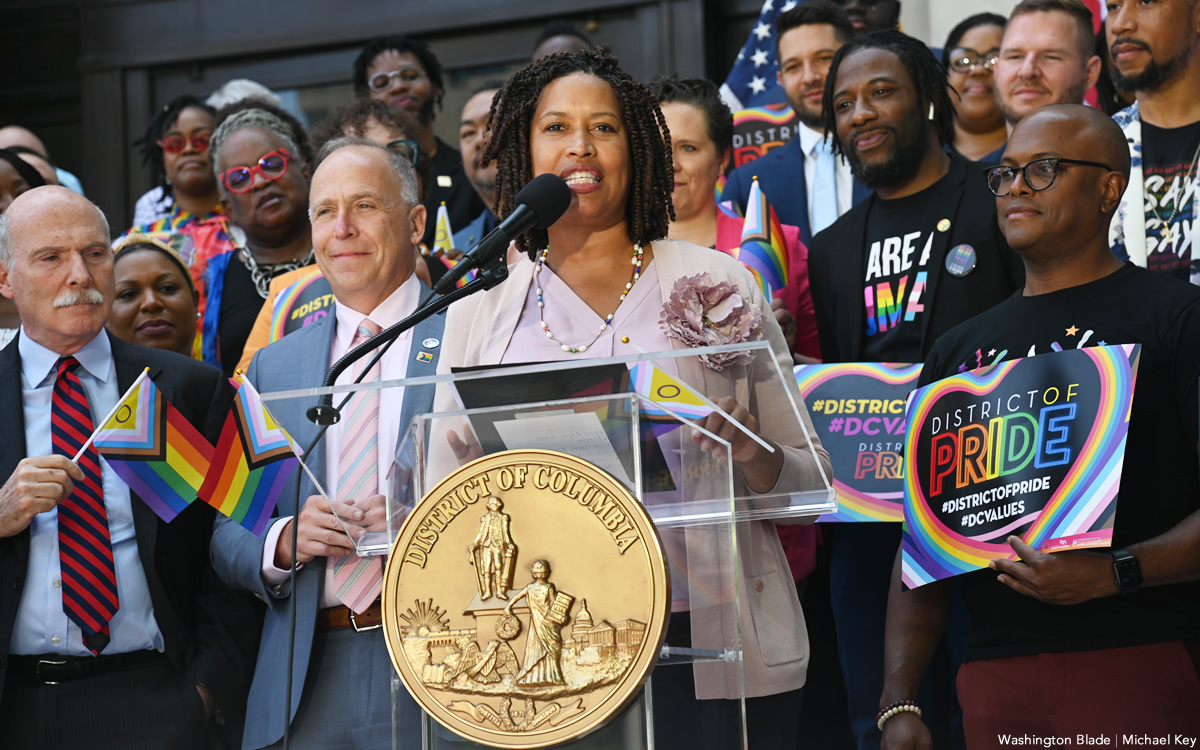
D.C. Mayor Muriel Bowser’s proposed fiscal year 2025 budget includes a request for $5.25 million in funding to support the June 2025 World Pride celebration, which D.C. will host, and which is expected to bring three million or more visitors to the city.
The mayor’s proposed budget, which she presented to the D.C. Council for approval earlier this month, also calls for a 7.6 percent increase in funding for the Mayor’s Office of LGBTQ Affairs, which amounts to an increase of $132,000 and would bring the office’s total funding to $1.7 million. The office, among other things, provides grants to local organizations that provide services to the LGBTQ community.
Among the other LGBTQ-related funding requests in the mayor’s proposed budget is a call to continue the annual funding of $600,000 to provide workforce development services for transgender and gender non-conforming city residents “experiencing homelessness and housing instability.” The budget proposal also calls for a separate allocation of $600,000 in new funding to support a new Advanced Technical Center at the Whitman-Walker Health’s Max Robinson Center in Ward 8.
Among the city agencies facing funding cuts under the mayor’s proposed budget is the HIV/AIDS, Hepatitis, Sexually Transmitted Disease, and Tuberculosis Administration, known as HAHSTA, which is an arm of the D.C. Department of Health. LGBTQ and AIDS activists have said HAHSTA plays an important role in the city’s HIV prevention and support services. Observers familiar with the agency have said it recently lost federal funding, which the city would have to decide whether to replace.
“We weren’t able to cover the loss of federal funds for HAHSTA with local funds,” Japer Bowles, director of the Mayor’s Office of LGBTQ Affairs, told the Washington Blade. “But we are working with partners to identify resources to fill those funding gaps,” Bowles said.
The total proposed budget of $21 billion that Bowser submitted to the D.C. Council includes about $500 million in proposed cuts in various city programs that the mayor said was needed to offset a projected $700 million loss in revenue due, among other things, to an end in pandemic era federal funding and commercial office vacancies also brought about by the post pandemic commercial property and office changes.
Bowser’s budget proposal also includes some tax increases limited to sales and business-related taxes, including an additional fee on hotel bookings to offset the expected revenue losses. The mayor said she chose not to propose an increase in income tax or property taxes.
Earlier this year, the D.C. LGBTQ+ Budget Coalition, which consists of several local LGBTQ advocacy organizations, submitted its own fiscal year 2025 budget proposal to both Bowser and the D.C. Council. In a 14-page letter the coalition outlined in detail a wide range of funding proposals, including housing support for LGBTQ youth and LGBTQ seniors; support for LGBTQ youth homeless services; workforce and employment services for transgender and gender non-conforming residents; and harm reduction centers to address the rise in drug overdose deaths.
Another one of the coalition’s proposals is $1.5 million in city funding for the completion of the D.C. Center for the LGBTQ Community’s new building, a former warehouse building in the city’s Shaw neighborhood that is undergoing a build out and renovation to accommodate the LGBTQ Center’s plans to move in later this year. The coalition’s budget proposal also calls for an additional $300,000 in “recurring” city funding for the LGBTQ Center in subsequent years “to support ongoing operational costs and programmatic initiatives.”
Bowles noted that Bowser authorized and approved a $1 million grant for the LGBTQ Center’s new building last year but was unable to provide additional funding requested by the budget coalition for the LGBTQ Center for fiscal year 2025.
“We’re still in this with them,” Bowles said. “We’re still looking and working with them to identify funding.”
The total amount of funding that the LGBTQ+ Budget Coalition listed in its letter to the mayor and Council associated with its requests for specific LGBTQ programs comes to $43.1 million.
Heidi Ellis, who serves as coordinator of the coalition, said the coalition succeeded in getting some of its proposals included in the mayor’s budget but couldn’t immediately provide specific amounts.
“There are a couple of areas I would argue we had wins,” Ellis told the Blade. “We were able to maintain funding across different housing services, specifically around youth services that affect folks like SMYAL and Wanda Alston.” She was referring to the LGBTQ youth services group SMYAL and the LGBTQ organization Wanda Alston Foundation, which provides housing for homeless LGBTQ youth.
“We were also able to secure funding for the transgender, gender non-conforming workforce program,” she said. “We also had funding for migrant services that we’ve been advocating for and some wins on language access,” said Ellis, referring to programs assisting LGBTQ people and others who are immigrants and aren’t fluent in speaking English.
Ellis said that although the coalition’s letter sent to the mayor and Council had funding proposals that totaled $43.1 million, she said the coalition used those numbers as examples for programs and policies that it believes would be highly beneficial to those in the LGBTQ community in need.
“I would say to distill it down to just we ask for $43 million or whatever, that’s not an accurate picture of what we’re asking for,” she said. “We’re asking for major investments around a few areas – housing, healthcare, language access. And for capital investments to make sure the D.C. Center can open,” she said. “It’s not like a narrative about the dollar amounts. It’s more like where we’re trying to go.”
The Blade couldn’t’ immediately determine how much of the coalition’s funding proposals are included in the Bowser budget. The mayor’s press secretary, Daniel Gleick, told the Blade in an email that those funding levels may not have been determined by city agencies.
“As for specific funding levels for programs that may impact the LGBTQ community, such as individual health programs through the Department of Health, it is too soon in the budget process to determine potential adjustments on individual programs run though city agencies,” Gleick said.
But Bowles said several of the programs funded in the mayor’s budget proposal that are not LGBTQ specific will be supportive of LGBTQ programs. Among them, he said, is the budget’s proposal for an increase of $350,000 in funding for senior villages operated by local nonprofit organizations that help support seniors. Asked if that type of program could help LGBTQ seniors, Bowles said, “Absolutely – that’s definitely a vehicle for LGBTQ senior services.”
He said among the programs the increased funding for the mayor’s LGBTQ Affairs office will support is its ongoing cultural competency training for D.C. government employees. He said he and other office staff members conduct the trainings about LGBTQ-related issues at city departments and agencies.
Bowser herself suggested during an April 19 press conference that local businesses, including LGBTQ businesses and organizations, could benefit from a newly launched city “Pop-Up Permit Program” that greatly shortens the time it takes to open a business in vacant storefront buildings in the downtown area.
Bowser and Nina Albert, D.C. Deputy Mayor for Planning and Economic Development, suggested the new expedited city program for approving permits to open shops and small businesses in vacant storefront spaces could come into play next year when D.C. hosts World Pride, one of the word’s largest LGBTQ events.
“While we know that all special events are important, there is an especially big one coming to Washington, D.C. next year,” Bowser said at the press conference. “And to that point, we proposed a $5.25 million investment to support World Pride 2025,” she said, adding, “It’s going to be pretty great. And so, we’re already thinking about how we can include D.C. entrepreneurs, how we’re going to include artists, how we’re going to celebrate across all eight wards of our city as well,” she said.
Among those attending the press conference were officials of D.C.’s Capital Pride Alliance, which will play a lead role in organizing World Pride 2025 events.
Maryland
Health care for Marylanders with HIV is facing huge cuts this summer
Providers poised to lose three-quarters of funding
BY MEREDITH COHN | By the end of June, health care providers in Maryland will lose nearly three-quarters of the funding they use to find and treat thousands of people with HIV.
Advocates and providers say they had been warned there would be less money by the Maryland Department of Health, but were stunned at the size of the drop — from about $17.9 million this fiscal year to $5.3 million the next. The deep cuts are less than three months away.
The rest of this article can be read on the Baltimore Banner’s website.
District of Columbia
Taste of Point returns at critical time for queer students
BIPOC scholar to speak at Room & Board event on May 2

The Point Foundation will kick off May with its annual Taste of Point DC event. The event will be hosted at Room & Board on 14th Street and feature a silent auction, food tastings, a speech from a scholar, and more.
Point’s chief of staff, Kevin Wright, said that at Taste of Point, the scholars are the star of the show.
“People never come to an event to hear Point staff speak, they come to hear from the people most impacted by the program,” he said. “At its core Taste of Point is designed to center and highlight our scholars’ voices and experiences.”
This year, a Point BIPOC Scholar, Katherine Guerrero Rivera will speak at the event.
“It is a great opportunity to highlight the scholars out there on the front lines making impacts in almost every sector and job field,” Wright said.
Wright pointed out that this year especially is a pivotal time for LGBTQ students.
“In 2023, there were 20 states that passed anti-LGBTQ legislation,” he said. “By this point in [2024] we already have more.”
Wright said the impacts of those legislative attacks are far reaching and that Point is continuously monitoring the impact they have on students on the ground.
Last month, The Washington Post reported that states with anti-LGBTQ laws in place saw school hate crimes quadruple. This report came a month after a non-binary student, Nex Bennedict, died after being attacked at school.
“So, we see this as a critical moment to really step up and help students who are facing these challenges on their campus,” Wright said. “Our mission is to continue to empower our scholars to achieve their full academic and leadership potential.”
This year Point awarded nearly 600 LGBTQ students with scholarships. These include the flagship scholarship, community college scholarship and the BIPOC scholarship. When the foundation started in 2002, there were only eight scholarships awarded.
Dr. Harjant Gill is one of those scholars who said the scholarship was pivotal for him. Gill said he spent his undergraduate years creating films and doing activism for the LGBTQ community.
As a result, his academic record wasn’t stellar and although he was admitted into American University’s graduate program he had no clue how he would fund it.
Upon arrival to American he was told to apply for a Point scholarship and the rest was history.
“It ended up being the one thing that kept me going otherwise I would have dropped out,” he said. “Point was incredibly instrumental in my journey to becoming an academic and a professor.”
More than a decade later, Gill serves on the host committee for Taste of Point and is a mentor to young Point scholars. He said that he donates money yearly to Point and that when he is asked what he wants for a gift he will often tell his friends to donate too.
To attend the event on Wednesday, May 2, purchase tickets at the Point website. If you can’t attend this year’s Taste of Point DC event but would like to get involved, you can also donate online.

Malcolm Kenyatta could become the first LGBTQ statewide elected official in Pa.

Bowser budget proposal calls for $5.25 million for 2025 World Pride

White House debuts action plan targeting pollutants in drinking water

Health care for Marylanders with HIV is facing huge cuts this summer

Maine governor signs transgender, abortion sanctuary bill into law

Daniel Zamudio murderer’s parole request denied

State Department releases annual human rights report

‘Amm(i)gone’ explores family, queerness, and faith

Joe Vogel campaign holds ‘Big Gay Canvass Kickoff’