
Feedback
Feedback for Sept. 3
The following was submitted as a letter to the editor.
As summer begins to wind down and kids head back to school, those of us who are advocates for reproductive health education that addresses sexual orientation, gender identity and HIV/STD prevention have reason to feel hopeful.
In the city with the nation’s highest rates of new HIV/AIDS infections, the role of education is crucial to keeping ALL youth safe and to ensure that future generations live free from HIV. Appreciating this connection, city leaders have shown considerable commitment to improving schools.
In December 2007, the D.C. State Board of Education passed Health Learning Standards, which were based on national best practices and outline what information and skills students should be acquiring in Washington, D.C. classrooms. Since then, the leadership at D.C. Public Schools (DCPS) has taken these standards seriously and begun to move forward, and the results are very promising.
In the last three years, D.C. Public Schools have been working diligently to ensure that all students receive a complete, age-appropriate, science-based health education. The DCPS curriculum, which meets the Standards, covers everything from the diversity of family configurations to the importance of family and trusted adults when questions about sexual orientation arise. The curriculum also emphasizes the importance of abstinence while also providing students all the information and skills needed to protect against HIV, STIs and unwanted pregnancies. Teachers’ training on content and sensitivity has increased and there has been positive movement on instructional quality.
Building up from the Standards, the D.C. Council passed the Healthy Schools Act in May, 2010. Although the media focused primarily on obesity and soda taxes, the Act contained much that will ensure that more youth will have access to high quality health education.
We now believe that all the regulatory and legislative barriers to effective, age appropriate and comprehensive health education in D.C.’s public and charter schools have been removed. The last hurdle, as is often the case, is implementation.
Metro TeenAIDS and our partners are grateful to Michelle Rhee and her staff for their continued commitment to health education. We also look forward to working with Superintendent Briggs as we plan for assessing the quality of health education in D.C. and the full implementation of the Healthy Schools Act.
Despite the election fervor, our community must hold the line for providing high quality health education to all students. We must ensure that schools become the front line defense against HIV and other STDs. The health of our community depends on it. –Adam Tenner, executive director, Metro TeenAIDS
Feedback
Clarifying the record on Mexican homophobia case
Court judgment challenged as accusations of discrimination disputed


(This is a response to a story published Jan. 18 by contributor Armando Ocampo Zambrano)
I brought to the attention of the Washington Blade that no court decision exists in the terms set out by Armando Ocampo Zambrano in the interview published in the Blade on Jan. 18, 2019.
Ocampo untruthfully stated that “he became the first Mexican to win a lawsuit due to homophobia against one of the most powerful law firms in the country”; such statement as the result of a judgment issued on Sept. 5, 2018 by the High Chamber of the Federal Court of Administrative Justice, which Ocampo falsely brags as a judgement against Chevez Ruiz Zamarripa y Cía., S.C. (“Chevez”) condemning it for acts of discrimination.
The firm represents the interests of Chevez in the lawsuit that resulted from the complaint/legal action filed by Ocampo with the National Council to Prevent Discrimination alleging several facts that Ocampo claims happened on November 2015, in which he and partners of Chevez participated; Ocampo considered them to be discriminatory and therefore filed the complaint.
Council, by decision issued on Jan. 26, 2017, concluded that Chevez was not liable for discriminatory acts affecting Ocampo.
Ocampo filed legal action for the annulment of Council’s decision of Jan. 26, 2017 with the Federal Court of Administrative Justice; this Court annulled Council’s decision ordering it to re-issue same considering certain evidence provided by the parties.
Chevez and Ocampo, both, contested the judgment through Amparo lawsuits, to be decided by the Seventh Collegiate Tribunal for Administrative Matters of the First Circuit, which will decide on the validity and legality of the Judgment, which obviously as of today is not final and conclusive.
The above statement by Ocampo in the interview is totally and absolutely false because of the following two reasons:
1. There is no court decision issued by any Mexican court/authority that concludes that Chevez was found guilty of acts of discrimination against Ocampo.
2. The judgement has been challenged by Ocampo precisely because Chevez was not found liable for acts of discrimination against Ocampo.
Chevez also challenged the judgment considering that Council´s decision issued on Jan. 26, 2017 is correct and impeccable, not being legally correct that the High Chamber of the Federal Court of Administrative Justice annuls Council´s decision.
Luis Alfonso Cervantes Muñiz is an attorney licensed in Mexico by the Escuela Libre de Derecho, and founding partner of Cervantes Sainz, S.C.

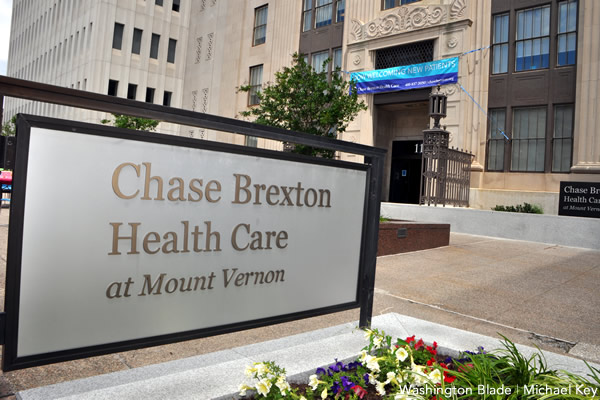
Chase Brexton Health Care (Washington Blade file photo by Michael Key)
Chase Brexton not an exemplary provider
Re: “Where is Chase Brexton growing?” (Op-ed by Nate Sweeney, Oct. 28)
I read Nate Sweeney’s op-ed with a mixture of anger and incredulity. Sweeney’s desperate appeal in defense of Chase Brexton conveniently glosses over a recent, well-documented pattern of irresponsible, unethical, and potentially illegal behavior at the beleaguered Baltimore institution that was once a beacon for the LGBTQ community.
“An exemplary LGBTQ provider and resource for our communities” does not fire five beloved staff members with outstanding service records (four of them openly gay, like Sweeney), as Chase Brexton did in August in a blatant attempt to retaliate against staff involved in organizing a labor union.
An exemplary LGBTQ provider does not deprive the community of hardworking, dedicated professionals who specialized in HIV/AIDS and LGBT care and were integral to the programs and services Sweeney boasts about.
An exemplary LGBTQ provider does not censor online commentary and ignore patient and community feedback, as Chase Brexton did when it took great pains to literally block out patients protesting outside the recent Charm Ball Fundraiser.
An exemplary LGBT organization doesn’t stifle employee voices, inform healthcare professionals they are only worth the number of patients they see, and disrespect its staff by hiring union busters to attempt to intimidate them into submission. Tell me Mr. Sweeney, what does your employee survey say now, after the despicable events of August of this year?
An exemplary LGBTQ organization isn’t captained by an arrogant, irresponsible board of directors that validates the status quo despite staff issuing a clear vote of no-confidence in the current CEO — a board that by all accounts demonstrates an astounding lack of basic LGBT literacy and has zero representation from transgender individuals.
No, Mr. Sweeney, these days Chase Brexton Health Care is far from an exemplary LGBTQ organization. Your words fall flat and can’t change the sad reality that an organization with deep roots in the gay community has been commandeered by myopic, vindictive “leadership” that values profit over patient care and has shown a callous indifference towards LGBTQ people, their health, and their history. —Marion Goldstein, Baltimore
Support CAMP Rehoboth

CAMP Rehoboth (Washington Blade photo by Michael Key)
I retired recently to Rehoboth Beach from Vermont and my transition was smooth, in large part, due to CAMP Rehoboth. Our Coastal Community is blessed with the good works, services, resources and multiple community programs provided by CAMP Rehoboth. For more than 25 years now CAMP Rehoboth has genuinely ‘Created A More Positive’ Rehoboth, with room for all. Please join me in showing our appreciation as a community in the coming winter months by attending one of the CAMP Rehoboth Chorus events. The CAMP Chorus truly is an asset in which Rehoboth, Sussex County and all of Delaware can take great pride.
Please mark your calendars: “Yule Love It,” Saturday, Dec. 10, 7 p.m. Epworth UMC $20. “Come Fly with Me!” Epworth UMC, $25 Friday, Jan. 27 at 7 p.m.; Jan. 28 at 7 p.m.; Jan. 29 at 3 p.m. And DelTech C.C. Georgetown $25, April 2 at 3 p.m. Tickets on sale in December at HYPERLINK “http://www.camprehoboth.com” www.camprehoboth.com. —Herb Russell, Rehoboth Beach
Feedback
Beyer a longtime LGBT rights supporter
His ‘evolution’ consistent with many leading politicians


Don Beyer (Photo public domain)
The following was submitted as a letter to the editor in response to “Beyer changed position on same-sex marriage” (news, March 19).
I was surprised to see the Blade single out Don Beyer as someone who has changed his position on gay marriage since 1997. Let’s be honest – a vast number of Americans have changed their position on gay marriage since 1997, and that is something that should be applauded, not criticized.
The truth is, like many of our friends and family, coworkers and neighbors, Don has evolved on this issue. In fact, Don evolved long before many of our current Democratic leaders. In 2003, Don endorsed Howard Dean’s presidential campaign in a primary in which Dean and no other candidate was in favor of gay marriage.
In 2006, when several Virginia Democrats joined Republicans in their crusade to ban gay marriage in the Commonwealth, Don personally contributed significantly to the effort opposing the Defense of Marriage Act referendum in Virginia. In doing so, he bucked many in his own party and even the majority of Virginia voters. Don came to the conclusion that it was the right thing to do well before many others, including many in the Democratic Party.
When my partner and I decided to start our own family in 2002, Don and his wife were among the first of our friends, gay or straight, to offer to help us. They have been unwavering advocates in the community for our family, which now includes two children, and we believe Don’s experience and perspective will be critical to addressing the unique issues we face going forward.
President Obama, Vice President Biden, Bill Clinton, Hillary Clinton and nearly every Democratic elected official in Virginia has progressed on this issue, and ultimately, that’s what matters.
From prohibiting discrimination in housing, employment and elsewhere, to supporting the inclusion of sexual orientation-based crimes in hate crime statutes, Don has been a strong advocate for LGBT rights. To try to paint him as anything otherwise is disingenuous and misleading; it also does a disservice to the people of Virginia.
I realize that in a crowded Democratic primary field we look for points of differentiation among the candidates. This isn’t one of them. —Mark C. Lowham

Taste of Point returns at critical time for queer students

State Department releases annual human rights report

Dominica High Court of Justice strikes down sodomy law

Smithsonian staff concerned about future of LGBTQ programming amid GOP scrutiny

Upcoming Ugandan Census will not count intersex people

Daniel Zamudio murderer’s parole request denied

Montgomery County police chief discusses arrest of trans student charged with planned school shooting

World ‘isn’t much different today’

‘Amm(i)gone’ explores family, queerness, and faith

Survey finds support for Biden among LGBTQ adults persists despite misgivings
-
 South America3 days ago
Daniel Zamudio murderer’s parole request denied
-
 Maryland4 days ago
Montgomery County police chief discusses arrest of trans student charged with planned school shooting
-
 Commentary4 days ago
World ‘isn’t much different today’
-
 Theater3 days ago
‘Amm(i)gone’ explores family, queerness, and faith