
Miscellaneous
Getting to the Point
Local LGBT students honored with prestigious scholarships

Joe Goldman (Blade photo by Michael Key)
Coming out as LGBT can be a scary proposition, even to supportive parents. But for too many LGBT youth, coming out results in being cut off emotionally and financially by disapproving family.
That’s where the Point Foundation can help. It’s an organization that provides financial support, mentoring, leadership training and hope to students who have been marginalized based on their sexual orientation, gender identity or gender expression. Scholarship recipients aren’t all rejected by family; the Foundation also supports LGBT students with leadership potential. Its annual D.C. reception is Thursday from 6-8:30 p.m. in the Equality Center at the Human Rights Campaign (1640 Rhode Island Ave., N.W.).
There are six Point scholars studying in the D.C. area. Two of this year’s scholars are Kelsey Phipps and Joe Goldman, who both say they’re thrilled to be recipients. They’ll join a recent, but highly elite, LGBT academic tradition.
In 2002, Bruce Lindstrom, Carl Strickland and a few of their friends funded the first seven Point Scholars according to the organization’s website.
Lindstrom had been rejected by his family when he came out.
“I didn’t want what happened to me to happen to other LGBT youth,” he said in a statement.
Since then, the Point Foundation has been featured in many mainstream publications, including Time, The New York Times and The Boston Globe and its scholars have been guests on “The Oprah Winfrey Show.”
A Los Angeles native, Goldman, who is studying political communication at George Washington University, came out to his family almost eight years ago.
To quote a popular phrase, Goldman says it gets better, especially after high school.
“It’s OK to be nervous … to be afraid, that’s natural, I was too,” Goldman says. The anxiety existed even though he was pretty sure his family would react positively.
“Don’t prevent yourself from being out with your friends just because you’re afraid of what your family will think,” he says.
After coming out, Goldman helped bring his high school’s gay/straight alliance, which had been started in the ‘90s, back to life. At the end of his freshman year, Goldman organized a marriage equality rally that was attended by about 200 high school students.
He interned at the Natural Resources Defense Council, pursuing an interest in curbing climate change. Goldman wants to be a lobbyist for solar energy.
Goldman also interned at Equality California, The Trevor Project, California League of Conservation Voters, and the offices of state Sen. Sheila Kuehl, Councilman Bill Rosendahl and Sen. Barbara Boxer.
Goldman later worked on Hillary Clinton’s presidential campaign. He started out staffing “high-dollar” fundraisers in Hollywood and then worked his way up into her scheduling office.
“Hillary Clinton’s campaign changed my life. It completely transformed how I view politics and how the world works,” Goldman said. “It’s crazy for me to think about the fact … how I knew where she was practically every minute of the day.”
After Clinton lost the race for the Democratic presidential nomination, Goldman joined Obama’s campaign. He says Clinton’s loss may have been one of the best things to happen to him because of what he learned from the experience.
“A lot of young people who supported Obama, they don’t know what it’s like to lose a campaign yet,” Goldman says. “And I think if you want to do anything in politics, you have to know what it’s like to feel that.”
Phipps, who is studying public interest law at Georgetown University Law Center, also did some work on the campaign trail.
During her time as a Fulbright Scholar in Ireland, she campaigned for a woman running for Senate.
“That was a really unique experience. It was a small campaign, run out of a kitchen,” Phipps says. “Ultimately, she didn’t end up winning, she came in fourth.”
Phipps grew up in a military family in Bothell, Wash., that was dedicated to public service.
She came out to her family in the ‘90s, before even Ellen DeGeneres. She had a girlfriend in high school, but they did not go to prom.
“The world has changed since I came out,” Phipps says. “I’d say come out early, often and wherever you can. It changes your life.”
She began her academic career at Scripps College. Phipps was involved in civil rights organizing. She served as student body president and helped develop a diversity awareness curriculum.
Phipps also organized a march against Proposition 22, a law in California that restricted marriages to only those between opposite-sex couples.
Due to her work and achievements at Scripps, Phipps was selected as a Truman Scholar and interned with the Civil Rights Division of the U.S. Department of Justice.
After her time in Ireland, Phipps went on to work with Sen. Edward Kennedy’s staff. Through that work, she was named the first female co-chair of the Senate’s LGBT staff caucus.
“[Working with Kennedy’s staff] was a dream come true,” Phipps says. “I came to Washington to work on the Hill.”
In the Senate, she focused on legislation to provide greater access to services for individuals with HIV/AIDS, mental illness, substance use disorders and brain injuries.
She has also worked with GLAAD in Boston.
Both were excited when they found out they had been chosen as Point Scholars.
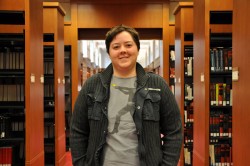
Kelsey Phipps (Blade photo by Michael Key)
“I was very honored, relieved and excited,” Phipps says. “I knew it came with a scholarship, but I didn’t know what else.”
The organization’s selection committee weighs all aspects of a person’s application. Marginalization, financial need, academic achievement, personal merit, leadership, professional experiences, future and personal goals are all taken into consideration.
“Point is something I really wanted to be, not because of dire need, but because I knew Point … is a culmination of the young elite in the LGBT community,” Goldman says. “I’m thankful for everything Point has done for me.”
Goldman, a former student clerk at the Executive Office for U.S. Attorneys at the U.S. Department of Justice, recently wrapped an internship at the Raben Group, a local public affairs firm, and plans to attend law school after graduation.
Phipps hopes to remain active in progressive politics and public policy and begin a career in civil rights law. She will be clerking for lesbian Superior Court of the District of Columbia Associate Judge Marisa J. Demeo.
Tickets to the D.C. reception are $75 and can be purchased at pointfoundation.org/dc.
For more information on the Point Foundation and other scholars, visit pointfoundation.org.






Miscellaneous
What it means to be an active ally to your LGBTQ+ co-workers TEST
Five easy tips to help you avoid common risks

Your home is more than just a place to eat and sleep; it’s your safe haven. As much as you might cherish your home, you should probably also recognize the potential hazards within its familiar walls. Accidents can happen in an instant, yet with a little foresight and some simple adjustments, you can transform your house into a safer haven.
Accidents can happen anywhere, and with a few simple tweaks, you can lower risks in your space. Below you’ll find five tips for each room in your home to help prevent injuries, falls, and other mishaps. In short, home safety.
This article was inspired by a shower in a rental we managed that began leaking through the kitchen ceiling below. If only the landlord had installed grab bars, right!? Below, we’ll guide you through the steps to fortify your bathroom, making it a place of relaxation without the fear of slips and falls. Then, we’ll venture into the room where the magic happens, where proper planning can ensure great nights and peaceful mornings. We’ll show you how to prevent accidents while you experiment becoming the next Gordon Ramsey. And we’ll include a few surprising solutions for those other rooms that hold their own unique hazards, offering solutions to safeguard against unexpected mishaps.
Bathroom Safety
Install Grab Bars: Adding grab bars near the shower and toilet can provide essential support for family members of all ages. Not only can they help with getting in and out, but they can help provide stability when washing. Make sure they are securely anchored to the wall.
Non-Slip Mats: Place non-slip mats inside the shower and bathtub to prevent slips. They’re a small investment that can save you from falls and head injuries.
Adjust Water Temperature: Ensure your hot water is set to a safe temperature to avoid scalding. The hot water heater should be set to around 120°F (49°C)l, the middle setting on many water heater settings.
Medicine Cabinet Locks: If you have young children, use childproof locks on your medicine cabinet to keep harmful substances out of reach.
Proper Lighting: Ensure there’s adequate lighting in the bathroom to avoid trips and falls during nighttime visits. Nightlights can be a simple and effective solution.
Bedroom Safety
Clear Pathways: Keep pathways in the bedroom clutter free to prevent tripping. Ensure there’s enough space to move around comfortably, particularly getting around the bed. Be aware where all furniture is when walking around to avoid stubbed toes, particularly at night.
Secure Rugs: If you have throw rugs, use rug grippers or double-sided tape to keep them from slipping. Loose rugs are a common trip hazard.
Bed Rails: For anyone at risk of falling out of bed, consider installing bed rails to provide extra support and prevent falls.
Nightstands with Drawers: Opt for nightstands with drawers to keep essential items. This reduces the need to get out of bed at night, minimizing the risk of falls, as you race to grab what you need and not lose a moment’s rest.
Fire Safety: Install battery-operated smoke detectors in the bedrooms if there are none. Make sure to install them 36 inches away from an air vent or the edge of a ceiling fan. Also six inches away from the joint between the wall and ceiling. And test smoke detectors regularly.
Kitchen Safety
Non-Slip Flooring: Choose slip-resistant rugs in the kitchen, especially in areas where spills are common. Mats near the sink and stove can also help and you can often buy them fairly cheaply at Costco.
Childproof Cabinets: If you have little ones, use childproof latches on cabinets and drawers to prevent them from accessing potentially hazardous items.
Anti-tip brackets: Install an anti-tip bracket behind the range. These are often used when children are in the home. Although they are less likely to open the oven door and use it as a step stool to get to the stove-top, adults can also benefit from installing these.
Adequate Lighting: Proper lighting is crucial in the kitchen to avoid accidents. Under-cabinet lighting can illuminate work areas effectively.
Secure Heavy Items: Ensure heavy pots and pans are stored at waist level to prevent straining or dropping them from high shelves.
Sharp Object Storage: Keep knives and other sharp objects in a secure drawer or block. And handle all sharp items with extreme care, even when washing and drying. These steps reduce the risk of accidental cuts.
Other Safety Tips
Furniture Anchors: Secure heavy furniture, like bookshelves and dressers, to the wall to prevent tip-overs, especially if you have young children.
Adequate Outlets: Check for damaged outlets and replace them promptly. Avoid overloading circuits with too many devices. Install placeholder plugs in outlets to prevent young curious fingers (or tongues?) from going inside an electrical outlet.
Stair Gates: If your home has stairs, install safety gates at the top and bottom to prevent falls, especially if you have toddlers or pets to keep them off of the stairs when you cannot monitor them.
Emergency Escape Plan: Develop and practice an emergency escape plan with your family, including a designated meeting place outside.
Carbon Monoxide Detector: If your home burns any fossil fuels for heating or appliances, install carbon monoxide detectors in common areas of your home to detect this odorless gas. The D.C. building codes require this if you use a fireplace or if you have an attached garage. In essence, if there is any potential source of carbon monoxide in the home, be sure to install these detectors.
Remember, a safer home not only prevents accidents but also provides peace of mind for you and your family. Implement these simple tips to create a secure environment in every room of your house.
With these practical tips and a few adjustments, you can significantly reduce the risk of injuries and falls in your home. Enjoy peace of mind in your now much safer haven.
Scott Bloom is owner and senior property manager of Columbia Property Management.

When Lizzo sings “If I’m shinin,’ everybody gonna shine,” in her hit song, “Juice,” she means it. Proof of that came this week on Instagram when the LGBTQ ally announced the first winner of her annual Juneteenth Giveback Campaign is the Marsha P. Johnson Institute, a national nonprofit based in Richmond, Calif., dedicated to the protection and defense of Black transgender people.
And she did so in song: “On the first day of Juneteenth, Lizzo gave to me,” she sang in her video, posted Tuesday, as she revealed her $50,000 gift to MPJI.
“That’s right, we know who Marsha P. Johnson is. We know what Marsha P. Johnson has done for the LGBTQ, emphasis on that ‘T,’ Q community,” said Lizzo to her 13.5 million followers. “Thank you so much to the people at the Marsha P. Johnson Institute. You deserve this, and I hope this helps you so much as you help protect our Black trans family.”
“What the Marsha P. Johnson Institute does is protects and defends the rights of Black transgender people. They do this by organizing community, advocating for the people, and creating an intentional healing community, developing transformative leadership and promoting collective power,” she said.
“We are overjoyed for the shoutout from Lizzo today, the generosity of her sharing her platform and the recognition of MPJI and its work,” said Elle Moxley, MPJI’s executive director. “The resources from this campaign will ensure the protection and defense of Black transgender people continue at a time where it is so vitally needed. We are so grateful for the support of Lizzo and her fans.”
As one of Time Magazine’s Persons of the Year for 2019 and a 2023 Grammy winner, Lizzo is more than a pop star but an inspiration to millions of fans for her body-positive attitude, her self-confidence on stage and in her videos, her empowering music and her activism. She’s also the founder of her own clothing line, Yitty. In 2021, she made headlines when she publicly corrected a paparazzo for using “she/her” pronouns and misgendering Demi Levato.
As part of her campaign, now in its 4th year, Lizzo recognizes Black-led grassroots organizations and businesses and encourages her fans to join her in supporting each of the five organizations she highlights this week. Fans who take action by donating are entered into a drawing for an all-expenses paid trip to see her perform at Fuji Rock in Japan later this year.
This week’s other nonprofits receiving gifts are: Black Girls Smile, Sphinx Music, the University of Houston and Save Our Sisters United.
Find out more about Lizzo’s 4th annual Juneteenth Giveback Campaign by clicking here.
Celebrity News
Anne Heche dies after removal from life support
Actress dated Ellen DeGeneres in late 1990s

Actress Anne Heche died after she was removed from life support on Sunday, nearly two weeks after her Mini-Cooper crashed through a two-story house in Los Angeles’ Mar Vista neighborhood. Investigators with the Los Angeles Police Department believe she was intoxicated at the time.
She sustained a severe anoxic brain injury along with severe burns and was being treated at the Grossman Burn Center at West Hills Hospital, near Chatsworth in the San Fernando Valley.
The 53-year-old actress who was a star of films like “Donnie Brasco,” the political satire “Wag the Dog” and the 1998 remake of “Psycho,” had been declared legally dead under California law on Friday, however, her family kept her alive long enough to be an organ donor.
In a statement Friday, the LAPD announced that: “As of today, there will be no further investigative efforts made in this case. Any information or records that have been requested prior to this turn of events will still be collected as they arrive as a matter of formalities and included in the overall case. When a person suspected of a crime expires, we do not present for filing consideration.” LAPD detectives had previously made public that investigators into the crash found narcotics in a blood sample taken from Heche.
The actress’s family released a statement on Friday:
“Today we lost a bright light, a kind and most joyful soul, a loving mother, and a loyal friend. Anne will be deeply missed but she lives on through her beautiful sons, her iconic body of work, and her passionate advocacy. Her bravery for always standing in her truth, spreading her message of love and acceptance, will continue to have a lasting impact,” the statement added.
Heche was married to camera operator Coleman Laffoon from 2001 to 2009. The two had a son, Homer, together. She had another son, named Atlas, during a relationship with actor James Tupper, her co-star on the TV series “Men In Trees.”
Laffoon left a moving tribute on an Instagram reel in which he also gave an update on how their 20-year-old son Homer Laffoon is coping with the loss of his mother.
“I loved her and I miss her, and I’m always going to,” he said adding: “Homer is okay. He’s grieving, of course, and it’s rough. It’s really rough, as probably anybody can imagine. But he’s surrounded by family and he’s strong, and he’s gonna be okay.”
“Rest In Peace, Mom, I love you, Homer,” the actor’s 20-year-old son, Homer, said in a statement after Heche was declared legally dead on Friday.“ My brother Atlas and I lost our Mom,” read the statement. “After six days of almost unbelievable emotional swings, I am left with a deep, wordless sadness. Hopefully, my mom is free from pain and beginning to explore what I like to imagine as her eternal freedom. Over those six days, thousands of friends, family, and fans made their hearts known to me. I am grateful for their love, as I am for the support of my Dad, Coley, and my stepmom Alexi who continue to be my rock during this time. Rest In Peace Mom, I love you, Homer.”
Tupper, a Canadian actor who starred alongside Heche in “Men in Trees,” had a 13-year-old son, Atlas, with her. “Love you forever,” Tupper, 57, wrote on his Instagram post’s caption with a broken heart emoji, which shared an image of the actress from Men in Trees.
Between 1997 and 2000, Heche was also in a relationship with talk show host Ellen DeGeneres.
“This is a sad day,” DeGeneres posted on Twitter. “I’m sending Anne’s children, family and friends all of my love.” The year after her break-up with the comedian, in September 2001, Heche recounted in her memoir “Call Me Crazy,” about her lifelong struggles with mental health and a childhood of abuse.
KTLA’s entertainment reporter Sam Rubin noted that over the past two decades, Heche’s career pivoted several times. In 2017, she hosted a weekly radio show on SiriusXM with Jason Ellis called “Love and Heche.”
In 2020, Heche made her way into the podcast world. She launched “Better Together” which she cohosted alongside Heather Duffy Boylston. The show was described as a way to celebrate friendship.
She also worked in smaller films, on Broadway, and on TV shows. She recently had recurring roles on the network series “Chicago P.D.,” and “All Rise” and was a contestant on “Dancing with the Stars.”
People magazine reported that several of Heche’s acting projects are expected to be released posthumously.
These include “Girl in Room 13,” expected to be released on Lifetime in September, “What Remains,” scheduled to be released in 2023, and HBO Max TV series “The Idol,” created by Abel Tesfaye (The Weeknd) and Euphoria creator Sam Levinson.
In her Instagram post from earlier this year Heche stands between her sons Atlas, 13 and Homer, 20.
From KTLA:

Bisexual former umpire sues Major League Baseball for sexual harassment

Argentina government dismisses transgender public sector employees

Eastern Shore chef named James Beard Finalist

Fact: The next president will be Biden or Trump

Catching up with the asexuals and aromantics of D.C.

State Department releases annual human rights report

Joe Vogel campaign holds ‘Big Gay Canvass Kickoff’

Smithsonian staff concerned about future of LGBTQ programming amid GOP scrutiny

White House debuts action plan targeting pollutants in drinking water

Maine governor signs transgender, abortion sanctuary bill into law
-
 State Department2 days ago
State Department releases annual human rights report
-
 Maryland4 days ago
Joe Vogel campaign holds ‘Big Gay Canvass Kickoff’
-
 Politics3 days ago
Smithsonian staff concerned about future of LGBTQ programming amid GOP scrutiny
-
 The White House1 day ago
White House debuts action plan targeting pollutants in drinking water