
Opinions
Elementary schools must teach about LGBT families
Teachers can’t prevent bullying if they’re not aware of our issues

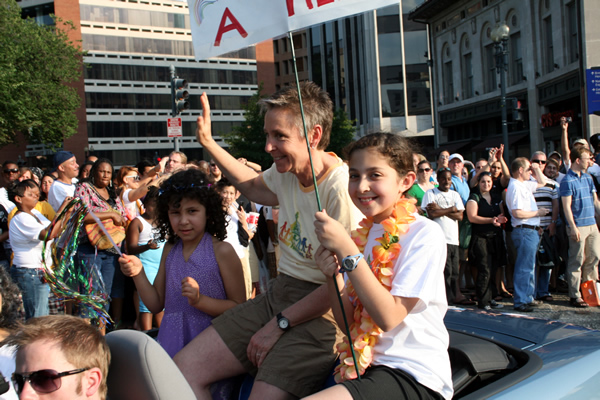
Ellen Kahn with her two daughters. (Blade file photo by Michael Key)
Only two out of 10 elementary school students have learned about same-sex-headed families, according to a new study commissioned by the Gay, Lesbian, and Straight Education Network (GLSEN). Combine this with the fact that same-sex families with children live in 96 percent of counties in the United States, and we clearly have a failure to teach children about the world and people around them.
In its study, “Playgrounds and Prejudice: Elementary School Climate in the United States,” GLSEN found that during classroom discussions of families, nearly 90 percent of elementary school teachers said they taught students about different types of families—but less than a quarter included representations of LGB parents, and less than 10 percent included transgender parents.
Only a quarter reported “having personally engaged in efforts to create a safe and supportive classroom environment for families with LGBT parents.”
That might be because less than one quarter of teachers received training on families with LGBT parents, and just over a third on gender issues—even though 85 percent said they received training on other diversity or multicultural matters.
The study was conducted by Harris Interactive on behalf of GLSEN, using online surveys of 1,065 U.S. school students in 3rd to 6th grade and 1,099 U.S. teachers of kindergarten to 6th grade.
On the positive side, eight in 10 teachers said they would feel comfortable addressing name-calling, bullying or harassment of students who were perceived to be LGB or gender nonconforming. That is a vital step. But less than half of the teachers said they felt comfortable responding to questions from students about LGB people, and even less to questions about transgender people.
If teachers don’t have the ability to answer questions about LGBT people, however, their ability to “address” anti-LGBT bullying will never rise much above “Stop because I said so”—and while that is sometimes a necessary approach (as every parent knows), it only goes so far. Unless schools also promote a better understanding of diverse people and communities, they will never address one of the root causes of bullying.
One resource that may help is GLSEN’s new Ready, Set, Respect! GLSEN’s Elementary School Toolkit. But that is not the first LGBT-inclusive educational resource aimed at elementary schools.
The HRC Foundation’s Welcoming Schools initiative piloted in 2007, has offered its materials online for several years, including, most recently, “What Do You Know? Six to twelve year olds talk about gays and lesbians,” a short professional development film for school staff and parents. And educational film company Groundspark has produced numerous LGBT-inclusive diversity education films since 1996, when “It’s Elementary” showed elementary school teachers and their experiences talking about LGB families. The company’s award-winning 2005 film, “That’s a Family!” features elementary school children who are being raised by parents of different races or religions, adoptive parents, single parents, divorced parents, gay or lesbian parents and grandparents serving as guardians.
The problem has not been a lack of resources — although more are always welcome. It would seem, rather, to be a lack of desire, or the misperception that we don’t need to use them with children so young.
We do need to use them, however. GLSEN’s survey found that homophobic slurs start early. Almost half of the elementary school teachers and students surveyed reported regularly hearing comments like use of the word “gay” in a negative way (e.g., “that’s so gay”), “spaz,” or “retard.” About one quarter reported regularly hearing students use homophobic slurs, such as “fag” or “lesbo,” as well as negative comments about race or ethnicity.
Three-fourths of the students reported that, “students at their school are called names, made fun of or bullied with at least some regularity.” Twenty-one percent said this was because the targeted students were thought to be gay, and 23 percent said it was because the students didn’t conform to traditional gender norms/roles.
To those who say elementary students are too young to learn about LGBT people, I say: They already know about them—but many know only based on slurs and misconceptions.
Teachers might seem to bear the brunt of blame for this, but that is a misleading and simplistic explanation. Schools are dynamic and interconnected systems. Administrators, district officials, and even state officials are also responsible for setting curricula, choosing materials and creating an inclusive environment.
The main drivers of change, however, must be parents. We can inform teachers and school administrators about the above resources, and recommend they be included in teacher training and student diversity programs. We can talk with school board officials and let them know such inclusion matters to us—and impacts our voting.
More critically, we parents can educate ourselves and make sure our own children know that families come in many different forms, and that people express gender in different ways.
LGBT parents can also help our neighbors and friends understand the importance of LGBT inclusion—and help them find the language to discuss it with their families.
Life may “get better” as teens get older, as the well-known awareness project says. But there’s no reason we can’t try to make it good right from the start.



Opinions
Open or closed? No, not your bar tab
The swinging couple’s dream is the hopeless romantic’s nightmare
(Editor’s note: This is the first of a two-part feature on open relationships.)
Boy meets boy. Boy likes boy.
For the first time in a long time, boy feels that thing, that connection, that spark with boy.
Then one day boy grabs dinner with boy. Boy’s smiles and laughs throughout are equal parts sincere and excited. Boy wonders, is this the one? After all this time, has it finally happened?
Boy takes boy home. Boys cuddle. Boys kiss. Boys have amazing sex. And in the glowing aftermath of what can only be described as a perfect night, boy spots an unnoticed ring.
“What’s that?” boy asks.
“My wedding ring,” the other replies. “I thought you knew.”
When I returned to D.C. in 2016, I quickly received a lecture on why open relationships were the future of queer love. Nearly eight years later, they’ve more than just sprouted among the gay scene – they’ve overtaken the landscape. Simultaneously, what became the swinging couple’s dream descended into the hopeless romantic’s nightmare.
It’s not all so bad given what comes with it: a lot of sex, particularly with hotties who were off-limits before. However, alongside that sex comes a minefield of rules and regulations open couples create but horny singles must abide by. One wrong move, and you’re the villain.
Truthfully, I’ve soiree’d with open couples before, both separate and together. On the bad end, things get awkward – particularly between me and the other partner. On the good end, I might come home satisfied, but the moment I hop on my couch to watch rerun television, I realize I’m back to where I started: alone.
If you’re like me and not yet onboard with an open relationship, it’s also easy to feel like a fish out of water. Queer social outings can sometimes become a Swinging 70’s Redux, with partners passed around like gay dishes at a potluck. Next up: ass, and lots of it.
This leads to another issue: in a scene full of open couples, detached sex is more than just accepted – it’s often expected. The moment you let emotional attachment enter the equation, you lose. Now even the singles are trained to run away, for your attachment may prevent them from jumping onto – or into – the next in their queue. And I can’t even get upset, for I’ve been that guy before.
For all these reasons, I wanted to dive further into the rise of open relationships. All I needed was someone in an open relationship willing to speak on the matter.
“That’s easy,” quipped my coworker, Chad. “Just open Grindr.”
Chad and I met working at the pub, and under similar circumstances; he lost his day job a few months after me losing mine. We quickly found solace in our shared circumstance, and now he and I hang in the kitchen of a gay bar divulging details of our sex lives and pining to meet the man of our dreams.
And Chad wasn’t wrong, for these days Grindr is chockfull of profiles in open relationships looking to play. Yet it turned out I wouldn’t need Grindr, for at that moment, in pranced our fellow coworker, Scott.
There’s no better way to describe Scott than this: They’re a bundle of positivity and joy. Oddly, I didn’t meet Scott at the bar but rather at a coffee shop in Petworth in 2018, where they were my regular barista. Little did I know we’d work together half a decade later. Life is funny that way, isn’t it?
Outside the bar, Scott is an actor in productions across the DMV. Naturally, they became my biggest inspiration for abandoning my career for the arts. Following a bar shift last summer we smoked a blunt and talked about it. They taught me to tune out the noise and follow my heart.
Together, Chad and Scott became my newfound support system. In a way we’re like the Three Musketeers – equally gay, just a lot more working class.
Of course, as soon as Scott entered, I had to ask: “Are you and your partner open?”
Scott smiled coyly. “Oh yes, honey.”
So as fate had it, here in the kitchen of a gay bar, I had both ends of the open/closed spectrum represented. On one side Chad, a self-proclaimed romantic seeking monogamy; on the other, the fully open Scott.
While there were many takeaways from our conversations on the matter, I distilled six truths in the debate between open and closed relationships. But please, take these with a grain of salt – I am just a barback, after all.
- Monogamy is rooted in tradition.
For many of us, gay or straight, finding our one and only was a dream of our youth. Mine was supposed to be Colby Donaldson from season 2 of the hit TV show “Survivor,” but life had other plans.
Yet many never dissect where this desire stems from. Our culture is inundated with stories of princesses rescued by their prince and true love’s kiss setting us free. There seemed to be a script we had to follow, and if we didn’t, no worries – God would simply banish us to hell.
This is a common starting point for both the monogamist and the open connoisseur. When I asked Chad what drew him toward monogamy, he replied, “Honestly, it was how I was raised: settle down, have kids, and carry on the family name. I didn’t have any non-traditional role models.”
Meanwhile, Scott’s past reservations toward open relationships were for similar reasons. “When I was younger, I was not pro-open relationship,” they told me. “I didn’t understand the intricacies of it. I didn’t understand the nuances of it. I also grew up in a very conservative, Catholic household.”
Both responses touch on a key argument in the pro-open saga: that closed relationships are often reflections of tradition, ranging from folklore to religion, and these traditions held queer people back for centuries. If queer means subverting these traditions, then monogamy is simply outdated. Or so they say.
- The desire to be open is biological.
Over time, Scott’s views on being open changed. “As I matured and grew into my queerness,” they started, “and saw friends with alternative lifestyles, I realized this is something I could be interested in.”
In Scott’s relationship, this led to an understanding of the core needs for them and their partner. “I knew my partner’s libido was higher than mine. For me, it came from a desire to allow my partner to experience something I wasn’t able to fulfill fully. I personally get a lot of pleasure knowing my partner can go out, meet people, and make connections, knowing at the end of the day we will be each other’s number one priority and person.”
Scott’s libido reference made me wonder: are open relationships taking off across the LGBTQ community, or specifically among sex-obsessed gay men? Realizing this conversation should probably be more inclusive, I made an arduous journey east – roughly 150 feet, to the front entrance.
Kelsey is a hot badass who works the door of the bar. She’s stylish, a fellow Aires like myself, and I once told Chad I thought she was Fabulous with a capital F. I realized then I’m getting gayer by the minute.
While Kelsey is currently in a closed relationship, she enlightened me to the status among lesbians. “It’s about 50/50 with the ones I know,” she replied. Honestly, this surprised me, mainly because I figured men were the ones dicking around.
Kelsey has also been in open relationships before, and she isn’t exactly closed to that route again. “I don’t think people were made for one person for the rest of their life,” she added. This reflected what Scott shared as well: “The human body craves sex to different degrees, and as you get older those degrees wax and wane.”
To me, both statements highlight that the desire to be with others sexually is natural for many, so caging that desire can feel confining. As queer people, we can all relate to that.
Next week: Part two looks at finding the right reasons for pursuing an open relationship.
Jake Stewart is a D.C.-based writer and barback.
Opinions
RFK Jr. a dangerous spoiler helping Trump
A reckless man now on the ballot in several swing states
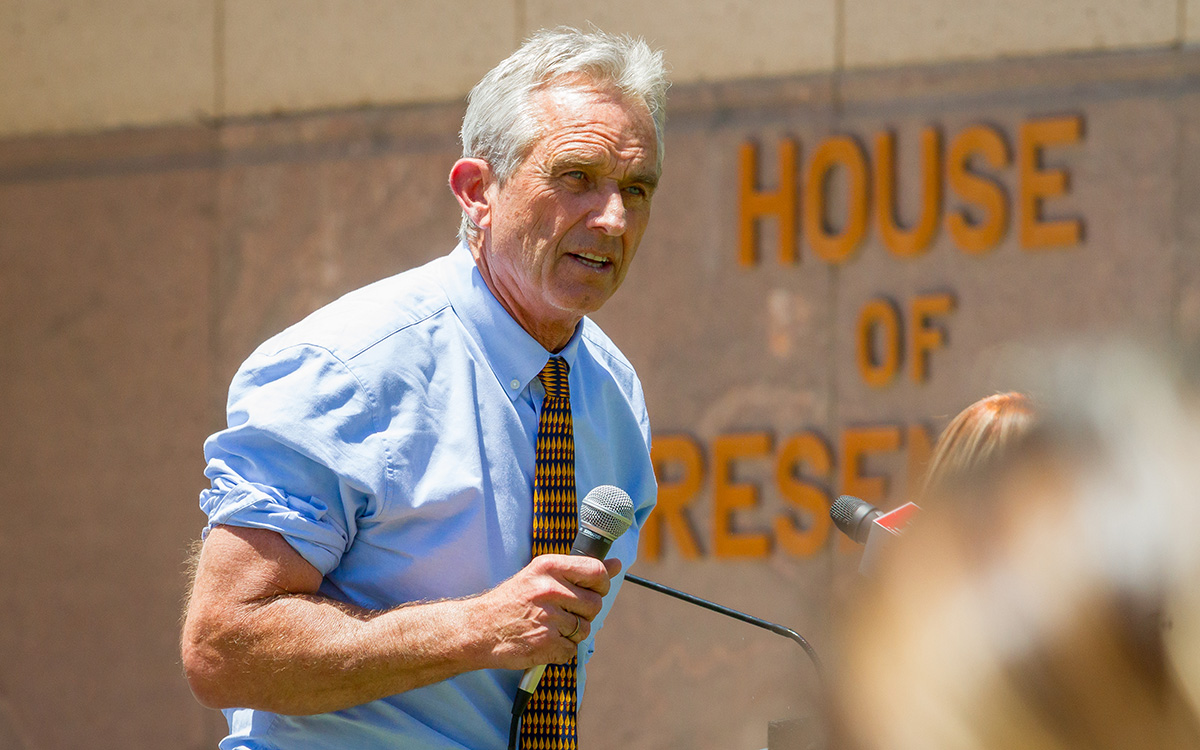
Robert F. Kennedy Jr. is an embarrassment to his family, and to so many others like me who supported his father and uncle. He uses his last name to try to gain credibility and that is sad.
His real claim to fame is being an anti-vaxxer and lying about what impact vaccinations will have on the health of the American people. Were it up to him, and God forbid he had been president during the COVID-19 pandemic, millions more Americans would have died. Because of his dangerous lies, many more will die of diseases once nearly eradicated, like measles.
Listening to RFK Jr. is difficult because of his voice. The cause of that is Spasmodic dysphonia, a rare neurological condition, in which an abnormality in the brain’s neural network results in involuntary spasms of the muscles that open or close the vocal cords. He has said, “I feel sorry for the people who have to listen to me.” I am also sorry for people who listen to him, but not because of his disability. I am sorry for those who listen to him because of the garbage he spouts when he speaks. He is actually a man with dangerous ideas, and one whose outsized ego could end up getting us Donald Trump as president.
Kennedy is an environmental lawyer who recently made the bizarre statement, “Biden is a ‘much worse’ threat to democracy than Trump.” Like Trump, Kennedy is forever making statements like that and then trying to weasel out of them like he has with this one. The statement reminded me of when Susan Sarandon said in 2016, “there is no significant difference between Donald Trump and Hillary Clinton.”
Kennedy recently sent out a campaign email saying the Jan. 6 Capitol Hill rioters were simply “activists.” Then when the blowback got too strong, he blamed that on someone else. Kennedy is a lawyer with no real government or foreign policy experience. Unfortunately, that doesn’t seem to matter to many Americans, even though Trump clearly proved it should. We live in an often dangerous, and very complicated, world. A president has to deal with issues that could mean life or death, such as the wars in Ukraine and the Middle East.
Like Trump, RFK Jr. is on his third wife. His current wife is the talented actress, Cheryl Hines. When asked whether she agrees with his views Hines said, “there are some political topics she differs on with her husband, which she did not disclose.” She did mention one and referenced “the time Kennedy, made a comparison to the Holocaust while delivering a speech at a rally against vaccine mandates. She assured her Twitter followers she found the comparison ‘reprehensible.’ We can all agree it was reprehensible but so is much of what RFK Jr. says.
Kennedy recently named Nicole Shanahan as his running mate. Her ex-husband is Sergey Brin, one of the founders of Google. She is a California lawyer involved in the tech field. It looks like she bought her way onto the ticket donating millions of dollars, including $4 million, toward the Super Bowl ad Kennedy produced. He will use her money to help get him on ballots across the nation. As of April 10th Kennedy is already on the ballot in Utah, and his campaign has gathered the necessary signatures to be on the ballot in New Hampshire, Nevada, Hawaii, North Carolina and Idaho, according to a recent campaign news release.
If he gets on swing state ballots, it heightens his chance of being a spoiler. The reality of this was touted by one of his staffers who when talking to a group of Republicans about the campaign in New York, said “The only way that Trump can even see the remote possibility of taking New York is if Bobby is on the ballot. If it’s Trump vs. Biden, Biden wins. Biden wins six days, seven days a week. With Bobby in the mix, anything can happen. How do we block Biden from winning the presidency? Again, that’s the number one priority for me.”
After the blowback, Kennedy said she didn’t speak for the campaign and let her go. But in reality, when looking at who to choose as my candidate I look at the people he/she surrounds themselves with. Who is advising them? I guess for Kennedy it doesn’t really matter since he won’t be elected. But it is time people like Kennedy stop trying to fool the American people into thinking they could win.
He will simply get the political epitaph ‘Spoiler’ if Trump wins. No one will remember him for anything else. Let’s pray, and work hard, to see that doesn’t happen.
Peter Rosenstein is a longtime LGBTQ rights and Democratic Party activist. He writes regularly for the Blade.
Opinions
The High Road – Walking the Pathway to National Cannabis Legalization
Grassroots organizing has been the driving force behind shifting public perception and pushing for policy changes in the cannabis industry

As we gear up for a major election year, the buzz around cannabis legalization is getting louder. Policymakers are starting to see the need for comprehensive reform, while advocates and small business owners in the industry are cautiously optimistic about the future. But let’s not kid ourselves, this system was designed to keep certain communities out, and it’s crucial that we continue to address these deep-rooted inequities as we blaze the trail forward. A step towards legalization that doesn’t prioritize equity and dismantle the barriers that have held back marginalized groups would be a major bummer. In this op-ed, we’re going to take a groovy journey through the evolution of grassroots organizing in the cannabis industry and highlight the importance of social equity in achieving true national cannabis legalization and boosting our humanity along the way.
Over the years, I’ve been right in the thick of it, helping to build grassroots organizations like Supernova Woman and Equity Trade Network. These groups have been on the frontlines, fighting for cannabis programs in Oakland and San Francisco. I’ve also rocked my own brand, Gift of Doja, and organized the first Cannabis Garden at a major neighborhood street fair, Carnaval San Francisco. I even served as the chair of the first Cannabis Oversight Committee in the nation. But the real magic has always happened in when working in coalitions. Each individual and organization brings a unique piece to the puzzle. Grassroots organizating is as challenging as crafting a democratic society but is worth the effort in generating workable implementable solutions. Collective efforts have been game-changers in shifting public opinion and paving the way for major policy changes at both the state and local levels.
As we navigate the path towards cannabis legalization, lobbyist and lawmakers can’t forget about the small business owners who have been grinding to build their dreams. Political advocacy and lobbying are important, but if we’re not uplifting the voices and experiences of those who have been fighting on the ground, we’re missing the mark. Big companies can hire lobbyists, but small business owners don’t have that luxury and if we are not in the room we are on the table. Coalitions allow for us to be in the room when we can’t physically be there. Our communities, especially people of color, have been hit hard by systemic oppression, from over-policing to mass incarceration and limited economic opportunities to limit our ability to be in the room of power and decision making.
Social equity needs to be front and center in any cannabis legalization efforts. It’s not enough to just remove criminal penalties or create a legal market. We need to actively work on repairing the damage caused by years of prohibition. That means fighting for resources, investment, and low-interest loans for small businesses. It means creating a tiered fee and tax structure that doesn’t crush the little guys. And it means opening up equity programs to all industries, not just cannabis. Social justice without economic access and repair is like a joint without a lighter – it just won’t spark the change we need. We have a responsibility to evolve the economy and break down unnecessary barriers. Activism, social justice, and economic reform are all connected, man.
Industry leaders, culture creators, advocates, and consumers alike, we all need to step up and promote social equity. It’s on us to support initiatives that provide resources, mentorship, and funding for individuals from affected communities to enter the legal cannabis market. And let’s not forget the power of our wallets. Buying from companies that align with our values and support the work we believe in can send a powerful message. Voting with our dollars might just be more impactful than showing up at the ballot box.
As we head into a major election year, the cannabis industry is at a crossroads. It’s a time for drumming up voter interest and for candidates to make promises that grassroots organizations have fought hard for. Small business owners will be navigating a tricky landscape, but we can’t lose sight of the power of collective work. By keeping social equity at the forefront, we can undo the harms of the past while building new frameworks that will shape a brighter future for all.
In conclusion, grassroots organizing has been the driving force behind shifting public perception and pushing for policy changes in the cannabis industry. But let’s not forget that true national cannabis legalization can only be achieved if we address social equity. It’s time for us to come together, listen to the voices of those most impacted, and walk the high road towards a future where cannabis legalization isn’t just about business opportunities, but also about healing and empowerment for all communities. Let’s light up a joint of social justice and blaze a trail towards a better tomorrow.
Nina Parks, Co-Founder of Equity Trade Network & Supernova Women [email protected]

Survey finds support for Biden among LGBTQ adults persists despite misgivings

Activists demand EU sanction Uganda over Anti-Homosexuality Act

Court records raise concerns about right-wing TikTok investor’s influence

New D.C. LGBTQ+ bar Crush set to open April 19

After 25 years, a forgotten queer classic reemerges in 4K glory

Congolese lawmaker introduces anti-homosexuality bill

Out in the World: LGBTQ news from Europe and Asia

Reenactment of first gay rights picket at White House set for April 17

Ugandan activists appeal ruling that upheld Anti-Homosexuality Act

Ariz. governor vetoes anti-transgender, Ten Commandments bill
-
 Africa4 days ago
Congolese lawmaker introduces anti-homosexuality bill
-
 World4 days ago
Out in the World: LGBTQ news from Europe and Asia
-
 District of Columbia3 days ago
Reenactment of first gay rights picket at White House set for April 17
-
 Africa3 days ago
Ugandan activists appeal ruling that upheld Anti-Homosexuality Act