
Local
U.S. Attorney challenges use of civil rights law
Government defends Library of Congress in firing of gay employee
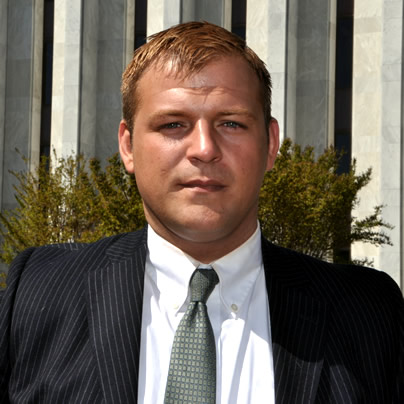
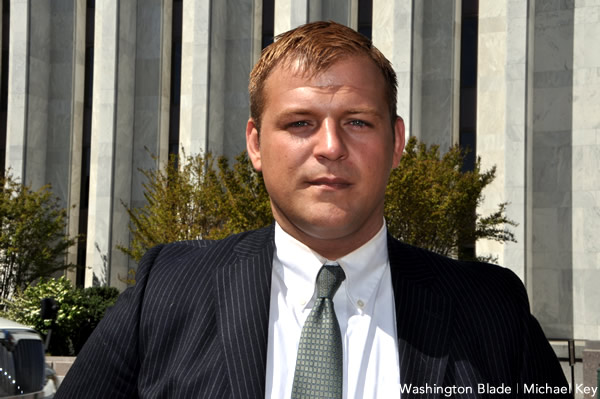
Peter TerVeer (Blade photo by Michael Key)
The United States Attorney for the District of Columbia filed court papers on Dec. 17 arguing that a gay man, who sued the Library of Congress for firing him because of his sexual orientation, failed to show he’s entitled to protection under Title VII of the U.S. Civil Rights Act of 1964.
The court filing by U.S. Attorney Ronald C. Machen Jr., who was appointed by President Obama, places the Obama administration in the awkward position of opposing a gay discrimination claim under Title VII.
In a lawsuit filed against the Library of Congress in August 2012, former management analyst Peter TerVeer, 30, says he was fired from his job after being harassed and humiliated for more than a year by a supervisor who repeatedly quoted biblical passages condemning homosexuality.
The lawsuit charges that although TerVeer was targeted because he’s gay, he suffered employment discrimination and harassment based on his gender, gender stereotyping and his religious beliefs, which he says didn’t conform to those of supervisor John Mech.
Title VII of the famed 1964 Civil Rights Act bans discrimination based on race, religion, ethnicity, gender and, according to recent court rulings, gender identity, but not sexual orientation by itself.
According to the lawsuit, TerVeer and Mech had a cordial working relationship from the time TerVeer was hired in February 2008 as a management analyst in the library’s Auditing Division. It says TerVeer received high performance ratings and two promotions between 2008 and 2010.
The lawsuit says Mech allegedly became hostile and unfairly critical of TerVeer’s work performance and created an unbearably hostile work environment after Mech learned TerVeer was gay.
The government’s filing of a motion to dismiss the case on legal and procedural grounds comes at a time when gay rights attorneys are seeking to persuade courts to treat anti-gay discrimination as a form of sex discrimination protected under Title VII.
“We believe that the allegations in the complaint are insufficient to substantiate a Title VII claim,” said Charles Miller, a spokesperson for the Justice Department’s Civil Division.
Miller pointed to an April 2012 ruling by the Library of Congress’s in-house equal employment opportunity division, which investigated TerVeer’s allegations of discrimination and harassment and dismissed an in-house complaint he filed in September 2011 on grounds that the allegations could not be substantiated.
“The Executive Branch is of course opposed to discrimination on the basis of sexual orientation, and this filing does not reflect any contrary policy,” Miller told the Blade.
But Christopher Brown of the D.C. law firm Ackerman Brown, which is representing TerVeer, said the government’s motion to dismiss the case “relies on legal precedent that excludes LGBT employees from protection under Title VII.”
Brown declined to comment further on the government’s arguments, saying TerVeer’s legal team prefers not to comment in detail on pending litigation.
Greg Nevins, supervising attorney for the gay litigation group Lambda Legal Defense and Education Fund, which is monitoring the TerVeer case, said the government’s motion to dismiss appears to be arguing that TerVeer did not present sufficient evidence to show that his supervisor targeted him for discrimination because TerVeer displayed mannerisms or behavior of a stereotypical gay man, which some might view as being effeminate.
“I think what the U.S. Attorney is saying here is a masculine gay man or a feminine lesbian would not be covered under Title VII,” Nevins said. “Some court rulings have essentially said Title VII does not apply to sexual orientation.”
In a landmark ruling last April, the U.S. Equal Employment Opportunity Commission declared that transgender people are protected against job discrimination under Title VII because bias against their gender identity is equivalent to sex discrimination. The EEOC ruling followed several appeals court decisions holding that transgender people were protected under Title VII.
Lambda Legal and other LGBT advocacy organizations say they hope to persuade courts that gay men and lesbians enjoy Title VII protections. They argue that sexual orientation discrimination is also linked to gender role stereotyping and bias, regardless of whether the victim is perceived as masculine or feminine.
TerVeer’s lawsuit says he also was targeted for retaliation after he filed his discrimination complaint with the library’s in-house EEO office, which is known as the Office of Opportunity, Inclusiveness and Compliance.
“Plaintiff’s discrimination and retaliation claims fall short,” Machen and two other government attorneys argue in their Dec. 17 motion seeking to dismiss the case, which was filed in U.S. District Court for the District of Columbia.
“Plaintiff alleges that he was subject to harassment after his employer learned that he was gay, and he presents his claim as one of non-conformity with sex stereotypes,” the motion to dismiss says. “But the detailed allegations in the complaint do not provide what courts have held is required to show that sex stereotyping was the cause of his employer’s actions.”
The motion to dismiss adds, “[C]ourts have generally required plaintiffs to set forth specific allegations regarding the particular ways in which an employee failed to conform to such stereotypes — generally relating to an employee’s behavior, demeanor or appearance in the workplace — and allegations to support the claim that this non-conformity negatively influenced the employer’s decision … In this case, however, plaintiff fails to offer anything more than the conclusory statement that, as a result of his sexual orientation, ‘he did not conform to the defendant’s gender stereotypes associated with men under Mech’s supervision.’”
One civil rights attorney familiar with the case, who spoke on condition of anonymity, said the U.S. Attorney’s office was fulfilling its role in defending its client — the Library of Congress — and should not be faulted for arguing against TerVeer’s attempt to invoke protection from Title VII.
“The government’s argument that the complainant fails to allege sufficient facts to state a claim … are typical arguments that they’d make equally if the plaintiff were female or black rather than gay,” the attorney said.
The government’s motion to dismiss the case is based mostly on procedural and legal grounds rather than on the merits of TerVeer’s specific allegations of discrimination and retaliation.
The government’s motion cites legal and procedural grounds to seek the dismissal of a separate claim in the lawsuit that the firing violated TerVeer’s Fifth Amendment constitutional right to due process and equal protection under the law.
In addition, it cites procedural grounds to call on the court to dismiss separate claims in the lawsuit that the library violated the Library of Congress Act, which bans discrimination based on factors unrelated to an employee’s ability to perform his or her job; and an internal library policy banning sexual orientation discrimination.
Library investigation finds no substantiation of discrimination
The motion to dismiss releases publicly for the first time the April 26, 2012 ruling by the library’s Office of Opportunity, Inclusiveness and Compliance (OIC) that rejects TerVeer’s allegations on grounds that they could not be substantiated or proven.
The 14-page ruling by the OIC, which was filed in court by the U.S. Attorney’s office as “Exhibit D,” was based on an in-house library investigation into a discrimination complaint filed by TerVeer on Nov. 9, 2011, according to OIC acting supervisor Vicki Magnus.
Magnus discusses the findings in an April 26 letter to Brown, TerVeer’s attorney, which the U.S. Attorney’s office submitted in court as part of Exhibit D.
“Based on the available evidence, the Office of Opportunity, Inclusiveness and Compliance (OIC) does not find sufficient evidence to support Complainant’s allegations that he was discriminated against based on religion, sex, and reprisal, and that he was subjected to sexual harassment and a hostile work environment in his meetings with supervisors regarding performance and in actions taken by supervisors regarding his performance,” Magnus said in her letter.
In what potentially could be damaging to TerVeer’s lawsuit, Magnus notes that the OIC investigation into TerVeer’s discrimination and retaliation complaint included interviews of and testimony by five of TerVeer’s co-workers. Each of the five testified that they personally observed less than satisfactory work performance by TerVeer, according to the OIC ruling.
In his complaint, TerVeer accuses his immediate supervisor, John Mech, and a higher level supervisor, Nicholas Christopher, of giving him a lower job performance rating based on anti-gay bias.
The five co-workers, “each of whom personally observed complainant’s performance, fully support the reasons presented by management justifying their decision to issue complainant poor performance ratings and to deny complainant a [performance based salary increase].”
Brown, TerVeer’s attorney, declined to comment on the OIC ruling or its potential impact on the lawsuit.
The library’s official reason for firing TerVeer was his failure to report to work after a leave of absence he requested and received permission to take had expired. TerVeer told reporters in a news conference in April that his doctor and therapist urged him to take a leave from work after the hostile work environment he said Mech created caused him to suffer severe emotional distress.
He said the library refused to grant his request to be transferred to another office under another supervisor, making it impossible for him to return to work.





District of Columbia
Catching up with the asexuals and aromantics of D.C.
Exploring identity and finding community
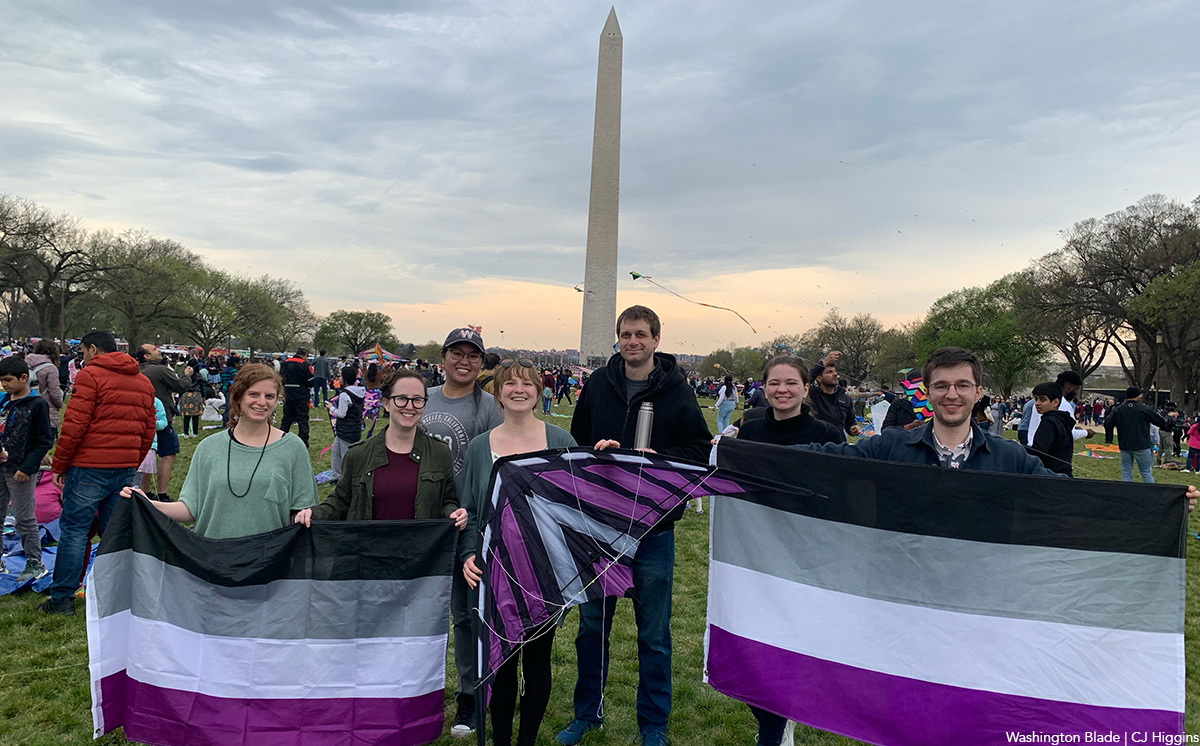
There was enough commotion in the sky at the Blossom Kite Festival that bees might have been pollinating the Washington Monument. I despaired of quickly finding the Asexuals and Aromantics of the Mid-Atlantic—I couldn’t make out a single asexual flag among the kites up above. I thought to myself that if it had been the Homosexuals of the Mid-Atlantic I would’ve had my gaydar to rely on. Was there even such a thing as ace-dar?
As it turned out, the asexual kite the group had meant to fly was a little too pesky to pilot. “Have you ever used a stunt kite?” Bonnie, the event organizer asked me. “I bought one. It looked really cool. But I can’t make it work.” She sighed. “I can’t get the thing six feet off the ground.” The group hardly seemed to care. There was caramel popcorn and cookies, board games and head massages, a game of charades with more than its fair share of Pokémon. The kites up above might as well have been a coincidental sideshow. Nearly two dozen folks filtered in and out of the picnic throughout the course of the day.
But I counted myself lucky that Bonnie picked me out of the crowd. If there’s such a thing as ace-dar, it eludes asexuals too. The online forum for all matters asexual, AVEN, or the Asexual Visibility and Education Network, is filled with laments: “I don’t think it’s possible.” “Dude, I wish I had an ace-dar.” “If it exists, I don’t have it.” “I think this is just like a broken clock is right twice a day type thing.” What seems to be a more common experience is meeting someone you just click with—only to find out later that they’re asexual. A few of the folks I met described how close childhood friends of theirs likewise came out in adulthood, a phenomenon that will be familiar to many queer people. But it is all the more astounding for asexuals to find each other this way, given that asexual people constitute 1.7% of sexual minorities in America, and so merely .1% of the population at large.
To help other asexuals identify you out in the world, some folks wear a black ring on their middle finger, much as an earring on the right ear used to signify homosexuality in a less welcoming era. The only problem? The swinger community—with its definite non-asexuality—has also adopted the signal. “It’s still a thing,” said Emily Karp. “So some people wear their ace rings just to the ace meet-ups.” Karp has been the primary coordinator for the Asexuals and Aromantics of the Mid-Atlantic (AAMA) since 2021, and a member of the meet-up for a decade. She clicked with the group immediately. After showing up for a Fourth of July potluck in the mid-afternoon, she ended up staying past midnight. “We played Cards against Humanity, which was a very, very fun thing to do. It’s funny in a way that’s different than if we were playing with people that weren’t ace. Some of the cards are implying, like, the person would be motivated by sex in a way that’s absurd, because we know they aren’t.”
Where so many social organizations withered during the pandemic, the AAMA flourished. Today, it boasts almost 2,000 members on meetup.com. Karp hypothesized that all the social isolation gave people copious time to reflect on themselves, and that the ease of meeting up online made it convenient as a way for people to explore their sexual identity and find community. Online events continue to make up about a third of the group’s meet-ups. The format allows people to participate who live farther out from D.C. And it allows people to participate at their preferred level of comfort: while many people participate much as they would at an in-person event, some prefer to watch anonymously, video feed off. Others prefer to participate in the chat box, though not in spoken conversation.
A recent online event was organized for a discussion of Rhaina Cohen’s book, “The Other Significant Others,” published in February. Cohen’s book discusses friendship as an alternative model for “significant others,” apart from the romantic model that is presupposed to be both the center and goal of people’s lives. The AAMA group received the book with enthusiasm. “It literally re-wired my brain,” as one person put it. People discussed the importance of friendship to their lives, and their difficulties in a world that de-prioritized friendship. “I can break up with a friend over text, and we don’t owe each other a conversation,” one said. But there was some disagreement when it came to the book’s discussion of romantic relationships. “It relegates ace relationships to the ‘friend’ or ‘platonic’ category, to the normie-reader,” one person wrote in the chat. “Our whole ace point is that we can have equivalent life relationships to allo people, simply without sex.” (“Allo” is shorthand for allosexual or alloromantic, people who do experience sexual or romantic attraction.)
The folks of the AAMA do not share a consensus on the importance of romantic relationships to their lives. Some asexuals identify as aromantic, some don’t. And some aromantics don’t identify as asexual, either. The “Aromantic” in the title of the group is a relatively recent addition. In 2017, the group underwent a number of big changes. The group was marching for the first time in D.C. Pride, participating in the LGBTQ Creating Change conference, and developing a separate advocacy and activism arm. Moreover, the group had become large enough that discussions were opened up into forming separate chapters for D.C., Central Virginia, and Baltimore. During those discussions, the group leadership realized that aromantic people who also identified as allosexual didn’t really have a space to call their own. “We were thinking it would be good to probably change the name of the Meetup group,” Emily said. “But we were not 100% sure. Because [there were] like 1,000 people in the group, and they’re all aces, and it’s like, ‘Do you really want to add a non-ace person?’” The group leadership decided to err on the side of inclusion. “You know, being less gatekeep-y was better. It gave them a place to go — because there was nowhere else to go.”
The DC LGBT Center now sponsors a support group for both asexuals and aromantics, but it was formed just a short while ago, in 2022. The founder of the group originally sought out the center’s bisexual support group, since they didn’t have any resources for ace folks. “The organizer said, you know what, why don’t we just start an ace/aro group? Like, why don’t we just do it?” He laughed. “I was impressed with the turnout, the first call. It’s almost like we tapped into, like, a dam. You poke a hole in the dam, and the water just rushes out.” The group has a great deal of overlap with the AAMA, but it is often a person’s first point of contact with the asexual and aromantic community in D.C., especially since the group focuses on exploring what it means to be asexual. Someone new shows up at almost every meeting. “And I’m so grateful that I did,” one member said. “I kind of showed up and just trauma dumped, and everyone was really supportive.”
Since the ace and aro community is so small, even within the broader queer community, ace and aro folks often go unrecognized. To the chagrin of many, the White House will write up fact sheets about the LGBTQI+ community, which is odd, given that when the “I” is added to the acronym, the “A” is usually added too. OKCupid has 22 genders and 12 orientations on its dating website, but “aromantic” is not one of them — presumably because aromantic people don’t want anything out of dating. And since asexuality and aromanticism are defined by the absence of things, it can seem to others like ace and aro people are ‘missing something.’ One member of the LGBT center support group had an interesting response. “The space is filled by… whatever else!” they said. “We’re not doing a relationship ‘without that thing.’ We’re doing a full scale relationship — as it makes sense to us.”
CJ Higgins is a postdoctoral fellow with the Alexander Grass Humanities Institute at Johns Hopkins University.
District of Columbia
Bowser budget proposal calls for $5.25 million for 2025 World Pride
AIDS office among agencies facing cuts due to revenue shortfall
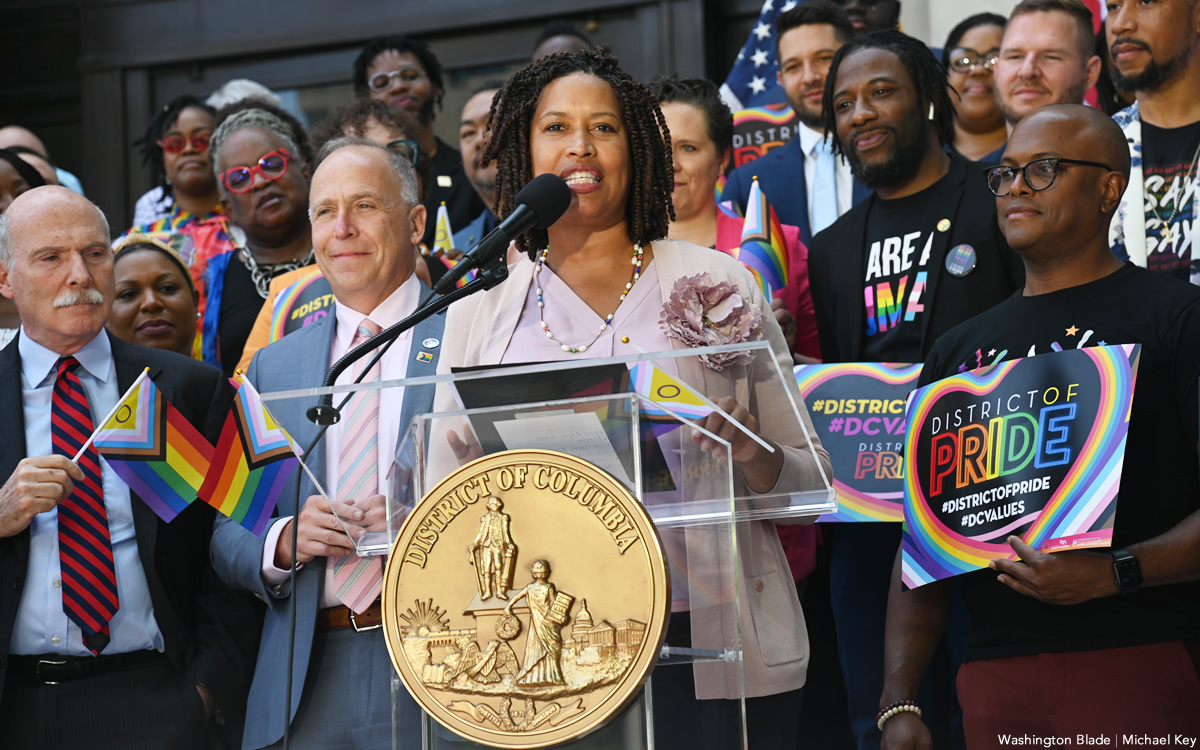
D.C. Mayor Muriel Bowser’s proposed fiscal year 2025 budget includes a request for $5.25 million in funding to support the June 2025 World Pride celebration, which D.C. will host, and which is expected to bring three million or more visitors to the city.
The mayor’s proposed budget, which she presented to the D.C. Council for approval earlier this month, also calls for a 7.6 percent increase in funding for the Mayor’s Office of LGBTQ Affairs, which amounts to an increase of $132,000 and would bring the office’s total funding to $1.7 million. The office, among other things, provides grants to local organizations that provide services to the LGBTQ community.
Among the other LGBTQ-related funding requests in the mayor’s proposed budget is a call to continue the annual funding of $600,000 to provide workforce development services for transgender and gender non-conforming city residents “experiencing homelessness and housing instability.” The budget proposal also calls for a separate allocation of $600,000 in new funding to support a new Advanced Technical Center at the Whitman-Walker Health’s Max Robinson Center in Ward 8.
Among the city agencies facing funding cuts under the mayor’s proposed budget is the HIV/AIDS, Hepatitis, Sexually Transmitted Disease, and Tuberculosis Administration, known as HAHSTA, which is an arm of the D.C. Department of Health. LGBTQ and AIDS activists have said HAHSTA plays an important role in the city’s HIV prevention and support services. Observers familiar with the agency have said it recently lost federal funding, which the city would have to decide whether to replace.
“We weren’t able to cover the loss of federal funds for HAHSTA with local funds,” Japer Bowles, director of the Mayor’s Office of LGBTQ Affairs, told the Washington Blade. “But we are working with partners to identify resources to fill those funding gaps,” Bowles said.
The total proposed budget of $21 billion that Bowser submitted to the D.C. Council includes about $500 million in proposed cuts in various city programs that the mayor said was needed to offset a projected $700 million loss in revenue due, among other things, to an end in pandemic era federal funding and commercial office vacancies also brought about by the post pandemic commercial property and office changes.
Bowser’s budget proposal also includes some tax increases limited to sales and business-related taxes, including an additional fee on hotel bookings to offset the expected revenue losses. The mayor said she chose not to propose an increase in income tax or property taxes.
Earlier this year, the D.C. LGBTQ+ Budget Coalition, which consists of several local LGBTQ advocacy organizations, submitted its own fiscal year 2025 budget proposal to both Bowser and the D.C. Council. In a 14-page letter the coalition outlined in detail a wide range of funding proposals, including housing support for LGBTQ youth and LGBTQ seniors; support for LGBTQ youth homeless services; workforce and employment services for transgender and gender non-conforming residents; and harm reduction centers to address the rise in drug overdose deaths.
Another one of the coalition’s proposals is $1.5 million in city funding for the completion of the D.C. Center for the LGBTQ Community’s new building, a former warehouse building in the city’s Shaw neighborhood that is undergoing a build out and renovation to accommodate the LGBTQ Center’s plans to move in later this year. The coalition’s budget proposal also calls for an additional $300,000 in “recurring” city funding for the LGBTQ Center in subsequent years “to support ongoing operational costs and programmatic initiatives.”
Bowles noted that Bowser authorized and approved a $1 million grant for the LGBTQ Center’s new building last year but was unable to provide additional funding requested by the budget coalition for the LGBTQ Center for fiscal year 2025.
“We’re still in this with them,” Bowles said. “We’re still looking and working with them to identify funding.”
The total amount of funding that the LGBTQ+ Budget Coalition listed in its letter to the mayor and Council associated with its requests for specific LGBTQ programs comes to $43.1 million.
Heidi Ellis, who serves as coordinator of the coalition, said the coalition succeeded in getting some of its proposals included in the mayor’s budget but couldn’t immediately provide specific amounts.
“There are a couple of areas I would argue we had wins,” Ellis told the Blade. “We were able to maintain funding across different housing services, specifically around youth services that affect folks like SMYAL and Wanda Alston.” She was referring to the LGBTQ youth services group SMYAL and the LGBTQ organization Wanda Alston Foundation, which provides housing for homeless LGBTQ youth.
“We were also able to secure funding for the transgender, gender non-conforming workforce program,” she said. “We also had funding for migrant services that we’ve been advocating for and some wins on language access,” said Ellis, referring to programs assisting LGBTQ people and others who are immigrants and aren’t fluent in speaking English.
Ellis said that although the coalition’s letter sent to the mayor and Council had funding proposals that totaled $43.1 million, she said the coalition used those numbers as examples for programs and policies that it believes would be highly beneficial to those in the LGBTQ community in need.
“I would say to distill it down to just we ask for $43 million or whatever, that’s not an accurate picture of what we’re asking for,” she said. “We’re asking for major investments around a few areas – housing, healthcare, language access. And for capital investments to make sure the D.C. Center can open,” she said. “It’s not like a narrative about the dollar amounts. It’s more like where we’re trying to go.”
The Blade couldn’t’ immediately determine how much of the coalition’s funding proposals are included in the Bowser budget. The mayor’s press secretary, Daniel Gleick, told the Blade in an email that those funding levels may not have been determined by city agencies.
“As for specific funding levels for programs that may impact the LGBTQ community, such as individual health programs through the Department of Health, it is too soon in the budget process to determine potential adjustments on individual programs run though city agencies,” Gleick said.
But Bowles said several of the programs funded in the mayor’s budget proposal that are not LGBTQ specific will be supportive of LGBTQ programs. Among them, he said, is the budget’s proposal for an increase of $350,000 in funding for senior villages operated by local nonprofit organizations that help support seniors. Asked if that type of program could help LGBTQ seniors, Bowles said, “Absolutely – that’s definitely a vehicle for LGBTQ senior services.”
He said among the programs the increased funding for the mayor’s LGBTQ Affairs office will support is its ongoing cultural competency training for D.C. government employees. He said he and other office staff members conduct the trainings about LGBTQ-related issues at city departments and agencies.
Bowser herself suggested during an April 19 press conference that local businesses, including LGBTQ businesses and organizations, could benefit from a newly launched city “Pop-Up Permit Program” that greatly shortens the time it takes to open a business in vacant storefront buildings in the downtown area.
Bowser and Nina Albert, D.C. Deputy Mayor for Planning and Economic Development, suggested the new expedited city program for approving permits to open shops and small businesses in vacant storefront spaces could come into play next year when D.C. hosts World Pride, one of the word’s largest LGBTQ events.
“While we know that all special events are important, there is an especially big one coming to Washington, D.C. next year,” Bowser said at the press conference. “And to that point, we proposed a $5.25 million investment to support World Pride 2025,” she said, adding, “It’s going to be pretty great. And so, we’re already thinking about how we can include D.C. entrepreneurs, how we’re going to include artists, how we’re going to celebrate across all eight wards of our city as well,” she said.
Among those attending the press conference were officials of D.C.’s Capital Pride Alliance, which will play a lead role in organizing World Pride 2025 events.
Maryland
Health care for Marylanders with HIV is facing huge cuts this summer
Providers poised to lose three-quarters of funding
BY MEREDITH COHN | By the end of June, health care providers in Maryland will lose nearly three-quarters of the funding they use to find and treat thousands of people with HIV.
Advocates and providers say they had been warned there would be less money by the Maryland Department of Health, but were stunned at the size of the drop — from about $17.9 million this fiscal year to $5.3 million the next. The deep cuts are less than three months away.
The rest of this article can be read on the Baltimore Banner’s website.

Bisexual former umpire sues Major League Baseball for sexual harassment

Argentina government dismisses transgender public sector employees

Eastern Shore chef named James Beard Finalist

Fact: The next president will be Biden or Trump

Catching up with the asexuals and aromantics of D.C.

State Department releases annual human rights report

Joe Vogel campaign holds ‘Big Gay Canvass Kickoff’

Smithsonian staff concerned about future of LGBTQ programming amid GOP scrutiny

White House debuts action plan targeting pollutants in drinking water

Maine governor signs transgender, abortion sanctuary bill into law
-
 State Department2 days ago
State Department releases annual human rights report
-
 Maryland4 days ago
Joe Vogel campaign holds ‘Big Gay Canvass Kickoff’
-
 Politics3 days ago
Smithsonian staff concerned about future of LGBTQ programming amid GOP scrutiny
-
 The White House1 day ago
White House debuts action plan targeting pollutants in drinking water