
National
Testing poz could lead to legal issues in Mich.
HIV surveillance technologies could lead to prosecution for HIV-positive people who do not disclose status to partners

(Photo by Daniel Gay via Wikimedia Commons)
ANN ARBOR — Michigan health officials are using HIV surveillance technologies to assist in enforcing a “health threat” law that makes it illegal for HIV-positive people to have sex without disclosing their status, the Windy City Times has reported.
A new University of Michigan study reveals that health officials employ the state’s names-reporting database, alongside partner services referrals, for law enforcement purposes, the Times wrote. But the study’s author Trevor Hoppe, a doctoral candidate in sociology and women’s studies, says this is bad social policy.
When clients visit publicly funded health clinics in Michigan to be tested for HIV, health officials ask clients extensive questions about their sexual practices and partners. If the client tests positive for HIV or other sexually transmitted diseases, the counselor will provide treatment referrals but are also legally mandated to ask clients to report the names of sexual partners, which health officials attempt to contact to recommend that they be tested, the Times report said.
Hoppe found that some health officials also ask their clients if any of their partners reported to them that they were HIV-positive. Officials then attempt to cross-reference the reported name against the state’s database of everyone in the state who has been diagnosed as HIV-positive. If an individual reported as a partner is identified by the state as HIV-positive and the client did not report that they disclosed, an investigation would be launched that could have legal ramifications.
“The evidence is mounting that these laws are bad public policy and certainly bad public health policy, yet Michigan health officials are helping to enforce them,” the Times reported Hoppe as saying.
The findings appear in the February issue of the journal Social Problems.






Michigan
Mich. Democrats spar over LGBTQ-inclusive hate crimes law
Lawmakers disagree on just what kind of statute to pass

Michigan could soon become the latest state to pass an LGBTQ-inclusive hate crime law, but the state’s Democratic lawmakers disagree on just what kind of law they should pass.
Currently, Michigan’s Ethnic Intimidation Act only offers limited protections to victims of crime motivated by their “race, color, religion, gender, or national origin.” Bills proposed by Democratic lawmakers expand the list to include “actual or perceived race, color, religion, gender, sexual orientation, gender identity or expression, ethnicity, physical or mental disability, age, national origin, or association or affiliation with any such individuals.”
Democratic Gov. Gretchen Whitmer and Attorney General Dana Nessel have both advocated for a hate crime law, but house and senate Democrats have each passed different hate crimes packages, and Nessel has blasted both as being too weak.
Under the house proposal that passed last year (House Bill 4474), a first offense would be punishable with a $2,000 fine, up to two years in prison, or both. Penalties double for a second offense, and if a gun or other dangerous weapons is involved, the maximum penalty is six years in prison and a fine of $7,500.
But that proposal stalled when it reached the senate, after far-right news outlets and Fox News reported misinformation that the bill only protected LGBTQ people and would make misgendering a trans person a crime. State Rep. Noah Arbit, the bill’s sponsor, was also made the subject of a recall effort, which ultimately failed.
Arbit submitted a new version of the bill (House Bill 5288) that added sections clarifying that misgendering a person, “intentionally or unintentionally” is not a hate crime, although the latest version (House Bill 5400) of the bill omits this language.
That bill has since stalled in a house committee, in part because the Democrats lost their house majority last November, when two Democratic representatives resigned after being elected mayors. The Democrats regained their house majority last night by winning two special elections.
Meanwhile, the senate passed a different package of hate crime bills sponsored by state Sen. Sylvia Santana (Senate Bill 600) in March that includes much lighter sentences, as well as a clause ensuring that misgendering a person is not a hate crime.
Under the senate bill, if the first offense is only a threat, it would be a misdemeanor punishable by one year in prison and up to $1,000 fine. A subsequent offense or first violent hate crime, including stalking, would be a felony that attracts double the punishment.
Multiple calls and emails from the Washington Blade to both Arbit and Santana requesting comment on the bills for this story went unanswered.
The attorney general’s office sent a statement to the Blade supporting stronger hate crime legislation.
“As a career prosecutor, [Nessel] has seen firsthand how the state’s weak Ethnic Intimidation Act (not updated since the late 1980’s) does not allow for meaningful law enforcement and court intervention before threats become violent and deadly, nor does it consider significant bases for bias. It is our hope that the legislature will pass robust, much-needed updates to this statute,” the statement says.
But Nessel, who has herself been the victim of racially motivated threats, has also blasted all of the bills presented by Democrats as not going far enough.
“Two years is nothing … Why not just give them a parking ticket?” Nessel told Bridge Michigan.
Nessel blames a bizarre alliance far-right and far-left forces that have doomed tougher laws.
“You have this confluence of forces on the far right … this insistence that the First Amendment protects this language, or that the Second Amendment protects the ability to possess firearms under almost any and all circumstances,” Nessel said. “But then you also have the far left that argues basically no one should go to jail or prison for any offense ever.”
The legislature did manage to pass an “institutional desecration” law last year that penalizes hate-motivated vandalism to churches, schools, museums, and community centers, and is LGBTQ-inclusive.
According to data from the U.S. Department of Justice, reported hate crime incidents have been skyrocketing, with attacks motivated by sexual orientation surging by 70 percent from 2020 to 2022, the last year for which data is available.
Twenty-two states, D.C., Puerto Rico, and the U.S. Virgin Islands have passed LGBTQ-inclusive hate crime laws. Another 11 states have hate crime laws that include protections for “sexual orientation” but not “gender identity.”
Michigan Democrats have advanced several key LGBTQ rights priorities since they took unified control of the legislature in 2023. A long-stalled comprehensive anti-discrimination law was passed last year, as did a conversion therapy ban. Last month the legislature updated family law to make surrogacy easier for all couples, including same-sex couples.
A bill to ban the “gay panic” defense has passed the state house and was due for a Senate committee hearing on Wednesday.
Indiana
Drag queen announces run for mayor of Ind. city
Branden Blaettne seeking Fort Wayne’s top office
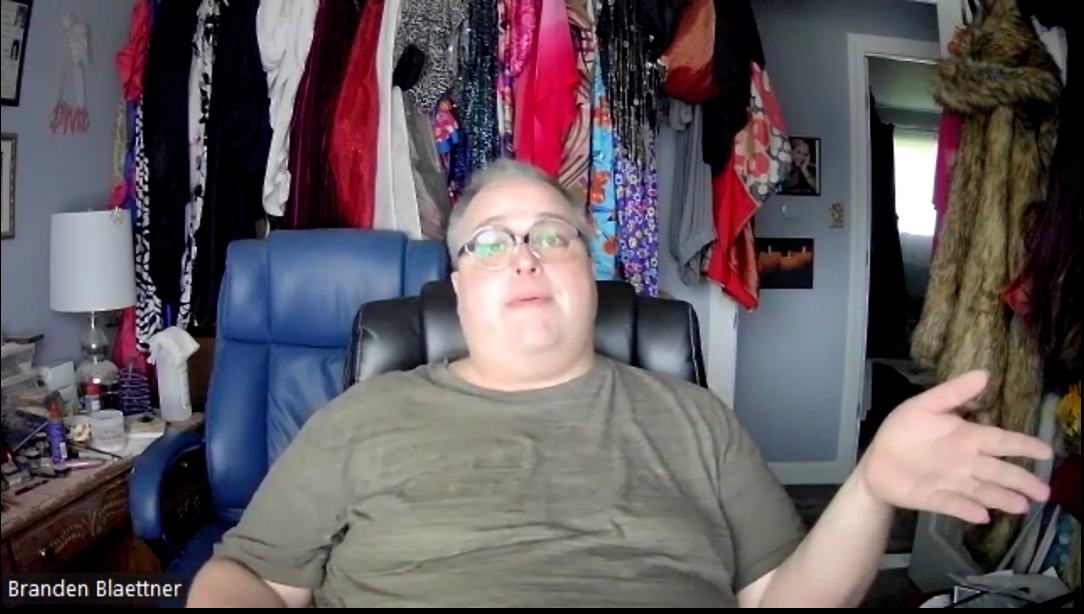
In a Facebook post Tuesday, a local drag personality announced he was running for the office of mayor once held by the late Fort Wayne Mayor Tom Henry, who died last month just a few months into his fifth term.
Henry was recently diagnosed with late-stage stomach cancer and experienced an emergency that landed him in hospice care. He died shortly after.
WPTA, a local television station, reported that Fort Wayne resident Branden Blaettne, whose drag name is Della Licious, confirmed he filed paperwork to be one of the candidates seeking to finish out the fifth term of the late mayor.
Blaettner, who is a community organizer, told WPTA he doesn’t want to “get Fort Wayne back on track,” but rather keep the momentum started by Henry going while giving a platform to the disenfranchised groups in the community. Blaettner said he doesn’t think his local fame as a drag queen will hold him back.
“It’s easy to have a platform when you wear platform heels,” Blaettner told WPTA. “The status quo has left a lot of people out in the cold — both figuratively and literally,” Blaettner added.
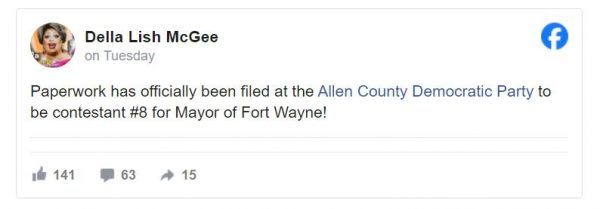
The Indiana Capital Chronicle reported that state Rep. Phil GiaQuinta, who has led the Indiana House Democratic caucus since 2018, has added his name to a growing list of Fort Wayne politicos who want to be the city’s next mayor. A caucus of precinct committee persons will choose the new mayor.
According to the Fort Wayne Journal Gazette, the deadline for residents to file candidacy was 10:30 a.m. on Wednesday. A town hall with the candidates is scheduled for 6 p.m. on Thursday at Franklin School Park. The caucus is set for 10:30 a.m. on April 20 at the Lincoln Financial Event Center at Parkview Field.
At least six candidates so far have announced they will run in the caucus. They include Branden Blaettne, GiaQuinta, City Councilwoman Michelle Chambers, City Councilwoman Sharon Tucker, former city- and county-council candidate Palermo Galindo, and 2023 Democratic primary mayoral candidate Jorge Fernandez.
Arizona
Ariz. governor vetoes anti-transgender, Ten Commandments bill
Katie Hobbs has pledged to reject anti-LGBTQ bills that reach her desk
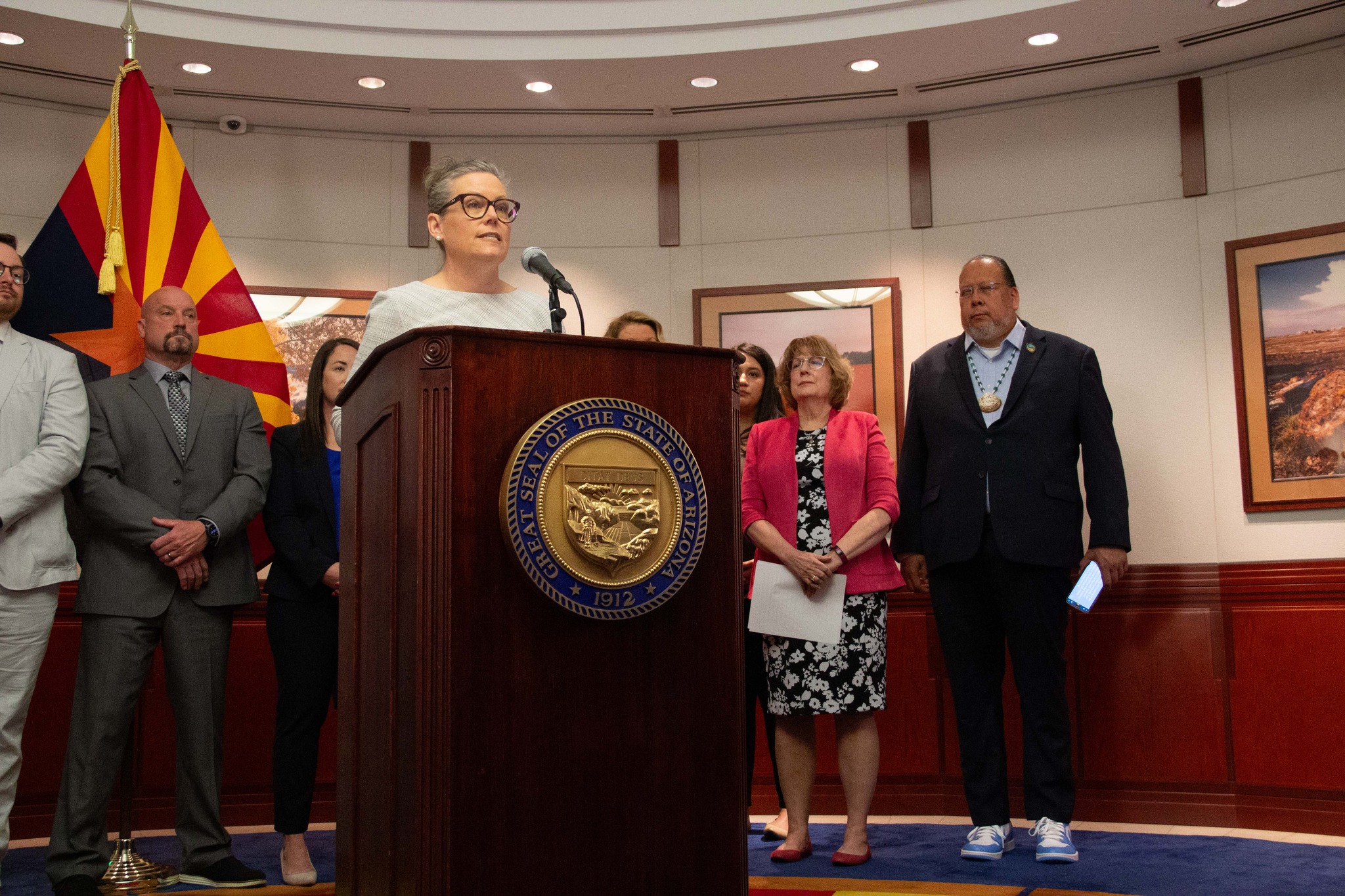

BY CAITLIN SIEVERS | A slew of Republican bills, including those that would have allowed discrimination against transgender people and would have given public school teachers a green light to post the Ten Commandments in their classrooms, were vetoed by Gov. Katie Hobbs on Tuesday.
Hobbs, who has made it clear that she’ll use her veto power on any bills that don’t have bipartisan support — and especially ones that discriminate against the LGBTQ community — vetoed 13 bills, bringing her count for this year to 42.
Republicans responded with obvious outrage to Hobbs’s veto of their “Arizona Women’s Bill of Rights,” which would have eliminated any mention of gender in state law, replacing it with a strict and inflexible definition of biological sex. The bill would have called for the separation of sports teams, locker rooms, bathrooms, and even domestic violence shelters and sexual assault crisis centers by biological sex, not gender identity, green-lighting discrimination against trans Arizonans.
“As I have said time and again, I will not sign legislation that attacks Arizonans,” Hobbs wrote in a brief letter explaining why she vetoed Senate Bill 1628.
The Arizona Senate Republicans’ response to the veto was filled with discriminatory language about trans people and accused them of merely pretending to be a gender different than they were assigned at birth.
“With the radical Left attempting to force upon society the notion that science doesn’t matter, and biological males can be considered females if they ‘feel’ like they are, Katie Hobbs and Democrats at the Arizona State Legislature are showing their irresponsible disregard for the safety and well-being of women and girls in our state by killing the Arizona Women’s Bill of Rights,” Senate Republicans wrote in a statement.
The Senate Republicans went on to accuse the Democrats who voted against the bill of endangering women.
“Instead of helping these confused boys and men, Democrats are only fueling the dysfunction by pretending biological sex doesn’t matter,” Senate President Warren Petersen said in the statement. “Our daughters, granddaughters, nieces, and neighbors are growing up in a dangerous time where they are living with an increased risk of being victimized in public bathrooms, showers, and locker rooms because Democrats are now welcoming biological males into what used to be traditionally safe, single-sex spaces.”
But trans advocates say, and at least one study has found, that there’s no evidence allowing trans people to use the bathroom that aligns with their identity makes those spaces less safe for everyone else who uses them.
In the statement, the bill’s sponsor, Sen. Sine Kerr (R-Buckeye), claimed that the bill would have stopped trans girls from competing in girls sports, something she said gives them an unfair advantage. But Republicans already passed a law to do just that in 2022, when Republican Gov. Doug Ducey was still in office, though that law is not currently being enforced amidst a court challenge filed by two trans athletes.
Republicans also clapped back at Hobbs’ veto of Senate Bill 1151, which would have allowed teachers or administrators to teach or post the Ten Commandments in public school classrooms, a measure that some Republicans even questioned as possibly unconstitutional.
In a statement, the bill’s sponsor, Sen. Anthony Kern (R-Glendale), accused Hobbs of “abandoning God” with her veto.
“As society increasingly strays away from God and the moral principles our nation was founded upon, Katie Hobbs is contributing to the cultural degradation within Arizona by vetoing legislation today that would have allowed public schools to include the Ten Commandments in classrooms,” Kern said in the statement.
In her veto letter, Hobbs said she questioned the constitutionality of the bill, and also called it unnecessary. During discussion of the bill in March, several critics pointed out that posting the Ten Commandments in public school classrooms, tenets of Judeo-Christian religions, might make children whose families practice other religions feel uncomfortable.
“Sadly, Katie Hobbs’ veto is a prime example of Democrats’ efforts to push state-sponsored atheism while robbing Arizona’s children of the opportunity to flourish with a healthy moral compass,” Kern said.
Another Republican proposal on Hobbs’s veto list was Senate Bill 1097, which would have made school board candidates declare a party affiliation. School board races in Arizona are currently nonpartisan.
“This bill will further the politicization and polarization of Arizona’s school district governing boards whose focus should remain on making the best decisions for students,” Hobbs wrote in her veto letter. “Partisan politics do not belong in Arizona’s schools.”
******************************************************************************************

Caitlin joined the Arizona Mirror in 2022 with almost 10 years of experience as a reporter and editor, holding local government leaders accountable from newsrooms across the West and Midwest. She’s won statewide awards in Nebraska, Indiana and Wisconsin for reporting, photography and commentary.
******************************************************************************************
The preceding piece was previously published by the Arizona Mirror and is republished with permission.
Amplifying the voices of Arizonans whose stories are unheard; shining a light on the relationships between people, power and policy; and holding public officials to account.
Arizona Mirror is part of States Newsroom, the nation’s largest state-focused nonprofit news organization.

Survey finds support for Biden among LGBTQ adults persists despite misgivings

Activists demand EU sanction Uganda over Anti-Homosexuality Act

Court records raise concerns about right-wing TikTok investor’s influence

New D.C. LGBTQ+ bar Crush set to open April 19

After 25 years, a forgotten queer classic reemerges in 4K glory

Congolese lawmaker introduces anti-homosexuality bill

Out in the World: LGBTQ news from Europe and Asia

Reenactment of first gay rights picket at White House set for April 17

Ugandan activists appeal ruling that upheld Anti-Homosexuality Act

Ariz. governor vetoes anti-transgender, Ten Commandments bill
-
 Africa4 days ago
Congolese lawmaker introduces anti-homosexuality bill
-
 World4 days ago
Out in the World: LGBTQ news from Europe and Asia
-
 District of Columbia3 days ago
Reenactment of first gay rights picket at White House set for April 17
-
 Africa3 days ago
Ugandan activists appeal ruling that upheld Anti-Homosexuality Act