District of Columbia
A brief history of D.C.’s High Heel Race
From police attacks to mayoral takeover

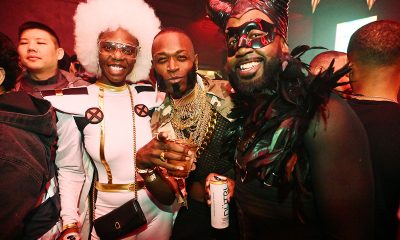
The Office of Mayor Muriel Bowser hosted the 39th annual High Heel Race on Tuesday, a drag tradition that began back on Halloween 1986.
LGBTQ+ Halloween celebrations often have rich local histories — from Florida’s Wicked Manors to New York City’s Greenwich Village Parade. For Washington, D.C., this is the High Heel Race. The tradition first began rather spontaneously at midnight on Halloween 1986. Just a year earlier, Annie’s Paramount Steakhouse relocated from its old location at 1519 17th Street to 1609 17th Street where it currently stands. JR.’s Bar & Grill, where the first High Heel Race took place, opened up in the old space at 1519 17th Street.

Billy Williams and Eric Little, two managers at JR.’s Bar, founded the race, inviting 25 drag queens to run from JR.’s Bar to Annie’s Upstairs Bar, take a shot of schnapps and then run back down the 15th stairs and down the street to JR.’s. The first race was won by Clinton Winter, receiving a congratulatory bottle of Champagne. Little first started as a staff member at JR.’s, before later managing the bar and purchased the bar in 1996. Unfortunately, Little passed away in May 2022.
The following year, 20 people participated, and the award shifted to a lucrative $100 cash prize, and by 1988, the award was a $100 cash prize and dinner for two at Annie’s Paramount Steakhouse. By 1991, Doug Hinckle reported for the Blade that “hundreds of people packed 17th St. Wednesday night to see the Fourth Annual High Heel Race sponsored by J.R.’s. There were enough contestants on hand, or on foot, to cause a shortage of size 14 and larger pumps in the metropolitan area.”

The tradition continued up until 1991 when JR.’s cancelled the event several months before Halloween after it received complaints from neighboring businesses and residents. But 500 people still showed up with the hope that the High Heel Race would go ahead, and in response, about a dozen police officers attacked revelers. In a large-scale police response involving a helicopter, seven attendees were injured, and four people were arrested.
“Two of the others who were arrested, D.C. residents Drew Banks and Dan Reichard, said they sustained injuries when police officers threw them to the ground at the time of their arrests. They said they plan to file brutality charges against the police officers,” Lou Chibbaro Jr. wrote for the Bladeon Nov. 8, 1991.“The already tense situation was worsened, activists said, when several police officers hurled anti-Gay epithets at members of the crowd.”
That night, Yayo Grassi had a video camera, planning to capture the costumes people wore to the celebrations. Instead, Grassi recorded the violence, and the footage was later released to new outlets by the Gay Men and Lesbian Opposed to Violence (GLOV) and Queer Nation. Despite Queer Nation’s call to host a protest on Nov. 8 after the violence, other LGBTQ+ organizations including GLOV disagreed, arguing that they and Queer Nation were planning to host a “Walk Without Fear March” to protest anti-gay violence in Washington, D.C. A police report about the violence was released in March 1992, and the police chief Isaac Fulwood apologized to the public and reprimanded the captains who were responsible on duty that night.
As the Blade published on Dec. 27, “activists called for the dismissal of D.C. police officials who called for the use of force to disperse Gays who assembled on Halloween night to watch an annual high heel race at 17th and Q streets, N.W. Several dozen officers wearing helmets and nightsticks waded into the peaceful crowd.”
Despite the violence, or maybe in response to it, the 1992 race was even bigger, drawing more than 60 drag queens to compete in the race and 8,000 spectators. Sponsored by Whitman-Walker Clinic, the event included a live stage, a costume contest and a drag show, food vendors, and even carnival games. Lovingly dubbed “Street Scream 92,” the event also served as a fundraiser for the Whitman-Walker Clinic, a leader in HIV care since the epidemic started. Following the violence the previous year, the event organizers obtained a permit to officially close 17th Street to traffic and agreed that events would end and people would leave by 11 p.m.
“Both Gays and non-Gays living in the neighborhood turned out for this year’s race,” Chibbaro Jr. wrote in the Bladein 1992, “Many people brought their children, who could be seen sitting on a parent’s shoulders to peer at the runners, over the heads of the crowd.”
The following year, the race took place somewhere new — inside the Old Post Office Pavilion as a benefit masquerade ball for Food and Friends, a Washington, D.C.-based nonprofit organization founded in 1988 that provided free, home-delivered and medically tailored meals and groceries to people living with HIV/AIDS, cancer, diabetes, and other chronic, serious illnesses.
In 1997, the race shifted from Halloween night to the Tuesday before the holiday in order to prevent traffic and potentially reduce intoxication. This is the first year that JR.’s does not sponsor the event, largely in response to complaints from a local condominium complex about damage to landscaping, trash that was left behind by attendees, and difficulty accessing their building. Planners suggested shifting the event farther north to relieve pressure around the residential area but complaints from local residents persist to this day. No history of the race would be complete without acknowledging the contributions of Dave Perruzza who organized it for 26 years while he managed JR.’s. He gave up the role when he opened his own bars, Pitchers and A League Of Her Own.
In 2001, long-time DMV resident Cheryl Ann Spector wrote into the Bladereminiscing on how much the festivities have changed since that fateful 1991 night. “I love our queer community and our supporters,” she wrote. “Just think: It’s a decade later, and the police on the scene were waving American flags, riding their bikes, enjoying the night and not wearing riot gear. It felt like Pride in October.”
Washington local Mary I. Woodell agreed, citing the importance of the High Heel Race in the aftermath of the 9/11 attacks just over a month earlier: “This year’s race organizers and participants performed a real — and to me, important — public service. They produced a night-long block party that brought us out to dance in the streets; an occasion to laugh and make fools of ourselves and enjoy the world. They proved that festivity is an antidote — a powerful act of benign defiance. Please accept my sincere thanks.”
Ever since, crowds attending the High Heel Races have continued to grow, with some drawing people from across the country and even the world. By 2002, the annual High Heel Race continued to grow, bringing in between 2,000-3,000 people, and in 2018, Mayor Muriel Bowser officially proclaimed the race a mayoral event. Last year, the High Heel Race brought thousands of spectators to Washington, D.C. This year’s race route was markedly different from last year (P Street to S Street), now stretching from R Street to Church Street.
This year, the Mayor’s Office for LGBTQ+ Affairs announced that a new mural will be created at JR.’s Bar & Grill, honoring the history of the race. “Since 1986, the High Heel Race has been crossing the line—and making history,” said Japer Bowles, director of the Mayor’s Office of LGBTQ Affairs. “This year’s mural will help ensure that the stories and spirit of this incredible tradition remain part of the District’s LGBTQIA+ history for generations to come.”
Along with celebrating Washington, D.C.’s unique LGBTQ+ history, the return of the High Heel Race to 17th Street recognizes its roots and the gay and gay-friendly businesses that first welcomed revelers and runners alike. To this day, Annie’s Paramount Steakhouse and JR.’s Bar & Grill remain vital LGBTQ+ meeting spots, with the former serving as one of the longest, continually operated gay-friendly restaurants in the D.C. area since 1948.


District of Columbia
Lewis George appoints gay former White House official to mayoral transition team
Gautam Raghavan directed Office of Presidential Personnel during Biden-Harris administration

D.C. Mayor-elect Janeese Lewis George has named Gautam Raghavan, an openly gay former White House official under the administrations of Presidents Barack Obama and Joe Biden as one of five co-chairs for her mayoral transition team.
On the day following the Nov. 3 D.C. general election, in which Lewis George won election as mayor by a wide margin, she announced her transition team co-chairs and her transition director, including Raghavan, who served, among other roles, as director of the White House Office of Presidential Personnel under the Biden-Harris administration.
“My transition team is rooted in D.C. and will work tirelessly to ensure we have a successful transition,” Lewis George said in a Nov. 4 statement. “They also understand the inner workings of government and will help me bring talented individuals who are ready to execute our plans to make D.C. safer, more affordable, and accountable to residents in all eight wards,” the statement says.
In addition to Raghavan, the other transition team co-chairs named by Lewis George include Aaron Jenkins, a former Obama administration official; Beatriz “BB” Otero, who served as deputy mayor for Health and Human Services under former D.C. Mayor Vincent Gray; Greg Akerman, president of the Baltimore-D.C. Metro Building Trades Council; and Kimberly Perry, director of D.C. Action, a nonprofit organization focused on youth and families.
The announcement says the transition team will be directed by Jennifer Levy, a Lewis Geroge campaign advisor and former deputy attorney general in the office of the New York State Attorney General.
At a news conference announcing her transition team on Wednesday, Lewis Geroge mentioned Raghavan and his husband.
Raghavan’s LinkedIn page shows he worked in the Biden-Harris administration as Assistant to the President & Director of the White House Office of Presidential Personnel from Jan. 2022 to Jan. 2025. It shows he served as Deputy Director of Presidential Personnel from Jan. 2021, when Biden first took office, to Jan. 2022.
He worked in the Obama administration as Associate Director of Public Engagement in the Executive Office of the President from Oct. 2011 to Sept. 2014, where, among other things, he served as liaison to both the LGBT and Asian American and Pacific Islander American communities.
His LinkedIn page shows he currently works as a partner with the global executive talent search firm True Search as the Washington, D.C. representative for its Nonprofit & Social Impact Practice.
“I love Washington, D.C,” he states on his LinkedIn page. “More than two decades ago I came here to change the world – and along the way, I found my community, met my husband, and started a family.”
He adds, “That’s why I’m so honored to serve as a Transition Co-Chair for our dynamic and brilliant new Mayor-elect Janeese Lewis George, working closely with my fellow Co-Chairs.”
District of Columbia
Janeese Lewis George wins race for D.C. mayor by wide margin
Incumbent gay Council member, bi candidate also victorious

D.C. Council member Janeese Lewis George (D-Ward 4), who has expressed strong support for LGBTQ related issues, emerged as the expected winner in the city’s Nov. 3 mayoral election, capturing 84.3 percent of the votes that had been counted as of late Tuesday night in a three-candidate race.
Although the D.C. Board of Elections announced it had not completed its vote counting as of 11:26 p.m. on election night and would resume its vote counting on Wednesday morning, the Associated Press projected Lewis George as the clear winner.
The vote count as of Tuesday night showed independent mayoral candidate Rhonda Hamilton receiving 10.06 percent of the vote and Statehood Green Party candidate Robert Gross receiving 6.29 percent, with one or more write-in candidates receiving 3.67 percent,
Several hundred people turned out for Lewis George’s election night victory party held at the Sycamore & Oak event hall in the Congress Heights section of Southeast D.C., where Lewis George gave a rousing speech thanking her supporters and highlighting her campaign proposals, among other things, to make the city more affordable.

Among those who also spoke at the event was Stevie McCarty, president of the D.C. LGBTQ political group Capital Stonewall Democrats, which endorsed Lewis George for mayor. McCarty noted that at the invitation of the D.C. Democratic Party and the Lewis George campaign, Capital Stonewall Democrats was among the co-sponsors of the election night event.
Among the other D.C. election races, gay D.C. Council member Zachary Parker (D-Ward 5) and Ward 1 D.C. Council candidate Aparna Raj (D), who identifies as bisexual, won their respective races by a wide margin. Parker received 89.8 percent of the vote in a three-candidate race and Raj received 86.3 percent in a four-candidate race.
Raj’s Republican opponent, Jet James Jasper, who received 5.17 percent of the vote, had been endorsed by the LGBTQ group Log Cabin Republicans of D.C., according to local gay GOP activist Chris Allen.
Parker and Raj’s victories will mark the first time since 2014 that two LGBTQ members have served on the D.C. Council. Gay D.C. Council member Jim Graham (D-Ward 1) lost his race for re-election in 2014. And fellow gay Council member David Catania (I-At-Large) gave up his Council seat to run for mayor in 2014 and lost that race to Mayor Muriel Bowser.
In the race for the non-voting D.C. delegate to the U.S. House of Representatives, former D.C. Council member Robert White (D-At-Large), a longtime LGBTQ rights supporter, won decisively with 87.2 percent of the vote in a three-candidate race. Republican candidate Denise Rosado received 6.4 percent and Statehood Green Party candidate Kimone Freeman received 5.6 percent.
White, who will replace longtime D.C. Del. Eleanor Holmes Norton (D) and who received the endorsement of Capital Stonewall Democrats, has pledged to speak out forcefully in support of LGBTQ rights in the U.S. House.
In the race for D.C. Council Chair, incumbent Phil Mendelson (D), also a longtime LGBTQ rights supporter, received 92.7 percent of the vote against Republican challenger Abi-Ananiah Prudent, who received 6.09 percent.
In the At-Large D.C. Council race, in which two At-Large seats were up for election and for which the two candidates receiving the highest two vote counts are declared the winner, LGBTQ supportive candidate Oye Owolewe, a Democrat, received 69.7 percent of the vote. Incumbent Elisa Silverman, an independent, finished in second place with 20.4 percent. Both are expected to be declared winners when the final vote count comes in..
Two other candidates competed for the At-Large seat. Republican Darrell Green received 5.9 percent and Statehood Green Party candidate Darryl Moch received 3.3 percent.
Under the city’s home rule charter approved by Congress, one of the two At-Large seats up for election this year must be held by a non-majority party candidate, meaning a non-Democrat, with that seat being held by Silverman.
In the Ward 3 D.C. Council race, incumbent Matthew Frumin (D), an outspoken LGBTQ rights supporter, ran unopposed, receiving 96.2 percent of the vote, with 3.7 percent going to one or more write-in candidates. He was endorsed by Capital Stonewall Democrats.
In the Ward 6 D.C. Council race, incumbent Charles Allen (D), also a longtime LGBTQ rights supporter who was endorsed by Capital Stonewall Democrats, received 88.9 percent of the vote against Republican challenger Jorge Rice, who received 10.5 percent.
In the race for D.C. Attorney General, incumbent Democrat Brian Schwalb, also an LGBTQ rights supporter who was endorsed by Capital Stonewall Democrats, received 92.3 percent of the vote against Republican challenger Manuel Rivera, who received 6.9 percent. According to gay Republican activist Allen, Rivera was also endorsed by D.C. Log Cabin Republicans.
In the race for D.C.’s shadow U.S. Senator, which has no congressional powers and has been used to lobby Congress for D.C. congressional representation, incumbent Democrat Paul Strauss, who has expressed support for LGBTQ rights issues, received 92.7 percent of the vote against Republican challenger Robert Simmons, who received 6.7 percent of the vote.
Regarding the race for shadow representative to the U.S. House of Representatives, Democratic candidate Franklin Garcia, also an LGBTQ rights supporter, received 93 percent of the vote against Republican challenger Ciprian Ivanof, who received 5.9 percent.
Candidates for the D.C. State Board of Education, which are nonpartisan positions under D.C.’s election law, were running this year in Wards 1, 3, 5, and 6.
Their positions on LGBTQ related issues couldn’t immediately be determined, but Capital Stonewall Democrats endorsed two of the candidates, Ben Williams of Ward 1, who was unopposed and won the race; and Lynn Jennings of Ward 5, who received 76.6 percent of the vote against opponent Jon Alforth, who received 22.3 percent.
Out of 45 known LGBTQ candidates running for D.C. Advisory Neighborhood Commission seats in ANC single member districts throughout the city, 30 appear to have won. But with several of the LGBTQ candidates ahead by a small number of votes, the outcome in those races could change when the final vote count is completed. The Blade will update the outcome of the ANC races in a separate report.
District of Columbia
Former Blade publisher Lynne Brown named LGBTQ Community Pioneer
Rainbow History Project to induct honorees at Nov. 8 ceremony

D.C.’s Rainbow History Project has named former Washington Blade publisher Lynne Brown as a 2026 LGBTQ Community Pioneer, a role the group says recognizes “instrumental” contributions to the D.C. LGBTQ community.
A statement released by Rainbow History Project says Brown will be among 16 local LGBTQ community members to be officially inducted as a Community Pioneer at a Nov. 8 ceremony to be held at the Heurich House Museum in Dupont Circle.
Brown, who joined the Blade staff in 1987 as senior sales executive and became the Blade’s publisher in 2007, assumed the role of publisher emerita in June of this year after retiring from her day-to-day duties while remaining a part owner.
Brown played a lead role in the Blade’s growth and evolution as the nation’s most prominent LGBTQ newspaper, including its launch of sister publication the Los Angeles Blade.
“These pioneers were instrumental in the creation of many of the safe spaces and institutions we have today,” Rainbow History Project says in its statement announcing the 2026 Pioneers. “Their contributions were incredibly varied – they labored in the political, health and social services, social, cultural, and journalistic arenas – but in each case they made the D.C. metropolitan area a better place for LGBT people to live.”
The statement notes that prior to its recognition of the 16 Pioneers on Nov. 8, Rainbow History Project has recognized 91 other Pioneers since it began these honors 26 years ago.
Among those named as 2026 Pioneers is former Washington Blade editor Lisa Keen.
Rainbow History Project released these names as its newly selected 2026 Community Pioneers:
• Lynne Brown
• Robert Mitchell (Judge) Coggin
• Christopher Dyer
• Clint Hockenberry
• Ernest Hopkins
• Joseph Izzo
• Dr. Barbara Kannapell
• Lisa Keen
• Freddie Lutz
• Ray Melrose
• Leigh Mosley
• Nicolas Shi and Frank Blackburn
• Michael Singerman
• Savannah Wanzer
• Courtney Williams

Out actor on his 25-year love affair with ‘Mamma Mia’

Comings & Goings

Stephen Miller, key architect of anti-LGBTQ policies, named White House chief of staff

Escritora trans venezolana reivindica una fe sin exclusiones ante la visita del papa a Sudamérica

Baltimore lawmaker’s ex-treasurer charged with theft of $87K in campaign cash

Meet the talented makeup artist behind Broadway’s ‘Rocky Horror’

Sarah McBride returns to Congress after historic first term

Chris Pappas elected to U.S. Senate

Election watch parties to take place throughout DMV

Supreme Court weighs religious exemptions to LGBTQ nondiscrimination protections in Colo. preschool case
-

 a&e features5 days ago
Meet the talented makeup artist behind Broadway’s ‘Rocky Horror’
-
2026 Midterm Elections4 days ago
Sarah McBride returns to Congress after historic first term
-
2026 Midterm Elections4 days ago
Chris Pappas elected to U.S. Senate
-
Local5 days ago
Election watch parties to take place throughout DMV