Arts & Entertainment
Snapshots from the stage
Set of eight mini-plays explore black gay experience


Actors Reginald Richard, left, and Tristan Phillip Hewitt in ‘New and/or Slightly Used,’ a reading slated for two performances Sunday. (Photo by Emile Benjamin; courtesy of ACT)
‘New and/or Slightly Used’
Sunday at 5 and 8 p.m.
Warehouse Theater
645 New York Ave., NW
202-745-3662
alansharpe.org
Two lives can be significantly changed — for better or worse — by one fleeting but momentous encounter. That’s the thematic thread running through “New and/or Slightly Used,” a collection of eight short plays about black gay, bi and questioning men here in Washington.
In celebration of D.C. Black Pride Weekend, the African-American Collective Theater (ACT) is presenting the work as a staged reading for one night only with two performances on Sunday.
Written and directed by ACT’s Artistic Director Alan Sharpe, the 10-minute-long mini-plays thoughtfully explore instances of love, lust and longing as experienced by a cross section of men ranging from hustlers to husbands.
“The plays run the gamut in terms of characters and situations,” Sharpe says. “Some characters are self-identified as gay, some are in relationships with both men and women and some are straight. It’s kind of a salad.”
“The cast is a mix too,” Sharpe says. “We have gay actors playing straight characters and vice versa. And because it’s a staged reading, there’s very little in terms of set, so I tried to pick a gorgeous cast so the audience will have a something to look at. We’re competing with a lot on gay pride day.”
In “Kickin’ It,” young out actor Tristan Phillip Hewitt plays Dante, a straight cocky high school jock who’s unaware that his buddy has feelings for him. When hot weather prompts the friends to trade basketball for a racier indoor game, it means something different to each boy.
“For me,” says Hewitt, a 21-year-old native Washingtonian who says he’s too tall to be confined to any closet, “this show gives me the experience to be someone else for 10 minutes. In reality I’m no good at basketball. I may have the body of an athlete, but I’m not one. I get to play a jock whose personality is nothing like mine.”
On the other hand, out actor Reginald Richard who plays 30-something Eric in “All Over Him,” says he is very similar to his gay character. “When I first read the play it was as if I was seeing my life story written on the page. Like Eric, I’ve been hurt by someone who wasn’t as much in love with me as I was with him. You have that awkward moment when you see them and you’re not sure what to do. As Eric, I have a chance to unload and achieve closure.”
“Sharpe’s writing is refreshingly realistic and natural,” Richard says. “It’s not stereotypical gay humor. He writes honestly about a very diverse community.”
Originally from Memphis, Tenn., Richard has been in D.C. for 10 years and has been acting for the last four. His experiences with ACT have led him to consider acting as a career. “If I want to be with the best I have to learn with the best, so I put myself in school [at the National Conservatory of Dramatic Arts]. It’s very challenging, but I’m always up for a challenge.”
With Sharpe at the helm, ACT has been commemorating Black Pride with LGBT-centric theater for 15 years. “When we first started, there were not a lot of vehicles where black and gay lesbians could see themselves on stage, and they were thirsty for that. The response was so great that it completely altered my artistic focus. I discovered a niche that no else was filling.”
ACT’s mission is to showcase contemporary black gay and lesbian life and culture, promote visibility and raise awareness of issues faced in the African-American community.
“By increasing visibility,” Sharpe says, “We strive to demonstrate to people that regardless of race class and gender we have similar experiences. Everyone has been disappointed. Everyone has fallen in love and had their heart broken. The human experience is very universal.”
Cast member Hewitt concurs: “Be prepared to find a piece of yourself in one of these plays.”



Theater
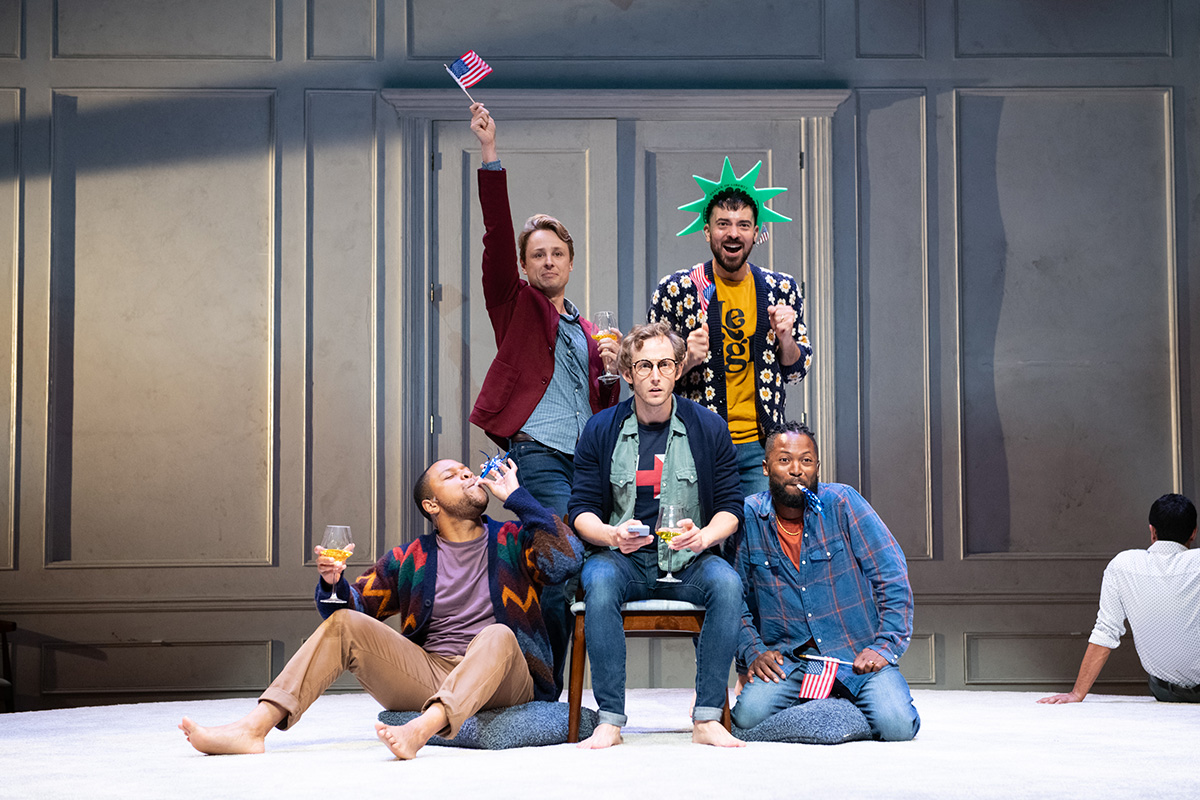
‘The Inheritance’ is most-nominated at this year’s Helen Hayes Awards
42nd annual celebration of excellence in local theater set for May 18
Helen Hayes Awards 2026
May 18, 2026
For tickets go to theatrewashington.org
Last year, when out director Tom Story took on the daunting task of directing Round House Theatre’s production of “The Inheritance, Parts One and Two,” he knew that casting would be important, maybe even paramount, to the endeavor’s success. So, Story didn’t mess around.
Penned by queer playwright Matthew López, “The Inheritance” (inspired by E.M. Forster’s 1910 novel “Howards End”) is based on gay culture in the wake of the AIDS crisis.
Story looked at actors he knew, and some he didn’t. He wanted low drama and maybe players who could relate to the LGBTQ experience. In the end, the production’s 13-person cast was entirely queer except for brilliant local favorite Nancy Robinette as Margaret, the wise housekeeper.
Clearly, Story’s vision resonated with audiences. Round House’s production of “The Inheritance” is the most-nominated work of this year’s Helen Hayes Awards, earning 14 nominations. It’s also one of Round House’s highest grossing popular successes ever.
The queer cast members whose ages ranged from about 22 to 60, worked hard and enjoyed the process, and along the way garnered an Outstanding Ensemble in a Play (Hayes) nomination for their efforts.
The ensemble included Jamar Jones as Tristan, a brilliant doctor who leaves New York for Canada after deciding there’s no place for a gay, HIV-positive Black man in America. For the experienced actor, being part of “The Inheritance” was profound: “I think it was a divinely orchestrated production.”
He adds “I really feel that it’s so rare that you get to work on a show of that magnitude…size, time, where virtual strangers genuinely fell into rhythm. We became a cohort. I never felt a sense of unease, or reluctance to try things. I could be as big or bold as I wanted to be; or I could be small. Fail, mess up, try again. I didn’t feel judged.”
Jones considers Richmond his home, but says “I’m based where the work is.” Currently, he’s back at Round House rehearsing “Sally & Tom” (May 27-June28), a play within a play/meta exploration of the relationship between Thomas Jefferson and Sally Hemings by Suzan-Lori Parks.
Jones plays both a contemporary violinist and an enslaved fiddler, parts that have required him to learn to “air fiddle.” He’s all over it: “I want to represent the art and to be as precise as possible. Taught by an instructor, I’ve made strides with movement of the bow; next up is finger placement.”
Will he leave the play a violinist? “I’ll report back on closing night. Maybe I will have added something to the special skills list on my resume.”
For about a decade, Jones worked in living history, interpreting, performing, and writing pieces about the enslaved people of Colonial Virginia. Among the many historical characters he portrayed was Jupiter (Thomas Jefferson’s longtime enslaved manservant), an experience that’s proved a connection and preparation for his current role.
The 42nd Helen Hayes Awards celebration recognizing excellence in professional theater in the DMV will be held on Monday, May 18, 2026 at The Anthem on the District Wharf in Washington, D.C. Named for Helen Hayes, the legendary first lady of Broadway, the program consists of the awards presentation hosted by Felicia Curry, Awa Sal Secka, and Derrick Truby, followed by an after-party at nearby Whitlow’s.
With works selected from 149 eligible productions presented in the 2025 calendar year, nominations were made in 41 categories and grouped as either “Helen” (non-Equity/small Equity presence) or “Hayes” (Equity-heavy).
The many nominations are the result of 49 vetted judges considering 1,997 pieces of work, such as design, direction, choreography, performances, and more. The productions under consideration included 42 musicals, 107 plays, and 33 world premieres.
The following are more of this year’s queer nominees.
A past Helen Hayes Award recipient and nominee, Fran Tapia is competing against herself this year in the Outstanding Lead Performer in a Musical (Helen) category. Nominated for her memorable turn as the diva barkeep in GALA Theatre’s “Columbia Heights Bolero Bar,” an immersive musical centered on songs of longing and immigration set in a diverse neighborhood on the eve of a divisive presidential election
“It was a challenging time, because a lot of what was happening in the show was happening in the neighborhood,” says Tapia who lives in Columbia Heights just eight minutes from GALA.
Based in D.C. since 2019, Tapia says “Being recognized in a country that is not my homeland but where I’m building my artistic home, is deeply meaningful. And the variety of roles I have been able to play speaks to the richness of DC theater and the collaborators who trusted me with these roles.”
Her other individual nomination is for the title role in Spooky Action Theater’s “Professor Woland’s Black Magic Rock Show,” a passionately comedic political satire. She approached the mysterious central character as nonbinary.
Tapia (“Chilean, Latina, queer and proud immigrant”) says while very different, both performances involved particularly strong characters. She’s grateful audiences responded positively to her work.
Stanley Bahorek, who moved to D.C. with his husband four years ago, is best known as an accomplished actor with a long list of Broadway and regional credits (including playing Carl, the gay son in Studio Theatre’s recent production of “The Mother Play”). Now, he is nominated for Outstanding Music Direction (Helen) for his work on “A Strange Loop,” a production of D.C.’s Visionaries of the Creative Arts (VOCA) in collaboration with Deaf Austin Theatre. He shares this nomination with Walter “Bobby” McCoy.
Michael R. Jackson’s Tony and Pulitzer wining play “A Strange Loop,” is the story of Usher, a Black, queer theater usher trying to write a musical. VOCA’s take on the work is seen through a deaf BIPOC lens with a deaf Usher played by a deaf actor (out actor Gabriel Silva). Invited by director and longtime friend Alexandria Wailes (who is deaf), Bahorek (who is hearing) joined the creative team as a sort of hybrid associate director/ music supervisor.
“I’m fluent in conversational American Sign Language (ASL),” he says. “I sort of functioned as a sherpa between the hearing and deaf and hard-of-hearing creatives. It’s been a great thrill to be a part of VOCA’s biggest production to date.”
If he and McCoy take home the prize, who makes the acceptance speech? Bahorek takes a beat before replying “That’s something we still need to talk about. And soon.”
A full list of award recipients will be available at theatrewashington.org on Tuesday, May 19, 2026.

Anthony Oakes will host “DC Black Pride Comedy Show” on Thursday, May 21 at 7 p.m.
Oakes will workshop his new hour about addiction, incarceration, recovery, and redemption with special guests.
This event will be hosted by the hilarious Apple Brown Betty with TJ So Silly, Howl Cooper, and featuring Patrice Deveaux. DJ Art.is will be spinning on the 1’s & 2’s. Libations will be provided by Drink Alchy. Images by RGF ENT. Tickets are $28.52 and can be purchased on Eventbrite.
Out & About
United Night Out set for Saturday
Team DC hosts evening of soccer, Pride, music, drag and community

On Saturday, May 16, Team DC is taking over Audi Field for United Night OUT as D.C. United faces St. Louis SC.
Come out for an evening of soccer, Pride, music, drag, and community. The night kicks off with pre-game fun featuring DC Different Drummers, DJ Heat, and a Pride Night OUT Party at the Heineken Rooftop. Then get ready for a 7:30 p.m. match, including the National Anthem sung by Dana Nearing and a halftime drag performance.
After the match, the celebration continues at the Post-Game Rooftop Party with DJ Heat and the After Party at Dacha Navy Yard. Game tickets and after party tickets are available now through Zeffy. After party tickets are $20 and include one drink.

‘The Inheritance’ is most-nominated at this year’s Helen Hayes Awards

HIV Vaccine Awareness Day set for May 18

DC Black Pride is around the corner

United Night Out set for Saturday

Calendar: May 15-21

America’s broken pipeline of mental healthcare for trans youth

Senate Democrats press DOJ over anti-trans prison directives

Anti-LGBTQ violence prevention efforts highlighted at D.C. community fair

Celebrated performer Rose Levine plays Rehoboth on May 15

Washington Blade’s Pride on the Pier returns June 13 to kick off D.C. Pride week
-

 National4 days ago
America’s broken pipeline of mental healthcare for trans youth
-
Federal Government5 days ago
Senate Democrats press DOJ over anti-trans prison directives
-
District of Columbia5 days ago
Anti-LGBTQ violence prevention efforts highlighted at D.C. community fair
-
Rehoboth Beach5 days ago
Celebrated performer Rose Levine plays Rehoboth on May 15