Sports
10 questions for Rennae Stubbs
Tennis legend reflects on record-busting season

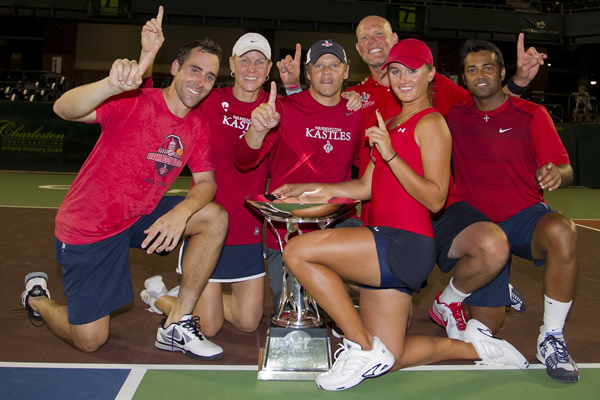
From left, Bobby Reynolds, Rennae Stubbs, Owner Mark Ein, Coach Murphy Jensen, Arina Rodionova and Leander Paes. (Photo courtesy the Kastles)
Last month the Washington Kastles won the World Team Tennis (WTT) championships and capped off a perfect 16-0 season which included 14 wins in the regular season. This was the first time since the league began in 1974 that a team has completed an undefeated season and gone on to win the championships.
The bulk of the workload rested on the shoulders of Arina Rodionova, Leander Paes, Bobby Reynolds and Rennae Stubbs with an assist by Venus and Serena Williams. With the new Kastles Stadium at The Wharf and multiple sellout home matches, the season was truly magical.
After the dust settled, Coach Murphy Jensen was named WTT 2011 Coach of the Year, Leander Paes was named WTT 2011 Male MVP and Arina Rodionova was named WTT 2011 Female Rookie of the Year.
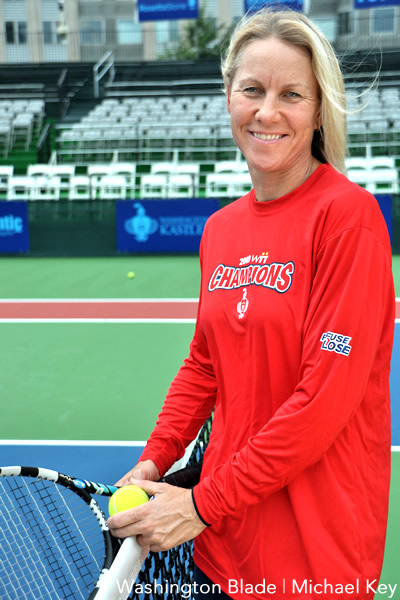
The final home match of the season was also Night Out with the Kastles for the LGBT community. Kastles stalwart and LGBT sports hero Rennae Stubbs, a lesbian, sat down to reflect on the winning season.
BLADE: The media has assigned nicknames for the four mainstays of the team. Rodionova is Hot Rod. Paes is Scissorhands. Reynolds is The Closer. I have heard them refer to you as Stubbsy. Do you have a favorite nickname for yourself?
STUBBS: I had not heard of Leander being called Scissorhands, I think Magician is probably more appropriate and as for me, Stubbsy has been my nickname for as long as I can remember, so I will stick with it.
BLADE: Coach Murphy Jensen seems to embody the perfect mix of leadership, motivation and fun. What’s it like to play tennis for him?
STUBBS: Murphy was and is the perfect combination of all those things. With an experienced team like Leander, myself and Bobby, there isn’t too much tennis instruction or experience he needs to push on us, more just keeping us positive in tough moments and keeping us laughing. With Arina it was a matter of him keeping her positive and feeling good.
BLADE: I love the camaraderie of the players on the court in World Team Tennis. It’s like your entourage is out there with you. That must be a great change of pace from the WTA tour. Do you love it?
STUBBS: I do love it. I have always loved being on a team and team tennis with it’s balance and equality make it the perfect team environment. Our team camaraderie was the reason behind our success this year. We always supported each other. There were nights when one of us might have had a rough set and we would always say, ‘Hey I got your back tonight,’ and we always did. We cared for one another and our team owner Mark Ein kept stressing to us, keep supporting each other. We even started to get together in huddles in the middle of matches and end of matches and motivate each other. Saying things like, ‘Everyone keep taking care of your own business and no matter what we support each other to the end.’ It was such a nice feeling in the end to continually support and motivate one another and get the job done. I was so proud of us.
BLADE: Do you get to enjoy the sights and sounds of D.C. when the Kastles are in town, or is it all business?
STUBBS: Unfortunately there isn’t a lot of down time, but one Sunday I had off and I did as much site seeing as possible. I absolutely love the city, its architecture and parks are so beautiful. I tell all my friends, it’s a must on the list of cities to see, truly a favorite.
BLADE: You and Leander Paes are two of the greatest doubles players of all time. Did you play together before partnering for the Kastles?
STUBBS: Only once. It was back a few years ago at Wimbledon. We lost in the first round, but it was a close match and it was a really tough draw. Most other times we have had regular partners and plus he wins without me.
BLADE: You have competed for Australia in four consecutive Olympics. Are you gunning for a berth in 2012 in London?
STUBBS: I will never say never, but that is a long way away and I just can’t see myself going for another full year of the tour. It would be amazing to play an Olympics at Wimbledon, I won’t lie, but like I said, that’s seems like an eternity to me right now.
BLADE: You picked up the microphone and gave a heartfelt thanks to the fans at the Kastles season finale. Did the new stadium and the sellout crowds motivate you or add to the pressure?
STUBBS: Oh it motivated me for sure and I know the rest of the team felt the same way. The work that Mark Ein and his staff did to get that great new stadium up and running every night was amazing. Also the fans were the reason we won most of those matches this year, especially the tough ones. We have the best fans in the league and to not thank them after the season we had, would not have felt right, especially after going 14-0. I wanted to let everyone know how much we appreciated their support all season and I promised them we would bring the title back to D.C.
BLADE: Was there a doubles team this year in WTT that rattled your cage?
STUBBS: Not really. I am want to beat everyone I play and contribute as much as possible to the end score for our team. There might be a team or two that motivates a little more, but overall, a win’s a win. The most nervous I was all season was when the first lady Michelle Obama and her kids came. I was really motivated that night to play well, I won’t lie. And they were so into it, it was great and they could not have been nicer. Only in D.C.
BLADE: At the regular season finale at Kastles Stadium against the Philadelphia Freedoms, the heat index was 115 degrees. What do you think it smelled like inside of Topspin and Slice’s mascot uniforms?
STUBBS: Oh gross! We all kept saying, ‘Oh Topspin and Slice must being dying, we better keep an eye on them, in case they start fainting.’ Troopers.
BLADE: Will you be back in 2012?
STUBBS: I would love to come back, but that’s again an eternity for me and I can’t say if I will be playing. I think it might be the perfect way to exit into WTT retirement, but we will see. But I can guarantee you, no matter in what capacity, I will be back to D.C. and the Kastles whenever I can. Maybe we can get a visit to the White House. Thank for all the community support. I love you guys.

Egypt
Iran, Egypt object to playing in Seattle World Cup ‘Pride Match’
Game to take place on June 26
Iran and Egypt have objected to playing in a “Pride Match” that will take place in Seattle during the 2026 World Cup.
The Egyptian Football Association on Tuesday said it told FIFA Secretary General Mattias Grafström in a letter that “it categorically rejects holding any activities related to supporting (homosexuality) during the match between the Egyptian national team and Iran, scheduled to be held in Seattle, USA, on June 26, 2026, in the third round of the group stage of the 2026 World Cup.” Football Federation Islamic Republic of Iran President Mehdi Taj told ISNA, a semi-official Iranian news agency that both his country and Egypt “protested this issue.”
The 2026 World Cup will take place in the U.S., Canada, and Mexico. The draw took place at the Kennedy Center on Dec. 5.
Iran is among the handful of countries in which consensual same-sex sexual relations remain punishable by death.
The State Department’s 2023 human rights report notes that while Egyptian law “did not explicitly criminalize consensual same-sex sexual activity, authorities regularly arrested and prosecuted LGBTQI+ persons on charges including ‘debauchery,’ prostitution, and ‘violating family values.’” Egyptian authorities “also reportedly prosecuted LGBTQI+ individuals for ‘misuse of social media.’”
“This resulted in de facto criminalization of same-sex conduct and identity,” notes the report.
The 2024 human rights report the State Department released earlier this year did not include LGBTQ-specific references.
Soccer has ‘unique power to unite people across borders, cultures, and beliefs’
The June 26 match between Iran and Egypt coincides with Seattle Pride. The Washington Post reported the Seattle FIFA World Cup 2026 Local Organizing Committee decided to hold the “Pride Match” before last week’s draw.
“As the Local Organizing Committee, SeattleFWC26’s role is to prepare our city to host the matches and manage the city experience outside of Seattle Stadium,” said SeattleFWC26 Vice President of Communications Hana Tadesse in a statement the committee sent to the Washington Blade on Wednesday. “SeattleFWC26 is moving forward as planned with our community programming outside the stadium during Pride weekend and throughout the tournament, partnering with LGBTQ+ leaders, artists, and business owners to elevate existing Pride celebrations across Washington.”
“Football has a unique power to unite people across borders, cultures, and beliefs,” added Tadeese. “The Pacific Northwest is home to one of the nation’s largest Iranian-American communities, a thriving Egyptian diaspora, and rich communities representing all nations we’re hosting in Seattle. We’re committed to ensuring all residents and visitors experience the warmth, respect, and dignity that defines our region.”
The 2034 World Cup will take place in Saudi Arabia.
Consensual same-sex sexual relations remain punishable by death in the country. The 2022 World Cup took place in neighboring Qatar, despite concerns over the country’s anti-LGBTQ rights record.
Sports
Gay speedskater racing toward a more inclusive future in sports
Conor McDermott-Mostowy says anti-DEI push is driving away corporate sponsors
LOS ANGELES — As the countdown begins to the February Winter Olympic Games in Milan, Pride House LA is shining a spotlight on queer athletes who are breaking boundaries both on and off the field. Among them is Team USA speedskater Conor McDermott-Mostowy – a fierce competitor and proud member of the queer community. With blistering speed on the ice and a steadfast commitment to equity in sports, Conor is doing so much more than winning medals – he’s redefining what it means to represent one’s country while representing one’s community.
McDermott-Mostowy is one step closer to the 2026 Winter Olympics after winning the recent silver and bronze medals at the U.S. Championships in speedskating. He appeared at a Nov. 1 event presented by Out Athlete Fund/Pride House LA in the organization’s efforts to raise funds to support Conor and other out athletes as they pursue their Olympic dreams in Milan 2026 and beyond.The Blade spoke to the star athlete to talk about resilience, representation, and the legacy he hopes to leave one day.
Blade: Huge congrats, Conor! Winning a World Cup gold is no small feat. Do you feel like this win proved something to the world – or more importantly, to yourself?
McDermott-Mostowy: Winning gold with my team last year was definitely a major goal achieved. That said, the event we won isn’t yet an Olympic event. The races that have had the most profound impact on me actually happened two years ago.
The first was the team pursuit in Obihiro, Japan. I’d always been more of an alternate for that event, since it’s typically raced by skaters who compete in both the 1500m and 5000m. But I’d been itching for the opportunity to race it at the World Cup level. I finally got that chance when a teammate had to pull out at the last minute due to a back issue. We led the race through six of eight laps, ultimately finishing third. While it was a little disappointing to fall out of the lead, I was proud to prove that I could contribute meaningfully and help the team medal.
The second race was later that year in Salt Lake City, my home ice. After competing in Japan, I came down with a lung infection that affected my performance at the next few World Cups. Fortunately, I had time to recover before the North American World Cups and World Championships. At the Salt Lake City World Cup, I was balancing competition with completing my undergraduate degree. I didn’t know what to expect, but I ended up finishing fifth in the 1000m—my highest individual finish ever—and posted a time of 1:06.91. That’s a very significant time in speedskating; only three other Americans have gone under 1:07 in that event, all of whom became world champions. That result felt like a turning point, showing me that an Olympic or World Championship medal wasn’t just a dream—it was within reach.
Blade: This PrideHouse LA event is a huge moment. What does that support from the queer community mean to you?
McDermott-Mostowy: It’s incredibly meaningful. Being queer in Olympic sport can be very isolating, both inside and outside the sport. I barely have time to socialize outside of skating, and relocating to Salt Lake City doesn’t exactly help when it comes to queer community. So having that kind of solidarity and support from the wider LGBTQ+ community really means a lot.
Blade: Do you remember the moment you realized skating could take you all the way to the Olympics?
McDermott-Mostowy: There hasn’t been one single moment. It’s been a series of them. Over the years, I’ve had many races that shattered the limits I thought I had and inspired me to reach higher. That Salt Lake City race was one of them. It made me realize I shouldn’t just aim for the Olympics. I should aim for medals.
Another key moment came in 2018 at my last Junior World Cup, when my teammate and I finished 2nd and 3rd in the mass start. That event is similar to short track but held on a long track. It was my first full year focusing on long track after previously dabbling in it, and we had no expectation of medaling. But after we did, I realized I might actually have a future in this discipline—and that I could be competitive on the world stage. It was a pivotal realization, especially as I was trying to decide whether to continue skating or pursue a traditional college experience.
Blade: What initially drew you to speedskating? How did you get into the sport—and what’s kept you motivated?
McDermott-Mostowy: I grew up on skates. I started at age two and became a strong skater early on. But I never had any interest in hockey or figure skating. One winter, I was skating with my family on the C&O Canal in Washington, D.C., when a guy skated past us on these wild-looking speed skates. I was immediately intrigued. My parents found a local club, which happened to be run by three-time Olympian Nathaniel Mills, and I was hooked.
What’s kept me going is simple: I love it. This isn’t a sport you get rich in. I’ve only earned more than $20,000 a year twice in my career, and you can’t use it to pay for college either. The motivation has to come from within—the pursuit of excellence, the dream of going to the Olympics, and pure love for the sport.
Blade: What’s been your toughest race to date, and what did it teach you?
McDermott-Mostowy: That would be the team pursuit in Japan. I wasn’t expecting to race it and had already competed in a full weekend of events before getting the call. Team pursuit is arguably the toughest event in speedskating. Stepping up without being mentally or physically prepared was a challenge, but I did it. It showed me I could push through, even under extreme circumstances.
Blade: You’ve made headlines not just for your speed, but for your openness. What was it like coming out publicly in the world of elite sport?
McDermott-Mostowy: By the time I was publicly identified as gay, I had already been out to anyone who asked. So “coming out” doesn’t feel like the right term. It wasn’t a big declaration. I had the benefit of growing up seeing openly gay athletes and being part of a supportive community. I never felt the need to hide who I was.
Eventually, as I started achieving more on the ice, people began noticing me and the content I posted, and they put two and two together. When I was asked to speak publicly about being an openly gay athlete in speedskating, I didn’t hesitate.
Blade: What have been the biggest challenges in your career – physically, mentally, or otherwise?
McDermott-Mostowy: Honestly, my entire career has been about overcoming challenges. The two biggest obstacles have been illness and finances.
I’ve dealt with asthma, a norovirus that derailed my chances in 2022, and a fatigue condition last season that affected my performance. These setbacks take a toll. Not just physically, but mentally. When you invest everything into your sport, being forced to pause or scale back is a huge emotional hurdle.
Financially, speedskating is a tough path. Even as a consistent top-20 skater in the world, I’ve only broken $20k twice in a year, and we’re paid for just nine months, even though we train year-round. I’ve leaned on friends and family for support many times just to make ends meet.
Blade: Have you ever been told – explicitly or implicitly – that being openly gay could hurt your chances with sponsors or coaches?
McDermott-Mostowy: Never with coaches. In our sport, selections are based on the clock, not someone’s opinion. My coaches have always been great.
But when it comes to sponsorships, especially over the past year, I’ve noticed a shift. As anti-DEI sentiment grows, brands are backing away from anything that could be seen as “controversial.” Being openly gay seems to fall into that category now. Since most of our income comes from sponsorships, that retreat is deeply felt.
Sports
Trans cyclist’s victory sparks outrage in conservative media
Katheryn Phillips is originally from DC
On the heels of UPenn erasing the record of the first openly transgender NCAA Division I All-American swimmer and the U.S. Supreme Court’s decision to tackle bans on trans student-athletes, right wing media is now all hot and bothered about the latest trans woman who won a cycling championship — even though she competed according to the rules.
On Tuesday, 58-year-old Katheryn Phillips finished first in USA Cycling’s Lyons Masters National Championship race for women aged 55-59, with a time of 1:42:10, according to the official results posted by the organization. The record shows her gender as “F” for female.
One second behind Phillips was Julie Peterson, with a time of 1:42:11 — as were three other cyclists: Mary Beth Grier, Andrea Cherniak-Tyson, and Carolyn Maddox.
Peterson, 57, was so outraged, she told Fox News she refused to stand on the podium in second place next to Phillips. Her story was swiftly shared by the New York Post (also owned by Fox’s parent company News Corp.), the Daily Mail, Breitbart, and other conservative media.
Both Peterson and another competitor are accusing USA Cycling of “hiding” that a transgender woman had registered to race.
“It was hidden from us. Katheryn Phillips, KJ’s name, was not on that list. And I checked it up all the way to the point of closure when we couldn’t register online anymore,” Debbie Milne told Fox.
“If I had known, I wouldn’t have spent thousands of dollars in travel and time off work to come and do a race,” Peterson said. Fox welcomed Milne, 56, who finished seventh on Tuesday, to Fox & Friends Thursday morning.
(Video courtesy of Fox News)
Peterson told Fox she did complain to USA Cycling officials prior to the race. Both Milne and Peterson referred to Phillips as a male, and with “he/him” pronouns.
“To be fair to all humans, if we want to say ‘him’ or ‘her,’ he was born a biological male, that is a fact,” Milne said. “And that is the thing that makes it an unfair advantage. Whatever has happened after that is a whole different topic.”
“I said, ‘I don’t want to race against a man,’ and they quickly scolded me and said ‘Oh, you can’t call him a man,’ and I’m like ‘Well, he is a man,’ so I was quickly scolded and corrected that it is a woman and I don’t even know what to say.”
USA Cycling did not respond to the Washington Blade’s emails requesting comment.
Phillips, who goes by Kate and by “KJ,” is a former rugby player with the D.C. Furies, who stated in the comments of a 2024 article published by Zwift Insider that she was the first out trans athlete in the U.S. to compete under the 2004 International Olympic Committee’s guidelines on trans participation.
“When USA Rugby told me about the IOC decision in 2004, I raised my hand to be included. I experience nothing but joy when I play, ride, and race,” Phillips said.
As the Blade has reported, the International Olympic Committee drastically revised those rules in 2021, and in March, Republican lawmakers in D.C. demanded the IOC ban trans female athletes from women’s sporting events altogether.
The Blade also reached out to Phillips for comment but as of press time we have not received a response. She told Zwift Insider in March 2024 she does not let those who disapprove or spread hate impact her performance or her attitude.
“I am unaffected by dissent. I love, I share joy, I am me, and I have been my authentic self for decades,” she said. It’s been reported Phillips came out in 1999, and told Zwift Insider she considers herself a lifelong cyclist.
“I’ve been on a bike for as long as I can remember,” said Phillips. “As kids, my friends and I rode all over town, we were feral kids; no cell phones, no trackers … we just roamed, and nobody got in trouble or hurt bad enough not to ride home … Scrapes/bruises/cuts were not an issue for us. In my teens, I worked for myself as a court/legal messenger, doing all of the work via my bike until I got a car. Raced BMX as a kiddo (when I mowed lawns to cover the race entry fees), I did MTB stuff (non-racing) and Sprint/Olympic Triathlons in my 30’s, and now I’m racing on Zwift, Road/Gravel, and CX in my 50s.”
In the comments section, Phillips made clear she’s not competing to win.
“I don’t do sports for victory, I do it because like many other women, I am an athlete to my core,” she said. “Unlike some, I am not there to WIN, I am there to do my best with the competitors and teammates I have around me trying to do the same…we are in it for the experience. I rejoice in their wins, and a lot of joy is reflected back to me when I have a good day.”
-
Politics2 days agoLGBTQ Democrats say they’re ready to fight to win in 2026
-
District of Columbia2 days agoBrian Footer suspends campaign for Ward 1 D.C. Council seat
-
Chile4 days agoFar-right José Antonio Kast elected Chile’s next president
-
Opinions2 days agoLighting candles in a time of exhaustion