Local
Kameny gravesite ceremony set for March 3
Plot next to Air Force veteran, LGBT activist Matlovich; formal military veteran headstone provided by Dept. of Veterans Affairs
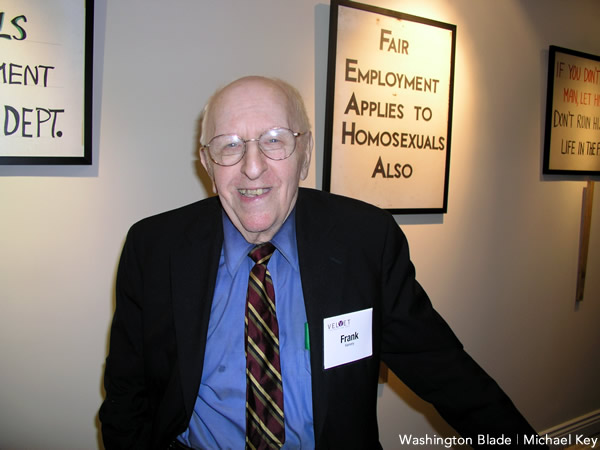
Frank Kameny will be buried next to Leonard Matlovich, the first active duty service member to come out publicly in 1975.
A grave site ceremony for the late gay rights leader Franklin E. Kameny will be held March 3 at D.C.’s Congressional Cemetery, organizers of the event announced on Wednesday.
“All friends, family and the public are welcome to observe the interment for Dr. Kameny at historic Congressional Cemetery,” the announcement says. The ceremony is scheduled to begin at 11 a.m.
“The informal observance will include brief remarks as well as recognition by the Servicemembers Legal Defense Network of Dr. Kameny’s honorable military service during World War II,” it says.
Charles Francis, co-founder of the Kameny Papers Project, said Kameny’s friends and associates organizing the ceremony applied for and received a formal military veteran’s headstone provided by the U.S. Department of Veterans Affairs identical to the ones used for burials at Arlington National Cemetery.
The inscription on the headstone will identify Kameny’s rank, military service, World War engagement in Germany, where Kameny served in combat, along with his date of birth and death – May 25, 1925 – Oct. 11, 2011.
Francis said a separate pink granite grave marker will include the inscription, “Gay is Good,” the slogan Kameny coined in the 1960s that he has said symbolized his nearly 50-year campaign to bring about equal rights for LGBT people.
Congressional Cemetery, located near Capitol Hill, was founded in 1807 and is listed on the National Register of Historic Places and was designated a National Historic Landmark in 2011.
Among the 55,000 people interred there is one U.S. vice president, one Supreme Court justice, six cabinet members, 19 U.S. senators, and 71 U.S. representatives, according to literature released by the cemetery.
Francis and Kameny Papers Project co-founder Bob Witeck said the Kameny grave site will be next to that of U.S. Air Force veteran Leonard Matlovich, who became the first active duty member of the military to publicly declare he was gay in 1975. Kameny played a key role in advising Matlovich in his effort to end the military’s ban on gay service members.
The Kameny gravesite is also near the gravesite of the late FBI Director J. Edgar Hoover and Hoover’s longtime companion Clyde Tolson.
As part of a longstanding tradition by U.S. presidents, all U.S. military veterans receiving Department of Veterans Affairs’ headstones for their interment also receive an official certificate of recognition signed by the president.
Kameny’s certificate states, “The United States of America honors the memory of Franklin E. Kameny. This certificate is awarded by a grateful nation in recognition of devoted and selfless consecration to the service of our country in the Armed Forces of the United States. Barack Obama, President of the United States.”



District of Columbia
Nearly 6,000 turn out for Pride Night Out at the Nationals
Gay Men’s Chorus sings National Anthem

“Just shy of” 6,000 people purchased tickets for the Wednesday, June 24, 21st annual Pride Night Out at the Washington Nationals baseball stadium, which the Nationals said is the longest running LGBTQ Pride event in Major League Baseball, according to a Nationals spokesperson.
The event was organized with the Nationals by Team D.C., the local LGBTQ sports group that organizes similar Pride Nights for other professional D.C. area sports teams.
“It was a good time had by all as the Nationals celebrated the LGBTQ+ community during the Nationals 21st Pride Night Out, presented by Team D.C.” the Nationals said in a statement.
Nationals spokesperson Erica George said the overall game attendance was 27,200.
Similar to recent past years, the Gay Men’s Chorus of Washington sung the National Anthem at the start of the game, drawing loud cheers from people throughout the stadium.
The Nationals lost the game to the Philadelphia Phillies by a score of 5-4. Although most of the LGBTQ attendees of the event, held in the right-field mezzanine section of the stadium, were cheering for the Nationals, a sizeable number also cheered for the Phillies.
Miguel Ayala, one of Team D.C.’s lead organizers, said he noticed fans displaying Pride flags and recognized LGBTQ people in all parts of the stadium, indicating significantly more LGBTQ people and their supporters attended the game beyond the close to 6,000 or more who purchased the specific Pride Night Out tickets.
“It was a great excitement last night,” he told the Washington Blade on the day following the event. “I saw a lot of big crowds of our people, I saw everybody I can think of in the community. And it was really great to see the turnout.”
Also, like in previous years, Team D.C. along with the Nationals helped to organize a pre-game show on the large concourse platform area next to the stadium seating area involving a drag show led by local drag performer Shi-Queeta Lee.
“During pregame ceremonies, the Nationals Pride employee resource group was recognized on the field,” the statement released by the Nationals says. “Dr. Demetre Daskalakis, a physician and public health leader who has had a profound impact on the LGBTQ+ community and those living with or vulnerable to HIV, threw out the ceremonial first pitch as the guest of Team D.C.,” the statement says.
It adds that Team D.C.’s scholarship recipient Spencer Doll made the ceremonial call to “Play Ball.”
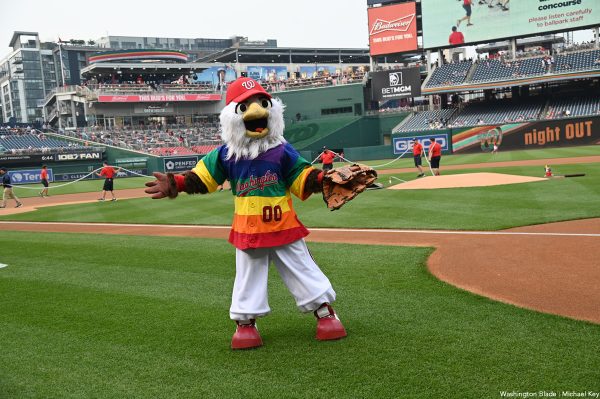
As if all that were not enough, a Nationals employee who entertains during the Nationals pre-game shows on the field dressed as a giant eagle named “Screech” wearing an eagle’s head mask appeared in the seating area where the Pride Night Out crowd was seated and mingled with the LGBTQ fans, many of whom posed for photos with Screech.
District of Columbia
Washington Blade names new publisher
Longtime ad exec Brian Pitts to assume role from Lynne Brown

The Washington Blade announced this week that its longtime publisher, Lynne Brown, who has worked at the publication for nearly 40 years, is retiring from her day-to-day duties.
Blade co-owner and longtime advertising executive Brian Pitts will assume the role of publisher effective June 26.
Pitts, 46, is a native of Fredericksburg, Va. In 2004, he moved to Washington, D.C., from Rehoboth Beach, Del., to work at the Blade as a 24-year-old sales executive. Pitts, along with Brown and Blade Editor Kevin Naff have owned the Blade since 2009. Pitts has served as the Blade’s lead sales executive since then.
“We’ve been through a lot over the last 17 years, including a recession and a pandemic,” said Pitts. “Lynne has been a steady hand throughout and I’m excited to take the reins and help steer the Blade into its next chapter.”
Brown will assume the title of publisher emerita and remain a part owner of the Washington Blade and Los Angeles Blade and contribute to the business via special projects.
As for what’s next, she said, “I will take the summer to regroup. I have one more LGBTQ community project in mind, and a few personal goals to check off the list. I am a Washingtonian. I will continue to live, work, and love here in D.C. Of course every Friday morning, I will grab a cup of coffee and read the Blade.”
Asked what advice she has for Pitts as he takes over the publisher’s job, Brown replied, “Brian is going to be great. He has all the skills needed to run this business. He also has a deep, silent passion for the Blade. My only advice: Slow and steady wins the race.”
Pitts said his primary goal as publisher is to ensure the Blade continues its mission as America’s LGBTQ news source.
“Another goal is to reach a younger audience and to include an educational component,” he added. “Some younger community members may be newer to the Blade and less familiar with LGBTQ history. Recently, we published a special commemorative magazine to coincide with America 250, chronicling LGBTQ history and contributions to U.S. culture. It’s so important not to let our history get erased and to remember where we came from and to work toward where we want to go.”
He described the biggest challenge to queer media as the Trump administration’s attacks on DEI.
“We have companies that have advertised with us for years who are now afraid of the potential consequences,” he said.
Brown joined the Blade in 1987. She was named publisher in 2007 by previous owner Window Media. In 2009, Window Media filed for bankruptcy; shortly after, Brown, Naff, and Pitts acquired the Blade’s assets from the bankruptcy court and relaunched the brand with Brown as publisher.
She said the period after the bankruptcy became her biggest challenge as publisher.
“The crisis that birthed Brown Naff Pitts Omnimedia kept me overly focused on millions of details,” she recalls. “My greatest personal challenge was delegating and letting go of details. Trusting staff with their strengths and skills to do their jobs was slow to come. It has proved to be most rewarding. Building the right team — knowing the people you work with are committed, professional, and honest — is a great thing.”
Pitts described the bankruptcy and rebirth of the Blade in 2009 as his proudest moment with the company.
“Working at the paper has been great, but becoming a co-owner was a dream come true,” he said.
Naff praised both of his colleagues.
“Lynne has been a rock, helping us navigate financial crises and a pandemic. The Blade wouldn’t have survived without her dedication,” he said. “She is the publisher every editor would want. Brian has terrific instincts, a passion for the Blade’s important mission, and an eye on growth. I am proud to call both of them friends and mentors and look forward to the next chapter.”
Asked why LGBTQ media are still relevant, Brown cited the recent erosion of queer rights as evidence that the Blade’s work remains important.
“The Blade helps fight invisibility and isolation,” she said. “We may have rights today, but we have seen rights eroded or erased. The Blade reports on those rights authentically and accurately and serves as a communication tool and a historian for the community.”
Pitts added, “While mainstream media may cover LGBTQ+ issues, no one covers them quite like us. These are our community’s stories and voices and this is your news source.”
The Blade will host a happy hour event later this summer where the community can meet Pitts and thank Brown for her decades of service.
Delaware
Vote to enshrine same-sex marriage in state constitution fails in Delaware
‘General Assembly turned its back on the people of this state’
The Delaware General Assembly on Tuesday failed to pass Senate Bill 100 (SB-100), an amendment that would add protections for same-sex and interracial marriage to the Delaware Constitution.
In order for the bill to pass, 28 out of 41 members needed to vote ‘yes,’ meaning all 27 Democrats and one Republican needed to vote in favor of the bill.
Rep. Eric Morrison (D-27) told the Blade that an anonymous Republican member agreed to vote in favor prior to the vote but ultimately did not follow through on that promise.
“It’s a shame,” said Rep. Morrison, who’s gay. He explained the difficult nature of passing this amendment with only three legislative days remaining in this session.
The bill needs to receive a two-thirds majority vote in two different sessions and the current two-year long session ends on July 1. Thus, if the bill does not pass before July 1, it will take a minimum of three years to pass the amendment.
The bill was introduced by State Sen. Russ Huxtable (D-07) on June 5, 2025.
Rep. Josue Ortega (D-03) was one of two Democrats to not vote in favor of the bill, voting ‘no.’ Rep. Ortega has not responded to the Blade’s request for comment.
Rep. Madinah Wilson-Anton (D-27) was the other Democrat missing from the ‘yes’ votes. She did not vote on the bill.
Sponsor of the measure, Rep. Claire Snyder-Hall (D-14), made a technical decision to reverse her vote from a ‘yes’ to a ‘no’ last-minute in order to keep the bill alive.
In a Facebook post, Rep. Snyder-Hall said that, “The General Assembly turned its back on the people of this state.”
“When we had the chance to add an extra layer of protection from attempts to turn back the clock and strip our constituents of the rights that Democrats fought for decades to secure, we failed,” said Snyder-Hall.
However, Snyder-Hall said that the failure to pass this bill is not the end. “There are still three legislative days left in the 153rd General Assembly and I am hopeful that we will be able to get the votes required to pass this incredibly basic — but important — bill.”

Eswatini’s government ordered to allow LGBTQ group to legally register

Does Pride decor resemble Trump’s design aesthetic?

Nearly 6,000 turn out for Pride Night Out at the Nationals

White House to end PEPFAR funding for South Africa

Washington Blade names new publisher

Union leader files assault complaint against gay Md. delegate after fight at early-voting site

PHOTOS: 2026 Capital Pride Parade

US no longer refuge for LGBTQ refugees

Cool convertibles