Arts & Entertainment
Calendar: April 27
Parties, support groups, concerts and more through May 3
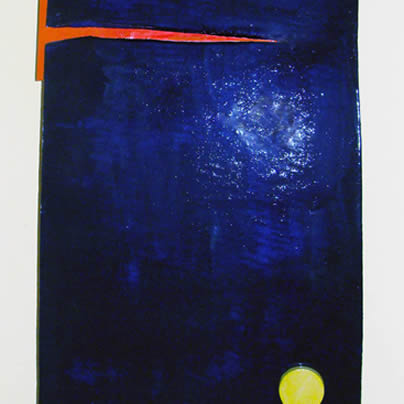
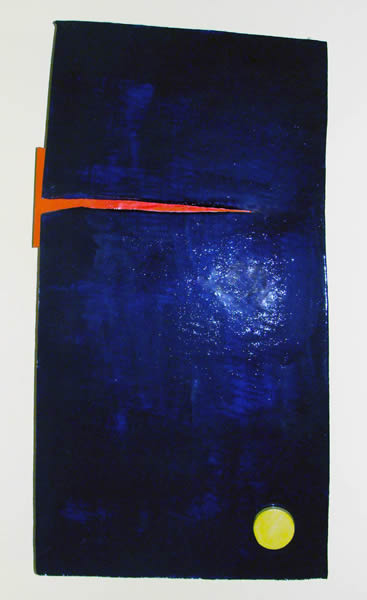
Sunday is the last chance to see ‘Spirit and Engima’ featuring ceramic sculptures by Bill Mould including ‘Morning’ and ‘String theory’ featuring works by Elena Tchernomazova at Touchstone Gallery. (Photo courtesy Touchstone Gallery)
TODAY (Friday)
D.C. Women4Women presents “Tryst,” a monthly professional lesbian happy hour, tonight at Topaz Bar (1733 N St., N.W.) from 7 to 10 p.m. with exclusive food and drink specials from 7 to 9 p.m.
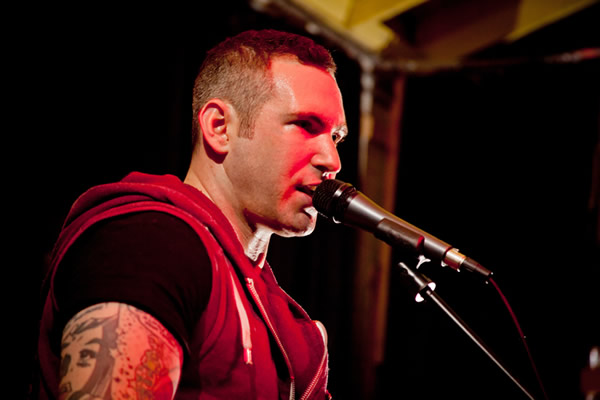
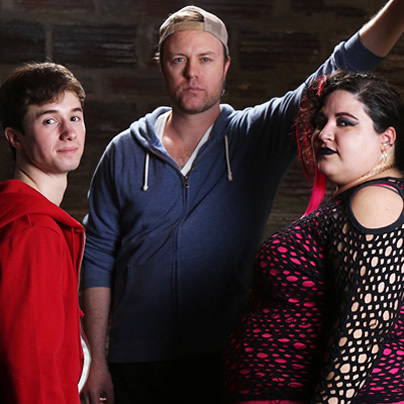
Positive Force D.C. presents Trophy Wife, War on Women, Fell Types and Fires in a benefit concert for D.C. Trans Coalition tonight at St. Stephen and the Incarnation Episcopal Church (1525 Newton St., N.W.) at 7 p.m. There is a $5 suggested donation. For more information, visit dctranscoalition.wordpress.com
Beat City, a queer lounge night, is tonight at Chief Ike’s Mambo Room (1725 Columbia Rd., N.W.) from 9:30 p.m. to 2:30 a.m.
Town’s (2009 8th St., N.W.) Bear Happy Hour presents “Bearaoke” tonight from 7 to 10 p.m. on the first floor, with mistress of ceremonies Tre. Doors open at 6 p.m.
Ted Leo and the Pharmacists play Black Cat (1811 14th St., N.W.) tonight at 9 p.m. with Mary Christ and The Tender Thrill. Tickets are $15 and available online atblackcatdc.com.
The Kennedy Center (2700 F St., N.W.) presents “Come Fly Away,” Twyla Tharp’s Broadway musical featuring Frank Sinatra’s greatest hits. Tickets range from $69 to $125 and are available online at kennedy-center.org.
Tonight is LGBT Night at ArtSpring (7014B Westmoreland Ave., Takoma Park) from 7 to 9 p.m. For more information, visit artspringsilverspring.com.
Saturday, April 28
Girlyman with Edie Carey plays the Birchmere (3701 Mount Vernon Ave., Alexandria) tonight at 7:30 p.m. Tickets are $15 and available online at birchmere.com.
Bill Cosby performs at the Kennedy Center (2700 F St., N.W.) tonight at 7 p.m. Tickets range from $54.50 to $79.50 and are available online kennedy-center.org.
The D.C. Center Women present an evening at CulinAerie (1131 14th St., N.W.) tonight 6:30 p.m. Attendees will make warm asparagus salad, seared salmon with black pepper crust and a chocolate tart with espresso anglaise. Tickets are $85 each and $10 from each ticket goes to the D.C. Center. For more information, visit thedccenter.org orculinaerie.com.
Tom From Prague brings “Tainted Love: An International ‘80s Dance Party” at Green Lantern (1335 Green Court, N.W.) tonight from 10 p.m. to 3 a.m. There is a $5 cover.
The stars of collegedudes.com, AJ Monroe and Devin Adams, perform live tonight as well as sign autographs and pose for photos at Town, (2009 8th St., N.W.). DJ Drew G will be spinning. Cover is $8 before 11 and $12 afterward. All attendees must be 21 or older. Doors open at 10 p.m.
Black Cat (1811 14th St., N.W.) presents Hellmouth Happy Hour where every week an episode of “Buffy the Vampire Slayer” will be screened and drink specials will be offered. This week the episode is “Living Conditions.” Doors open at 7 p.m.
Sunday, April 29
Suzanne Vega and Duncan Sheik play the Birchmere (3701 Mount Vernon Ave., Alexandria) tonight at 7:30 p.m. Tickets are $45 and available online at birchmere.com.
Classically trained musicians Black Violin play the Kennedy Center (2700 F St., N.W.) today at 1:30 and 4 p.m. Tickets are $18 and available online at kennedy-center.org.
Today’s the last day to see Touchstone Gallery’s (901 New York Ave., N.W.) exhibits “Spirit and Enigma” featuring ceramic sculptures by Bill Mould and “String theory” featuring works by Elena Tchernomazova. The gallery is open from noon to 5 p.m. For more information, visit touchstonegallery.com.
Monday, April 30
Nickelback plays Verizon Center (601 F St., N.W.) tonight with Bush, Seether and My Darkest Days at 6 p.m. Tickets range from $75 to $89.50 and are available online atticketmaster.com. Doors open at 4:30 p.m.
Whitman-Walker Health is having a series of Community Conversations this year and the next Conversation is “Improving Health of LGBT Elders” tonight at the D.C. Center (1318 U St., N.W.) at 7 p.m. For more information and a complete list of the series conversations, visit whitman-walker.org.
Tuesday, May 1
The Chesapeake Squares, a gay square dancing group, is having a mainstream-through-advanced club night tonight at the Waxter Center (1000 Cathedral St.) in Baltimore from 8 to 10 p.m. For more information, visit chesapeakesquares.org.
Join Burgundy Crescent Volunteers to help pack safer sex kits from 7 to 9 p.m. tonight at FUK!T’s packing location, Green Lantern, 1335 Green Ct., N.W.
Wednesday, May 2
Riot Act Comedy Theater’s (801 E St., N.W.) monthly gay and gay-friendly comedy show “Gay-larious” returns tonight at 8 p.m. with Lori Sommer, Emma Willmann, Sampson McCormick and co-founders Chris Doucette and Zach Toczynski. Tickets are $15 and can be purchased online at riotactcomedy.com.
Professionals in the City and the D.C. Center are hosting a speed dating event for lesbian and bisexual women at Chi-Cha Lounge (1624 U St., N.W.) from 7 to 9 p.m. tonight. Attendees will date for about an hour and then be able to mingle with everyone. After the event, matches can be made online. Tickets are $30. For more information, visit thedccenter.org.
Thursday, May 3
Log Cabin Republicans holds its monthly happy hour at Nellie’s (900 U St., N.W.) tonight from 6:30 to 8:30 p.m. on the roof deck featuring a new drink, The Pink Elephant.
Phase 1 of Dupont (1415 22nd St., N.W.) presents “Jock U” a men’s college night hosted by Secrets. Doors open at 9 p.m. No cover before 11 p.m. with college ID.
Movies
A Sondheim masterpiece ‘Merrily’ rolls onto Netflix
Embracing raw truth lurking just under the clever lyrics
It’s been long lamented by fans of the late Stephen Sondheim – and they are legion – that Hollywood has hardly ever been successful in transposing his musicals onto the big screen.
Sure, his first Broadway show – “West Side Story,” on which he collaborated with the then-superstar composer Leonard Bernstein – was made into an Oscar-winning triumph in 1961, but after that, despite repeated attempts, even the most starry-eyed Sondheim aficionados would admit that the mainstream movie industry has mostly offered only watered-down versions of his works that were too popular to ignore: “A Little Night Music” was muddled into an ill-fitted star vehicle for Liz Taylor, “Sweeney Todd” became a middling entry in the Tim Burton/Johnny Depp canon, “Into the Woods” mutated into a too-literal all-star fantasy with most of its wolf-ish teeth removed, and we’re still waiting for a film version of “Company” – not that we would have high hopes for it anyway, given the track record.
Of course, most of those aficionados would also be able to tell you exactly why this has always been the case: erudite, sophisticated, and driven by an experimental boldness that would come to redefine American musical theater, Sondheim’s musicals were never about escapism; rather, they deconstructed the romanticized tropes and presentational glamour, turning them upside down to explore a more intellectual realm which favored psychological nuance and moral ambiguity over feel-good fantasy. Instead of pretty lovers and obvious villains, they showcased flawed, complicated, and uncomfortably relatable people who were just as messed-up as the people in the audience. Any attempt to bring them to the screen inevitably depended on changes to make them more appealing to the mainstream, because they were, at heart, the antithesis of what the Hollywood entertainment machine considers to be marketable.
To be fair, this often proved true on the stage as well as the screen. Few of Sondheim’s shows, even the most acclaimed ones, were bona fide “hits,” and at least half of them might be considered “failures” from a strictly commercial point of view – which makes it all the more ironic that perhaps the most purely “Sondheim” of the stage-to-screen Sondheim efforts stems from one of his most notorious “flops.”
“Merrily We Roll Along” was originally conceived and created more than 40 years ago, a reunion of Sondheim with “Company” book-writer George Furth and director Harold Prince, based on a 1934 play by George Kaufman and Moss Hart. Telling the 20-year story of three college friends who grow apart and become estranged as their lives and their goals diverge, it wasn’t ever going to be a feel-good musical; what made it even more of a “downer” was that it told that story in reverse, beginning with the unhappy ending and then going backward in time, step by step, to the youthful idealism and deep bonds of camaraderie that they shared in their first meeting. On one hand, getting the “bad news” first keeps the ending from becoming a crushing disappointment; but on the other hand, the irony that results from knowing how things play out becomes more and more painful with each and every scene.
The original production, mounted in 1981, compounded its challenging format with the additional conceit of casting mostly teen and young adult actors in roles that required them to age – backwards – across two decades; though the cast included future success stories (Jason Alexander and Giancarlo Esposito, among them), few young actors could be expected to convey the layered maturity required of such a task, and few audiences were capable of suspending their disbelief while watching a teenager play a disillusioned 40-year old. This, coupled with a minimalist presentation that left audiences feeling like they were watching their nephew’s high school play, turned “Merrily We Roll Along” into Sondheim’s most notorious Broadway flop – despite raves reviews for the show’s intricately woven score and the xtinging candor of its lyrics.
Fast forward to 2022, when renowned UK theater director Maria Friedman staged a new revival of the show in New York. In the interim, “Merrily” had undergone multiple rewrites and conceptual changes in an effort to “fix” its problems, abandoning the concept of using young performers and opting for a more “fleshed-out” approach to production design, and the show’s reputation, fueled by a love for its quintessentially “Sondheim-esque” score, had grown to the level of “underappreciated masterpiece.” Inspired by an earlier production she had helmed at home a decade earlier, Friedman mounted an Off-Broadway version of the show starring Jonathan Groff, Daniel Radcliffe, and Lindsay Mendez – and suddenly, as one critic observed, Sondheim’s biggest failure became “the flop that finally flew.” The production transferred to Broadway, winning Tony Awards for Groff and Radcliffe’s performances, as well as the prize for Best Revival of a Musical, in 2024.
Sondheim, who died at 91 in 2021, participated in the remount, though he did not live to see its premiere, nor the success that officially validated his most “problematic” work.
Fortunately, we DO get the chance to see it, thanks to a filmed record of the stage performance, directed by Friedman herself, which was released in limited theaters for a brief run last year, but which is now streaming on Netflix – allowing Sondheim fans to finally experience the show in the way it was designed to be seen: as a live performance.
Embracing the conventions of live theatre into its own cinematic ethos, this record of the show gives viewers the kind of up-close access to its performances that is impossible to experience even from the front-row of the theatre. The performances it gives us are impeccable: Groff’s raw and deeply deluded Frank Shepard, the ambitious composer who sells out his values and alienates his friends on the road to success and wealth; Radcliffe’s mawkishly loyal Charlie Kringas, who remains loyal to the dream he shared with his best friend until he can’t anymore; and Mendez’ heartbreaking perfection as Mary Flynn, the wisecracking good-time girl who rounds out their trio while concealing a secret passion of her own – each of them bring the kind of raw and vulnerable honesty to their roles that can, at last, reveal both the deep insights of Sondheim’s intricate lyrics and the discomforting emotional conflicts of Furth’s mercilessly brutal script.
Yes, it’s true that any filmed record of a live performance loses something in the translation; there’s a visceral connection to the players and a feeling of real-time experience that doesn’t quite come through; but thanks to unified vision that Friedman shepherded and instilled into her cast – including each and every one of the brilliant ensemble, who undertake the show’s supporting characters and embody “the blob” of show-biz hangers-on who are central to its cynical theme.
Honestly, we can’t think of another Sondheim screen adaptation that comes close to this one for embracing the raw truth that was always lurking just under the clever lyrics and creative rhyme schemes. For that reason alone, it’s essential viewing for any Sondheim fan – because it’s probably the closest we’ll ever get to having a “real” Sondheim film that lives up to the genius behind it.
a&e features
New book celebrates 1970s dance music icons
‘A Night at the Disco’ features interviews with Donna Summer, Debbie Harry, more
If you’re a fan of 1970s-era dance music, don’t miss the irresistible new book by Christian John Wikane and Alice Harris, “A Night at the Disco,” which revisits more than 90 interviews conducted with some of the biggest names in pop culture.
“A Night at the Disco” (ACC Art Books) was published on March 24, and distributed by Simon & Schuster. It celebrates more than 100 artists who sparked a phenomenon in dance music from 1970-1979 and features excerpts from interviews with everyone from Donna Summer to Debbie Harry.

Lost City Books (2467 18th St., N.W.) will welcome author Christian John Wikane for a book signing and conversation about “A Night at the Disco” on Thursday, April 16 at 6 p.m. Details at lostcitybookstore.com. Bird in Hand Coffee & Books in Baltimore (11 E. 33rd St.) )will also host a Q&A with the author on Wednesday, April 15 at 6 p.m. Details at theivybookshop.com.
Below is an excerpt from “A Night at the Disco.”
“I’ll let in anyone who looks like they’ll make things fun.” Steve Rubell is guiding a New York Times reporter through Studio 54 as resident DJ Richie Kaczor dazzles the crowd with records by CHIC, Odyssey, and T-Connection. “Disco, that’s where the happy people go,” The Trammps sing as dancers spin and twirl underneath tubes of flashing lights. Seven months since Rubell and co-owner Ian Schrager opened Studio 54 in April 1977, it’s welcomed untold numbers of “happy people” … at least those lucky enough to pass through the doors.
“We were part of the chosen few,” says André De Shields, who immortalized the title role in The Wiz on Broadway at the time. “We could show up at Studio 54 and the doorman at the velvet stanchion would look over everyone and point to us from The Wiz to come in, that kind of thing.” As the lead vocalist in the GRAMMY-nominated Dr. Buzzard’s Original Savannah Band, whose debut modernized big band sophistication for the discothèques, Cory Daye had carte blanche in the club. “The energy was like a New Year’s Eve party every night,” she says. “I would go up to the mezzanine and watch the mechanical light pillars go up and down, metallic confetti falling from the ceiling, the spoon and the moon. I was so fascinated and enamored by it.
“When a certain song came on, the people would just rush to the dance floor. There was no contact dancing — the hustle was pretty much on its way out — but it was just an amazing experience to see all the cultures together. It was a fusion of cultures, which described my life and my band, so I was right at home there.”
“Studio 54 was the place,” adds Linda Clifford. “Crazy parties. If you could think it, you would see it. It was like a circus. Just an amazing place to be. I worked 54 so many times. It was like a second home to me. The people there treated me so well. The crowd always seemed to enjoy my show. I always had a good time with them. That was the most important thing: making sure that they had fun.”
Well before Studio 54 opened, disco had become a business juggernaut. “A four billion dollar market and still growing,” Billboard announced in February 1977, with dance music offering more variety than ever. “There is no longer a single, readily identifiable disco beat, but a kaleidoscope of sounds that are melodic and danceable,” Tom Moulton told the magazine. In the clubs, records by veteran artists like Stevie Wonder and the Bee Gees were mixed in with a range of new acts like Grace Jones, Boney M., and The Ritchie Family, while everyone from ABBA to Marvin Gaye scored number one pop hits with songs that had club-centric storylines.
Beyond the charts, disco itself remained as idiosyncratic as ever, especially on several productions by Laurin Rinder and W. Michael Lewis, whose studio creations, El Coco (“Let’s Get It Together,” “Cocomotion”) and Le Pamplemousse (“Le Spank”), joined their own “Lust” from Seven Deadly Sins (1977) among the most tantalizing releases on AVI Records. Rinder & Lewis also produced acts for the newly hatched Butterfly Records in Los Angeles, where Saint Tropez (“On a Rien à Perdre”) and Tuxedo Junction (“Moonlight Serenade”) reflected the duo’s high gloss sound, spanning everything from European sophistication to a more literal translation of the ’40s sensibilities popularized by Dr. Buzzard’s Original Savannah Band.
12-inch singles had also grown as the preferred format to approximate the club music experience at home. Nearly a year after Atlantic Records introduced its series of promotional 12-inch singles for DJs, New York-based Salsoul Records released the industry’s first commercially available 12-inch single, “Ten Percent” by Double Exposure, in May 1976. A year later, T.K. Records was the first label to certify a gold record for a 12-inch single when Peter Brown’s “Do You Wanna Get Funky With Me” tallied one million sales.— Christian John Wikane
(From “A Night at the Disco” by Alice Harris & Christian John Wikane. Published by ACC Art Books.)
The Blade may receive commissions from qualifying purchases made via this post.
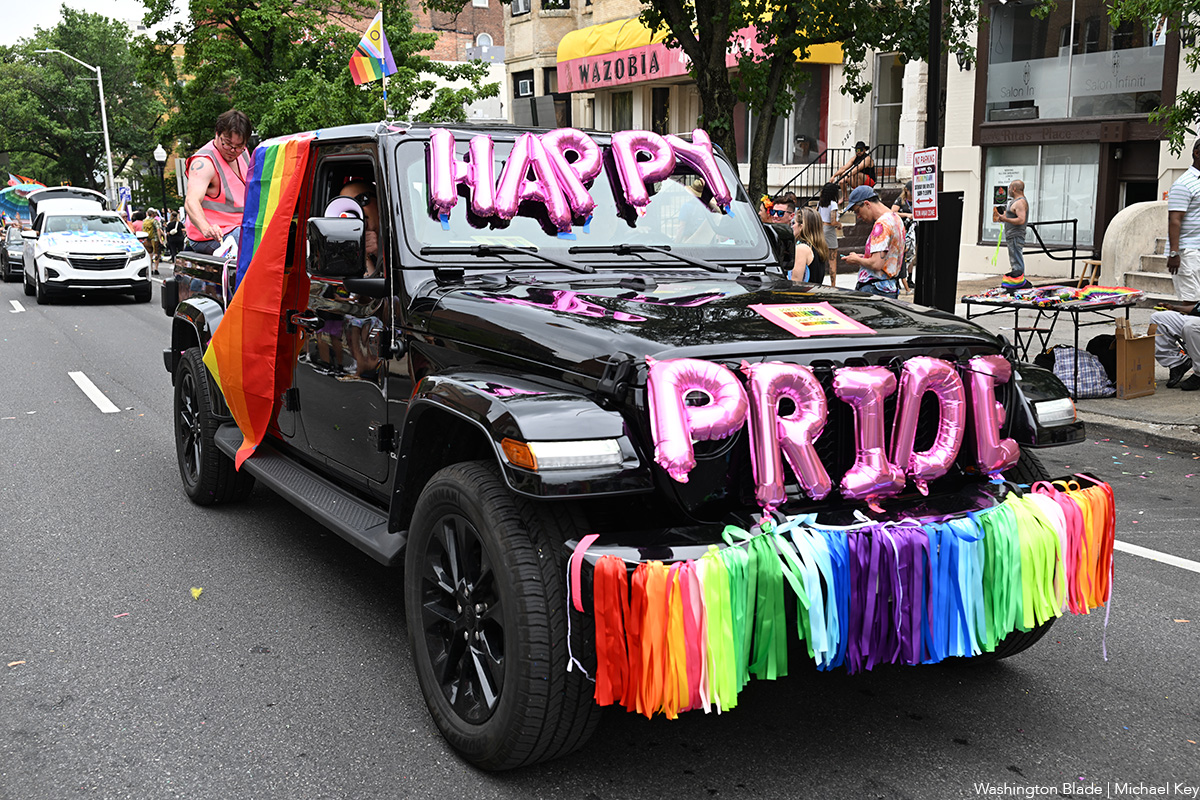
The Bonnet Ball was held at JR.’s Bar (1519 17th St., N.W.) on Sunday.
(Washington Blade photos and video by Michael Key)