Local
Black clergy back Md. same-sex marriage law
Al Sharpton and others spoke at downtown D.C. press conference
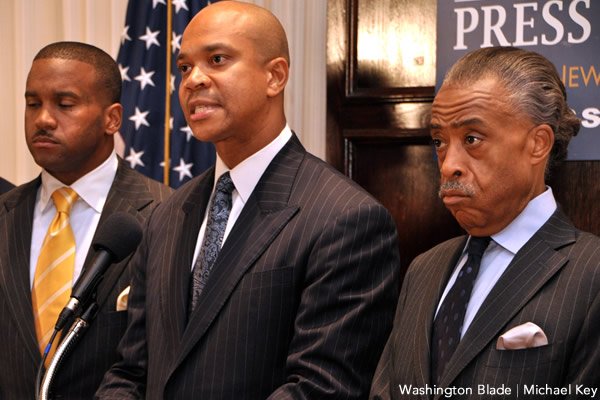
Rev. Delman Coates (Washington Blade photo by Michael Key)
A group of prominent black clergy today urged Maryland voters to support the state’s same-sex marriage law in the November referendum.
“As pastors and clergy leaders, we are here today to declare our unequivocal support for Maryland’s Civil Marriage Protection Act and to dispel the myth that all African American pastors are fundamentally opposed to the idea of marriage equality,” said Rev. Delman Coates, senior pastor of the 8,000 member Mt. Ennon Baptist Church in Clinton, Md., during a press conference at the National Press Club in downtown Washington. “For too long the issue of equal treatment under the law for gay and lesbian couples has been mired in a theological debate between those on the one hand who oppose same-sex marriage based upon their religious beliefs, and those on the other who affirm it based upon theirs. And while this is a legitimate discussion for people of faith to have, the appropriate arena that conversation is the house of worship, the seminary, the Bible study or some other religious setting.”
Rev. Howard-John Wesley, senior pastor of Alfred Street Baptist Church in Alexandria, Va., echoed Coates. He noted during the press conference that many of his congregants live in Maryland — specifically Prince George’s County.
“I will impress upon my membership to vote yes on this issue on the Nov. 6 ballot referendum simply because this act is civil, not religious,” Wesley said. “In no way [does] it [infringe] upon our religious freedom as an institution to define marriage as we would, to perform the rite of marriage according to our doctrinal believes nor in the same way does it infringe upon the state to protect the civil liberties of all its residents.”
Rev. Christine Wiley of Covenant Baptist United Church of Christ in D.C.; joined Rev. Brad Braxton of Open Church and Rev. S. Todd Yeary of Douglas Memorial Community Church in Baltimore; Rev. Frederick Haynes of Friendship-West Baptist Church in Dallas; Rev. Otis Moss, III, of Trinity United Church of Christ in Chicago; Rev. Amos Brown of Third Baptist Church in San Francisco and others at the press conference.

Rev. Christine Wiley (Washington Blade photo by Michael Key)
Rev. Al Sharpton, president of the National Action Network, applauded Coates and other black clergy for their support of Maryland’s same-sex marriage law.
“This is not an issue about gay or straight,” said Sharpton at the press conference. “This is an issue about civil rights and to take a position to limit the civil rights of anyone is to take a position to limit the civil rights of everyone. You cannot be a part-time civil rights activist. You cannot be for civil rights for African Americans, but not for gays and lesbians.”
This announcement comes less than two months before Marylanders will vote in the referendum on the same-sex marriage law that Gov. Martin O’Malley signed in March.
A Hart Research Associates survey conducted in late July found that 44 percent of black Marylanders would support Question 6, compared to 45 percent who would oppose it. A Public Policy Polling survey in May found that 55 percent of the state’s black voters support marriage rights for same-sex couples.
Benjamin Jealous, president of the Baltimore-based National Association for the Advancement of Colored People is among the prominent black leaders who have backed Question 6. Same-sex marriage advocates and others have noted that both President Obama’s support of nuptials for gays and lesbians and the NAACP Board of Directors’ resolution in support of the issue have had what they describe as a positive impact on public opinion among black voters.
Bob Ross, president of the Prince George’s Branch of the NAACP, appeared in a new web ad earlier this week in support of Question 6. The civil rights organization’s Maryland State Conference and Baltimore affiliates have also backed same-sex marriage, while other black supporters of nuptials for gays and lesbians appeared in a separate web ad that Marylanders for Marriage Equality released in July. Bishop Harry Jackson of Hope Christian Church in Beltsville remains one of the most prominent Question 6 opponents.
Josh Levin, campaign manager for Marylanders for Marriage Equality, the group defending the state’s same-sex marriage law, conceded in a fundraising pitch to supporters on Thursday that his group has only been able to purchase a week’s worth of television air time “in some places so far.” This admission comes on the heels of what he described as the “four weeks of commercial time on TV stations across Maryland” that Question 6 opponents have already bought.
“Our opponents are smart, well-funded and willing to play on the politics of race and fear in order to win,” wrote Levin in the e-mail that stresses Marylanders for Marriage Equality needs to raise $500,000 over the next two weeks to counter these ads. “And we know from past experience in other states that if we let them have the airwaves to themselves, we will lose.”
Sharpton noted to the Washington Blade during the press conference that he appeared in an ad ahead of the same-sex marriage bill’s passage in February.
“One thing I’ve never been accused of being is bashful,” he said when asked if Marylanders for Marriage Equality had asked him to appear in a pro-Question 6 spot. “I’ll do whatever because I see this as a civil rights issue.”
“This is a full court press,” Coates said. “In the remaining days and weeks leading up to Nov. 6, there are a variety of strategies that we can do and engage in across the state to educate further persons, to educate Marylanders about what this is about and what it is not. This is a full-court press and we’re creating strategies.”


District of Columbia
Your queer D.C. voting guide
June 16 primary nears; Lewis George, McDuffie lead in polling for mayor
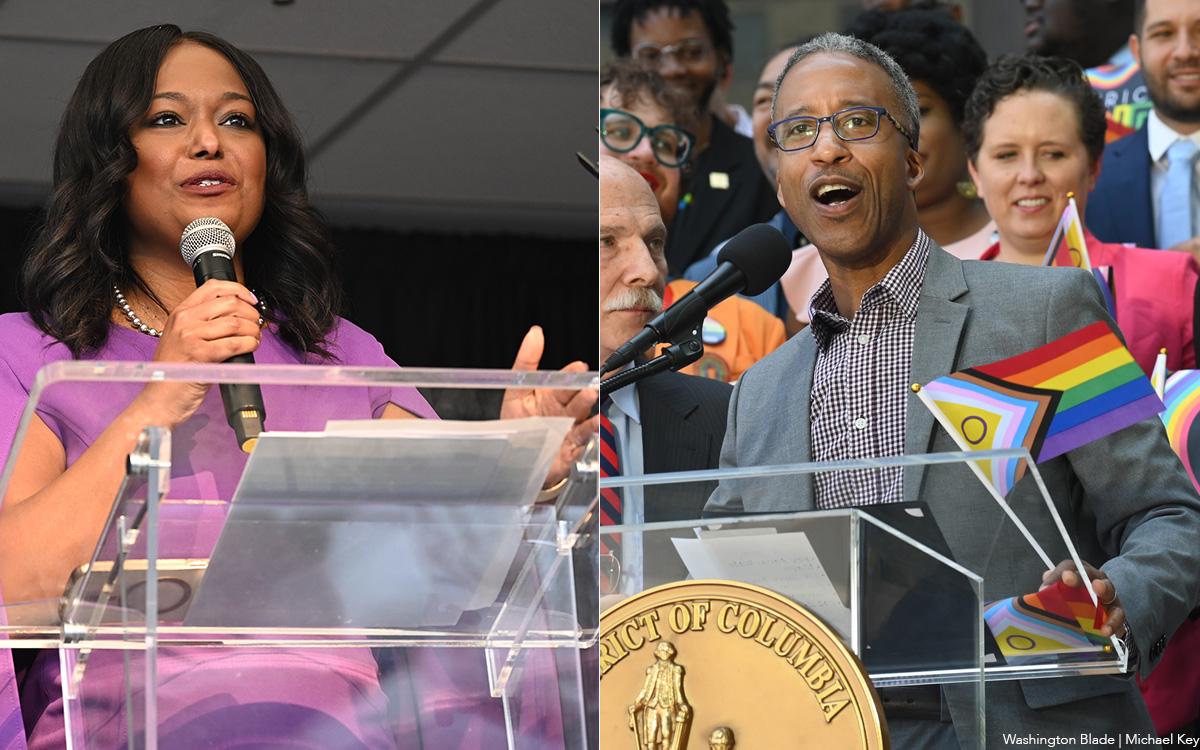
LGBTQ voters in the nation’s capital are choosing among a long list of LGBTQ supportive candidates running for mayor, D.C. City Council, and the position of D.C. Delegate to the U.S. House of Representatives in the city’s June 16 primary election.
LGBTQ activists who have spoken to the Washington Blade appear to be divided in their support for the two leading Democratic candidates for mayor – D.C. Council member Janeese Lewis George (D-Ward 4) and former D.C. Council member Kenyan McDuffie (I-At-Large) in a seven-candidate race.
Among the other five Democratic mayoral candidates is Rini Sampath, a cyber security consultant who told the Blade she identifies as queer.
“We’re living in an extremely diverse community, an extremely unique community,” she told the Blade. “And being able to self-label, self-identify as queer is something that I just want to take pride in.”
But a poll conducted by the Washington Post and George Mason University’s School of Policy and Government released on June 5 shows Sampath receiving just 3 percent in a sample of likely voters in the D.C. Democratic primary.
The poll, conducted from May 27-June 1, shows Lewis George leading in the mayoral primary with 36 percent compared to McDuffie, who had 25 percent. However, 25 percent of those polled were undecided in the mayoral race, according to the Post, indicating at least some of the undecided voters could go to McDuffie.
“Undecided voters are concentrated among groups that lean toward McDuffie, including moderates, Black voters and those ages 65 and older,” the Post story reporting on the poll states.
Another factor making it more difficult to predict the election outcome is the start in this year’s D.C. primary of ranked choice voting, which enables voters to select as many as five candidates on their ballot as their first through fifth choice depending on how many candidates are running for a specific office, including the office of mayor.
The ranked choice process takes effect if no candidate receives at least 50 percent of the vote in a race with three or more candidates and serves as an instant run-off using voters’ second-choice or third or more choice votes until one candidate receives 50 percent of the vote.
In what appears to support the belief of many local political observers that Lewis George and McDuffie are the two leading mayoral candidates, the poll shows the remaining candidates receiving less than 5 percent.
They include former D.C. Council member Vincent Orange with 4 percent, local real estate manager and developer Gary Goodweather with 3 percent, and former U.S. Department of Homeland Security contractor Hope Solomon and real estate broker and Ward 1 community activist Ernest Johnson each receiving 1 percent.
Goodweather, a political newcomer, has attended LGBTQ events in his mayoral campaign and has expressed strong support on LGBTQ issues.
With that as a backdrop, the Capital Stonewall Democrats, the city’s largest LGBTQ political group, has endorsed Lewis George for mayor and GLAA DC, formerly known as the Gay and Lesbian Activists Alliance of Washington, awarded Lewis George its highest candidate rating score of +10.
GLAA said it did not issue a rating for McDuffie because his campaign did not return a GLAA candidate questionnaire on which it bases its ratings. A spokesperson for the McDuffie campaign said campaign workers later discovered the questionnaire landed in the spam folder of their email account and McDuffie would have returned it had he received it.
At GLAA’s invitation, McDuffie completed the questionnaire and GLAA has posted it with its full responses to a list of 10 questions on the GLAA website along with the questionnaire responses from other candidates, including Lewis George. Like Lewis George, McDuffie expressed strong support for a wide range of LGBTQ issues in his responses, but GLAA said it could not issue a rating for him due to the missed deadline for submitting the questionnaire.
According to GLAA, just two other mayoral candidates returned the questionnaire and received a rating. Sampath received a +6.5 rating, and Johnson received a rating of +4.5. Under the GLAA rating system, a -10 is the lowest possible rating, with a +10 being the highest.
D.C. Board of Elections records show that no Republican candidate is running for mayor and one Statehood Green Party candidate – Robert L. Gross – is running unopposed on the primary ballot for voters registered as Statehood Green Party members. GLAA’s website shows Gross did not receive a rating under the group’s policy of not rating candidates that do not return the questionnaire.
The Statehood Green Party and its candidates for local D.C. offices have historically been supportive of LGBTQ rights.
LGBTQ activists who are backing Lewis George or McDuffie appear to be gravitating to the two based on their political leadings separate from LGBTQ issues, just like voters in general. Lewis George, who identifies as a Democratic Socialist, is popular among progressive voters.
McDuffie, who is seen as a more moderate candidate like current D.C. Mayor Muriel Bowser, is being supported by LGBTQ activists who hold those views, some of whom currently work in the Bowser administration.
Among Lewis George’s LGBTQ supporters are longtime Ward 8 community leader Phillip Pannell and former Capital Stonewall Democrats President Howard Garrett. Among the LGBTQ McDuffie backers are longtime D.C. Democratic activists John Fanning and David Meadows.
“The rights of LGBTQ residents in our country are under attack,” Pannell told the Blade. “We need a mayor of our nation’s capital who will be a progressive voice and force in standing up for our rights and advancing the quality of life for our community,” he said. “That is one of the reasons I enthusiastically support Janeese Lewis George for mayor.”
Fanning, a member of the staff of D.C. Council member Anita Bonds (D-At-Large), said he has observed McDuffie’s work on the Council firsthand. “He has been out and upfront on many of our issues and he has been an ally to our community,” Fanning said. “And I feel more comfortable with his judgements when it comes to city policy,” Fanning said, adding, “And I sense he has more of a pulse on how to grow our economy.”
In the race for D.C. Delegate to the U.S. House, five Democrats are competing in the June 16 primary, including D.C. Council members Brooke Pinto (D-Ward 2) and Robert White (D-At-Large). Pinto and White have been outspoken supporters of the LGBTQ community. Capital Stonewall Democrats has endorsed White.
Also running as Democrats for the congressional seat are community activists Kinney Zalesne, Trent Holbrook, and Greg Jaczko, who have expressed support for LGBTQ issues at candidate forums. Denise Rosado is running unopposed for the congressional seat as a Republican, and Kymone Freeman is running unopposed as a Statehood Green Party candidate in the primary.
Under D.C.’s “closed” primary system voters can only vote for a candidate for a specific political party if they are registered members of that party in the primary. In the general election in November, voters can vote for any candidate regardless of party affiliation.
GLAA has said it does not issue candidate ratings for the D.C. Delegate position, which has been held for many years by Democratic incumbent Eleanor Holmes Norton, who announced earlier this year that she is retiring and not running for re-election. Norton has been a longtime outspoken LGBTQ rights supporter.
D.C. Council Chair Phil Mendelson (D-At Large), also a longtime LGBTQ rights supporter, is running unopposed for re-election in the Democratic primary, He received the Capital Stonewall Democrats endorsement and a +6.5 rating from GLAA.
Nine Democrats are running for the At-Large D.C. Council seat currently held by Bonds, who is also retiring and not running for re-election. Capital Stonewall Democrats has endorsed local pharmacist, community activist, and LGBTQ ally Oye Owolewa, who received a +9 rating from GLAA.
The other Democrats running for the at-large seat who received a rating from GLAA include Lisa Raymond, +7.5; Dwight Davis, +6.5; Dyana Forester, +6; and Fred Hill, +5.5.
Board of Elections ballot records show that Darrell Green is running unopposed for the at-large seat in the Republican Primary and Darryl Moch is running unopposed in the primary as a Statehood Green Party candidate.
In the Ward 1 D.C. Council race, five LGBTQ supportive candidates are competing in the Democratic primary, including two LGBTQ candidates – gay rights activist Miguel Trindade Deramo and bi candidate Aparna Raj. The Ward 1 seat became vacant when incumbent Democrat Brianne Nadeau announced she was not running for re-election.
Capital Stonewall Democrats announced it did not make an endorsement in the Ward 1 race because the endorsement vote by its members was divided and none of the candidates received a required 60 percent of the vote for an endorsement.
GLAA awarded its highest +10 rating to both Deramo and Raj as well as to Ward 1 Democratic candidate Rashida Brown. It assigned a rating of +5.5 to candidate Terry Lynch but did not issue a rating for the fifth Democratic candidate – Jackie Reyes Yanes, who did not return the GLAA questionnaire.
The group didn’t issue ratings for Ward 1 Republican candidate Jett James Jasper or Statehood Green Party candidate Jude Cranniitch, both of whom are running unopposed. GLAA has said it sent out its questionnaire to all candidates listed by the Board of Elections to be placed on the ballot and does not rate those who do not return the questionnaire.
In the Ward 3 D.C. Council race, incumbent Council member Matthew Fruman (D), also an outspoken LGBTQ rights supporter, is running unopposed in the Democratic primary, with no GOP or Statehood Green Party candidate running in the primary. Fruman received the Capital Stonewall Democrats endorsement but was not rated by GLAA.
In the Ward 5 Council race, incumbent Zachary Parker, the Council’s only gay member, is being challenged by two Democrats in the primary – community activists Bernita Carmichael and Bridget French. Parker received the Capital Stonewall Democrats endorsement and a +7 rating from GLAA. Carmichael and French did not receive a GLAA rating.

Political observers in the ward believe Parker is the favorite to win the primary as well as the general election in November, when he will be challenged by Republican Jeffrey Kihien-Palza and Statehood Green Party candidate Joyce Robinson-Paul, who are running unopposed in their party primaries on June 16.
In Ward 6, incumbent Council member Charles Allen (D). a longtime LGBTQ rights supporter, received the Capital Stonewall Democrats endorsement and a +6.75 rating from GLAA. He is being challenged in the primary by Democrats Gloria Ann Nauden and Michael Murphy. Ward 6 political observers consider Allen the strong favorite to win the primary and the general election, when he will be challenged by Republican Jorge Rice, who is running unopposed in the GOP primary. No Statehood Green Party candidate is running for the Ward 6 Council seat.
Capital Stonewall Democrats did not make an endorsement for the D.C. Council special election for the At-Large Council seat that became vacant when then-independent Council member McDuffie resigned to enable him to run for mayor as a Democrat. Under the city’s Home Rule Charter adopted by Congress, that At-Large seat is restricted to a “non-majority party” candidate, meaning a non-Democrat.
The three candidates running for the seat, all independents, include incumbent Doni Crawford, who was temporarily appointed to the seat earlier this year; former D.C. Council member Elisa Silverman; and Jacque Patterson, president of the D.C. Board of Education. All three have expressed support for LGBTQ issues. GLAA issued a +6.5 rating for Crawford and a +5.75 rating for Silverman.
In the race for D.C. Attorney General, Capital Stonewall Democrats has endorsed incumbent Brian Schwalb, who is an outspoken LGBTQ rights supporter. He is being challenged in the Democratic primary by D.C. attorney and law firm partner J.P. Szymkowicz, who is a Ward 3 Advisory Neighborhood Commissioner.
Attorney and local law firm partner Manuel Rivera is running unopposed for the Attorney General office in the Republican primary. No Statehood Green Party candidate is running for the AG post. GLAA issued a rating of +4.5 for Rivera but did not issue ratings for Schwalb or Szymkowicz.
Finally, in the race for the so-called “shadow” D.C. U.S. Senator and D.C. U.S. Representative—offices with no voting or official authority in Congress that were created to lobby Congress on behalf of D.C. issues—Capital Stonewall Democrats did not make an endorsement. In the Democratic primary Paul Strauss is running unopposed for the shadow U.S. Senate seat and Franklin Garcia is running unopposed for the shadow U.S. House seat. Both have been LGBTQ rights supporters.
No Republican or Statehood Green Party candidates are running for either of the two “shadow” positions. GLAA does not issue ratings for the two positions.
Following are short excerpts from the detailed statements four of the seven Democratic mayoral candidates submitted to the Capital Stonewall Democrats or the Washington Blade.
Kenyan McDuffie: “As mayor, every piece of legislation I sign, craft, or endorse should also encompass the interest and input of the LGBTQ community members and advocates…From housing to health care and everything in between… We have a dire crisis regarding the rise in homelessness especially among the youth in our LGBTQ communities. In my administration that simply cannot be the status quo and will not be…I have been a consistent champion for our LGBTQ community and will remain so as mayor of D.C.”
Janeese Lewis George: “As mayor, I will protect our LGBTQ+ neighbors against federal attacks on their identity, including their health care…On the Council I have been a strong supporter of pro-LGBTQ+ bills, including making D.C. a sanctuary for people seeking gender-affirming health care as well as addressing discrimination and harassment in nightlife and hospitality…And as mayor, I am prepared to move up and win those fights – a fight for D.C. statehood, a fight for our true economy, and a real opportunity to uplift our Black queer and trans youth.”
Gary Goodweather: “A Goodweather administration will defend every D.C. law protecting LGBTQ residents. I will establish a Defend DC office to coordinate the District’s legal and public response to federal overreach, with LGBTQ+ protections explicitly within its mandate…My affordable D.C. plan will produce 50,000 new homes with 36,000 affordable units, and I will ensure LGBTQ+ youth housing programs are funded as a budget priority.”
Rini Sampath: “I am an immigrant, proud queer woman, and a 10-year resident of Washington, D.C…For me, LGBTQ+ voters including transgender and nonbinary residents, are not a separate or symbolic constituency; they are a core part of a broader, multiracial, cross-ward coalition rooted in equity and opportunity.”
Vincent Orange: “I have a long and consistent record of supporting LGBTQ+ equality and inclusion in the District of Columbia, grounded in both policy and personal commitment. As the District’s Democratic Committeeman from 2006 to 2015, I publicly supported marriage equality and voted accordingly … During my time on the D.C. Council, I worked to advance protections for LGBTQ+ residents, including authoring and passing legislation to prohibit discrimination against transgender individuals in the workplace.”
15 LGBTQ candidates running for Democratic State Committee
At least 15 known LGBTQ candidates are running for seats on the D.C. Democratic State Committee in the city’s June 16 Democratic primary.
Under local Democratic Party rules, the State Committee includes a total of 38 members, half of whom must be women and half of whom consist of men. The highest two positions include National Committeeman and National Committeewoman. Other positions include seven At-Large Committee men and seven At-Large Committee women, and two Committee men and two Committee women for reach of the city’s eight wards.
Democratic primary voters can vote for as many as seven At-Large male and At-Large female candidates and for two male and two female candidates in each of the ward committee races.
The known LGBTQ Democratic State Committee candidates are as follows:
National Committeeman
Phillip Pannell, Free DC Slate
David Meadows, Democrats United to Free DC slate
At-Large Committeeman
Jordan Kagelmayer, Free DC slate
Malake Glee, Free DC slate
At-Large Committeewoman
Lia Lake Kuduk, Free DC slate
Sonya Joseph, Free DC slate
Ward 1 Committeewoman
Vita Rangel, Free DC slate
Ward 2 Committeeman
Steven M. McCarty, Free DC slate
John Fanning, Democrats United to Free DC
Ward 3 Committeeman
Kurt Vorndran, Democrats United to Free DC slate
Michaell Haresign, Democrats United to Free DC slate
Ward 4 Committeewoman
Corey Welcher
Ward 7 Committeeman
Jimie Williams, Democrats to Free DC slate
Ward 8 Committeeman
Alejaibra Sloan, Free DC slate
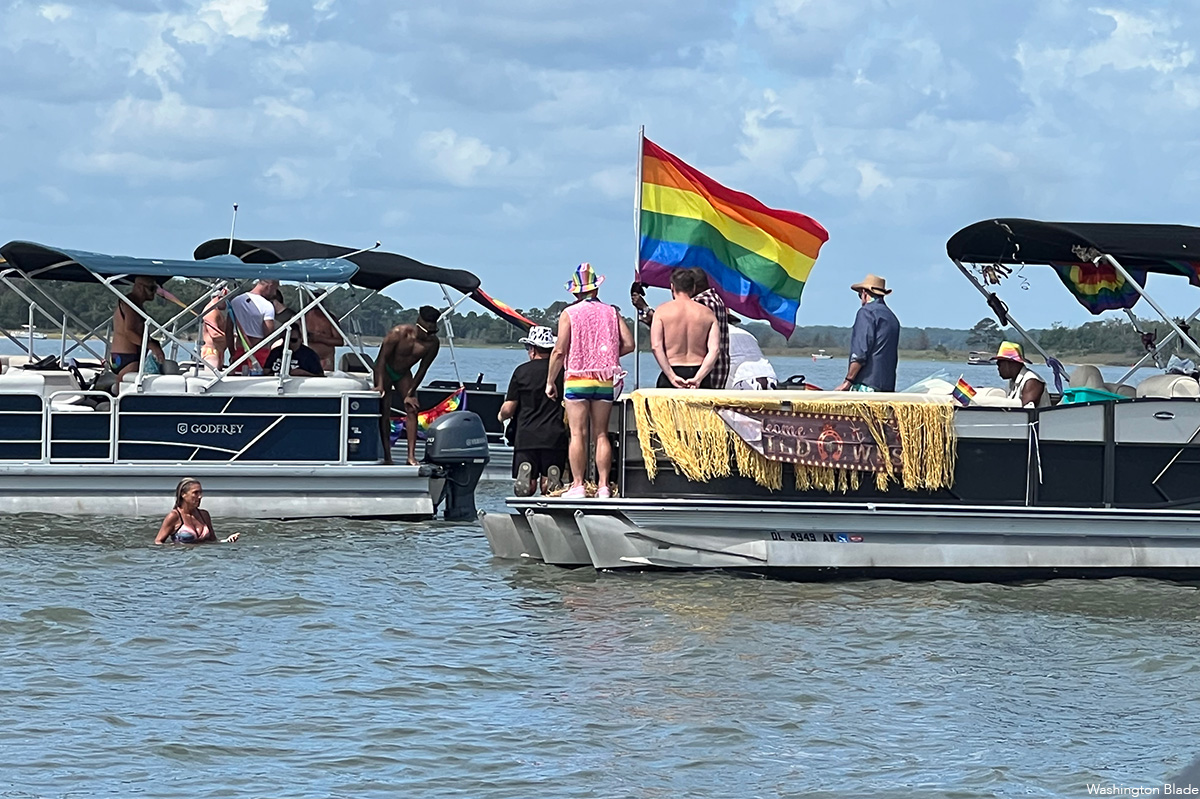
Pride month festivities continue through the end of the month and there’s a new event for Rehoboth/Dewey Beach residents and visitors, Pride on the Bay, set for June 27.
Boaters will tie up at the sandbar near Massey’s Landing from 12-4 p.m. Visit Pride on the Bay’s Facebook page for a map of the exact location. You can rent pontoons for the day at Dewey Beach Watersports (deweybeachwatersports.com).
Aqua Bar & Grill is sponsoring the inaugural event and will provide a floating DJ for the afternoon. Aqua will then host an after-party back on land (57 Baltimore Ave., Rehoboth Beach).
Local part-time resident Brian Sparrow is organizing the gathering, citing the need for more Pride-oriented events at the beach.
“I decided to create an event in June for Pride month,” Sparrow told the Blade. “There aren’t many Pride events in Rehoboth and Dewey where we can take advantage of the Rehoboth Bay.”
He noted that there is another event called “Bay Pride” but that it is held in late summer on a Sunday. “Having the event on Saturday will allow for more boat renting options for visitors and friends to join,” Sparrow said, adding that he plans to make this an annual event.
District of Columbia
McDuffie on LGBTQ support and standing up to Trump
‘I’m committed to governing with the queer community at the table’
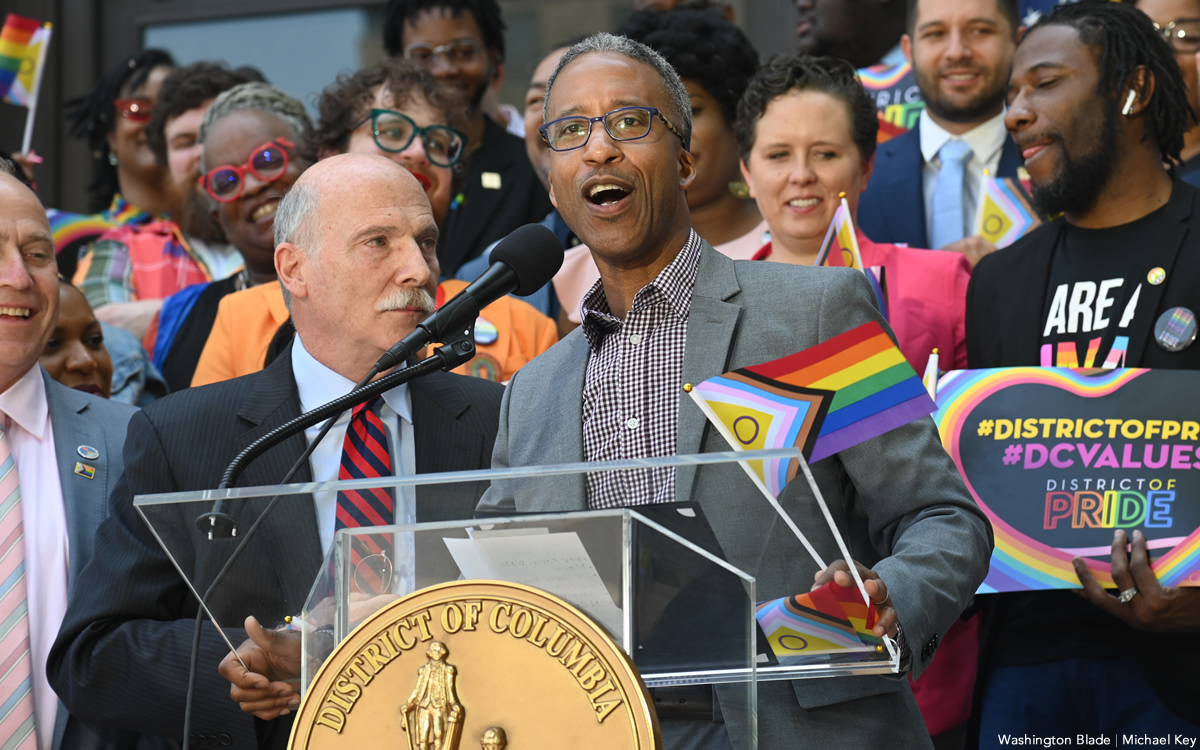
Former D.C. Council member Kenyan McDuffie is running for mayor as Muriel Bowser’s third term expires in January. He’s running in a crowded Democratic primary field; recent polls show him in second place behind Council member Janeese Lewis George. D.C.’s primary is Tuesday, June 16.
The Blade sat down with McDuffie on June 8 for a wide-ranging conversation about his pro-LGBTQ record and challenges now facing the community.
The Blade reached out to fellow mayoral candidates Lewis George and Rini Sampath, who identifies as queer, for interviews. Neither responded to repeated requests over several weeks.
Blade: Members of the D.C. LGBTQ community are receiving information that most if not all the seven Democratic candidates for mayor, including you and Council member Janeese Lewis George, are strong supporters of the LGBTQ community. What message would you have for LGBTQ voters on why they should support you rather than one of the other candidates?
McDuffie: Thank you for the question, Lou. And thank you for your work over the years with the Washington Blade. I’m really looking forward to having this conversation. You know, Washington, D.C. is the capital of the United States, and our city is one of the most beautifully diverse and inclusive cities in America because generations of LGBTQ+ residents, advocates, and organizations have fought to make it that way.
And throughout my time on the Council, I’ve been proud to support that work by advancing equity and opportunity and standing up for the rights and dignity of every resident across the District regardless of where they live, who they know, how much money they have. And as mayor, I’m going to build on that progress by ensuring D.C. remains a place where LGBTQ+ residents can live safely, where they can access quality healthcare and housing, they can build families and businesses and thrive in the neighborhoods of our city.
And now more than ever, making sure we protect residents from a hostile federal administration, including President Donald Trump, who seeks to roll back civil rights and civil liberties.
Blade: Some people, including members of the LGBTQ community, have criticized Mayor Bowser for what they say has been her position of not standing up forcefully enough against the Trump administration on various issues, including the deployment of National Guard soldiers in the city. What are your thoughts on that? How would you deal with the Trump administration if you were mayor?
McDuffie: Well, I’m going to deal with the Trump administration by prioritizing D.C. residents first. I’m going to stand up and fight back against federal infringement from Donald Trump and from Republicans in Congress or any other individual or organization that seeks to threaten Washington, D.C. residents.
And that means on day one rescind the executive order that permits cooperation between the Metropolitan Police Department and ICE and DHS [U.S. Department of Homeland Security]. And I know because of my work 13-and-a-half years on the Council doing research, authoring transformational legislation that protects people’s civil rights, that makes the Metropolitan Police Department more transparent, doing things like authoring the landmark NEAR Act [a 2016 D.C. law aimed at reducing violent crime].
I know from that work, and I know from my former work as a civil rights attorney in President Obama’s Department of Justice that you have to fight to ensure that we have a fair and more just society. I did that as a civil rights attorney traveling the country fighting to protect people’s civil rights. I did that as a prosecutor who fought crime and delivered justice for victims.
And I’m going to do that as mayor to ensure that we use every legal and political tool available as mayor to resist any federal effort to roll back LGBTQ+ protections in Washington, D.C. And I’m committed to governing with the queer community at the table and lifting up their contributions to this city at the center of every decision that I make as mayor. You know that I’ve been a champion making Washington, D.|C. more equitable, more just, and economically inclusive. And I plan to continue to build on that work that I have done and the work that so many important people have done in the LGBTQ+ community in Washington, D.C. to make sure that our residents can live safely and thrive in Washington, D.C.
And so, we’re going to fight back against Trump and any hostile federal administration to make sure we’re protecting the residents first. And we will work with the federal government where there is an opportunity to do transformational economic development projects like RFK, transformational infrastructure projects like expanding Union Station. Both of those will create thousands of jobs and thousands of opportunities for D.C.-based small businesses.
But I will draw a very bright line when it comes to protecting the civil rights of individuals across the District of Columbia, including the LGBTQ+ community and our vulnerable neighbors like our immigrant neighbors and families who in many cases today are living in the shadows, afraid to leave their homes, afraid to go to work, afraid to walk their kids to school because they’re being snatched off the streets in safe places around schools and places of worship. And it is utterly despicable what Donald Trump has done and how he’s weaponized our federal law enforcement.
Blade: As a follow-up to that, reports surfaced last year that the mayor had to cut the budget for the Office of LGBTQ Affairs for this year by $600,000 because of a large cut in the city’s budget by Republicans in the U.S. House of Representatives. Would you do something to try to restore the funds that were cut from that office?
McDuffie: Absolutely. I will as mayor fully fund the Mayor’s Office of LGBTQ+ Affairs and direct it to proactively identify gaps in city services while also ensuring that the Office of Human Rights has additional resources to vigorously enforce efforts against discrimination across government agencies and within the private sector where it arises. I am a civil rights attorney by training. And I will bring the full force of the District of Columbia government to bear when it comes to protecting the rights of our residents, including especially our vulnerable communities like LGBTQ+ community.
And we’re going to fully fund the Office of LGBTQ+ Affairs and make sure it is doing the work proactively to identify any gaps in services any gaps in resources that are needed to shore up the supports and services to the community. And that’s been my record on the Council, too. As you know, I’ve supported on the Council marriage equality. That I’ve supported helping to repeal D.C.’s anti-surrogacy laws, expanding opportunities for LGBTQ couples.
You know that I’ve supported polices that recognize diverse family structures and co-introduced and passed the birth certificate equality amendment act. I supported efforts to reduce bureaucratic barriers faced by transgender residents. So, that’s the kind of work that I’ve done as a Council member. And as mayor I’m going to really fight and deliver for our LGBTQ+ neighbors to ensure that they’re supported, seen, heard, continue to be woven into the fabric of our city.
Blade: Do you or your campaign have any plans for participating in any LGBTQ Pride events during Pride month?
McDuffie: Oh, we are going to be not only front and center in marching in the Pride parade but being there as a resources to work directly with the organizers to make sure that they have every single thing that they need to build on the strong legacy of Washington, D.C.’s Pride community and all the festivities that are associated with it. I was so proud to stand on the steps of the Wilson Building last year for WorldPride and announce what Washington, D.C. does and how we do it and why we’re so special as a city. And when it comes to supporting Pride this year, I’m going to be right there marching with everybody else and ensuring that the longstanding relationships with the LGBTQ community across the District of Columbia are shown and displayed as our nation’s capital sets the example of what it looks like to really protect the beautiful diversity that we have in our city.
Blade: People have been talking about the poll just released by the Washington Post showing you to be 11 points behind Janeese Lewis George in the race for mayor. Do you have any reaction to that?
McDuffie: Well, what the poll shows is that I have the broadest coalition of support across the District of Columbia. Because I continue to show up and meet residents where they are. That demonstrates whether you are a longtime resident or whether you are Black or white or a member of the LGBTQ+ community. My support in the District of Columbia is deep, and it is broad.
Because I will govern as mayor in the way I have led as a Council member, which is by building the broadest coalition possible, walking across differences and really coming out with solutions to address intractable issues. So, I know that Washington, D.C. has been a national leader when it comes to protecting civil rights and ensuring fairness and justice. And I’ve been one of the people who led on those issues, making our city more racially equitable, more socially just, and more economically inclusive.
Blade: As you know, some of your critics have been trying to link you to the Pepco electric rate increase and for being responsible for higher utility costs. Do you have a response to that?
McDuffie: They try to link me to a number of things that are a part of what is a widespread disinformation campaign much like what we’ve seen on a national level from Trump and other Republicans. I don’t accept it. I think the fact that I’ve been elected four times in the District of Columbia, I demonstrate my ability to work with residents across the District of Columbia to get things done.
When it comes to utilities, I’m going to fight to lower utilities costs for residents, ensuring that we expand renewables and alternative energy sources, recognizing that Janeese Lewis George was the only Council member who voted against expanding solar a couple of years ago. But I’m also going to make sure that we have automatic enrollment for individuals in the District of Columbia who are having trouble paying for the utilities. I will make sure we protect seniors who are feeling a squeeze when it comes to being able to pay for utilities …
And we’re going to make sure that everybody understands why their energy bill is going up and push back against disinformation, so that they understand that a lot of what we’re seeing in increased utility bills, which I also face with my wife, is driven by demand on the regional grid at PJM. It is the data centers that are driving up our costs and lowering supplies. I’m going to hold those data centers accountable to pay their fair share for how they are contributing to the increase in utility costs that residents across the District of Columbia and across the region are seeing on their Pepco bills.
Blade: Thank you for your time. Do you have anything else you may wish to say to conclude your remarks?
McDuffie: Just to be clear that the disinformation campaign that Janeese Lewis George and her supporters are waging is one of the lowest political tactics that we’ve seen in D.C. politics. But she is banking on voters who are not doing their research. And what I know is that D.C. voters are smart. They know me from my work on the Council. And they know I am better qualified on day one to stand up and fight back against Trump to protect home rule and to deliver a city that is safer, that is more affordable and deliver a government that is more accountable and works for residents across the District of Columbia.

Why I’m supporting Gary Goodweather for D.C. mayor

Don’t just vote for change — vote for Hope Solomon for mayor

Vote Kenyan McDuffie for D.C. mayor

Your queer D.C. voting guide

Blade reporters reflect on covering Pulse massacre 10 years ago

Timothy Nelson on the premiere of his opera ‘Song of Sakuntala’

Controversial ‘Blue Film’ pushes past taboos for gripping drama

PHOTOS: ‘Soul Divas’

‘Mighty Real’ explores history of LGBTQ music