Local
LGBT Asian groups to stage protests
Sept. 11 action targets alleged profiling by U.S. gov’t

 The National Queer Asian Pacific Islander Alliance and the LGBT South Asian group KhushDC plan to stage a series of “checkpoints” in several D.C. neighborhoods on Sunday, Sept. 11, to protest what they say is discriminatory profiling against them by the U.S. government.
“We are creating ‘checkpoints’ in high-traffic areas of D.C. that replicate the various ‘checkpoints’ South Asian, Muslim, Arab, Middle Eastern, and black people experience every day – being stopped when passing through TSA, being denied service because of religious markers, being called terrorists, being kicked off of flights, etc.,” the two groups said in a statement announcing the planned protests.
In mentioning TSA, the statement was referring to the Transportation Security Administration, an arm of the U.S. Department of Homeland Security, which some critics say has singled out certain minorities for extra scrutiny at airports and other locations as a means of safeguarding against potential terrorism.
The NQAPIA-KhushDC statement says the two groups chose to hold the protests on Sept. 11, the 15th anniversary of the 2001 terrorist attacks on the World Trade Center and the Pentagon, to highlight what they say has been “legalized profiling of LGBTQ South Asian, Muslim and black communities” in the years since 9/11.
A statement on the Department of Homeland Security’s website says the department strives to protect the civil liberties and civil rights of those it monitors to protect the nation against terrorist threats.
The NQAPIA-KhushDC statement says the Sept. 11 protests will be held between 10:30 a.m. and 12:30 p.m. in Adams Morgan, Dupont Circle, Chinatown, “and other locations.” It says a rally culminating the day’s activities will be held at 14th and U Streets, N.W., between 1-2 p.m.
The statement announcing the protests doesn’t say exactly what the “checkpoints” will involve. But one of the NQAPIA organizers who identified herself as Sasha W. told the Washington Blade there are no plans for the protest actions to lead to arrests.
Additional details about the ‘checkpoints’ protest actions can be obtained here.



District of Columbia
Gay priest credited with boosting church support for LGBTQ Catholics
Fr. Tom Oddo’s biographer speaks at Dignity Washington event
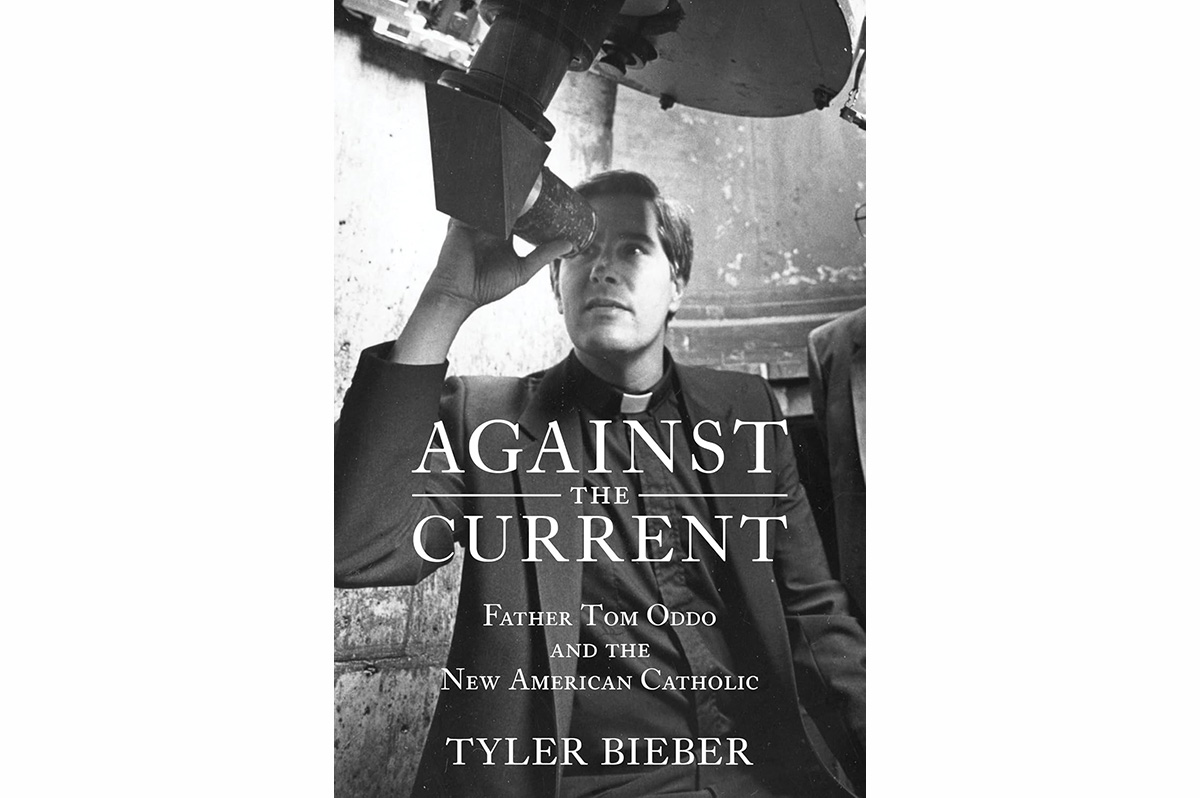
The author of a biography of a U.S. Catholic priest said to have advocated for support by the Catholic Church of gay Catholics in the early 1970s has called Father Thomas ‘Tom’ Oddo a little known but important figure in the LGBTQ rights movement.
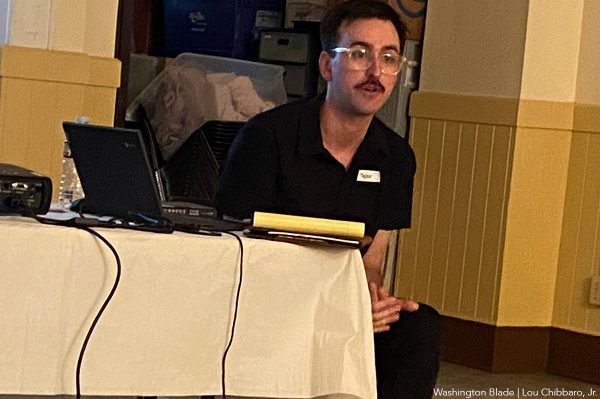
Tyler Bieber, author of the recently published book “Against The Current: Father Tom Oddo And the New American Catholic,” told of Oddo’s life and work on behalf of LGBTQ rights at a March 22 talk before the local LGBTQ Catholic group Dignity Washington.
Among Oddo’s important accomplishments, Bieber said, was his role as a co-founder of the national LGBTQ Catholic group Dignity U.S.A. in 1973 at the age of 29.
But as reported in the prologue of his book, Bieber presented details of the sad news that Oddo died in a fatal car crash in 1989 at the age of 45 in Portland, Ore., where he was serving as the highly acclaimed president of the University of Portland, a Catholic institution.
“He was a major figure in the gay rights movement in the 1970s, an unsung hero of that movement,” Bieber told Dignity Washington members, who assembled for his talk in a meeting room at St. Margaret Episcopal Church near Dupont Circle, where they attend their weekly Catholic mass on Sundays.
“And Dignity U.S.A. saw intense growth in membership and visibility” during its early years under Oddo’s leadership, Bieber said. “The story of Father Tom and his contemporaries is a story largely untold in the history of the gay rights movement, but one worth knowing and considering,” he said.
As stated in his book, Bieber told the Dignity Washington gathering Oddo was born and raised in a Catholic family on Long Island, N.Y., and attended a Catholic high school in Flushing Queens. It was at that time when he developed an interest in becoming a priest, according to Bieber.
After studying at the University of Notre Dame and completing his religious studies he was ordained as a priest in 1970 and began his work as a priest in the Boston area, Bieber said. It was around that time, Bieber told the Dignity Washington audience, that gay Catholics approached Oddo to seek advice on how they should interact with the Catholic Church. It was also around that time that Oddo became involved in a group supportive of then gay Catholics that later became a Dignity chapter in Boston.
In a development considered unusual for a Catholic priest, Bieber said Oddo in 1973 testified in support of gay rights bill before a committee of the Massachusetts Legislature and collaborated with then Massachusetts gay and lesbian rights advocate Elaine Noble.
In 1982, at the age of 39, Oddo was selected as president of the University of Portland following several years as a college teacher in the Boston area, Bieber’s book states. It says he was seen as a “vibrant and capable administrator who delivered real results to his campus,” adding, “His magnetism was obvious. One student described him as ‘John Kennedyesque’ to the university’s student newspaper.”
Bieber said that although Oddo was less active with Dignity U.S.A. during his tenure as UP president, he continued his support for gay Catholics and what is now referred to as LGBTQ rights.
“For those that knew him prior to his term at UP, though, he represented something greater than an accomplished university administrator and educator,” Bieber’s book states. “He was a new kind of priest, a gay man living and ministering in a world set loose from tradition by the Second Vatican Council,” the book says.
It was referring to the Vatican gathering of worldwide Catholic leaders from 1962 to 1965 concluding under Pope Paul VI that church observers say modernized church practices to allow far greater participation by the laity and opened the way for sympathetic consideration of gay Catholics.
District of Columbia
HRC to host National Rainbow Seder
Bet Mishpachah among annual event’s organizers
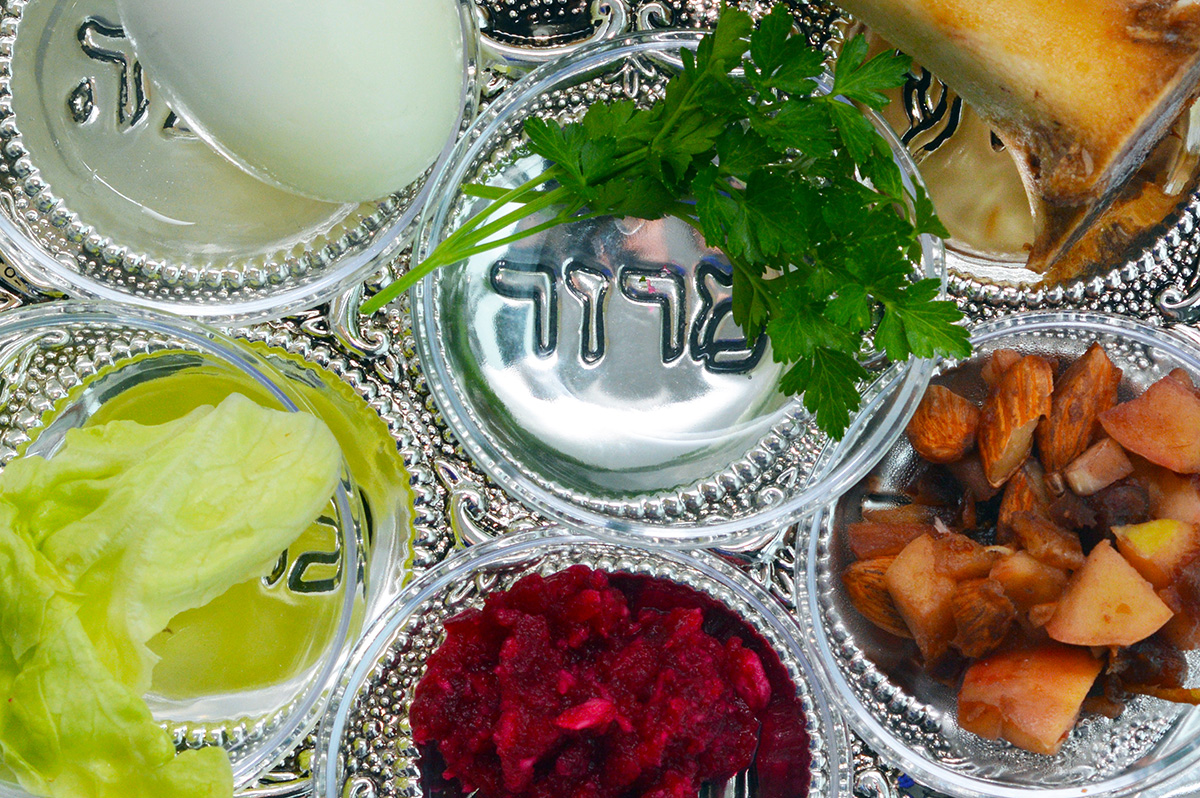
The 18th National Rainbow Seder will take place at the Human Rights Campaign on Sunday.
The sold out event is the country’s largest Passover Seder for the Jewish LGBTQ community.
Organizations behind the event include Bet Mishpachah, a local D.C. LGBTQ synagogue that Rabbi Jake Singer-Beilin leads, and GLOE, an Edlavitch DC Jewish Community Center program that sponsors events for the queer Jewish community. The theme for this year’s Seder is “Liberation For All Who Journey: Remembering, Resisting, Rebuilding.” Rabbis Atara Cohen, Koach Frazier, and Avigayil Halpern will lead it.
The Seder will honor the late GLOE co-chair Michael Singer. Singer also served on the Edlavitch DC Jewish Community Center’s board.
“This Seder is both a celebration of how far we have come and a call to continue building a more just and inclusive world.” Bet Mishpachah Executive Director Joshua Maxey told the Washington Blade.
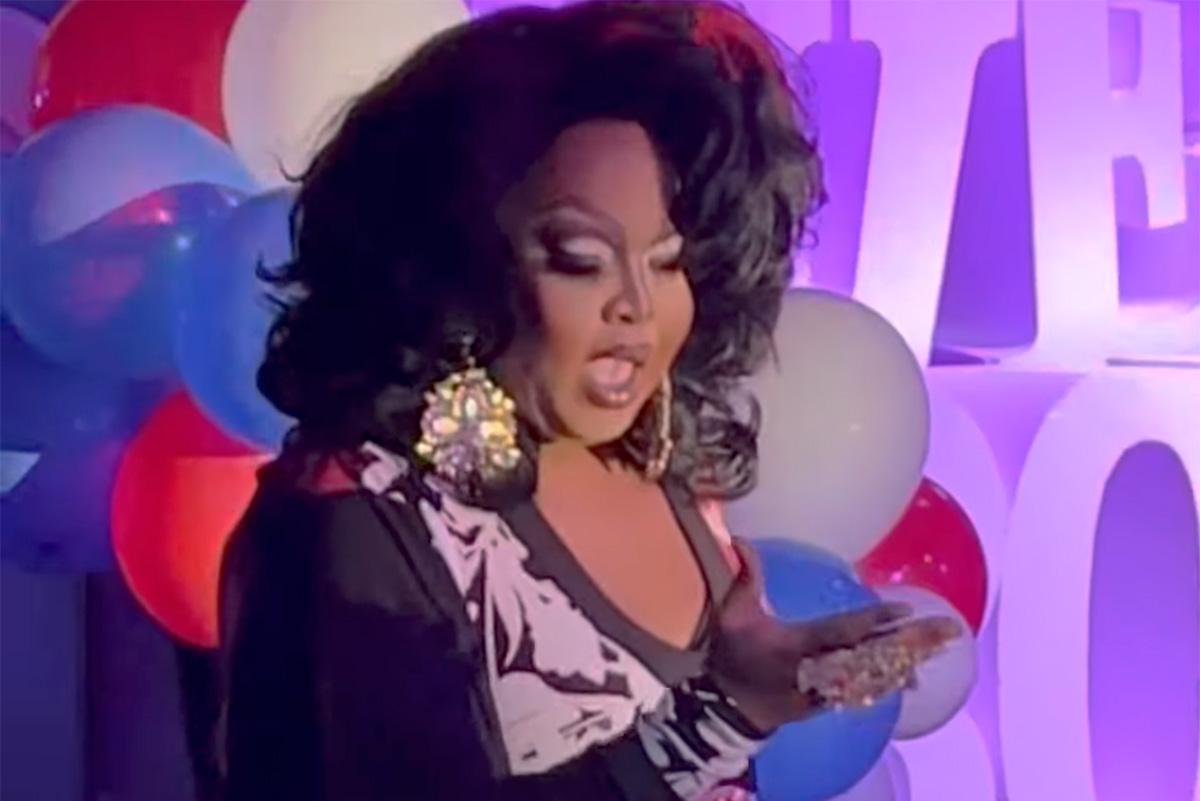
A gay man was murdered in Petersburg, Va., on March 13.
Shyyell Diamond Sanchez-McCray, who was also known as Saamel and Mable, was a drag queen who won the Miss Mayflower EOY pageant in 2015. Reports also indicate Sanchez-McCray, 42, was a well-known community activist in Virginia and in North Carolina.
Local media reports indicate police officers found Sanchez-McCray shot to death inside a home in Petersburg.
Sanchez-McCray’s brother, Jamal Mitchell Diamond, in a public statement the Washington Blade received from Equality Virginia and GLAAD, said Sanchez-McCray was not transgender as initial reports indicated.
“Our family has always embraced the fullness of who he was. He used the names Saamel, Shyyell, and Mable interchangeably, and we honor all of them. There is no division within our family regarding how he is being represented — only a shared commitment to preserving his truth with love and respect,” said Diamond.
“He was also deeply committed to community work through Nationz Foundation, where he worked and completed multiple state-certified programs to support marginalized communities,” added Diamond. “That work meant a great deal to him.”
Authorities have not made any arrests.
The Petersburg Bureau of Police has asked anyone with information about Sanchez-McCray’s murder to call Petersburg-Dinwiddie Crime Solvers at 804-861-1212.

DeSantis signs emergency bill that restores Fla. ADAP funding

Menaka Guruswamy celebrated as India’s first openly LGBTQ MP

Trans-led HIV clinic in Portsmouth struggles amid funding cuts

D.C. goes gaga for Gaga

Gay priest credited with boosting church support for LGBTQ Catholics

‘How We Survived’ panel set for March 25

Calendar: March 21-26

PHOTOS: Capital Stonewall Democrats 50th anniversary

‘Inherit the Wind’ isn’t about science vs. religion, but the right to think