Theater
New take on ‘Our Town’
Classic Americana piece reimagined with puppets
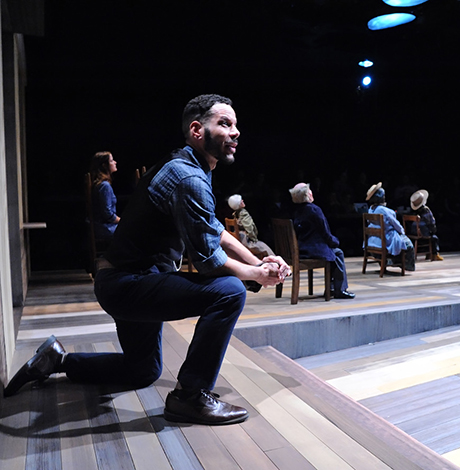
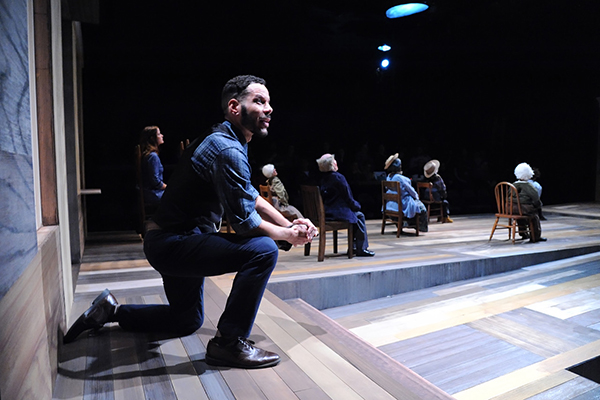
Jon Hudson Odom in ‘Our Town.’ (Photo by Stan Barouh; courtesy Olney)
‘Our Town’
Through Nov. 12
Olney Theatre Center
Mulitz-Gudelsky Theatre Lab
2001 Olney-Sandy Spring Road
$54-74
301-924-3400
Olneytheatre.org
Thornton Wilder’s “Our Town” and puppets. The two aren’t usually coupled, but that hasn’t deterred innovative director/ adapter Aaron Posner from bringing them together.
In his engaging new production of the 1938 American classic about love, loss and regret in small town America now playing at Olney Theatre Center, Posner uses just seven actors to play key roles and scarily expressive puppets to play the remainder of the townspeople.
Aaron explains his inspiration in the program notes. He’d been working on another show with “Our Town’s” puppet designer Aaron Cromie when he noticed a group of puppets seated onstage during a break. Posner immediately likened the tableau to “Our Town’s” final act (the cemetery scenes which ordinarily have a group of actors sitting stock-still in straight back chairs.).
His first instinct was right. When the racially diverse puppets, about the size of small children, are seated on tiny chairs in the cemetery they indeed appear solemn and eternal. And when they’re up and moving (manipulated and animated by the equally diverse cast) they’re endearing but a little hammy.
Like many lives, “Our Town” is divided into three acts: birth, marriage and death. For the residents of Wilder’s Grover’s Corner, New Hampshire, their daily lives are played out on Misha Kachman’s unadorned wooden set is a traverse stage with mirror image house facades on either end. Flat whitewashed plywood clouds hang above. The set is simple. Props are nonexistent (per Wilder’s direction). The blank space between the houses alternately serves as front yards, gardens, churches, Main Street and a graveyard.
Neighbors George Gibbs (William Vaughan) and Emily Webb (Cindy De La Cruz) have known each other all their lives. Staring dreamily at the bright moon from her bedroom window, teenage Emily Webb is clearly lovestruck. The object of her affection is George. Looking out from his window, George feels the same. In Grover’s Corner boys and girls grow up and marry. Even the few who go away to college return to the town.
Though tagged as one of the smartest girls ever to pass through Grover’s Corners’ public schools, Emily’s ambition dims as she focuses on marriage to classmate and wannabe farmer George. Yet dreams occasionally flame up, even in remote corners of New England. George’s mother, Mrs. Gibbs (Megan Anderson) longs to spend an inheritance on a trip to Paris where people “don’t speak English and don’t even want to,” but like a Fourth of July sparkler, her dream soon fizzles out. Instead, after Mrs. Gibbs’ death that legacy is spent to buy a state-of-the-art water trough for her son’s farm.
But small-town life is not for everyone. Case in point, Simon Stimson, the organist at the Congregationalist Church, here a disheveled puppet. Jolly church lady Luella Soames, also a puppet (delightfully animated by Odom), gossips about Stimson’s increasingly frequent drunkenness. Emily’s father and editor of the town paper, Mr. Webb (played by the excellent Todd Scofield), says, “Well, he’s seen a peck of trouble, one thing after another.” Later we learn that Stimson hangs himself in his barn and eventually ends up in the cemetery on the hill where proves embittered in death.
It’s been put forth by more than one Wilder scholar that Stimson represents a closeted gay man destroyed by life in a small town.
Wilder was gay, but never openly so. He’s been described as exceedingly discreet and a little self-loathing around the edges. But his friends and close associates knew he was gay. During the 1930s, he had a romantic relationship with Samuel Steward, a writer, pornographer, tattoo artist and one-time college professor, but reportedly was never too comfortable with intimacy.
Couched in a comfortable tale, Wilder talks about the vastness of the universe and mundanity of everyday life. He finds awesomeness in both. And though over the years “Our Town” has become associated with sentimentality and folksiness, it can still pack a wallop.
As stage manager, the play’s narrator who moves the drama along and freely converses with both actors and the audience, Helen Hayes Award-winning out actor Jon Hudson Odom is breezy and genial, yet markedly sincere where it matters. In the third act, he not only narrates but provides the voices for all the puppets patiently passing time in their graves. He deceptively makes it look so easy. It’s not.
Cindy De La Cruz is luminous as Emily Webb, convincingly moving from self-involved girl to young mother. She delivers her “goodbye to earth” monologue with a heartbreakingly light but moving touch.
Wilder’s play was edgy when it premiered with its scarcity of set and decoration. Director Posner whose production is faithful to the script and sanctioned by the Wilder Family Estate adds interest by paring down the cast and, of course, adding puppets. What’s more, Posner has the actors supply sound effects from the sidelines though still very much seen: cock crows, bird whistles, milk bottles clanging and an old egg beater provide the perfect sound for Mr. Webb’s manual lawnmower. The sounds of daily small-town life.






Theater
‘Jonah’ an undeniably compelling but unusual memory play
Studio production draws on scenes from the past, present, and from imagination

‘Jonah’
Through April 19
Studio Theatre
1504 14th St., N.W.
$55-$95 (discounts available)
Studiotheatre.org
Written by Rachel Bonds, “Jonah” is an undeniably compelling but unusual memory play with scenes pulled from the past, some present, and others seemingly imagined. Despite its title, the play is about Ana, a complicated young woman processing past trauma from the fragile safety of her usually quiet bedroom.
Studio Theatre’s subtly powerful production (through April 19) is finely realized. Director Taylor Reynolds smartly helms an especially strong cast and an inspired design team.
As Ana, out actor Ismenia Mendes radiates a quiet magnetism. She nails the intelligent woman with a hard exterior that sometimes melts away to reveal a warm curiosity and sense of humor despite a history of loss.
When we first meet Ana, she’s a scholarship student at a boarding school where she’s very much on the radar of Jonah, a sensitive day student (charmingly played by Rohan Maletira). Initially reluctant to know him, Ana soon breaks the ice by playfully lifting her shirt and flashing him. It’s a budding romance oozing with inexperience. And just like that, there’s a blast of white light and woosh, Jonah’s gone. Literally sucked out of an upstage door.
Clearly romanticized, the scenes between Ana and Jonah are a perfect memory captured in time that surely must be too good to be entirely true.
“Jonah,” a well-made nonlinear work, is pleasing to follow. Each of Bond’s scenes end with a promise that more will be revealed. And over its almost two hours, Ana’s story deftly unfolds in some satisfying ways, ultimately piecing together like a puzzle.
Next, Ana is a college writing student. She’s alone in her dorm room when volatile stepbrother Danny (Quinn M. Johnson) visits the campus. Growing up in Detroit, Danny was Ana’s protector taking the brunt of her stepfather’s abuse after the untimely death Ana’s mother. Now, he’s sort of a clinging nuisance; nonetheless, they maintain a trauma rooted relationship.
And finally, 40ish and still guarded, Ana is a published writer. While working in her bedroom at a rural writer’s retreat, she’s joined by a nerdy stranger, Steven (Louis Reyes McWilliams). At first annoyed by this fellow writer’s presence, Ana is ultimately won over by his dogged devotion, sincerity, and kind words. What’s more, he’s not unacquainted with abuse, and he’s willing to delve into discussions of intimacy. Again, is it too good to be true?
Chronology be damned, these three male characters come and go, dismissed and recalled. It’s through them that Ana’s emotional journey is reflected. They pursue, but she allows them into her life in different ways for different reasons.
Bonds, whose plays have been produced at Studio in the past (world premiere of “The Wolfe Twins” and “Curve of Departure”), and Reynolds who scored a huge success directing Studio’s production of “Fat Ham” in 2023, are well matched. Reynolds’s successful intimate staging and obvious respect for the script’s serious themes without losing its lighter moments are testimony to that.
Essential to the play is Ana’s bedroom created by set designer Sibyl Wickersheimer. It’s a traditional kind of bedroom, all wooden furniture with a neat and tidy kind of farmhouse feel to it. There are two large window frames with views of darkness. It could be anywhere. The only personal items are writing devices and maybe the lived-in bedding, but other than that, not a lot indicates home.
Theater
‘Inherit the Wind’ isn’t about science vs. religion, but the right to think
Holly Twyford on new role and importance of listening to different opinions

‘Inherit the Wind’
Through April 5
Arena Stage
1101 Sixth St., S.W.
Tickets start at $73
Arenastage.org
When “Inherit the Wind” premiered on Broadway in 1955 with a cast of 50, its fictional setting of Hillsboro, an obscure country town described as the buckle on the Bible Belt, was filled with townspeople. And now at Arena Stage, director Ryan Guzzo Purcell has somehow crowded Arena’s large Fichandler space with just 10 actors, five principals and a delightful ensemble of five playing multiple roles.
Inspired by the real-life Scopes Monkey Trial of 1925, Jerome Lawrence and Robert E. Lee’s fictionalized work pits intellectual freedom against McCarthyism via the imagined trial of Bertram Cates (Noah Plomgren), a Tennessee educator charged with teaching evolution. Drawn into the fracas are big shot lawyers, defense attorney Henry Drummond (Billy Eugene Jones), and conservative prosecutor, Matthew Harrison Brady (Dakin Matthew). On hand to cover the closely watched story is wisecracking city slicker and Baltimore reporter E.K. Horneck (played by nonbinary actor Alyssa Keegan).
Out actor Holly Twyford, a four-time Helen Hayes Award winner who has appeared in more than 80 Washington area plays, is part of the ensemble. In jeans and boots, she memorably plays Meeker, the bailiff at the Hillsboro courthouse and the jailer responsible for holding Cates in the days leading to his trial.
Twyford also plays Sillers, a slack jawed earnest employee at the local feed store who’s called to serve on the jury. And more importantly she plays Brady’s quietly strong wife Sarah whom he affectionately calls “Mother.”
When Twyford makes her memorable first entrance as Meeker, she’s wiping shaving cream from her face with a hand towel. With shades of Mayberry R.F.D., the jail is run casually. Meeker says Cates isn’t the criminal type, and he’s not.
“There’s a joke among actors,” says Twyford. “When an actor gets his shoes, they know who their character is. And it’s sort of true. When you put on boots, heels, or flip flops, there’s a different feeling, and you walk differently.”
Similarly, shares Twyford, it goes for clothes too: “When Mother slips a pink coat dress over her cowboy boots, dons a little hat and ties her scarf, or Meeker puts on his work shirt, I know where I am. And all of that is thanks to a remarkable wardrobe crew.
“Additionally, some of the ensemble characters are played broadly which is helpful to the actors and super identifying for the audience too.”
During intermission, an audience member loudly described the production as “a proper play” filled with beautifully written passages. And it’s true. Twyford agrees, adding “That’s all true, and it’s also been was fun for us to be a part of the Arena legacy as well. Arena took ‘Inherit the Wind’ to the Soviet Union in the early ‘70s when the respective governments did a cultural exchange. At the time, the iron curtain was very much in place, and they traveled with a play about a man with his own thoughts.”
When the ensemble was cast, actors didn’t know which tracts exactly they were going to play. “What came together was a cast, diverse in different ways. Some directors, including myself when I direct, are interested in assembling a cast that’s a good group. No time for egos. It’s more about who will make the best group to help me tell this story.”
At one point during rehearsal, ensemble members began to help one another with minor onstage costume changes, like jackets and hats: “We just started doing it and Ryan [Guzzo Purcell] picked up on it, saying things really began to come alive when we helped each other, so we went with that.”
“For me, it was reminiscent of ‘The Laramie Project’ [Ford’s Theatre in 2013] when we played five different parts and we’d help each other with a vest or jacket in a similar way. It worked so well then too,” says Twyford.
“Inherit the Wind” isn’t about science versus religion. It’s about the right to think, playwright Jerome Lawrrence has been quoted as saying. And it’s a quote that makes the play that much more relevant today.
Twford remembers a chat in a hair salon: “I was getting my hair cut and the woman next to me shared that she was tired of message plays. Understandably there are theater makers who believe that message plays are the point, while others think it’s all about entertainment. I feel like ‘Inherit the Wind’ sits in a nice place in the middle.”
She adds “the work is a creative way of showing different opinions and that, I think, is what we should be paying attention to right now. Clearly, it’s not right or wrong to express what you think.”

Ideally, spring is our season of renewal – personal, emotional, and social. Lucky for those in the DMV, there’s a lot of exhilarating new theater to help make it happen.
At Arena Stage, there’s still time to catch the world premiere production of “Chez Joey” (extended through March 22). Set around the 1940s Chicago jazz scene, this smart reboot of the Broadway classic “Pal Joey” effervesces with music by Rodgers and Hart and a terrific cast brimming with big talent (including Myles Frost, Awa Sal Secka, and out comedic actor Kevin Cahoon).
Also at Arena, is “Inherit the Wind” (through April 5), the extraordinarily timely work based on the real-life Scopes “Monkey” Trial. It’s a courtroom drama that pits two towering legal minds against each other in a small-town battle over science, religion, and the right to think. The large, talented cast includes Billy Eugene Jones, Dakin Matthews, and out actors Holly Twyford and Alyssa Keegan. Arenastage.org
La Pluma Theatre, a queer Latin company housed in Dupont Underground, presents “The Ladybird of Saint John” (April 6-12), a powerful story about two sisters navigating immigration, separation, and the fragile bonds of family. @laplumatheatre – Instagram
Great gay playwright Tennessee Williams’ “A Streetcar Named Desire” (April 20–May 4) is also coming to the Dupont Underground space. Directed by out actor/director Nick Westrate, the touring production of Williams’s classic work set in New Orlean’s steamy Vieux Carré is performed with neither set nor props. It focuses on the words. Lucy Owen and Brad Koed star as fragile Blanche Dubois and her brutal brother-in-law Stanley. Dupontunderground.org
Folger Theatre is serving up one of the Bard’s best comedies, “As You Like It” (through April 12). Staged by out director Timothy Douglas, Folger’s production “offers a love note to D.C., imbuing the forest of Arden with the familiar vibes, culture, and characters that mark the District as a singular, resilient, and redemptive place of belonging.” Folger.edu
As part of the country’s semi-quincentennial celebrations, Ford’s Theatre presents “1776” (through May 16), a Tony Award-winning musical about the Second Continental Congress’s struggle to adopt the Declaration of Independence in Philadelphia. Directed by Luis Salgado, the show features a large cast including queer talent like Tom Story, Jake Loewenthal, Jimmy Mavrikes, and Wood Van Meter. Fords.org
In Falls Church, Creative Cauldron presents “Twelve Dancing Princesses” (through March 29), a Learning Theater Production targeting both kids and adults. Adapted from a Brothers Grimm tale, the eerie story features Spanish language elements and original music by husbands Matt Conner and Stephen Gregory Smith. Creativecauldron.org
The National Theatre presents “Disney’s Beauty and the Beast” (March 18–April 5). This musical “tale as old as time” is a love story involving Belle, a cursed beast, and the arrogant and famously spurned Gaston played out actor Stephen Mark Lukas, a beauty in his own right. Broadwayatthenational.com
At Mosaic Theater Company, Michael Bahsil-Cook plays the titular activist/congressman in Psalmayene 24’s “Young John Lewis: Prodigy of Protest.” (March 26–May 3). Staged by Mosaic’s out artistic director Reginald L. Douglas, focuses on Lewis’s formative years of ages 18-28, revealing the budding humanity and heart of this mighty historic figure. Talented out actor Vaughn Ryan Midder plays legendary civil rights activist Medgar Evers and other parts. Mosaictheater.org
At Olney Theatre Center, it’s the anticipated area premiere of “Appropriate” (March 18–April 19). Penned by Tony Award-winning out playwright Branden Jacobs-Jenkins, the darkly comic work follows a dysfunctional white family that gathers on a plantation home to liquidate their late father’s estate where they uncover a dark history of racism.
Excellent area actors Kimberly Gilbert and Cody Nickell play siblings battling over possessions as well as their father’s shady legacy. Performed in Olney’s black box Mulitz-Gudelsky Theatre Lab, the company promises a unique staging of this important American play. Jason Loewith directs.
Also at Olney Theatre, celebrity chef and longtime queer ally Carla Hall debuts her one-woman show, “Carla Hall — Please Underestimate Me” (June 3–July 12). Olneytheatre.org
British imports are striding the boards at Shakespeare Theatre Company this spring. The first is “Hamnet” (March 17–April 12), the U.S. premiere of the Royal Shakespeare Company’s 2023 stage adaptation of Maggie O’Farrell’s best-selling novel about the life of Shakespeare’s wife, Agnes, and the death of their son.
And then it’s “Eddie Izzard in the Tragedy of Hamlet” (March 27–April 11), a one-woman show in which the British comedian takes on 23 characters in a unique re-telling of the renowned work. Shakespearetheatre.org
Woolly Mammoth Theatre presents “Travesty” (March 24–April 12). Created and performed by gender fluid drag performer Sasha Velour, the one-person show is part performance art, part history, and part call to action.
Also at Woolly, out actor Justin Weaks stars in his solo piece “A Fine Madness” (June 2–21), in which the Helen Hayes Award-winning actor shares his personal experience as a Black gay man receiving a positive HIV diagnosis. Woollymammoth.net
Spring at Studio Theatre is Rachel Bonds’ “Jonah” (through April 19), an exploration of a woman’s life through relationships with three men. Directed by Taylor Reynolds, the four-person cast includes Rohan Maletira in the title role and Ismena Mendes as Ana. Mendes is an accomplished stage and screen actor whose described as bisexual/queer in her IMBD bio. Studiotheatre.org
In Arlington, Signature Theatre’s out artistic director Matthew Gardiner stages “Pippin” (May 12–July 26), Stephen Schwartz’s musical about a young prince searching for a terrific life guided by a theatrical troupe. The original 1972 production featured stars like Ben Vereen and Irene Ryan (best known as TV’s Granny Clampett). Signature’s production’s big names have yet to be shared. Sigtheatre.org
Exciting stuff ahead.

The cost of speaking one’s mind

Senegalese president signs bill that further criminalizes homosexuality

Md. lawmakers reaffirm legislative priorities

Supreme Court rules against Colo. law banning conversion therapy for minors

Thousands attend ‘No Kings’ protests in D.C.

Celebrate cherry blossoms the drag way

Lorato ke Lorato: marriage equality, democracy, and the unfinished work of justice in Botswana

Japanese Supreme Court to consider marriage equality

The outrage economy is not the LGBTQ community

Anti-trans visa ruling echoes Nazi regime destroying trans documents
-

 Out & About4 days ago
Celebrate cherry blossoms the drag way
-
Botswana4 days ago
Lorato ke Lorato: marriage equality, democracy, and the unfinished work of justice in Botswana
-
Japan4 days ago
Japanese Supreme Court to consider marriage equality
-
Opinions4 days ago
The outrage economy is not the LGBTQ community