Opinions
An appeal for more conversation and less rage
What happens when you get kicked out of a restaurant?
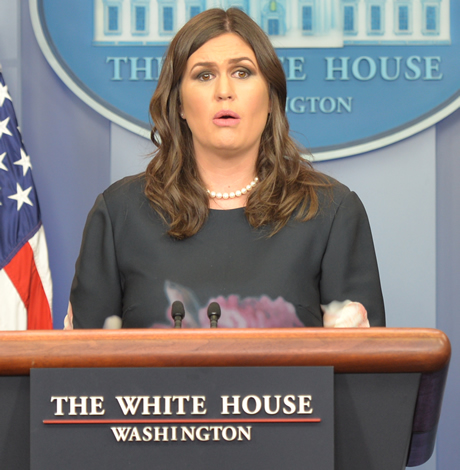
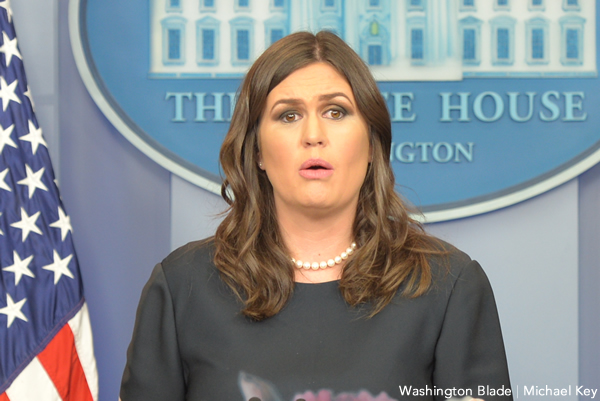
White House Press Secretary Sarah Huckabee Sanders (Washington Blade photo by Michael Key)
The hills are alive, and it’s pretty frightening, as Barbra Streisand sang way back in 1967. That was a turbulent time, like this one. And it’s not music in the air. It’s malice. Dangerous, misguided, naive malice.
We have gone from it’s OK to agree to disagree to I will ruin your dinner, and worse, if you don’t agree.
Case in point: in a recent column for the Blade, Peter Rosenstein says it was just fine to kick Trump spokeswoman Sarah Sanders out of the Red Hen restaurant. He argues, with hysterical irony, that we can “make a point in a civil way and try to educate her” by refusing her service in a public establishment. Civil? Educate her? Where is the Red Hen? The gulag?
Kids, this is madness. And certainly Trump’s own nasty rhetoric has fanned the flames. But it is a very, very slippery slope. Sliding down that slope with her usual wild abandon we now have Maxine Waters. Harass them all. Not just when they order a cheeseburger. But, at gas stations. At department stores. Anywhere you see them. Charge, dahlings, charge!
But is that who we are? Are we really going to sink that low? And if it’s OK for you to kick them out today, will it be OK for them to kick you out tomorrow? Who gets to decide who are the angels and who are the demons? And is it really that clear cut? Maybe we need less rage. Maybe we need more conversation.
Politics, to anyone who has ever swam in those currents, is muddy water. But to righteous zealots — on either side — it is all crystal clear. All smooth sailing in a world of good guys and bad guys. If only it were that simple. It isn’t.
Rosenstein is a Democratic Party activist. He has every right to assert that Trump is the enemy of women, immigrants, African Americans, gay people, and all that is good and holy. Others have every right to disagree with him. But, rather than have a rational conversation on the issues, usually there is no conversation at all. Not if you want dinner.
Mae West once said, “I used to be Snow White, but I drifted.” Honey, we’ve all drifted. Politics is not the stuff of purity. And it does not justify screaming at people in restaurants or refusing to sell them gas at Exxon.
Politicians are not angels. They are not demons. They are politicians. When Barack Obama ran for the Illinois state Senate, from a liberal district, he supported gay marriage. But, when he ran for the U.S. Senate, and needed more, shall we say, diverse support, he was against it. When he ran for president, the first time, he still opposed gay marriage. So, was he the devil then? But, he’s an angel now? When do these lines get drawn? And who gets to draw them?
Or, for a more current example, consider Sen. Kirsten Gillibrand. Senator Gillibrand wants to be president. She is everything the left presumably believes is on the side of the angels.
Sen. Gillibrand may be singing with the choir now. But, when she represented a more conservative upstate New York district in Congress, it was a far different tune. She had an A rating from the NRA. The Human Rights Campaign gave her the lowest rating on gay issues for any New York Democrat. She supported a balanced budget and opposed deficit spending. She supported fining sanctuary cities. Supported making English the national language. Yes to stronger border enforcement. No to amnesty for illegal immigrants. And for good measure no driver’s licenses either. Heresy! She sounds, well, kind of Trumpian.
That was then. This is now. Gillibrand, with her eyes on the White House, has gone from A to F with the NRA. Suddenly she wants to abolish ICE. And every entitlement is a good entitlement. One might reasonably ask: purity or politics? At what point was it OK for her to keep her menu and order? Which is not to ignore that Trump has his own history of flipping and flopping. Muddy water, my dears, muddy water.
Michelle Obama famously said that we go high when they go low. If only. We live now in a world of intolerance. Of rage. And hypocrisy. The sound of malice. And of silence.
It didn’t use to be this way. Ted Kennedy and Orrin Hatch — fierce opponents on the Senate floor — were great friends in the Senate dining room. They didn’t disrupt each other’s dinner. They had dinner together. They behaved like intelligent, civil human beings. And for all their differences, guess what, sometimes they actually worked together.
Now that sounds heavenly.
Jack Gardner is a former speechwriter in the U.S. Senate. He worked for Sen. Tom Udall (D-N.M.) and Sen. Robert Byrd (D-W.Va.)



Opinions
Literature is my companion
I’ve lived in Russia, Pakistan, India, but books are always home

People often ask where I am from and I never know how to answer.
The factual answer is straightforward enough: I was born in D.C., spent parts of my childhood in Pakistan and India, lived in Moscow, and later in Jordan before eventually settling in the United States. The emotional answer is much more complicated. Home kept changing. Languages changed. Schools changed. Friends changed.
The only country I never had to leave was literature.
Some children grow up with a single hometown that anchors their memories. I grew up with departure lounges, embassy compounds, cardboard boxes, and the understanding that permanence was a temporary arrangement. Just when I learned the shape of one place, another place arrived. By the time I reached adulthood, I had become adept at beginning again.
Books offered a different bargain. They asked only that I return.
I was too young in Saudi Arabia to remember much beyond fragments and family stories. Pakistan arrived as mountains and long drives. We passed through Abbottabad on our way to ski slopes, the landscape unfolding in a way that felt both ancient and immediate. Even as a child, I found comfort in reading during those journeys. A book transformed transit into destination. The hours belonged to a story rather than to geography.
India deepened that relationship. I remember wandering through bookstores near Khan Market in New Delhi, clutching bags of Lay’s chips and searching for something new to carry home. There was a particular joy in rummaging through shelves without any plan, allowing a title or a sentence to find me first. Outside our house, cows grazed peacefully on the grass, untouchable and entirely unconcerned with human schedules. Street vendors sold samosas that remain among the best food I have ever eaten. The world outside was vibrant, crowded, and overwhelming in the best possible way. Reading provided a parallel world—equally rich, but one I could enter and leave on my own terms.
By the time we moved to Moscow, literature had become less of a pastime and more of a companion.
Winters in Russia bring their own emotional architecture. The days contract. Darkness arrives early. At diplomatic receptions in Spaso House, there were blinis, caviar, Christmas cookies, and annual performances of “The Nutcracker.” Yet beyond the formal rituals of diplomacy stood an extraordinary literary inheritance. To live in Moscow is to feel, even faintly, the presence of writers who treated human suffering and longing with unmatched seriousness.
I found myself drawn to Fyodor Dostoevsky and his insistence that contradiction lies at the center of being human. You can hold faith and doubt simultaneously. You can seek love while fearing intimacy. You can desire freedom and still long for belonging. For someone who already felt different from those around him, those lessons mattered. Literature granted permission to be complicated.
Jordan, perhaps more than anywhere else, taught me that books and places can become intertwined. I think of afternoons in Jabal Amman and evenings near Rainbow Street. I think of traveling through Wadi Rum, floating in the Dead Sea, hiking through Wadi Mujib, and standing in Petra with the humbling awareness that civilizations outlast individual lives. Reading in such places changed the texture of the act itself. The world felt larger, and so did the questions worth asking.
People sometimes imagine literature as an escape from reality. I have never understood it that way.
For me, books did not remove me from the world. They taught me how to inhabit it.
They taught me that loneliness is a universal experience rather than a personal defect. They taught me that identity can be layered and unfinished. They taught me that grief and beauty frequently occupy the same sentence. Most importantly, they taught me that human beings across centuries and continents ask remarkably similar questions: Who am I? What do I owe others? How should I live?
Those questions followed me to college, where literature ceased to be merely a private refuge and became an intellectual vocation. Yet even then, I recognized that my relationship to books differed from that of many peers. I did not simply love reading. I depended upon it. Literature had functioned as continuity in a life defined by movement.
Other people had hometown diners, childhood neighborhoods, and lifelong classmates. I had novels, essays, and poems that accompanied every relocation.
Perhaps that is why I remain skeptical of narrow definitions of belonging. Home is not always a fixed point on a map. Sometimes it is a practice. Sometimes it is a set of stories you carry from one country to another. Sometimes it is a shelf of books that survives every move.
The older I become, the more grateful I am for that inheritance.
Long before I understood my identity, my ambitions, or even the shape of the life I wanted to build, I understood that books offered something enduring. They expected nothing from me except attention. They never demanded reinvention. They remained patient through every transition.
I have left many places behind over the course of my life. Literature, thankfully, never left me.
Isaac Amend is a writer based in the D.C. area. He is a transgender man and was featured in National Geographic’s ‘Gender Revolution’ documentary. He serves on the board of the LGBT Democrats of Virginia. His portfolio is available at isaacamend.com and you can contact him on Instagram at @isaacamend.
Opinions
ROSENSTEIN: Vote Susan Stewart for mayor of Rehoboth Beach
She says LGBTQ contributions have shaped town’s character
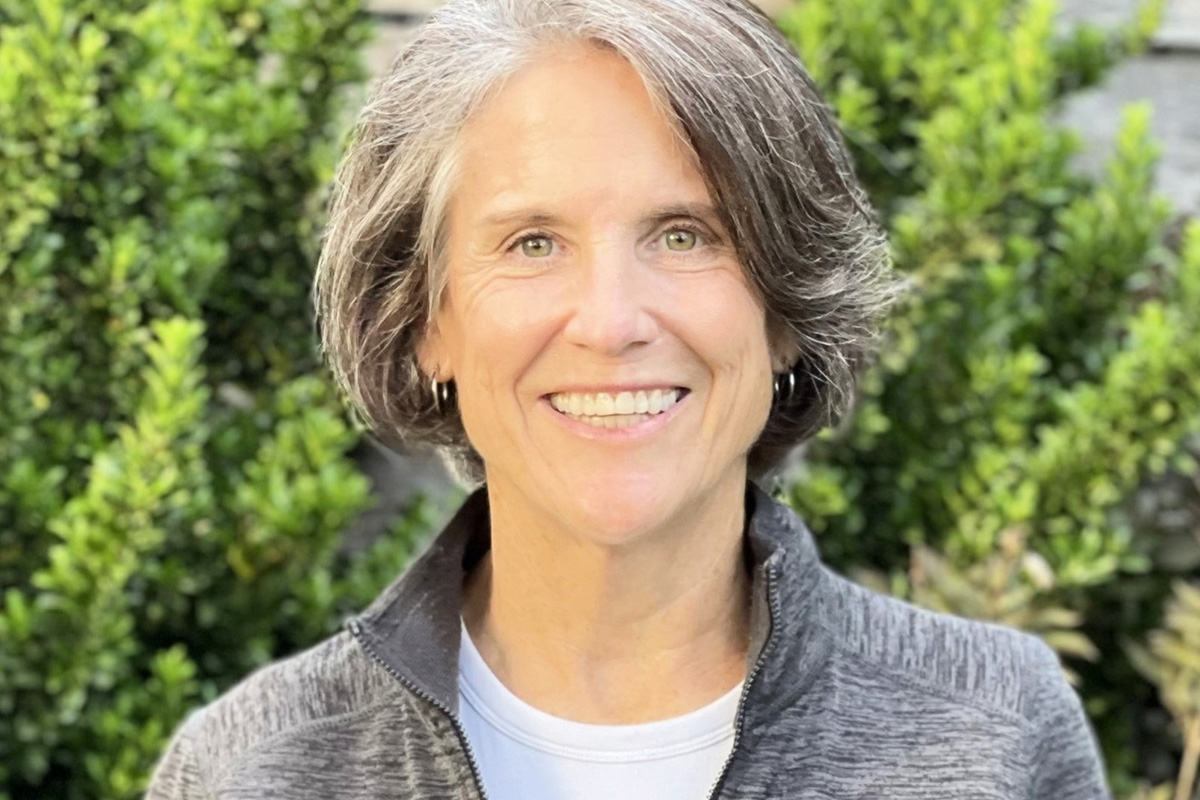
There is really only one clear choice for mayor of Rehoboth Beach, and that is Susan Stewart. She has the experience, knowledge, and clear vision, to successfully lead the city forward. If you want to see in detail what her priorities are, check out her website, www.Stewart4Mayor.com.
I have been coming to Rehoboth Beach for more than 40 years and love it. I want to see it continue to thrive, and be the place where people will enjoy living, retiring to, and vacationing. All those factors are important to consider when choosing the next mayor.
Susan has said, “I will work to preserve the character of Rehoboth Beach while responsibly investing in the infrastructure, financial stability, and community partnerships needed for the future.” She understands it is important to manage growth if you are to maintain a great quality of life, and sense of belonging, for those who live there now, and those who will come in the future. In a conversation I had with her, she said something important to me. She said, “As mayor, I will make sure every resident, regardless of who they are or whom they love, feels welcome and represented at City Hall. Rehoboth Beach has long been a place where the LGBTQ community has found belonging, built businesses, and shaped the character of this city. That is not incidental to what makes Rehoboth special. It is central to it.” She went on to say, “Our city works best when all residents feel heard, respected, and engaged in the decisions that affect their lives. I am committed to bringing people together around shared priorities, and practical solutions.”
When it comes to the city’s financial picture and growth Susan said, “A town’s growth must reflect the community’s values, not be imposed upon it. I am committed to collaborate with the community to preserve the walkable scale, natural beauty, and neighborhood character, that make Rehoboth Beach irreplaceable.” Susan understands investments in the future must be made in a thoughtful way to guarantee the city continues to thrive. This includes maintaining a great quality of life, with clean streets, safe and attractive structures, accessible beaches, and a vibrant commercial district. Every decision made by the mayor, with the Commission, must ensure that those who live here, feel the city truly belongs to them.
Susan began her career as an attorney, then transitioned into the financial services sector. Her early experience included roles at major banks and brokerage firms, where she developed deep expertise in investment strategy, and client advising. In 1996, she founded her own financial advisory firm where she advised high net worth individuals and families, managing large-cap equity mandates for several state retirement systems and a Fortune 500 company. After successfully leading the firm for 15 years, she closed it in 2011 and returned to the brokerage industry. Today, she is a financial adviser, and senior vice president with The StewartGroup, RBC Wealth Management. Her daughter, Taylor Stewart, is a business partner in their practice. Stewart works remotely from her home in Rehoboth Beach. She holds a bachelor’s degree from Ursinus College; and a Juris Doctor from The Dickinson School of Law, Pennsylvania State University. She is deeply committed to public service, and currently serves on the City of Rehoboth Beach Commission, and has previously served on the Planning Commission, as well as the Mixed-Use and Stormwater Utility Task Forces. She is also a member of the board of trustees for Ursinus College.
With her strong financial background people can be assured Susan will ensure Rehoboth Beach maintains its strong fiscal position. Contrary to what one of the commissioners who is also running for mayor has said, Rehoboth is in strong fiscal shape. It is projected the city will end the year with a surplus of about $1.5 million, and projections are for surpluses through 2031. With her financial background, Susan has the ability to manage taxpayer resources carefully, and has committed to maintaining healthy reserves for the future. She understands any investments must deliver lasting value for residents.
Susan hopes to engage with residents on important questions like deciding which infrastructure projects should be the top priority; how the city should use reserves that exceed its own requirements; what investments will deliver the most value to residents; and how to maintain long-term financial stability while meeting community needs. I believe as an experienced professional, Susan truly believes these are the real policy conversations that should be had, and she will have them.
Since I have heard people discussing another candidate for mayor, Commissioner Suzanne Goode, it is important to recognize she clearly doesn’t represent the people, or values, we have come to love about Rehoboth Beach. I last wrote about her when she tried to have her husband elected to join her on the Commission. She thought that was an appropriate thing to do. If she is elected mayor, will she try to have her husband appointed to fill her seat on the Commission? Rehoboth Beach is better than that. When I last wrote about her, I said she appears to represent MAGA Republicans. Apparently, she cleaned up her Facebook page but it had included attacks on Obamacare, President Joe Biden, Hillary Clinton, and support for Ron DeSantis. That is not who we want for mayor of Rehoboth Beach.
On Saturday, Aug. 8, I urge you to cast your ballot for Susan Stewart for mayor. She will make us all proud.
Peter Rosenstein is a longtime LGBTQ rights and Democratic Party activist.
Opinions
Pro-trans court ruling does little for Naval healthcare worker
Trump administration should support accomplished service members

Following the start of the Iran war, many Americans were worried for the first time in decades about a potential draft. When asked about the possibility, White House Press Secretary Karoline Leavitt noted that it was not part of the current plans but that, “The president wisely keeps his options on the table.”
While the Trump administration did not rule out the option to conscript unwilling young citizens, it had no problem alienating willing service members, removing high-ranking female or African-American officers, and banning transgender people from serving in the military, stating that “a history of gender dysphoria is incompatible with the high physical, surgical, and mental health standards required for military service.”
The decision to discharge thousands of service members who have already proven their dedication and efficacy in serving their country, simply because of their gender identity, seems counterintuitive for a nation that has just struggled through a war, a regression toward a long past of discrimination in our military, and a ruling that has been questioned in judicial systems.
On June 1, the U.S. Court of Appeals for the D.C. circuit issued a decision blocking the government from discharging 28 transgender plaintiffs from the military (Talbott vs. United States), calling the policy “animus” toward a politically unpopular group. News outlets reported it as a win for LGBTQ rights, but that hardly seems to matter for the close to 15,000 other transgender military service members who have either already been separated or constantly fear that they will soon be removed.
I interviewed a recently separated transgender Naval healthcare worker for this editorial, who used the initial S. for anonymity and who told me that hearing the news of the Talbott court decision was more bitter than sweet, remarking, “While the recent ruling in favor of trans service members offers fleeting hope, Department of Defense Secretary Pete Hegseth has already announced the decision to appeal to the Supreme Court, where we will likely expect the same outcome as before. Unfortunately, any definitive outcome in favor of trans service members will likely come long after the damage has been done.”
Studies by the RAND Corporation have found that transgender military service showed no significant impact on operational readiness, and according to the BBC, the Department of Defense spends eight to 10 times more on erectile dysfunction drugs than on gender-affirming care.
S. served a critical role in the Navy, as active-duty service members are far more likely to experience mental health challenges than the civilian population, and it doesn’t sound like his gender identity was a problem for any of his coworkers: “Everyone judged me by my ability, not my identity; most of them didn’t know that I was transgender until the separation process forced my public acknowledgement.”
Dedicating years of his life to serving his country, not only did S. lose that dream, but it also impacted his entire caseload of clients. “One by one, I had to meet with them and explain that I was abruptly leaving the clinic and ultimately separating from military service. It was death by a thousand cuts—having to tell people back-to-back, session after session, that I could no longer work with them. Many of them were in the midst of their own crises while I was quietly navigating mine. It was heartbreaking.”
He also spent 11 months in a state of limbo, waiting to be officially separated – having secured a job at another federal agency and beginning to treat new patients, the Department of Defense rescinded its approval, citing that you cannot work at two federal agencies at once, and effectively sidelined a critical health care worker until they could formally discharge S. from the Navy.
The irony of citing mental health standards to remove a Naval healthcare worker in good standing, at a time when many personnel are in dire need of clinical care is notable. To maximize operational readiness, the Trump administration should not turn its back on accomplished service members who hold critical roles in the military.
Tyler Kania is an independent journalist and 2025 IAN Book of the Year finalist.

Authorities investigate officer-involved shooting outside Asheville gay bar

Popular Mount Vernon gay bar Leon’s to temporarily close after owner’s death

30 years on, ‘The Birdcage’ remains a landmark

Comings & Goings

Whitman-Walker to host legal services workshop

Parents sue Anne Arundel schools, allege officials hid child’s gender transition

Who might replace Lindsey Graham? The contenders and their LGBTQ records

Democrats are trying to disqualify trans candidates. Here’s how

PHOTOS: Emerald City Pride

PHOTOS: Westminster Pride
-

 Maryland5 days ago
Parents sue Anne Arundel schools, allege officials hid child’s gender transition
-
South Carolina5 days ago
Who might replace Lindsey Graham? The contenders and their LGBTQ records
-
National4 days ago
Democrats are trying to disqualify trans candidates. Here’s how
-
Photos5 days ago
PHOTOS: Emerald City Pride