National
LGBTQ community shared nation’s grief after 9/11 attacks
Gay passenger may have helped stop hijackers from crashing into White House
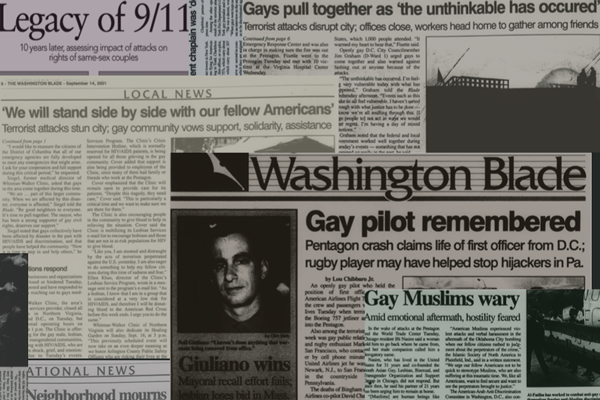
Many in the LGBTQ community throughout the country were expected to join their friends, neighbors, and family members this week in commemorating the 20th anniversary of the Sept. 11, 2001, terrorist attacks on the New York World Trade Center’s Twin Towers and on the Pentagon just outside Washington, D.C., as well as a hijacking that ended with a crash in Shanksville, Pa.
Activists involved with local and national LGBTQ advocacy organizations have said they recall a coming together of LGBTQ people and their co-workers, neighbors, and family members to support one another during a time of unimaginable horror and grief.
A total of 2,996 people died in the 9/11 attacks, including 19 terrorists who hijacked four jetliners whose passengers included Americans and citizens of 78 countries, according to history.com.
“The gay, lesbian, bisexual, and transgender communities and those living with HIV/AIDS have worked diligently to overcome other forms of evil, whether it be bigotry or violence,” said A. Cornelius Baker, who at the time was executive director of D.C.’s Whitman-Walker Clinic, in a statement during the week of the 9/11 attacks.
“And we will stand side by side with our fellow Americans and our fellow citizens of the world to do everything we can to overcome this new threat to humanity,” Baker said
For many LGBTQ residents of New York and the D.C. area, the suffering over the loss of loved ones, including same-sex partners, was heightened a short time later when they learned they were initially ineligible for local and federal programs aimed at providing financial assistance to survivors of the victims of the 9/11 attacks because same-sex partners were not legally recognized.
At the urging of LGBTQ rights organizations, state, and local officials in New York and the D.C. area took steps to address the initial denial of financial support for surviving same-sex partners in programs under their control. Officials with a massive, multi-million-dollar federal aid program for 9/11 survivors, however, said they did not have legal authority to authorize payments to same-sex partners.
The officials, in the administration of President George W. Bush, said the best they could do would be to leave it up to local authorities to determine whether state probate laws would recognize a same-sex partner as a family member for eligibility in the federal aid program for 9/11 survivors, many of whom lived in states outside New York and the D.C. area.
Among those who lost their lives in the 9/11 attacks was American Airlines co-pilot David Charlebois, an out gay man and member of the National Gay Pilots Association, who was on American Airlines Flight 77, which the terrorists crashed into the Pentagon.
Also among the terrorists’ victims in the 9/11 attacks was public relations executive and rugby enthusiast Mark Bingham of San Francisco, who contacted his mother by cell phone shortly before the United Airlines jet he was taking from Newark, N.J. to San Francisco crashed into the countryside in western Pennsylvania.
Surviving family members of other passengers on that flight have said they too were called by their loved ones who told them some of the passengers were planning an attempt to somehow regain control of the jet from the terrorists.
Bingham’s mother, Alice Hoagland, who at the time was a United Airlines flight attendant, said she believed her son joined other passengers to prevent the terrorists from carrying out what authorities said was their plan to crash the jet into the U.S. Capitol or possibly the White House. She said her son’s reputation as a fighter for civic justice, along with a past episode where he fought off muggers, led her to believe he was among those who foiled the terrorists’ plans to fly the jet to Washington.
An investigation into the 9/11 attacks by a federal 9/11 commission later found that flight data recordings from the cockpit of United Airlines Flight 93, where Bingham was among 44 people aboard, showed that one of the four hijackers who took control of the jetliner shortly after its takeoff responded to an attempt by passengers to storm the cockpit by deliberately steering the plane into a downward direction at about 500 miles per hour, causing it to crash into an empty field near the town of Shanksville in western Pennsylvania at 10:10 a.m. All 44 people were killed.
“The fact that he was so close to the action, it is likely that he was able to get at these guys,” Hoagland told the Associated Press. “It gives me a great deal of comfort to know my son may have been able to avert the killing of many, many innocent people,” she said.
Hoagland became an outspoken advocate for LGBTQ rights and for the gay rugby teams that Mark Bingham helped to create in the years after her son’s death. She died on Dec. 22, 2020, of natural causes at the age of 71 at her home in Los Gatos, Calif., according to the Associated Press.
Longtime LGBTQ rights advocate Jay Fisette, who at the time of the 9/11 attacks held the elected position of chair of the Arlington County Board, which serves as the county’s governing body, was among the Arlington officials that came to the Pentagon’s grounds to oversee efforts by Arlington firefighters to rescue Pentagon workers on the day of the attack.
Fisette noted that the Pentagon is in Arlington County, and it was largely the county’s firefighters and emergency medical teams that put out the fire caused by the jetliner crash and provided medical assistance to survivors of the crash.
At an Oct. 7, 2001, 9/11 Day of Remembrance and Appreciation ceremony held in Arlington, Fisette expressed the views of many in the community in response to the 9/11 attacks.
“Tonight, our community gathers as a family,” he told the gathering. “We gather in sorrow and in disbelief, in remembrance and appreciation,” he said. “But we come here, too, with resolve and pride. We come together as Arlingtonians who love our county, as Americans who love our country,” he said.
“Our enemies may hurt our bodies and destroy our buildings, but they will never defeat our determination to make this a world of peace and a community in which our children grow up safe and secure,” Fisette told participants at the gathering.
Although some of the same-sex partners of those killed in the 9/11 attacks faced obstacles in obtaining financial support through the federal 9/11 relief program, Tom Hay, the surviving partner of 14 years of American Airlines pilot David Charlebois was treated with respect and honor by American Airlines officials and colleagues at Charlebois’ funeral mass at D.C.’s St. Matthews Cathedral.
More than a dozen uniformed company pilots and flight attendants attended the mass. In a news release issued in June of this year, American Airlines mentions Charlebois’ relationship with Hay and tells how Hay stood with Charlebois when Charlebois pushed for equal rights for LGBTQ people in the airline industry through his involvement with the National Gay Pilots Association.
“David was an early member of the NGPA,” the American Airlines statement says. “His contribution helped ensure ongoing progress toward fairness and solidarity,” it says.
Activists in New York have said the 9/11 attacks drew attention to the need for legal protections for same-sex couples, including the need for legal recognition of same-sex marriage.
Ros Levi, who in 2001 served as executive director of the New York LGBTQ advocacy group Empire State Pride Agenda, or ESPA, said his group became aware that same-sex partner survivors were being treated differently when New York City and private relief agencies like the Red Cross set up an emergency station on a pier along the Hudson River. The station was intended to help people find a family member missing and as yet unaccounted for in the World Trade Center carnage.
“Literally, [gay] people had to go there, turn around, go back home, and get some paperwork that spouses didn’t have to get to prove a relationship existed,” Levi told the Washington Blade in 2011 when the Blade reported on the 10-year anniversary events related to the 9/11 attacks.
“You were nervous and scared and sad and then you had to go through that,” Levi said. “And worse, other people turned them away, even with the paperwork, saying sorry you’re not a family according to our guidelines.”
Activists said New York City and New York State officials quickly recognized the inequities faced by same-sex partner survivors and took steps to change policies and laws to correct the situation. Among other things, activists were pleased when New York’s then GOP Gov. George Pataki issued an executive order in October 2001 that included surviving partners of gay and lesbian victims of the World Trade Center attacks in receiving full spousal benefits from the state’s Crime Victims Board.
The New York State Legislature soon took its own action by approving three separate bills that included same-sex partner survivors in various state benefits to be allocated to 9/11 survivors and their families.
“The grief and loss were the same between heterosexual and same-sex couples, and a perception of this seemed to come through to much of the public,” said Jennifer Pizer, the then senior counsel for the LGBTQ litigation group Lambda Legal.
In a separate development, Lambda Legal, ESPA, the Human Rights Campaign and other LGBTQ advocacy groups created the September 11 Gay & Lesbian Family Fund to provide some support to surviving same-sex partners who were ineligible for help from the federal relief fund program.
“The Family Fund was established in December [2001] to help offset the discrimination gay and lesbian partners faced in obtaining benefits automatically afforded to surviving spouses, including Social Security and Workers Compensation survivor benefits and compensation under the Federal 9/11 Victims Compensation Fund,” ESPA said in a statement.
Among the other gay people known to have lost their lives in the 9/11 attacks was Father Mychal Judge, 68, a Franciscan priest who served as a Catholic chaplain for the New York City Fire Department. According to the National Catholic Reporter, Judge rushed to the scene of the World Trade Center to assist firefighters shortly before the Twin Towers collapsed. He was fatally struck by debris falling from the south tower while giving last rites to a fallen firefighter, the Catholic publication reported this week.
“He was a decent, wonderful human being,” said New York gay journalist Andy Humm, who had interviewed Judge for LGBT related stories prior to the 9/11 attacks. “When gays were kept out of the St. Patrick’s Day Parade, he gave me an interview on the street telling me how terrible it was for us to be discriminated against and for the church to be doing it,” Humm told the Blade.
“I saw him at many demonstrations for gay and AIDS causes, showing up in his Franciscan monk’s cassock,” said Humm. “And he was equally beloved by the Fire Department, there at every major fire tragedy in the city, lending moral support to firefighters.”
New Ways Ministries, the Maryland based LGBTQ Catholic group that advocates for LGBTQ supportive policies within the church, has announced it is reaching out to other faith-based organizations, asking them to form an association to call on the Catholic Church to officially recognize Fr. Judge as a saint by canonizing him.
Francis DeBernardo, New Ways Ministries’ executive director, has written a biography of Judge, which the group says will be published in March 2022 by Liturgical Press, one of the larger Catholic publishers.
A gay couple from California, Daniel Brandhorst and Ronald Gamboa, and their adopted son, David Brandhorst, were among those who died aboard the United Airlines flight that crashed in Pennsylvania. The Los Angeles Times reported that Brandhorst, a lawyer and Gamboa, the manager of a Santa Monica Gap store, had adopted 3-year-old David when he was an infant.


National
BREAKING NEWS: Shots fired at the White House Correspondents’ Dinner
Shooter reportedly opened fire inside hotel

Four loud bangs were heard in the International Ballroom of the Washington Hilton during the annual White House Correspondents’ Dinner on Saturday.
According to the Associated Press, a shooter opened fire inside the hotel outside the ballroom.
Attendees could hear four loud bangs as people started to duck and take cover. During the chaos sounds of salad and glasses were dropped as hotel employees, and guests ducked for cover.
The head table — which included President Donald Trump, Vice President JD Vance, first lady Melania Trump, and White House Correspondents Association President Weijia Jiang — were rushed off stage.
“The U.S. Secret Service, in coordination with the Metropolitan Police Department, is investigating a shooting incident near the main magnetometer screening area at the White House Correspondents’ Dinner,” the U.S. Secret Service said in a statement. “The president and the First Lady are safe along all protects. One individual is in custody. The condition of those involved is not yet known, and law enforcement is actively assessing the situation.”
Trump held a press conference at the White House after he left the hotel.
“A man charged a security checkpoint armed with multiple weapons and he was taken down by some very brave members of Secret Service,” said Trump.
Trump said the shooter is from California. He also said an officer was shot, but said his bullet proof vest “saved” him.
D.C. Mayor Muriel Bowser, interim D.C. police chief Jeffrey Carroll, U.S. Attorney for D.C. Jeanine Pirro, and other officials held their own press conference at the hotel.
Carroll said the gunman who has been identified as Cole Tomas Allen was armed with a shotgun, handgun, and “multiple” knives when he charged a Secret Service checkpoint in a hotel lobby. Carroll also told reporters that law enforcement “exchanged gunfire with that individual.”
Both he and Bowser said the gunman appeared to act alone.
“We are so very thankful to members of law enforcement who did their jobs tonight and made sure all guests were safe,” said Bowser. “Nobody else was involved.”
The Washington Blade will update this story as details become more available.
State Department
State Department implements anti-trans bathroom policy
Memo notes directive corresponds with White House executive order
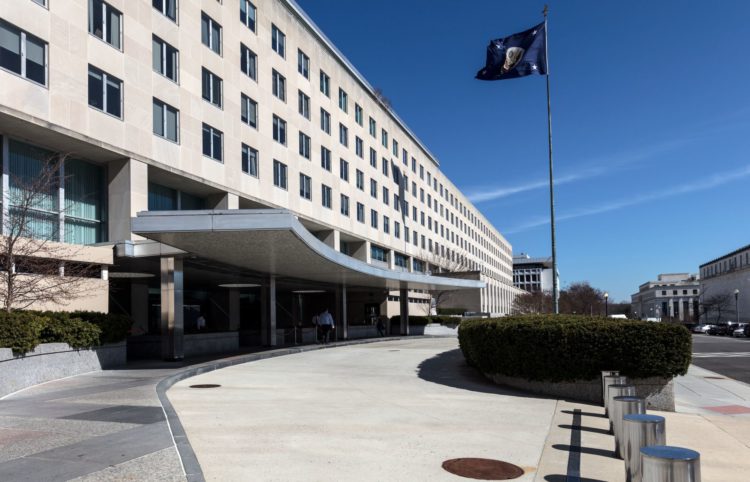
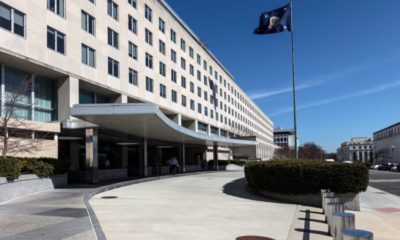
The State Department on April 20 announced employees cannot use bathrooms that correspond with their gender identity.
The Daily Signal, a conservative news website, reported the State Department announced the new policy in a memo titled “Updates Regarding Biological Sex and Intimate Spaces, Including Restrooms.”
The State Department has not responded to the Washington Blade’s request for comment on the directive.
“The administration affirms that there are two sexes — male and female — and that federal facilities should operate on this objective and longstanding basis to ensure consistency, privacy, and safety in shared spaces,” State Department spokesperson Tommy Piggot told the Daily Signal. “In line with President Trump’s executive order this provides clear, uniform guidance to the department by grounding policy in biological sex as determined at birth.”
President Donald Trump shortly after he took office in January 2025 issued an executive order that directed the federal government to only recognize two genders: male and female. The sweeping directive also ordered federal government agencies to “effectuate this policy by taking appropriate action to ensure that intimate spaces designated for women, girls, or females (or for men, boys, or males) are designated by sex and not identity.”
The Daily Signal notes the new State Department policy “does not prohibit single-occupancy restrooms.”
National
I’m telling the scared little girl I once was it’s okay to feel free
This week is Lesbian Visibility Week
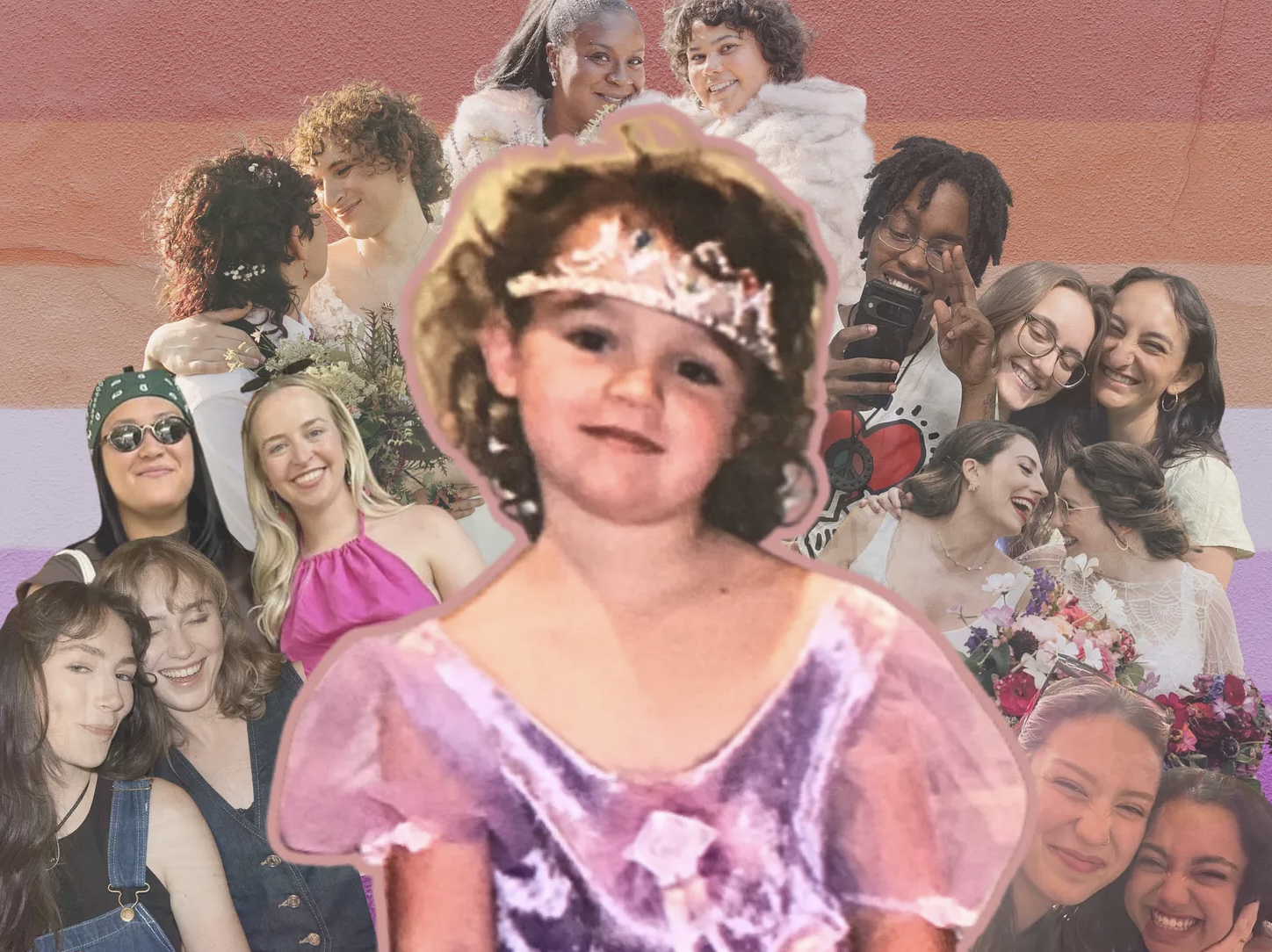
Uncloseted Media published this article on April 23.
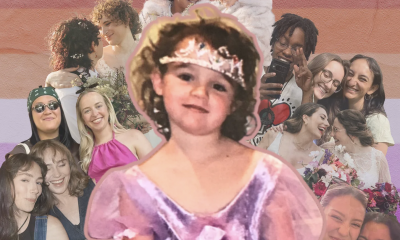
By SOPHIE HOLLAND | At 13 years old, I remember looking in the mirror in my Toronto bathroom and thinking, “Yeah, I’m a lesbian.” At the time, I thought it was a dirty word. Thinking back, it could be because the first time I heard it was when a family member said, “I don’t know what a lesbian is, they are like aliens.”
And although I walked around in camouflage Crocs with a rainbow My Little Pony charm, plaid knee-length shorts and a shark tooth necklace (yes, these are all, in my opinion, stereotypically lesbian apparel!), I didn’t feel like I fit the mold. The longer I thought about it, the worse I felt, so I buried my feelings deep inside.
Now I am 25, and I have been out since I was 22. Three years ago, I never could have imagined that I’d be working for a queer news publication and celebrating Lesbian Visibility Week, an annual event meant to honor and uplift lesbian perspectives and highlight the hardships our community faces. To me, LVW is so important because, frankly, it has been an absolute shit show getting here, to a place where I feel love and joy most days.
I think back to the frustration of constantly being asked, “Do you have a boyfriend?” Of watching princess movies and seeing a broken girl only find herself when her prince charming arrives. I remember listening to music that was always about heterosexual relationships. I remember feeling left out in high school when, one by one, my friends got boyfriends.
I tried the boyfriend, and I tried really hard for it to work at a large detriment to my wellbeing. I brainwashed myself into thinking I was probably bisexual, which I told my closest friends around 16 and unsuccessfully told my parents at the same age. I was probably subconsciously using this as a litmus test of their acceptance and to soothe the anxiety I felt around my sexuality.
Learning to love who I am did not only come from me unraveling my internalized lesbophobia and dissecting the oppressive societal messages of heteronormativity. It came from meeting an awesome community of lesbians and queers. I found people who understood my worldview and who showed me the ropes. I no longer had to stutter over concepts like lesbian loneliness or my frustration with misogynistic straight men.
They all just got it.
Without this community, I am not sure if I could be as warm and confident in myself as I am today.
And while I still experience homophobia, like being spat on while walking with an ex in downtown Toronto or having a stranger yell in my face “Are you fucking lesbians?” in Kensington Market, the joy and love still outweighs the nasty.
So, as the sentimental dyke that I have become, I decided to ask a set of lesbians in my orbit — including my friends as well as Uncloseted staffers, board members and followers — if they would share a little bit about what makes them love being a lesbian. And now, I can share it with all of you. Here they are. Happy LVW!
Timi Sotire
Falling in love with her was a reset. I felt like a kid again, hopeful about the future. We’ve had to overcome many obstacles to be together, but I’d choose her in every lifetime. I was sick with a long-term health condition when we met, and hanging out with Sophia really helped me with my recovery after my surgery.
Bella Sayegh
Being a lesbian is one of the most beautiful things in the world. To be authentically yourself in resistance and joy is so special within the lesbian community.
Parker Wales
When I met Liv, I finally understood why almost every song is about love.
Gillian Kilgour
There is no connection quite as perfect as between lesbians, no one sees me like my lesbians do.
Chyna Price
There’s many things I love about being a lesbian. But here are my top three:
- There’s just a deeper understanding when it comes to being loved by another woman.
- The next one would be the sense of community, especially being a POC masculine-presenting lesbian. I don’t feel like I’m cosplaying as someone else like I felt like I was doing before I came out.
- There’s so much history going back to the 1800s on how we found and fought for our love. That fight makes me proud because it shows me … that we’ve [found] ways to express our love even when it was misunderstood, illegal and deemed as madness.
Hope Pisoni
Before I knew I was a lesbian, romantic relationships seemed suffocating — it felt like everyone would expect me to act my part in the meticulous performance that is heterosexuality. But meeting my spouse and discovering our identities together showed me just how freeing it could be to love without a script to follow.
Leital Molad
It was the joy of watching the New York Sirens defeat the Toronto Sceptres at our first professional women’s hockey game — surrounded by hundreds (maybe thousands?) of cheering lesbians.
Angela Earl
I spent years building a life that looked right. But I never felt settled, and eventually I started asking what would actually make me happy. Coming out was about more than who I love, it was letting go of everything I was told to be. The last few years have felt like coming home to a life that had been waiting for me.
Tali Bray
What I love about being a lesbian is what I love about being in love … the wonder and joy of “oh, this is what it’s supposed to feel like.” I love moving through the world with women.
Izzy Stokes
I didn’t fall in love until I realized that queerness was an option. My queer friends have helped me see so much more than I grew up seeing. I’m so proud of us, and I’m so grateful for my lesbian community.
Nandika Chatterjee
When I met my fiancée is when I started to feel most like myself. That meant loving myself for who I am and embracing my identity as a lesbian. I felt free in a way I have never before. That’s the long and short of it.
Liz Lucking
The love and joy of being a lesbian is getting to live the life I dreamed of but never thought I would get to have!
Reflections
As I read these beautiful entries, it’s not lost on me that we’re still living in a world where lesbians are more likely to struggle with maternity problems, fetishization, and compulsory heterosexuality — not to mention the intersectional pressures of racism from both inside and outside the queer community. That’s part of why, according to a 2024 survey, 22 percent of LGBTQ women have attempted suicide, and 66 percent have sought treatment for trauma.
So if you are a lesbian who isn’t out or doesn’t feel safe, I hope you read this and can glean some hope from these messages. So when you look in the mirror, you know that it’s okay to release the weight — which can feel so heavy — of a heteronormative world.
We still have a long fight until all lesbians can feel safe to be themselves, but this is a community that does not back away from the tough, from the joy, from being loud and from all the other things that it takes to start a small revolution.
Hell yeah, lesbians! Here’s to you.
*I am signing off with my cat on my lap and a pride flag over my head <3.

From red carpet to chaos: A first-person narrative of the WHCD shooting

World premiere of ‘Everything, Devoured’ oozes queer energy
BREAKING NEWS: Shots fired at the White House Correspondents’ Dinner

An acting legend meets his match in ‘The Christophers’

Community mourns passing of D.C. trans rights advocate SaVanna Wanzer

Second trans member announces plans to resign from Capital Pride board

State Department implements anti-trans bathroom policy

I’m telling the scared little girl I once was it’s okay to feel free

Memorial for groundbreaking bisexual activist set for May 2

Adoption under suspicion
-

 District of Columbia4 days ago
Second trans member announces plans to resign from Capital Pride board
-
State Department5 days ago
State Department implements anti-trans bathroom policy
-
National5 days ago
I’m telling the scared little girl I once was it’s okay to feel free
-
a&e features5 days ago
Memorial for groundbreaking bisexual activist set for May 2