Minnesota
Andrea Jenkins makes history as 1st openly transgender city council president
Jenkins is now the first Out Trans person to hold such an elected position in the nation on a city council
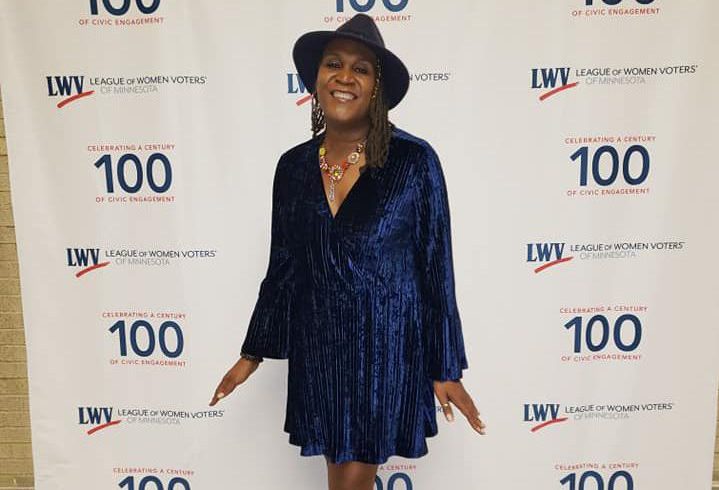
During their meeting Monday, city councilmembers elected their fellow Councilmember Andrea Jenkins to serve as the Minneapolis city council president. She was the first out Black trans woman ever elected to a major city council in 2017.
Jenkins is now the first Out Trans person to hold such an elected position in the nation on a city council, although Lisa Middleton was sworn-in as Palm Springs mayor last month. Middleton became the first out Trans mayor in California and just the third out transgender mayor in U.S. history. The mayor’s office in Palm Springs rotates among councilmembers who serve one-year terms.
The Twin-Cities’ major daily newspaper, The Star Tribune, noted that after the vote Jenkins told the paper: “We have a whole lot of work to do.” She also added; “We represent a diversity of thought, of ideas and solutions to the most pressing issues of our time.”
In 2020, Jenkins became a national figure and leader as protests erupted over the murder of George Floyd , who was killed in her council district. She called his murder “a symbol for a knee on the neck of Black America” and demanded racism be treated as a public health crisis.
Mayor Annise Parker, President & CEO of LGBTQ Victory Institute, released the following statement about Jenkins
“As major cities face unprecedented challenges wrought by the pandemic and incidents of police brutality, Andrea leads her constituents and our country with the calm but steely determination the moment calls for. The unanimous vote from her colleagues is a recognition of that leadership. Andrea is an elected official who serves all, but relentlessly champions those most marginalized, bringing an unmatched ability to spark empathy across divisions and communities. Minneapolis will be a better city with her as president and her history-making election will inspire more trans people to run and lead.”


Health
Too afraid to leave home: ICE’s toll on Latino HIV care
Heightened immigration enforcement in Minneapolis is disrupting treatment
Uncloseted Media published this article on March 3.
This story was produced in collaboration with Rewire News Group, a nonprofit publication reporting on reproductive and sexual health, rights and justice.
This story was produced with the support of MISTR, a telehealth platform offering free online access to PrEP, DoxyPEP, STI testing, Hepatitis C testing and treatment and long-term HIV care across the U.S. MISTR did not have any editorial input into the content of this story.
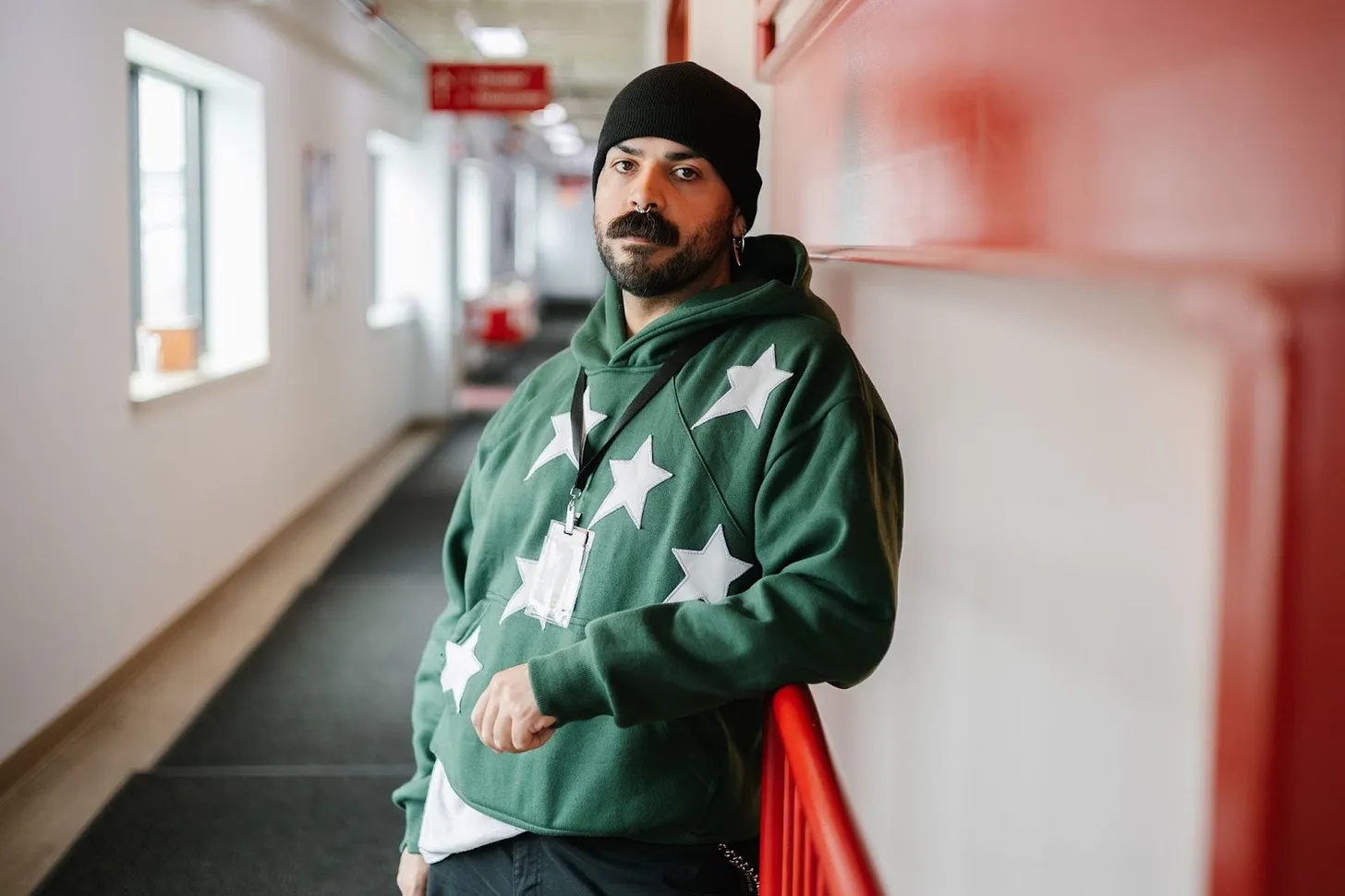
By SAM DONNDELINGER and CAMERON OAKES | For two weeks, Albé Sanchez didn’t leave their house in South Minneapolis.
“[I was] forced into survival mode,” Sanchez told Uncloseted Media and Rewire News Group (RNG). “I felt like there was an invisible wall [to the outside world] that I couldn’t cross unless I really wanted to put myself in a place where there was a chance that I might not be able to come back.”
Queer and Mexican American, Sanchez was afraid of being targeted by the Immigration and Customs Enforcement presence in their neighborhood, even though they are a U.S. citizen.
“Every day is a risk,” they say, adding that even if they have paperwork, if they fit the profile, they are a target, making it scary to go even to work or the grocery store.
Sanchez, a 30-year-old sexual health care educator, has been taking oral PrEP, the daily preventive medication for HIV, for over a decade. But the mounting stress of ICE raids has made it harder to keep up with dosing.
“A missed dose here and there pushed me to make the appointment [for something more sustainable],” they say.
Sanchez says they felt like somebody would have their back at their local clinic. It was only a 10-minute drive from where they worked, they knew its staff from previous visits and community outreach, and they could count on finding Spanish-speaking staff and providers of Latino heritage. But not everybody has had that same experience accessing care.
Since ICE’s Operation Metro Surge began in early December, an increasing number of Latino patients in Minnesota are delaying or canceling what can be lifesaving care for the prevention and treatment of HIV.
These findings are particularly alarming for Latino communities, who, as of 2023, are 72 percent more likely than the general U.S. population to be diagnosed with HIV. And while overall infections have decreased, cases among Latinos increased by 24 percent between 2010 and 2022.
“I’m very concerned that there is going to be a sharp uptick in transmission,” says Alex Palacios, a community health specialist in the Minneapolis area.
In a January 2026 declaration as part of a lawsuit seeking to end Operation Metro Surge in the days following Renee Nicole Good’s killing, the commissioner of the Minnesota Department of Health said HIV testing among Latino populations has “dropped dramatically” and that “although grantee staff continue to go into the community to promote and provide testing, people are not showing up.”
Local clinics are reporting the same thing. The Aliveness Project, a community wellness center in Minneapolis specializing in HIV care, told Uncloseted Media and RNG they have seen more than a 50 percent decrease in new clients. The clinic serves a large number of Latino and undocumented clients, and while it usually sees 750 people walk through their door each week, according to providers, it reported seeing 100 fewer people each week since December.
Red Door, Minnesota’s largest STI and HIV clinic, has had a “modest uptick” in no-shows and missed appointments since December.
What happens when treatment stops
Today, there are multiple medications available that work to prevent HIV and dozens that treat it once a person tests positive. Many people who consistently take their medication have such low levels of the virus that they can’t transmit it through sex. But becoming undetectable requires patients to stay on their medication; otherwise, the virus replicates and mutates, weakening the immune system and increasing the risk of life-threatening infections.
“If patients aren’t on their medicines consistently, HIV can learn about the medication and become resistant to them. When this happens, the medicine will not work for the patient, and the new resistant virus could potentially be passed on to others,” says George Froehle, a physician assistant and provider at Aliveness Project. “Medication adherence is one of the most important aspects of HIV care.”
To maintain care and prevent dangerous, untreatable strains from spreading in Minnesota, providers at Aliveness Project have begun delivering medication to patients when possible, offering telehealth when they can, and pausing routine lab work to limit in-person appointments.
“The most important thing we can do from a public health perspective is to keep people undetectable so they don’t transmit HIV,” Froehle says, adding that providers in other cities targeted by ICE will need to make plans for missed injection visits, pivot to telehealth and prepare their teams for the “trauma that can occur.”
Sanchez understands the risks of inconsistent treatment, which is why they opted for the injectable preventative medication.
“I have a lot of risk [to HIV in my community],” Sanchez says. “With so much uncertainty about the future and whether HIV care will remain stable, I realized I couldn’t let this opportunity pass.”
But injectable HIV treatments are commonly dosed at two weeks to six months apart, and the medication must be administered in a clinic — a setting many patients are avoiding, according to providers.
“They have a two-week window” to get their shots, according to Froehle, who added that because patients are afraid to come in person, they have had to transition people off of their injectable HIV treatments. This has caused patients to return to oral HIV treatments without the testing they would normally receive had ICE not been in Minneapolis. “[Oral treatments] weren’t super successful [for these patients] to begin with and that’s why they were on injectables.”
Oral HIV medications, too, must be taken consistently to work. In response, providers have urged patients to have their pills with them at all times in case they get deported or detained.
The caution is not unfounded. Federal immigration facilities have a history of denying adequate medical care to people living with HIV, despite internal standards that require them to comply. Since 2025, at least two men living with HIV have been denied access to their medication in a Brooklyn jail, according to lawsuits obtained by THE CITY. One man said he was only given his medication after his lips broke open and he developed an open pustule on his leg. And in January 2025, another man died of HIV complications while in ICE custody in Arizona.
Beyond being detained without proper medication, patients are at risk of being deported to countries with limited access to HIV care, like Honduras and Venezuela, experts say.
“A lot of men [from Venezuela] told me they left because it wasn’t safe to be gay there and because they struggled to access HIV care,” says Froehle. “It’s a little heartbreaking to see new folks not only face the threat of deportation, but to places where they didn’t feel safe medically or identity-wise.”
“Some of these patients will die in their home country,” says Anna Person, the chair of the HIV Medicine Association. “It’s a death sentence.”
A ‘cascading disaster’
While ICE’s presence is threatening the infrastructure of HIV care that Minneapolis has built over decades, experts say there has always been a blind spot in HIV care for the city’s Latino community.
Vincent Guilamo-Ramos, executive director of the Institute for Policy Solutions at the Johns Hopkins University of Nursing, describes HIV in Latino communities as a “cascading disaster,” the result of years of compounding inequities.
“There’s been an invisible crisis among Latinos that hasn’t gotten traction,” he says. “The numbers have consistently gone up in terms of new infections, while nationally they’ve gone down. … That should be a big alarm.”
Numbers are rising because structural barriers and stigma are preventing Latinos from receiving care. A 2022 report from the Centers for Disease Control and Prevention found that between 2018 and 2020, nearly 1 in 4 Hispanic people living with HIV reported experiencing discrimination in health care settings. Lack of representation among providers, language barriers and deep-rooted medical mistrust further complicate access to care, according to Guilamo-Ramos.
Beyond the medical system, stigma within Latino communities can be equally damaging. According to Human Rights Campaign data, more than 78 percent of Latino LGBTQ youth reported experiencing homophobia or transphobia within the Latino community in 2024.
Sanchez agrees that stigma and bias are already massive barriers to care, citing the strict gender norms and Catholic beliefs many Latino communities hold. They say ICE’s presence is threatening already delicate access to HIV care.
“This has caused so much damage to people,” Sanchez says. “Not being able to access your health care appointments is such a stab in the side. … Being able to navigate any of these things in normal circumstances already has so much difficulty to it.”
Palacios, who is Afro-Latine and living with HIV, says the heightened ICE presence is worsening barriers that have long undermined the Latino community’s access to HIV care.
“The horizon has always been stark and dim,” they say. “And this just feels like one more thing to address and to fight back against.”
Sliding backwards
Navigating HIV care is becoming more difficult across the board, as the federal government has decimated HIV funding, compromising decades of progress made in the fight against the virus since Donald Trump retook office just over a year ago.
In February 2026, three months into Operation Metro Surge, the Trump-Vance administration proposed slashing $600 million in HIV-related grants, targeting four blue states, including $42 million for Minnesota programs. A federal judge has temporarily blocked the cuts.
“This would completely decimate and gut all of our HIV prevention,” says Dylan Boyer, director of development at Aliveness Project. “That’s the reality that we live in.”
“We have all the tools, and yet we are staring down this rollback of infrastructure and research dollars, prevention efforts, treatment efforts, that are going to put us squarely back in the 1980s,” says Person, a national HIV expert who grew up in Minnesota. “[There] seems to be no other rationale for that besides cruelty, to be quite frank, since there’s no scientific reason for it.”
Repair and representation
Jenny Harding, director of advancement at a Minneapolis-area supportive housing program for people living with HIV, says that while ICE’s presence is lessening in the Twin Cities, the “damage is done.”
Person says that this mending will take time, especially between the medical community and patients, since HIV providers can have a “very fragile” relationship with their clients.
“It takes, sometimes, years to build that level of trust. And I do worry that folks are just going to say, ‘I don’t feel safe here anymore. The system does not have my best interest at heart, and I’m not coming back,’” she says. “This is not something that you can flip a switch and everything will go back to normal.”
“We need to hold our federal government accountable, particularly HHS, [and] we need to ensure that HIV funding remains intact,” Guilamo-Ramos says, adding that in order to lower rates of HIV in the Latino community, there should be more specialized efforts: such as bilingual and culturally aligned health care providers, community-based outreach programs co-located where risk is highest, trust-building initiatives to address medical mistrust, mobile clinics, and targeted programs to re-engage patients who have fallen out of care.
Aliveness Project’s patient numbers have increased in the last few weeks as the ICE operation has waned, but the clinic staff is keeping “a watchful eye” and is having “difficulty reaching folks who are understandably scared.”
“Our biggest focus right now is reconnecting with people through our outreach so no one has a lapse in their HIV medications or prevention care,” Boyer, of Aliveness Project, says.
For Sanchez, seeing providers who speak Spanish and are of Latin heritage at Aliveness Project built enough trust for them to reach out and make an appointment despite the risks. Sanchez feels optimistic about their new injectable prevention strategy with the support of their clinic.
“There’s many places where you can receive care here in the Twin Cities where you might not see your skin tone. … There’s still a lot of health care professionals that unfortunately carry bias. … Aliveness is the opposite of that,” they say. “Seeing that representation and knowing someone has that cultural context of how to meet you in moments of sensitivity, it’s crucial.”
Minnesota
LGBTQ Minnesotans speak out amid ICE crackdowns
‘Our nervous systems are not set up to live under constant threat’
Uncloseted Media published this article on Jan. 31.
By HOPE PISONI, SAM DONNDELINGER, SPENCER MACNAUGHTON, and TAYA STRAUSS | Since the start of December, Minneapolis and St. Paul, Minn., have been under the thumb of an extremely heavy presence of the U.S. Immigration and Customs Enforcement.
During the crackdown, which the agency refers to as “Operation Metro Surge,” at least 3,000 people — mostly undocumented immigrants — have been arrested so far. Tensions came to a boil in January when federal immigration enforcement agents shot and killed poet Renee Good and ICU nurse Alex Pretti on separate occasions. In response, Minneapolis-area residents have started to push back. On Jan. 23, Minnesotans organized the first citywide general strike in the U.S. in nearly 80 years, with tens of thousands protesting and over 700 businesses closing in solidarity. And additional protests are taking place nationwide in at least 36 states over Jan. 30 and 31.
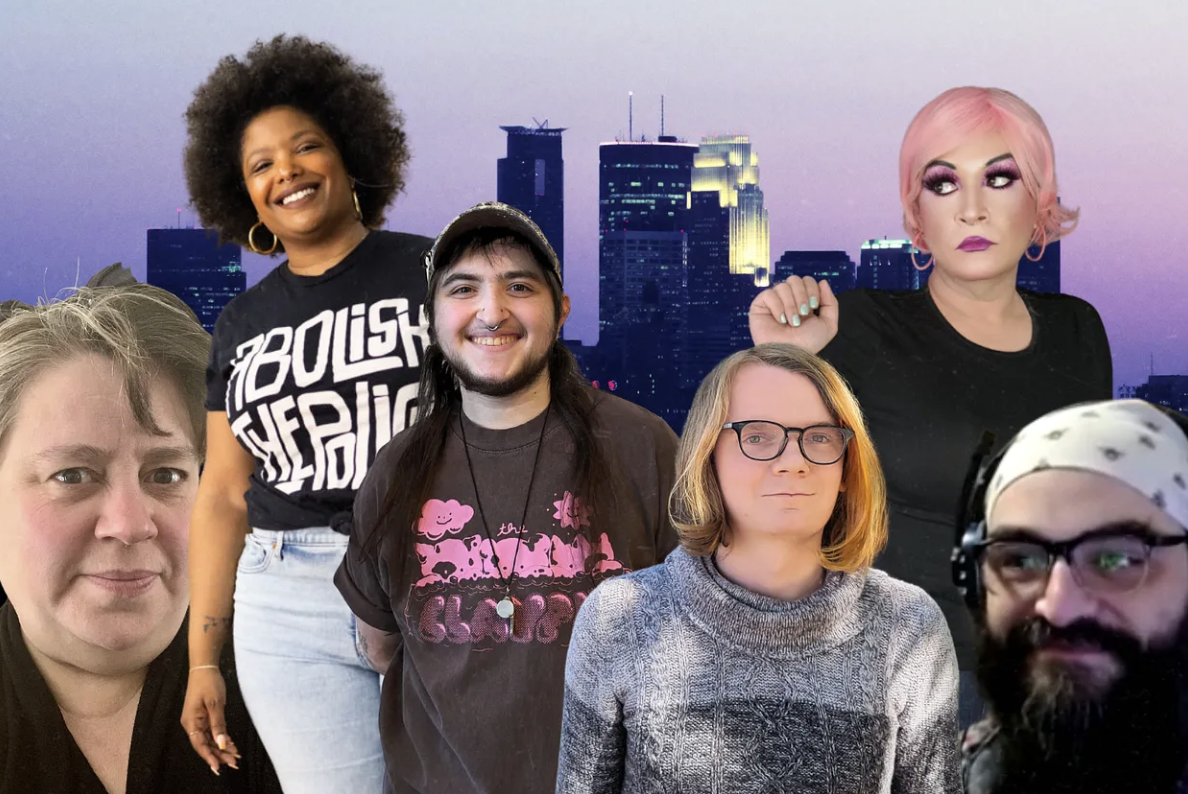
Many queer people have been on the frontline of these protests. We spoke with six people on the ground in the Twin Cities to learn more.
Watch the full interview above or read the transcript here:
SPENCER MACNAUGHTON: Hi everyone, I’m Spencer Macnaughton, and today I am here with six queer folks from the Minneapolis area. Everyone, thank you so much for speaking with me and Uncloseted Media today.
ALL: Thanks for having us.
SM: Yeah, great to be with you. And obviously we reached out to you all based on the headlines. And a lot of what’s playing out at the national level is happening right there in Minneapolis where you guys live. And I just wanted to start to really get a pulse check. How are you guys feeling right now? I have not been in Minneapolis. For folks who only see what’s unfolding on social media or on TV, take us inside what life has been like for you all the past few weeks.
RACHEL DOMINGUEZ: It’s incredibly stressful. Our nervous systems are not set up to live under constant threat. That’s the biggest thing that I think people are not understanding about what’s going on. And I’ve lived in Minneapolis for 41 years. We had a little dress rehearsal for this about five years ago, but it was nothing — there was no precedent. There’s no precedent for this. It’s like water about to come to a boil. Everyone here is stressed out. We’re angry. We’re scared for our safety, for our neighbors’ safety, for our livelihoods. We have no idea when this is gonna stop. Oh, and it’s two fucking degrees out.
JUNE REICHERT: It’s hard to go on like normal when this is happening. Part of my, and I’m sure everybody in your profession, is to not even acknowledge it. Pretend that everything’s okay while you’re at work, while you are going to school, while you are going shopping and everything. And little do you know, down the street, a Somali family is being harassed for no good reason. It brings this feeling of sorrow, especially when it does affect your professional life. When somebody who you’ve been working with for a long time, all of a sudden, as part of my job, I can’t get a hold of them. I work with a lot of people from the Hispanic community and they’re just gone. And you just sit wondering. It’s horrible. It’s a horrible feeling.
SM: And June, tell me more about that. That actually happened?
JH: So for what it’s worth, I sell insurance. I have had clients who have been picked up and I can’t get a hold of them. I mean, I can verify what happened to them, but these people I’m able to get a hold of every single day when I need to, to take care of this, that or the other issue. And now I can’t get a hold of them for a week straight. What am I supposed to think? You know?
SKOT RIEFFER: My day job, I work for a catering company. We have no work at my catering company for the next two months because every single event has canceled because of the ICE occupation. And these events are things from corporate events to weddings. And we’re all now without a job, essentially. My catering company is maybe 30 percent white people and so all of us are checking in with everyone else all the time. One of our folks, also a member of the Hispanic community, has lost four family members. They just got kidnapped. And they’re just gone.
ALICIA KOPP: I am the child of a migrant. I’m from a mixed heritage. My father is from Guatemala. He’s been a citizen since ‘83. Right now, we’re not letting him leave the house. We’re running all errands. The stress that you had spoken to earlier, Rachel, that is definitely wearing thin on all of us.
SM: I mean, what type of mental health effects is that having on him by not being able to leave the house and also probably understanding the reasons why he’s not leaving the house?
AK: When I handed him things like, I showed him what was in a whistle kit with the red cards. This is an emergency contact card. On the inside, the top part says, “help me,” and it’s got whoever’s holding it, their information. The bottom has their loved one and their lawyer and contact information. And they carry this in one of these red cards that on one side has your constitutional rights and on the other side says what you would tell to an immigration agent if they tried to stop you. Or you would just put it up to the window in your car or slip it through, so that you don’t have to talk to them. Now, what good it does? Yeah, I don’t exactly know. Because they’re not exactly following the rules, they kind of tell a lot of people, “That doesn’t matter, we don’t care.” But with this contact card, you have it on you, you literally hand it to somebody if you feel like you’re about to get picked up and say, “I need help. Contact this person for me.” Trying to explain to my dad why, even though he’s a citizen now, I wanted him to have this on him if he’s leaving the house? That was hard. And he was a little belligerent at first. I’m just like, “Look, you’ve kept me alive for 50 fricking years. It’s my turn to do the same for you. And right now, they don’t care that you’re a citizen. They just see you and they go, ‘Yep, we don’t want him here.’ And they’re gonna take you away. You’ll be away from your medicine. You’ll be away from us. It will take us how long to figure out where you are.” Even if it’s like hours, that probably isn’t great for somebody that probably shouldn’t be rassled to the ground by young dumb men or women or whoever they are. But you know, it’s hard. It’s really hard for him and it’s hard for all of us because you don’t wanna have to talk to your parents like that.
TERRESA HARDAWAY: I just wanted to comment on how I’m feeling in this moment, and I would say that while I am tired, I’m not exhausted. And it’s because Black people have always been under occupation. And I’m so happy that people are coming to the realization that state violence and national violence is something that affects all of us. But I gotta say my exhaustion probably comes from the long story posts and the Instagram posts of people realizing for the first time that they are also a part of this system. And they realize that they are also subject to be attacked and to be violently murdered in the street, just like Black people, I think that’s where my exhaustion might come in. But I will say, because we are used to this, I know that this is not gonna be the final moment. I don’t want to hold onto this hopelessness that I feel like a lot of folks who are just coming into that realization are starting to feel on their own. And so we have to just keep fighting. And as tired as we are, now is the time for us to actually push the system that we want to stop harming our neighbors.
SM: And how do you push a system in this moment? What is the strategy in terms of pushing? Because, you know, it does feel like a moment where change could happen because there’s so much attention on it.
TH: There are many, many ways that folks can tap into mutual aid networks, can tap into organizations who have been advocating for immigrant rights and equity in those spaces. If there are holes within our neighborhoods that need to be filled, people need food, people need supplies, and they aren’t comfortable leaving their house, there are organizations who have already been doing that work that people can tap and support. People can become legal observers. There is a lot of things that folks could do. This anxiety that I know that we’re all feeling and this exhaustion? I would say focus that into some of the work that’s already happening.
RD: My kid has only gone to Southside Family School for his entire life. That’s where Renee Good, that’s where her kid went. Still goes there actually. So, our kids, first off, they couldn’t be in school. Because the New York Post ran some bullshit article about how our school was some like communist indoctrination training center that recruited her to join an ICE watch. And then all of a sudden death threats, bomb threats, people coming into the teachers’ houses and knocking on the doors and running away. Bomb threat, they had to bring the dogs in. So my kid didn’t even get to go to school for two weeks and now they’re back in school in a secret location. Like this is the fucking Taliban that we’re hiding from.
SM: Wow.
RD: I can’t even say where my kid goes to school. We’re not even supposed to text it.
SM: I’m sorry you have to do that. And I, yeah, and we’ve all seen those harrowing headlines and images of children as young as 2, as young as 5, being taken by ICE over the last few weeks. I wanted to ask more broadly, for the kids you guys know in your life, what is the impact this is having on children?
AK: A lot of stuff for kids are being canceled. I know that the Minnesota Orchestra has canceled their Young People’s Concert Series for the time being because it’s just not safe to go down there. The students that auditioned last spring to be part of the All State Ensembles, all of their concerts have been canceled because it is just not safe.
SR: My partner and I have started doing neighborhood patrols because there’s a daycare two houses down from ours that caters to our small little, poor community around here and everything like that. And so there’s a lot of different folks who go to this daycare. And so every morning from 7:30 ‘til 10, I’m out there, and then from 3 until 5, which is the pickup times. And so we’re out there as observers.
And there’s been some real scary things, and one thing that is really burned in my head was this dad came up and was chatting with me and thanking me for being there and whatnot. He said to me that his kid, his daughter came up to him and asked him, “Dad, what do I do when the men come and take my friends?” And he didn’t have an answer and he was like, “I feel like my job as a dad is to be able to answer these questions and I do not have an answer” and he was sitting there, and we’re outside, it’s –10 and he’s crying. And I’m crying. And our tears are freezing to our damn faces and all I can do is just nod and hug this guy and just be like “yeah, I don’t have an answer either, man.”
SM: You mentioned the ICE patrolling. Tell me about what that is, what you do and why you’re doing it.
SR: We’re just looking for suspicious vehicles. So if out-of-state plates, a slew of identical looking SUVs drive by, we’re marking it, we’re reporting it to the other people in our Signal groups and everything like that. And then in the situation, just the other day, there were three black SUVs that drove by, all of them with ICE agents in full equipment, everything. So we reported all of that. We’re monitoring, we’re taking pictures, we are marking plates, we’re running plates if needed, and just letting every — like there’s a Hmong Market just down the road, and so we let them know. There’s a small, kind of a strip mall that’s almost all owned by people of color, and we call one of them and then they distribute the word and they’ll lock their doors if we see anyone. Just things like that.
SM: When you say you report it, who do you trust right now to report to?
SR: Our neighbors.
SM: Your neighbors.
SR: We have a Signal group, I’m part of several Signal groups. I will get called. Someone will tell me and be like, “hey, we need a big white guy here right now.” And I will show up. And then when I get there, I see things, I take pictures, I send it to that group and I send it to my group of my immediate block of neighbors. And so then they all know, and then they’ll either go check on the neighbors next door who didn’t respond in the group or will drive to the daycare or whatever is needed to do.
SM: Maybe this is a dumb question, but why do you think they’re saying “we need a big white guy”?
SR: I mean, I’m just as likely to get shot and killed and kidnapped and everything as anybody else at this point. But if they’re trying to push the agenda that these types of people are bad people and whatnot, and if in every camera frame that they have, if there’s someone who looks just like you? That bullshit narrative, it’s harder for them to sell it. If I’m standing there, it’s harder for them to sell it. And I hate it. It sucks on so many levels, obviously.
SM: Can people talk about what they’re doing to push back?
TH: Yeah. I think for me and my teams at Blackbird Revolt and Black Garnet Books, we have these spaces. And so this is something that we didn’t have in 2020. And so being able to activate these spaces, hosting a poster making and community space for folks to come together who do feel similarly and just want to be in space with each other has been really amazing. We are also holding a drive where folks can purchase a book, that’s either in English, Spanish or Somali, that we’re able to deliver to families that don’t feel comfortable leaving their homes.
RD: The people here, we don’t have any faith in the politicians, that they’re going to do anything meaningful or that they have any power at all. We don’t have any faith that the police are going to protect us or that the National Guard is gonna protect us or that Tim Walz or Jacob Frey or any of them are gonna be able to protect us.
SM: Why don’t you feel like you have faith in Jacob Frey? I mean, when I see him on TV and he’s saying “get the hell out,” it seems like he’s giving his best effort, but is that a sentiment that is not felt on this call?
SR: It’s super fucking easy to say “get the fuck out.” We’re all saying that, but all of us are also in the street. All of us are also helping, donating food, donating time. Where the fuck has he been?
TH: I’m seeing the real people who are standing up for these communities out at the protest. I ain’t never once seen that man and that man just stay talking shit and never moves and never has any action behind it. Fuck that man. Fuck all of this whole, “get the fuck out.” Stop, anybody can say a cuss word, but you actually have the power to pass policy and you’re not doing it. So it’s not about not having faith. We have a history of seeing them say shit and then not backing that up with action. So it’s not about faith. We have a historical record of y’all not doing shit for the people.
SM: So let me ask then quickly, what do you want him to do? What could he do that would be meaningful right now if he could actually do, that’s within his power?
JH: If you don’t want to start a constitutional crisis by arresting an ICE officer while he’s doing the awful things that he’s doing, fine, I guess. I would argue differently.
RD: No, that’s not fine. That’s what they should do. That’s what they could do.
JH: Correct.
RD: They could get some fucking balls and call the commanders into their office and say, “Look, are you loyal to the constitution or are you a Nazi that’s gonna fold?”
JH: If these people want to preserve whatever level of normalcy that we know has not existed as Rachel, Terry and Alicia have all described, then citations, parking violations, trespassing violations, these people are using their administrative warrants, that are not admissible to use to enter people’s homes, to enter people’s homes. And they aren’t getting trespassing citations for that. They aren’t getting charged for that, I don’t even think the mayor has talked about the fact that they’re doing that. And these are all things that are actions that can be done instead of tweeting really hard. I want action. I don’t want words. I don’t want you to look like a big tough guy and to get all the people on Twitter or Bluesky or whatever to go, “Oh, he owned him.” I want them gone. I don’t want them here anymore.
SR: He could at the very least talk to us. All he’s doing right now is talking to the media. Talk to us, show up. Maybe he’s doin’ shit behind closed doors. Okay fine, but tell us. Talk to us. Come out, listen. Talk. Be present.
SOREN ASTER: One thing we did at the clay pit as well is I changed it to appointment only. I did as much research as I could on how to keep ICE from coming into the public space of my business, and I found that by making it by appointment only, the whole space becomes private and they cannot come in. So my door stays locked. I let people in as I see fit, but just as another form of precaution, keeping those doors locked. It’s an absolute nightmare.
SM: It literally sounds like it’s created a situation where every move you make is nerve-wracking because of what’s happening.
SA: Absolutely.
SM: I’ve heard many people saying that what’s unfolding in Minneapolis is a queer story. And I find that interesting. And I’m curious, do you guys agree with that?
JH: I want to push back a lot on the idea that this is a very queer thing that’s happening. As a transgender person, I’ve been a community activist for quite a while, especially in 2022 when the federal government, from my perspective, was failing to protect my trans siblings in states like Florida and Texas. There’s a lot of my activism that I do that is directly fueled by my queer identity. My neighbors, my friends, my colleagues, my clients even, are being attacked by a force that is an invasion to our city and our state. And it is on me as a human with human emotions and a personal connection to this place to protect my community, and that’s got nothing to do with me being gay. The motivation is, in this instance, for one of a very rare time in my experience, very disconnected from my queer identity. It’s got more to do with protecting Minnesotans. It’s got more to deal with protecting communities, immigrant communities and communities of color who people who look like me, as we’ve discussed here, famously just don’t even bat an eye at, and it’s wrong.
SA: I don’t think it’s an inherently queer thing, but I think that queer people and Black and Brown people are used to having to rely on our community, rather than our government and other people to get the things that we need and to get the support and to make things happen. We’re used to having to riot, and we’re used to having to scream and try and get people to listen to us and our stories. And so I think when this started. The first people that really knew what to do and how to do it and how to organize are those people. And so I think that it’s one part of the story.
SM: One thing we had mentioned earlier is what happened in Minnesota in 2020. Many have compared what’s happening now to the George Floyd protests of 2020. Um, how do you guys compare it? How is it different? How’s it similar?
AK: The big difference? We knew who the police were, we kind of know who these people are, but we don’t know who those people are. We know that they are some of the same people that were let out of the Jan. 6 stuff because of the pardon. And we know they’re likely a lot of the cops that left the profession because they couldn’t beat up on people so freely in Minneapolis anymore with some of the initiatives that have been trying to change the culture of our police forces.
Editor’s Note: While some government officials, including U.S. Reps. Jamie Raskin (D-Md.) and Steve Cohen (D-Tenn.) have called for the DOJ to release information on any participants of the Jan. 6 insurrection employed by ICE, no details have been published. Additionally, several police chiefs and sheriffs have reported that ICE has tried to poach their officers for recruitment, but Uncloseted Media was unable to confirm any cases of this in Minneapolis.
TH: I think for me, I compare it to the longevity of support that’s gonna be happening. I think that after a year, after the protests, after the uprisings, it went back to business as normal, business as usual. I’m also a runner. And so when I’m gonna run a short distance, if I know I’m just trying to get a fast-ass time running a mile, I’m gonna run at that at full velocity. And I feel like people who are just getting activated, that’s what they’re doing. They’re running at it at full velocity and then they get exhausted. Y’all need to run this as if it’s gonna be a 50 mile race. I think for me, how I was activated during the uprisings, I’m really leaning on community. I am texting my group of white allies and being like, “Y’all, I need y’all to pick this up. I need you to help me here, dah dah dah.”
JH: It is unfortunate to me that many people, similar to in 2020 and 2021, will see the immediate aftermath of something and see Derek Chauvin got arrested or whatever it is, and they’re done. And that’s it. And we made the change. And now we can go back. It’s a joke in my community: We can go back to brunch. No we can’t. We’re not done. And they think once ICE is out of Minneapolis and the white people stop dying, then they can just go back to sipping their tea. And I’m worried about that. So it’s a push and pull, and I really want to remain optimistic, and I know there is a future worth fighting for. But I’m also worried that some people will see the short-term victories and give up.
SM: Trump has said that Minnesotan protesters are “left-wing agitators.” I want to know, maybe as a last question, I want to know, how important is protest and what else is getting you through right now?
AK: Well, protest is very important to me, but also understanding the multitude of ways that you can participate in protest. You don’t have to be out necessarily facing off with people that are on an opposing side. You are doing protest by maybe doing a Zoom concert because your concert got canceled and you’re still going to play. Or by delivering food for neighbors and other health and home needs, like laundry detergent is a huge one right now that people need as well as just things like shampoo and soap.
SA: All of the reactions that have happened are really logical when you think about it from an outside perspective. If you take out left and right and the political ideologies of it all, people are coming in and abducting people that are here, mostly not committing crimes. A lot of people, perfectly legal. In any other situation, I think the logical answer would be to fight back and to step up to your community and do what you can to prevent those kidnappings and to prevent that violence from happening.
TH: Protests were so important that it is the first amendment. And so when we get asked things like, “Why are we protesting?” The country was founded on that. I don’t want people to just only relate it to Black people or just to trans people. It was something that was laid at the foundation of this country. We do get to say what we want our government to do and protest is our way of being able to speak out about that. And if you weren’t comfortable with that, you shouldn’t have ran for president.
Minnesota
Lawyer representing Renee Good’s family speaks out
Antonio Romanucci condemned White House comments over Jan. 7 shooting
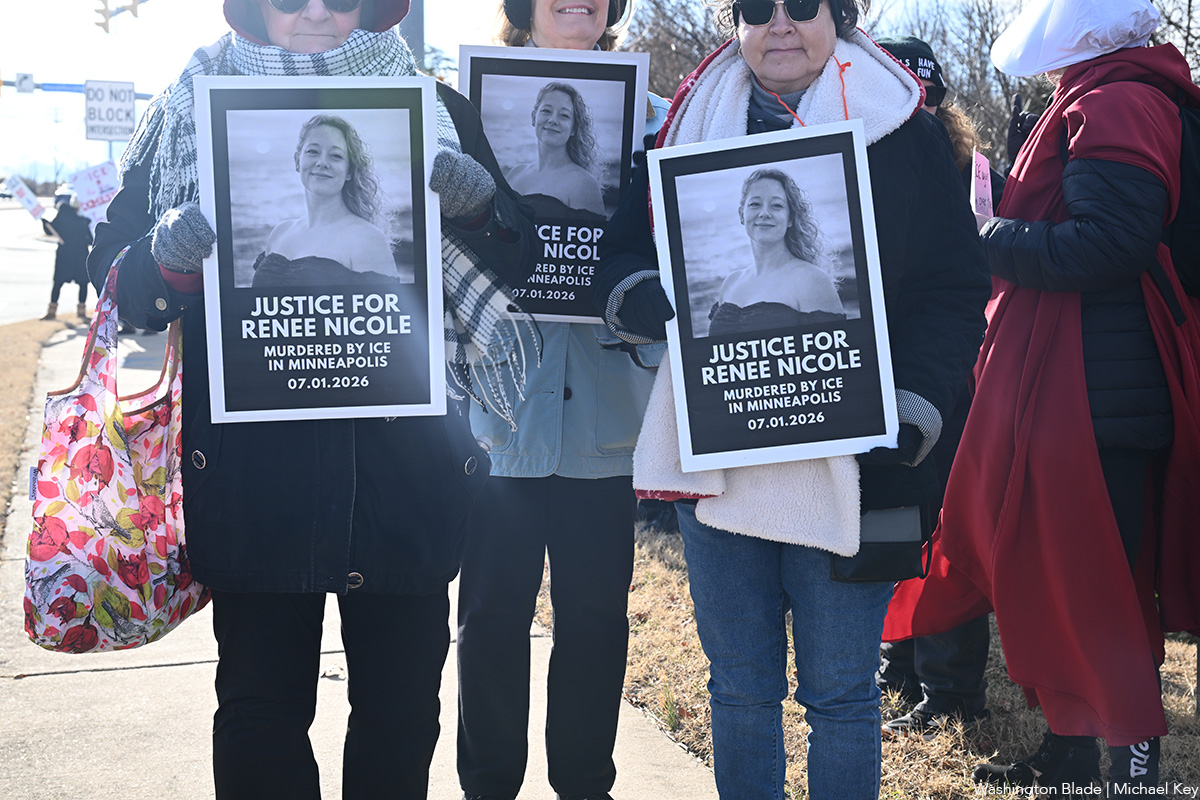
A U.S. Immigration and Customs Enforcement agent shot and killed Renee Good in Minneapolis on Jan. 7 as she attempted to drive away from law enforcement during a protest.
Since Good’s killing, ICE has faced national backlash over the excessive use of deadly force, prompting the Trump-Vance administration to double down on escalating enforcement measures in cities across the country.
The Washington Blade spoke with Antonio Romanucci, the attorney representing Good’s family following her death.
Romanucci said that Jonathan Ross — the ICE agent seen on video shooting Good — acted in an antagonizing manner, escalated the encounter in violation of ICE directives, and has not been held accountable as ICE and other federal agents continue to “ramp up” operations in Minnesota.
A day before the fatal shooting, the Department of Homeland Security began what it described as the largest immigration enforcement operation ever carried out by the agency, according to DHS’s own X post.
That escalation, Romanucci said, is critical context in understanding how Good was shot and why, so far, the agent who killed her has faced no consequences for killing a queer mother as she attempted to disengage from a confrontation.
“You have to look at this in the totality of the circumstances … One of the first things we need to look at is what was the mission here to begin with — with ICE coming into Minneapolis,” Romanucci told the Blade. “We knew the mission was to get the worst of the worst, and that was defined as finding illegal immigrants who had felony convictions. When you look at what happened on Jan. 7 with Renee and Rebecca [Good, Renee’s wife], certainly that was far from their mission, wasn’t it? What they really did was they killed a good woman — someone who was a mother, a daughter, a sister, a committed companion, an animal lover.”
Romanucci said finding and charging those responsible for Good’s death is now the focus of his work with her family.
“What our mission is now is to ensure that we achieve transparency, accountability, and justice … We aim to get it in front of, hopefully, a judge or a jury one day to make that determination.”
Those are three things Homeland Security Secretary Kristi Noem and DHS has outright rejected while smearing Good in the official record — including accusing her of being a “domestic terrorist” without evidence and standing by Ross, who Noem said acted in self-defense.
The version of events advanced by Noem and ICE has been widely contradicted by the volume of video footage of the shooting circulating online. Multiple angles show Good’s Honda Pilot parked diagonally in the street alongside other protesters attempting to block ICE agents from entering Richard E. Green Central Park Elementary School.
The videos show ICE officers approaching Good’s vehicle and ordering her to “get out of the car.” She then puts the car in reverse, backs up briefly, shifts into drive, and steers to the right — away from the officers.
The abundance of video evidence directly contradicts statements made by President Donald Trump, Noem, and other administration officials in interviews following Good’s death.
“The video shows that Renee told Jonathan Ross that ‘I’m not mad at you,’ so we know that her state of mind was one of peace,” Romanucci said. “She steered the car away from where he was standing, and we know that he was standing in front of the car. Reasonable police practices say that you do not stand in front of the car when there’s a driver behind the wheel. When you leave yourself with only the ability to use deadly force as an option to escape, that is not a reasonable police practice.”
An autopsy commissioned by Good’s family further supports that account, finding that her injuries were consistent with being shot from the direction of someone driving away.
The autopsy found three gunshot wounds: one to Good’s left forearm, one that struck her right breast without piercing major organs, and a third that entered the left side of her head near the temple and exited on the right side.
Romanucci said Ross not only placed himself directly in harm’s way, but then used deadly force after creating the conditions he claimed justified it — a move that violates DHS and ICE policy, according to former Assistant Homeland Security Secretary Juliette Kayyem.
“As a general rule, police officers and law enforcement do not shoot into moving cars, do not put themselves in front of cars, because those are things that are easily de-escalated,” Kayyem told PBS in a Jan. 8 interview.
“When he put himself in a situation of danger, the only way that he could get out of danger is by shooting her, because he felt himself in peril,” Romanucci said. “That is not a reasonable police practice when you leave yourself with only the ability to use deadly force as an option. That’s what happened here. That’s why we believe, based on what we’ve seen, that this case is unlawful and unconstitutional.”
Romanucci said he was appalled by how Trump and Noem described Good following her death.
“I will never use those words in describing our client and a loved one,” he said. “Those words, in my opinion, certainly do not apply to her, and they never should apply to her. I think the words, when they were used to describe her, were nearly slanderous … Renee Good driving her SUV at two miles per hour away from an ICE agent to move down the street is not an act of domestic terrorism at all.”
He added that his office has taken steps to preserve evidence in anticipation of potential civil litigation, even as the Justice Department has declined to open an investigation.
“We did issue a letter of preservation to the Department of Justice, Department of Homeland Security, and other agencies to ensure that any evidence that’s in their possession be not destroyed or altered or modified,” Romanucci said. “We’ve heard Todd Blanche say just in the last couple of days that they don’t believe that they need to investigate at all. So we’re going to be demanding that the car be returned to its rightful owner, because if there’s no investigation, then we want our property back.”
The lack of accountability for Ross — and the continued expansion of ICE operations — has fueled nationwide protests against federal law enforcement under the Trump-Vance administration.
“The response we’ve seen since Renee’s killing has been that ICE has ramped up its efforts even more,” Romanucci said. “There are now over 3,000 ICE agents in a city where there are only 600 police officers, which, in my opinion, is defined as an invasion of federal law enforcement officers into a city … When you see the government ramping up its efforts in the face of constitutional assembly, I think we need to be concerned.”
As of now, Romanucci said, there appears to be no meaningful accountability mechanism preventing ICE agents from continuing to patrol — and, in some cases, terrorize — the Minneapolis community.
“What we know is that none of these officers are getting disciplined for any of their wrongdoings,” he said. “The government is saying that none of their officers have acted in a wrongful manner, but that’s not what the courts are saying … Until they get disciplined for their wrongdoings, they will continue to act with impunity.”
When asked what the public should remember about Good, Romanucci emphasized that she was a real person — a mother, a wife, and a community member whose life was cut short. Her wife lost her partner, and three children lost a parent.
“I’d like the public to remember Renee about is the stories that Rebecca has to tell — how the two of them would share road trips together, how they loved to share home-cooked meals together, what a good mother she was, and what a community member she was trying to make herself into,” Romanucci said. “They were new to Minneapolis and were really trying to make themselves a home there because they thought they could have a better life. Given all of that, along with her personality of being one of peace and one of love and care, I think that’s what needs to be remembered about Renee.”

The cost of speaking one’s mind

Senegalese president signs bill that further criminalizes homosexuality

Md. lawmakers reaffirm legislative priorities

Supreme Court rules against Colo. law banning conversion therapy for minors

Thousands attend ‘No Kings’ protests in D.C.

Celebrate cherry blossoms the drag way

Lorato ke Lorato: marriage equality, democracy, and the unfinished work of justice in Botswana

Japanese Supreme Court to consider marriage equality

The outrage economy is not the LGBTQ community

Anti-trans visa ruling echoes Nazi regime destroying trans documents
-

 Out & About4 days ago
Celebrate cherry blossoms the drag way
-
Botswana4 days ago
Lorato ke Lorato: marriage equality, democracy, and the unfinished work of justice in Botswana
-
Japan4 days ago
Japanese Supreme Court to consider marriage equality
-
Opinions4 days ago
The outrage economy is not the LGBTQ community