Opinions
DC To Host 1st National TDOV Gala on Easter Sunday
Trans USA National Pageantry and the National Center for Transgender Equality (NCTE) will host the 1st Annual Blossom Gala at Hook Hall.
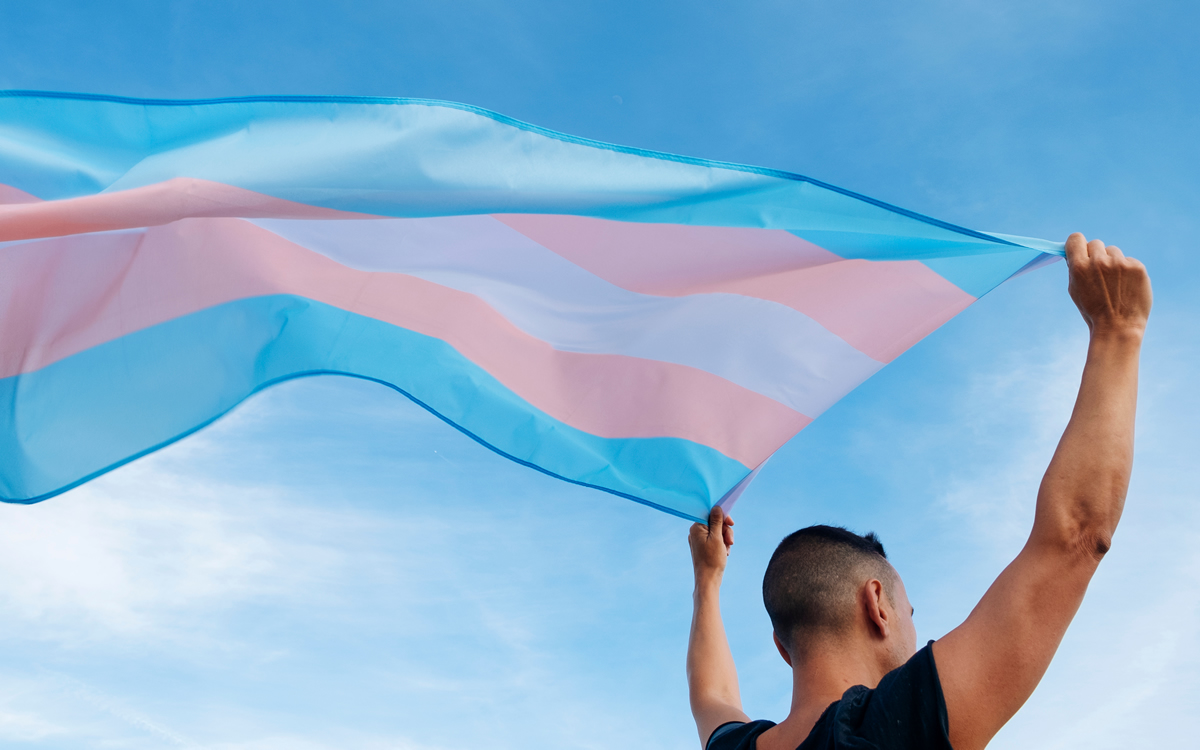
The first International Trans Day of Visibility (TDOV) celebration was held 15 years ago, with the goal of addressing the major concern that the only well-known trans-centered day was the Transgender Day of Remembrance, which mourned the murders of transgender people but did not acknowledge and celebrate living members of the transgender community. On March 31, Trans USA National Pageantry and the National Center for Transgender Equality (NCTE) will host the 1st Annual Blossom Gala at Hook Hall, which will serve as the culminating event of their TDOV programming in Washington, DC.
Dylan Drobish (also known as Dylan B. Dickherson White), National Director at Trans USA, offered the following: “It is our hope that Blossom will serve as a reminder not just of the battle we face every day but also of the beauty, excellence, intellect, and resilience of transgender Americans. We believe that this event is especially important given the increased backlash and violence against our community in the last few years alone, with nearly 500 anti-trans bills under consideration across 41 states as of March. However, Blossom—and TDOV itself—is a celebration held in defiance of the idea that trans lives are only worthy of headlines once they have ended.”
Preceded by an impactful, inspiring rally at the national mall (11:00 AM to 3:00 PM) featuring Angelica Ross of Pose and AHS, Blossom is a fundraising initiative that blends keynote speakers, a Q&A panel discussion with national leaders in the movement for transgender equality, and the artistry of drag with CHERRY BOMB–an all-trans drag showcase headlined by trans icon, activist, and Drag Race pioneer Monica Beverly Hillz. This pivotal event will also serve as the official public launch of the TRANSform the Vote initiative, which aims to inspire transgender people and allies to make their voices heard at the ballot box.
But make no mistake. Blossom is a celebration, and the event organizers have pulled out all the stops to ensure that ticket prices remain accessible without sacrificing the magic of a true gala experience. For truly gram-worthy “pink carpet” photos, all attendees are invited to “dress to impress” with their interpretation of a timely theme that celebrates the beauty of coming into one’s own as a visible member of the trans, non-binary, and gender non-conforming community.
The event comes at a pivotal time for both the community and the organizations seeking to protect it: This summer, NCTE will officially merge with Transgender Legal Defense and Education Fund (TLDEF) to create Advocates for Trans Equality, doubling their ability to lead the next chapter of the transgender rights movement. This November, Trans USA will welcome over 80 representatives from across the country to their national competition, which will for the first time also feature a national conference and exposition solely focused on the trans and non-binary community. While monumental, these 2024 events come with unprecedented challenges, as many major corporations and grant programs refuse to provide funding related to “controversial social or political issues”, especially in an election year.
Despite these challenges, celebratory events like Blossom are, unsurprisingly, now more important than ever, with trans lives having been politicized to such a polarizing extent. Drobish, a former Mr. Trans USA himself offered the following:
“‘Narrative identity’ refers to the idea that our identities are formed from the internal stories we tell about ourselves (and our interpretation of them). Organizations like Trans USA and NCTE are here to help rewrite the narrative that gets passed down to the next generation of trans and non-binary folks. My message to anyone involved with Trans USA or the movement in general has always been that you are the author of your story—the story that gives your life meaning and purpose—and you get to choose how it’s told. Are you the hero or the victim? Are you the agent or the object? Are you the one telling your story, or is someone else doing all the talking? It’s 2024, and it’s time to take the pen back. Because true visibility isn’t about being seen; it’s about making others feel seen. Seen enough to BLOSSOM.”
Tickets for the Blossom gala start at just $15, but VIP guests ($100) will receive access to a premium open bar from 6:00 PM to 9:00 PM, light hors d’oeuvres, and prime seating, in addition to the 20-entertainer showcase with a Drag Race headliner! While doors open at 4:30 PM for the event, advance purchase online is strongly recommended by the organizers, as only a limited number of these VIP tickets are available.
-Dylan Drobish (National Director, Trans USA National Pageantry; Mr. Trans USA 2022, Mr. Freddie’s 2019



Commentary
How do you vote a child out of their future?
Students reportedly expelled from Eswatini schools over alleged same-sex relationships

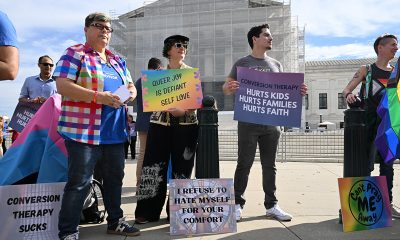
There is something deeply unsettling about a society that turns a child’s future into a public referendum. In Eswatini, there were reports that students were expelled from school over alleged same-sex relationships, and that parents were invited to vote on whether those children should remain, forcing us to confront a difficult question on when did education stop being a right and become a favor granted by collective approval? Because this is a non-neutral vote.
A vote reflects power, prejudice and personal beliefs, which are often linked to tradition, culture, politics and religion. It is shaped by fear, by stigma, by long-standing narratives about morality and belonging. To ask parents, many of whom may already hold hostile views about LGBTIQ+ people, to decide the fate of children is not consultation. It is deferring the responsibility and repercussion. It is placing the lives of young people in the hands of those most likely to deny them protection.
And where is the law in all of this?
The Kingdom of Eswatini is not operating in a vacuum. It has a constitution that guarantees the promotion and protection of fundamental rights, including equality before the law, equal protection of the laws, and the right to dignity. The constitution further goes on to protect the rights of the child, including that a child shall not be subjected to abuse, torture or other cruel, inhuman and degrading treatment or punishment.
The Children’s Protection and Welfare Act of 2012 extends the constitution and international human rights instruments, standards and protocols on the protection, welfare, care and maintenance of children in Eswatini. The Children’s Protection and Welfare Act of 2012 promotes nondiscrimination of any child in Eswatini and says that every child must have psychosocial and mental well-being and be protected from any form of harm. The acts of this very instance place the six students prone to harm and violence. The expulsion goes against one of the mandates of this act, which stipulates that access to education is fundamental to development, therefore, taking students out of school and denying them education contradicts the law.
Eswatini is a signatory to the United Nations Convention on the Rights of the Child and the African Charter on the Rights and Welfare of the Child. These are not just commitments made to make our governments look good and appeasing. They are obligations. The Convention on the Rights of the Child is clear regarding all actions concerning children. The best interests of the child MUST be a primary consideration and NOT secondary one. According to the CRC, as indicated in the Declaration of the Rights of the Child, “the child, by reason of his physical and mental immaturity, needs special safeguards and care, including appropriate legal protection, before as well as after birth.” It is not something to be weighed against public discomfort and popularity.
The African Charter on the Rights and Welfare of the Child reinforces this, grounding rights in non-discrimination (Article 3), privacy (Article 10) and protection from all forms of torture (Article 16). Access to education (Article 11) within these frameworks is not conditional but is a foundational right. It is not something that can be taken away because a child is perceived as falling outside social norms and threatening the moral fabric of society. It is a foundational right and determines one’s ability to participate in civic actions with dignity.
So again, where is the law when children are being expelled?
It is tempting to say the law is silent but that would be too generous. The law is not silent rather, it is being ignored and bypassed in favor of systems of decision-making that make those in power comfortable. When schools and their leadership defer to parental votes rather than legal standards, they are not acting neutrally. Expelling a child from school because of allegations is not a decision to be taken lightly. It disrupts education and limits future opportunities and for children already navigating identity and social pressure, this kind of exclusion can have profound psychological effects. It isolates them. It marks them for potential harm. Imagine being a child whose future is discussed in a room where people debate your worth. That is exposure. That is harm. There is a tendency to justify these actions in the language of culture, tradition, religion and protecting social cohesion. But culture is not static and the practice of Ubuntu values is not an excuse to violate rights. If anything, the principle of Ubuntu demands the opposite of what is happening here.
Ubuntu is not about conformity. It is about recognition and is the understanding that our humanity is bound up in one another. That we are diminished when others are excluded. That care, dignity, respect and compassion are not optional extras but central to how we exist together. Where, then, is Ubuntu in a school where some children are deemed unworthy of access to education?
Why are those entrusted with protecting children are failing to do so?
There is a very loud contradiction at play. On one hand, there is a claim to shared values and to the importance of community. On the other hand, there is a willingness to isolate and exclude those who do not fit within the narrow definition of what is acceptable. You cannot have both. A community that thrives on exclusion is neither cohesive nor safe.
It is worth asking why these decisions are being made in this way. Why not follow the established legal processes? Why not ensure that any disciplinary action within schools aligns with national and international obligations? Why introduce a vote at all? The answer is uncomfortable and lies in legitimacy and accountability. A vote creates the appearance of a collective agreement. But again, I reiterate, it distributes responsibility across many hands, making it hard to hold anyone accountable. It allows the school leadership to say “lesi sincumo sebantfu”(“This is what the community decided, not me”) rather than confronting their own role in human rights violations. If the law is clear and rights, responsibilities and obligations are established, then the question is not what the community feels. The question is why those entrusted with protecting children are failing to do so.
There is also a deeper issue here about whose rights are seen as negotiable. When we talk about children, we often speak of care, of understanding, of protection and safeguarding them because they are the future. But that language becomes selective when it intersects with sexuality, particularly when it involves LGBTIQ+ identities. Suddenly, care, understanding, protection, and safeguarding give way to punishment.
Easy decisions are not always just ones.
If the kingdom is serious about its commitments under its constitution, the Convention on the Rights of the Child and the African Charter on the Rights and Welfare of the Child, then those commitments must be visible in practice, not just in policy documents. Rather, they must guide decision-making in schools and in communities. That means recognizing that a child’s right to education cannot be overridden by a show of hands. It means ensuring that schools remain spaces of inclusion rather than sites of moral policing. It means holding leaders and institutions accountable when they fail to protect those in their care.
Bradley Fortuin is a consultant at the Southern Africa Litigation Center and a human rights activist.
Opinions
Tennessee’s trans data bill a frightening omen
Information collected for ‘research’ can be repurposed for enforcement

Something important recently happened in Tennessee — and it demands far more scrutiny than it’s getting.
The Tennessee state House passed a bill — HB 754 — that requires clinics and insurers to report data on patients receiving gender-affirming care to the state. On paper, it is framed as a neutral effort: a way to “study trends,” “understand outcomes,” and bring clarity to a politically charged area of medicine. That is how its supporters describe it.
But laws are not judged solely by their stated intent. They are judged by their structure, their context, and the foreseeable ways they can be used.
And in structure and context alike, this bill edges dangerously close to something far more unsettling: a system of tracking a politically targeted minority.
The mechanics matter. Under the legislation, providers must submit detailed information about transgender patients — data that will ultimately be compiled into state reports and made public in aggregated form.
Supporters emphasize a key safeguard: the data is supposed to be “de-identified.” No names, no Social Security numbers. In theory, no direct link to any one individual.
But that reassurance collapses under even minimal scrutiny.
Because data does not need to contain a name to identify a person. In smaller communities—rural counties, tight-knit towns—granular data points like age, treatment type, and geography can easily narrow a dataset down to a handful of individuals. In some cases, to one.
Privacy experts have been warning about this problem for years. Re-identification is not a hypothetical risk — it is a well-documented reality. And when the dataset concerns a stigmatized population, the stakes are not abstract. They are personal, immediate, and potentially dangerous.
That is why critics of the bill are not calling it “data collection.” They are calling it what it resembles: a registry in all but name.
And history gives that word weight.
Governments have always justified registries as tools of order and knowledge. Lists of dissidents. Lists of immigrants. Lists of the sick, the criminal, the different. They begin as bureaucratic exercises — tidy, rational, even boring. Only later do we confront what those lists enable.
To be clear, HB 754 is not a list of names published online. It is not, at least yet, a direct catalogue of individuals. But the architecture it builds—centralized data collection on a specific, politically contested group—is the same architecture that makes such lists possible.
And that is where context becomes unavoidable.
This bill does not exist in isolation. It comes after years of escalating legislation targeting transgender people in Tennessee—from restrictions on healthcare to limits on public expression. The trajectory is not ambiguous. It is cumulative.
When a government repeatedly singles out a group for legal scrutiny, and then begins building systems to track that group—even indirectly—it crosses a conceptual line. It moves from regulating behavior to mapping people.
Supporters argue that none of this is the point. That the bill is about medical evidence, not identity. That policymakers need data to evaluate treatments.
But this argument collapses under its own selectivity.
If the true goal were neutral scientific inquiry, we would expect similarly aggressive data collection across other areas of medicine—cosmetic surgery, psychiatric medication, fertility treatments. We do not see that. The focus here is narrow, targeted, and politically charged.
That selectivity reveals something important: this is not just about healthcare. It is about governance—about which populations the state chooses to monitor, and why.
And once that monitoring infrastructure exists, its use is not fixed.
Data collected today for “research” can be repurposed tomorrow for enforcement, litigation, or exposure. Laws change. Administrations change. What remains is the dataset—and the precedent that it is acceptable to build it.
That is the real risk embedded in HB 754. Not necessarily what it does on day one, but what it normalizes over time.
It normalizes the idea that transgender people are a category to be tracked. It normalizes the idea that their private medical decisions are of special interest to the state. And perhaps most dangerously, it normalizes the idea that the boundary between public policy and personal identity can be quietly, bureaucratically eroded.
There is a tendency, especially among lawmakers, to view policy as modular—each bill evaluated in isolation, each provision defended on its own terms. But for the people living under those laws, the experience is cumulative. It is the pattern that matters.
And the pattern here is becoming harder to ignore.
A state that restricts your care, debates your existence, and then begins compiling data about you is not neutral. It is not merely studying you. It is defining you as a subject of governance.
That distinction—between citizen and subject—is subtle. But it is where the stakes of this bill ultimately lie.
Because once a government begins building lists—even partial, anonymized, “harmless” ones—it is no longer just making policy.
It is deciding who counts.
Isaac Amend is a writer based in the D.C. area. He is a transgender man and was featured in National Geographic’s ‘Gender Revolution’ documentary. He serves on the board of the LGBT Democrats of Virginia. Contact him on Instagram at @isaacamend.
Opinions
The felon’s gang can’t get their story straight
Silver lining could be a blue wave in November
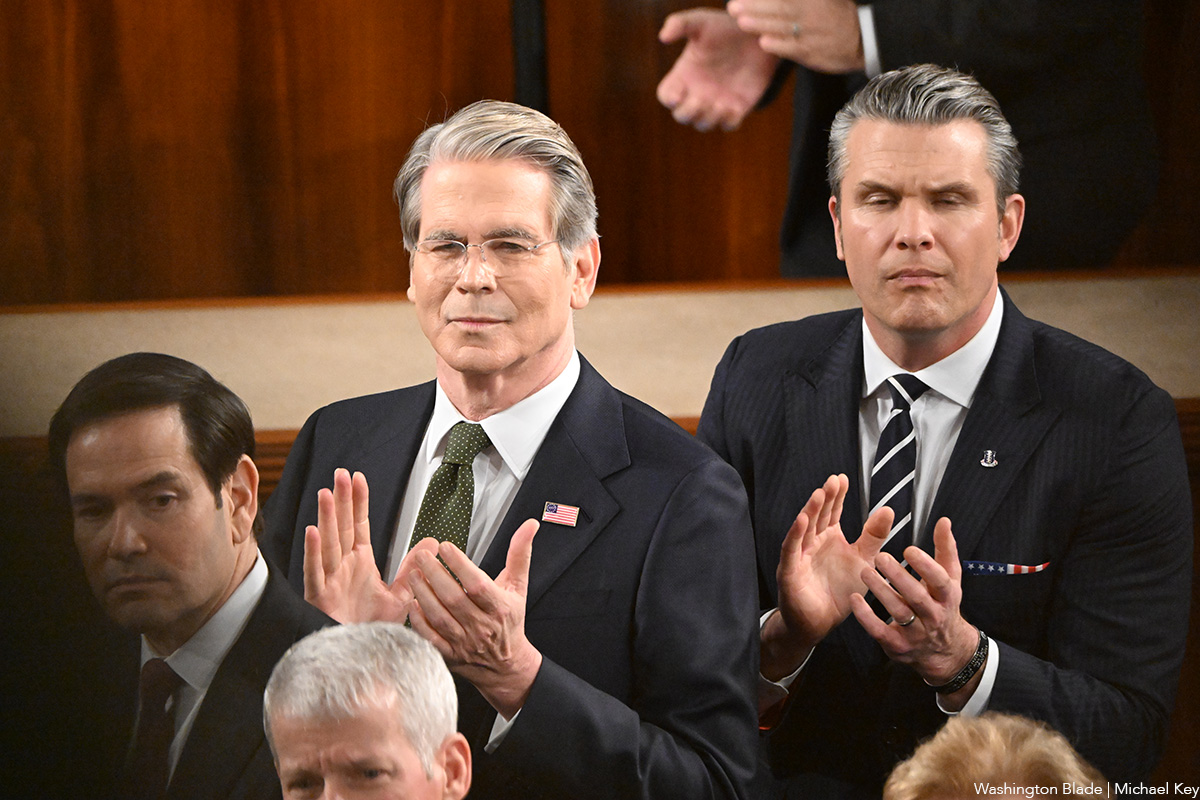
The felon and his administration all come up with different stories about a losing war. It’s bizarre to listen to the felon in the White House, and the different members of his administration, talk about the war in Iran. They can’t get their stories straight. Between gay Secretary of the Treasury Scott Bessent; the signal twins, Sec’y of Defense Hegseth and Michael Waltz, now the U.S. ambassador to the UN; little Marco, our Secretary of State; and the vice president who once called the felon our own Hitler. None of them seem to know what is going on in the world either with Iran, or anywhere else. They do interviews and come up with different stories, and then when asked to be specific they say, “well it’s up to the president.” Clearly, they don’t know, because the felon changes his mind every five minutes. Bessent changes his story on sanctions against Russia, and Waltz tries to justify the felon’s threats against infrastructure and private citizens in Iran, as not war crimes.
As I write this the president again sidelines his vice president, and wants to send the two grifters, Witkoff and Kushner, to Pakistan to try to negotiate with the Iranians who haven’t even said they will be there. These two, who seem to negotiate everything for the felon, while enriching themselves, fail to get any longstanding agreements. Last time they and Vance were in Pakistan, Rubio was attending a wrestling match with the felon in Florida, apparently left out of any negotiations concerning the illegal war the felon began. Some suggest he is looking at how to become the King/Queen of Cuba. Is it any wonder no country in the world trusts us?
As former senator and Secretary of State Hillary Rodham Clinton commented, it was close to criminal the felon claimed he wasn’t made aware Iran had the ability to close the Strait of Hormuz. She described that as “a long known fundamental pillar of geopolitical strategy in the Middle East.” She noted in her national security experience, “closing the Strait was always assumed to be the first thing Iran would do as its primary tool of global leverage.” She is much too polite to call the president a moron, or demented, when he clearly is both, and the moron appellation can easily be applied to people like Pete Hegseth, who surround him. It was reported those with any smarts, like the Chairman of the Joint Chiefs of Staff Dan Caine, told the felon not to start this war.
It looks like the best we can hope for after this illegal and unwise war the LOSER in the White House began, is we get back to about the same place we were before he began it. We were in negotiations, and the Strait of Hormuz was open. That is close to where we were years ago during Trump’s first term, when he pulled out of the agreement with Iran Obama had negotiated.
Now the unintended consequences of this war, and I have to assume they are unintended as why would the felon want to destroy his own credibility and Republican chances of keeping the Congress, which is what is happening. He is disrupting, and destroying, the lives of Americans with his actions and policies. This war has cost the American taxpayer nearly $60 billion so far. We have lost at least 13 of our service members and nearly 500 have been injured. We have bombed schools and hospitals in Iran. Gas prices are through the roof at home, and around the world, and inflation is climbing. Prices for everything are going up. Polling indicates Americans are rightly blaming the felon and Republicans for this. The felon’s approval ratings have hit a new low of about 34%. Even his MAGA cult opposes this war.
We know the felon will try to find some way to end this and claim he is winning. He did that with his tariffs. Anyone with a brain knows after he screwed with them, and then backed off, he claimed getting back to where he was before he levied them was a win. Now that the Supreme Court ruled, he had no authority to levy them, he is figuring out how the government will return the $166 billion that was collected illegally. The average American got screwed as in most cases they won’t get a refund on the cost that was passed on to them.
So, we move from one crisis to the next, all caused by the felon and his administration. The only positive I see in the future is all these disasters the felon is responsible for, might just lead to a blue wave allowing Democrats to take back Congress and some statehouses.
Peter Rosenstein is a longtime LGBTQ rights and Democratic Party activist.

A reign defined by commitment and human impact

Ukrainian MPs advance new Civil Code without protections for same-sex couples

Gay ICE detainee freed after 150 days in detention

How do you vote a child out of their future?

Under new extremism laws, LGBTQ Russians must fight to survive

Republicans attach five anti-LGBTQ riders to State Department funding bill

Both sides propose revised orders in Capital Pride stalking case

Tennessee’s trans data bill a frightening omen

Bill seeks to block global gag rule expansion

New Zealand blood donation rules shift
-

 Federal Government4 days ago
Republicans attach five anti-LGBTQ riders to State Department funding bill
-
District of Columbia5 days ago
Both sides propose revised orders in Capital Pride stalking case
-
Opinions3 days ago
Tennessee’s trans data bill a frightening omen
-
Congress5 days ago
Bill seeks to block global gag rule expansion