Theater
‘A Wrinkle in Time’ comes to Arena Stage
Actor, singer Taylor Iman Jones stars as Meg Murry

‘A Wrinkle in Time’
Through July 20
Arena Stage
1101 Sixth St., S.W.
Tickets range from $59-$209
Arenastage.org
Currently at Arena Stage, talented out actor and singer Taylor Iman Jones is rekindling an old friendship with an adored character of fiction.
Broadway vet Jones is starring as 13-year-old Meg Murry in “A Wrinkle in Time,” the world-premiere musical adaptation of Madeleine L’Engle’s same-titled book.
For many readers, especially women, the classic 1962 young adult novel, was their first foray into sci-fi, particularly one with a female protagonist.
The story centers on Meg, an awkward schoolgirl whose physicist father has mysteriously disappeared. Now, Meg, her popular friend Calvin, and smart younger brother Charles Wallace are tasked with moving through time and space to find him. Along the way they encounter adventure and evil.
For Jones, 33, playing 13-year-old Meg feels freeing in ways. She says, “As you get older, you’re told to grow up, so I like letting go of some of that. To feel feelings in their rawest form and to tap back into that is fun. I like the spontaneity. There are highs and lows to revisit.”
Born and raised in the San Francisco Bay Area, Jones began piano lessons at just six and soon added band and plays to their pursuits. Following high school, she made a deep dive into California theater for seven years before making the big move to New York in 2017 where after just two months she was singing on Broadway.
The determined and appealing Jones, who lives in New York with their partner, boasts an impressive bio. She has appeared on Broadway as Catherine Parr, Henry VIII’s sixth and final wife in Six, and in the original casts of “Head Over Heels” and “Groundhog Day.” She’s been seen in national tours of “Hamilton” and “American Idiot.”
WASHINGTON BLADE: It seems “A Wrinkle in Time” and Meg mean a lot to a lot of people.
TAYLOR IMAN JONES: The book tells the story of a girl with so much undiscovered power who’s accomplishing things she never imagined that she could.
BLADE: Can you relate?
JONES: Meg wears her emotions on her sleeve. I can certainly relate to that. I’m a Pisces. Sometimes being hyperemotional and very empathetic can feel like a burden, but as I’ve matured, I have realized that it’s not a bad quality. And it’s something I’ve learned to harness and to enjoy. I love that I can play a role like Meg in front of thousands of people.
BLADE: Was “Wrinkle in Time” a book you knew well?
JONES: Oh yeah, it’s a favorite book that lives in my heart and my mind. It’s one of the first books that taught me about the adventure of reading.
BLADE: And playing a favorite character must be a kick.
JONES: It really is.
BLADE: Meg is a big part in a big show.
JONES: This musical is huge. They’re traveling through space and meeting people on different planets. 20-person cast. 30 songs in the show. Quite the undertaking and I’m proud of us. I’m on stage for the entire musical and I sing four or five numbers.
As a mezzo soprano I guess you’d say I have the luxury of being able to do a lot of musicals that span a lot of different genres: rock musical, pop musical, and standards. “A Wrinkle in Time” is contemporary musical theater.
For me, singing is probably the least difficult part of the show. What’s harder for me is the way Meg experiences trauma; I need to be careful when I’m screaming and yelling.
BLADE: It seems mostly women have been involved in making this production happen (book by Lauren Yee; music and lyrics by Heather Christian; directed by Lee Sunday Evans; and choreography by Ani Taj.)
JONES: It’s true, the director, writer, etc., and most of our producers are all women. This doesn’t happen most of the time. For me it means new ideas and fresh energy, and pushing the limits of musical theater.
It’s also created a wonderful space in which to work. It can be more generous, and understanding. And centering the story on a young girl is something we can all relate to.
BLADE: Will “A Wrinkle in Time” resonate with queer theatergoers and their families?
JONES: I think so, especially on the heels of pride month. It’s truly a show for all ages about finding your inner strength and fighting for the things that you love; not letting evil win over the power of good, and not just for yourself but for those around you too.







Ideally, spring is our season of renewal – personal, emotional, and social. Lucky for those in the DMV, there’s a lot of exhilarating new theater to help make it happen.
At Arena Stage, there’s still time to catch the world premiere production of “Chez Joey” (extended through March 22). Set around the 1940s Chicago jazz scene, this smart reboot of the Broadway classic “Pal Joey” effervesces with music by Rodgers and Hart and a terrific cast brimming with big talent (including Myles Frost, Awa Sal Secka, and out comedic actor Kevin Cahoon).
Also at Arena, is “Inherit the Wind” (through April 5), the extraordinarily timely work based on the real-life Scopes “Monkey” Trial. It’s a courtroom drama that pits two towering legal minds against each other in a small-town battle over science, religion, and the right to think. The large, talented cast includes Billy Eugene Jones, Dakin Matthews, and out actors Holly Twyford and Alyssa Keegan. Arenastage.org
La Pluma Theatre, a queer Latin company housed in Dupont Underground, presents “The Ladybird of Saint John” (April 6-12), a powerful story about two sisters navigating immigration, separation, and the fragile bonds of family. @laplumatheatre – Instagram
Great gay playwright Tennessee Williams’ “A Streetcar Named Desire” (April 20–May 4) is also coming to the Dupont Underground space. Directed by out actor/director Nick Westrate, the touring production of Williams’s classic work set in New Orlean’s steamy Vieux Carré is performed with neither set nor props. It focuses on the words. Lucy Owen and Brad Koed star as fragile Blanche Dubois and her brutal brother-in-law Stanley. Dupontunderground.org
Folger Theatre is serving up one of the Bard’s best comedies, “As You Like It” (through April 12). Staged by out director Timothy Douglas, Folger’s production “offers a love note to D.C., imbuing the forest of Arden with the familiar vibes, culture, and characters that mark the District as a singular, resilient, and redemptive place of belonging.” Folger.edu
As part of the country’s semi-quincentennial celebrations, Ford’s Theatre presents “1776” (through May 16), a Tony Award-winning musical about the Second Continental Congress’s struggle to adopt the Declaration of Independence in Philadelphia. Directed by Luis Salgado, the show features a large cast including queer talent like Tom Story, Jake Loewenthal, Jimmy Mavrikes, and Wood Van Meter. Fords.org
In Falls Church, Creative Cauldron presents “Twelve Dancing Princesses” (through March 29), a Learning Theater Production targeting both kids and adults. Adapted from a Brothers Grimm tale, the eerie story features Spanish language elements and original music by husbands Matt Conner and Stephen Gregory Smith. Creativecauldron.org
The National Theatre presents “Disney’s Beauty and the Beast” (March 18–April 5). This musical “tale as old as time” is a love story involving Belle, a cursed beast, and the arrogant and famously spurned Gaston played out actor Stephen Mark Lukas, a beauty in his own right. Broadwayatthenational.com
At Mosaic Theater Company, Michael Bahsil-Cook plays the titular activist/congressman in Psalmayene 24’s “Young John Lewis: Prodigy of Protest.” (March 26–May 3). Staged by Mosaic’s out artistic director Reginald L. Douglas, focuses on Lewis’s formative years of ages 18-28, revealing the budding humanity and heart of this mighty historic figure. Talented out actor Vaughn Ryan Midder plays legendary civil rights activist Medgar Evers and other parts. Mosaictheater.org
At Olney Theatre Center, it’s the anticipated area premiere of “Appropriate” (March 18–April 19). Penned by Tony Award-winning out playwright Branden Jacobs-Jenkins, the darkly comic work follows a dysfunctional white family that gathers on a plantation home to liquidate their late father’s estate where they uncover a dark history of racism.
Excellent area actors Kimberly Gilbert and Cody Nickell play siblings battling over possessions as well as their father’s shady legacy. Performed in Olney’s black box Mulitz-Gudelsky Theatre Lab, the company promises a unique staging of this important American play. Jason Loewith directs.
Also at Olney Theatre, celebrity chef and longtime queer ally Carla Hall debuts her one-woman show, “Carla Hall — Please Underestimate Me” (June 3–July 12). Olneytheatre.org
British imports are striding the boards at Shakespeare Theatre Company this spring. The first is “Hamnet” (March 17–April 12), the U.S. premiere of the Royal Shakespeare Company’s 2023 stage adaptation of Maggie O’Farrell’s best-selling novel about the life of Shakespeare’s wife, Agnes, and the death of their son.
And then it’s “Eddie Izzard in the Tragedy of Hamlet” (March 27–April 11), a one-woman show in which the British comedian takes on 23 characters in a unique re-telling of the renowned work. Shakespearetheatre.org
Woolly Mammoth Theatre presents “Travesty” (March 24–April 12). Created and performed by gender fluid drag performer Sasha Velour, the one-person show is part performance art, part history, and part call to action.
Also at Woolly, out actor Justin Weaks stars in his solo piece “A Fine Madness” (June 2–21), in which the Helen Hayes Award-winning actor shares his personal experience as a Black gay man receiving a positive HIV diagnosis. Woollymammoth.net
Spring at Studio Theatre is Rachel Bonds’ “Jonah” (through April 19), an exploration of a woman’s life through relationships with three men. Directed by Taylor Reynolds, the young five-person cast includes Rohan Maletira in the title role and Ismena Mendes as Ana. Mendes is an accomplished stage and screen actor whose described as bisexual/queer in her IMBD bio. Studiotheatre.org
In Arlington, Signature Theatre’s out artistic director Matthew Gardiner stages “Pippin” (May 12–July 26), Stephen Schwartz’s musical about a young prince searching for a terrific life guided by a theatrical troupe. The original 1972 production featured stars like Ben Vereen and Irene Ryan (best known as TV’s Granny Clampett). Signature’s production’s big names have yet to be shared. Sigtheatre.org
Exciting stuff ahead.
Theater
Out actor Kevin Cahoon on starring role in ‘Chez Joey’
Arena production adapted from Broadway classic ‘Pal Joey’
‘Chez Joey’
Through March 15
Arena Stage
1101 Sixth St., S.W.
Tickets start at $93
Arenastage.org
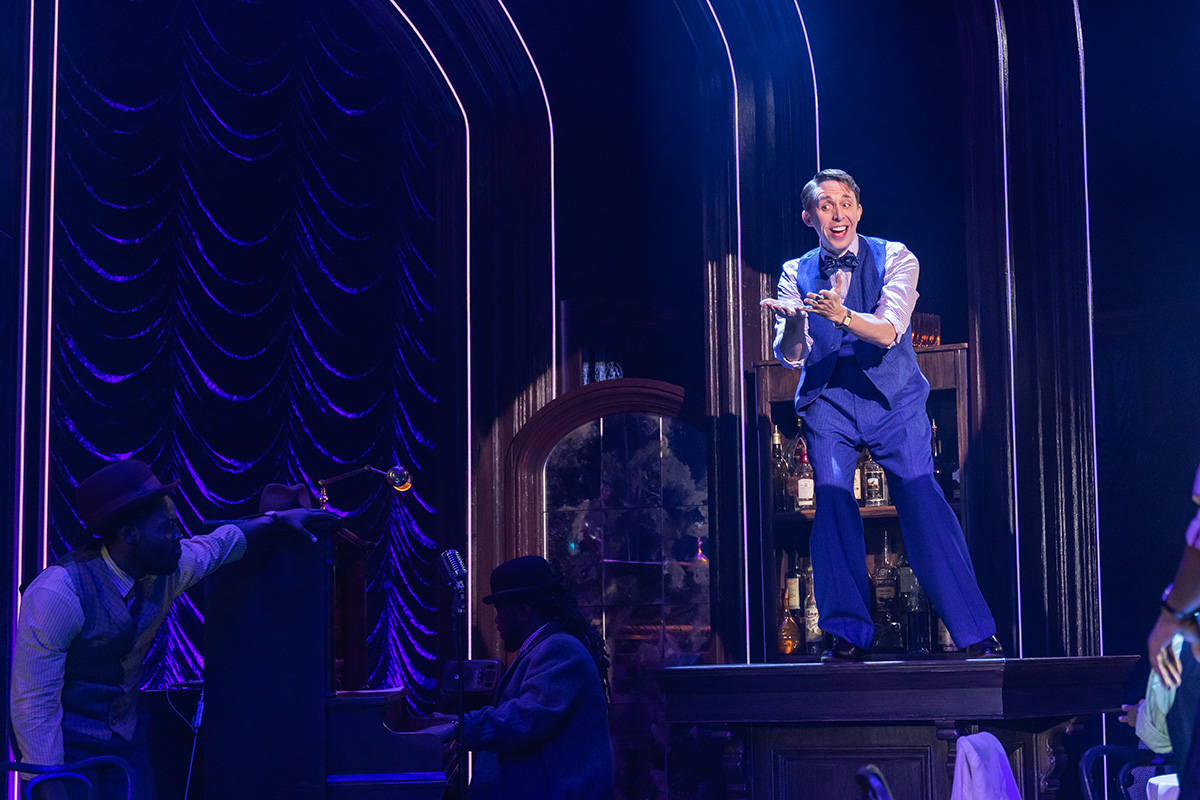
As Melvin Snyder in the new musical “Chez Joey,” out actor Kevin Cahoon plays a showbiz society columnist who goes by the name Mrs. Knickerbocker. He functions as a sort of liaison between café society and Chicago’s Black jazz scene circa 1940s. It’s a fun part replete with varied insights, music, and dance.
“Chez Joey” is adapted from the Broadway classic “Pal Joey” by Richard Rodgers and Lorenz Hart. It’s inspired by John O’Hara’s stories based on the exploits of a small-time nightclub singer published in The New Yorker.
A warm and humorous man, Cahoon loves his work. At just six, he began his career as a rodeo clown in Houston. He won the Star Search teen division at 13 singing songs like “Some People” from “Gypsy.” He studied theater at New York University and soon after graduating set to work playing sidekicks and comedic roles.
Over the years, Cahoon has played numerous queer parts in stage productions including “Hedwig and the Angry Inch,” “La Cage aux Folles,” “Rocky Horror” as well as Peanut in “Shucked,” and George the keyboardist in “The Wedding Singer,” “a sort of unicorn of its time,” says Cahoon.
Co-directed by Tony Goldwyn and the great Savion Glover, “Chez Joey” is a terrific and fun show filled with loads of talent. Its relevant new book is by Richard Lagravenese.
On a recent Monday off from work, Cahoon shared some thoughts on past and current happenings.
WASHINGTON BLADE: Is there a through line from Kevin, the six-year-old rodeo clown, to who we see now at Arena Stage?
KEVIN CAHOON: Anytime I want to land a joke in a theater piece it goes back to that rodeo clown. It doesn’t matter if it’s Arena’s intimate Kreeger Theatre or the big rodeo at the huge Houston Astrodome.
I was in the middle stadium and there was an announcer — a scene partner really. And we were doing a back and forth in hopes of getting laughs. At that young age I was trying to understand what it takes to get laughs. It’s all about timing. Every line.
BLADE: Originally, your part in “Chez Joey” Melvin was Melba who sings “Zip,” a clever woman reporter’s song. It was sort of a star feature, where they could just pop in a star in the run of “Pal Joey.”
CAHOON: That’s right. And in former versions it was played by Martha Plimpton and before her Elaine Stritch. For “Chez Joey,” we switched gender and storyline.
We attempted to do “Zip” up until two days before we had an audience at Arena. Unexpectedly they cut “Zip” and replaced it with a fun number called “I Like to Recognize the Tune,” a song more connected to the story.
BLADE: Wow. You must be a quick study.
CAHOON: Well, we’re working with a great band.
BLADE: You’ve played a lot of queer parts. Any thoughts on queer representation?
CAHOON: Oh yes, definitely. And I’ve been very lucky that I’ve had the chance to portray these characters and introduce them to the rest of the world. I feel honored.
After originating Edna, the hyena on Broadway in “The Lion King,” I left that to do “Hedwig and the Angry Inch” as standby for John Cameron Mitchell, doing one show a week for him.
Everyone thought I was crazy to leave the biggest musical of our time with a personal contract and getting paid more money that I’d ever made to get $400 a week at the downtown Jane Street Theatre in a dicey neighborhood.
At the time, I really felt like I was with cool kids. I guess I was. And I never regretted it.
BLADE: When you play new parts, do you create new backstories for the role?
CAHOON: Every single time! For Melvin, I suggested a line about chorus boys on Lakeshore Drive.
BLADE: What’s up next for Kevin Cahoon?
CAHOON: I’m about to do the New York Theatre Workshop Gala; I’ve been doing it for nine years in a row. It’s a huge job. I’ll also be producing the “Cats: The Jellicle Ball” opening on Broadway this spring; it’s a queer-centric uptown vogue ball with gay actor André de Shields reprising his role as “Old Deuteronomy.”
BLADE: There’s a huge amount of talent onstage in “Chez Joey.”
CAHOON: There is. I’m sharing a dressing room with Myles Frost who plays Joey. He won accolades for playing Michael Jackson on Broadway. We’ve become great friends. He’s a miracle to watch on stage. And Awa [Sal Secka], a D.C. local, is great. Every night the audience falls head over heels for her. When this show goes to New York, Awa will, no doubt, be a giant star.
BLADE: Do you think “Chez Joey” might be Broadway bound?
CAHOON: I have a good feeling it is. I’ve done shows out of town that have high hopes and pedigree, but don’t necessarily make it. “Chez Joey” is a small production, it’s funny, and audiences seem to love it.
Theater
José Zayas brings ‘The House of Bernarda Alba’ to GALA Hispanic Theatre
Gay Spanish playwright Federico García Lorca wrote masterpiece before 1936 execution
‘The House of Bernarda Alba’
Through March 1
GALA Hispanic Theatre
3333 14th St., N.W.
$27-$52
Galatheatre.org
In Federico García Lorca’s “The House of Bernarda Alba,” now at GALA Hispanic Theatre in Columbia Heights, an impossibly oppressive domestic situation serves, in short, as an allegory for the repressive, patriarchal, and fascist atmosphere of 1930s Spain
The gay playwright completed his final and arguably best work in 1936, just months before he was executed by a right-wing firing squad. “Bernarda Alba” is set in the same year, sometime during a hot summer in rural Andalusia, the heart of “España profunda” (the deep Spain), where traditions are deeply rooted and mores seldom challenged.
At Bernarda’s house, the atmosphere, already stifling, is about to get worse.
On the day of her second husband’s funeral, Bernarda Alba (superbly played by Luz Nicolás), a sixtyish woman accustomed to calling the shots, gathers her five unmarried daughters (ages ranging from 20 to 39) and matter-of-factly explain what’s to happen next.
She says, “Through the eight years of mourning not a breeze shall enter this house. Consider the doors and windows as sealed with bricks. That’s how it was in my father’s house and my grandfather’s. Meanwhile, you can embroider your trousseaux.”
It’s not an altogether sunny plan. While Angustias (María del Mar Rodríguez), Bernarda’s daughter from her first marriage and heiress to a fortune, is betrothed to a much younger catch, Pepe el Romano, who never appears on stage, the remaining four stand little chance of finding suitable matches. Not only are they dowry-less, but no men, eligible or otherwise, are admitted into their mother’s house.
Lorca is a literary hero known for his mastery of both lyrical poetry and visceral drama; still, “Bernarda Alba’s” plotline might suit a telenovela. Despotic mother heads a house of adult daughters. Said daughters are churning with passions and jealousies. When sneaky Martirio (Giselle Gonzáles) steals the photo of Angustias’s fiancé all heck kicks off. Lots of infighting and high drama ensue. There’s even a batty grandmother (Alicia Kaplan) in the wings for bleak comic relief.
At GALA, the modern classic is lovingly staged by José Zayas. The New York-based out director has assembled a committed cast and creative team who’ve manifested an extraordinarily timely 90-minute production performed in Spanish with English subtitles easily ready seen on multiple screens.
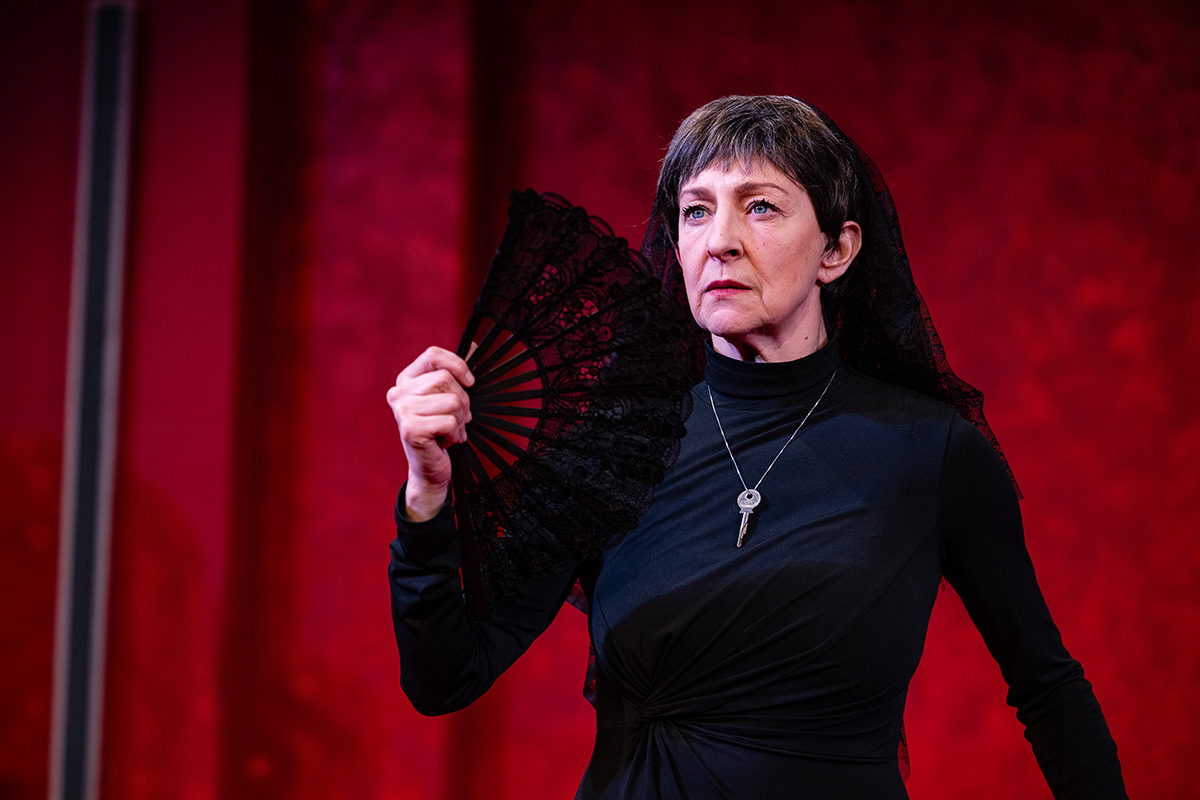
In Lorca’s stage directions, he describes the set as an inner room in Bernarda’s house; it’s bright white with thick walls. At GALA, scenic designer Grisele Gonzáles continues the one-color theme with bright red walls and floor and closed doors. There are no props.
In the airless room, women sit on straight back chairs sewing. They think of men, still. Two are fixated on their oldest siter’s hunky betrothed. Only Magdelena (Anna Malavé), the one sister who truly mourns their dead father, has given up on marriage entirely.
The severity of the place is alleviated by men’s distant voices, Koki Lortkipanidze’s original music, movement (stir crazy sisters scratching walls), and even a precisely executed beatdown choreographed by Lorraine Ressegger-Slone.
In a short yet telling scene, Bernarda’s youngest daughter Adela (María Coral) proves she will serve as the rebellion to Bernarda’s dictatorship. Reluctant to mourn, Adela admires her reflection. She has traded her black togs for a seafoam green party dress. It’s a dreamily lit moment (compliments of lighting designer Hailey Laroe.)
But there’s no mistaking who’s in charge. Dressed in unflattering widow weeds, her face locked in a disapproving sneer, Bernarda rules with an iron fist; and despite ramrod posture, she uses a cane (though mostly as a weapon during one of her frequent rages.)
Bernarda’s countenance softens only when sharing a bit of gossip with Poncia, her longtime servant convincingly played by Evelyn Rosario Vega.
Nicolás has appeared in “Bernarda Alba” before, first as daughter Martirio in Madrid, and recently as the mother in an English language production at Carnegie Melon University in Pittsburgh. And now in D.C. where her Bernarda is dictatorial, prone to violence, and scarily pro-patriarchy.
Words and phrases echo throughout Lorca’s play, all likely to signal a tightening oppression: “mourning,” “my house,” “honor,” and finally “silence.”
As a queer artist sympathetic to left wing causes, Lorca knew of what he wrote. He understood the provinces, the dangers of tyranny, and the dimming of democracy. Early in Spain’s Civil War, Lorca was dragged to the the woods and murdered by Franco’s thugs. Presumably buried in a mass grave, his remains have never been found.

Report: US to withhold HIV aid to Zambia unless mineral access expanded

‘They took him!’ Gay married couple torn apart by ICE

Man charged with carjacking, kidnapping after having sex in D.C. park pleads guilty

The rule of law, not the rule of religion

Meet the Scandals, D.C.’s LGBT rugby team

Trump proclamation targets trans rights as State Dept. shifts visa policy

Gay Cameroonian immigrant will be freed from ICE detention — for now

Adolescentes trans en Ecuador podrán cambiar datos en su cédula, pero con condicionamientos

Gay Venezuelan man ‘forcibly disappeared’ to El Salvador files claim against White House

BMA celebrates enduring influence of Henri Matisse
-

 The White House5 days ago
Trump proclamation targets trans rights as State Dept. shifts visa policy
-
Cameroon5 days ago
Gay Cameroonian immigrant will be freed from ICE detention — for now
-
Ecuador5 days ago
Adolescentes trans en Ecuador podrán cambiar datos en su cédula, pero con condicionamientos
-
Federal Government5 days ago
Gay Venezuelan man ‘forcibly disappeared’ to El Salvador files claim against White House