Spain
Victory Institute honors transgender Spanish senator in D.C.
Carla Antonelli describes Trump policies as ‘absolutely terrifying’
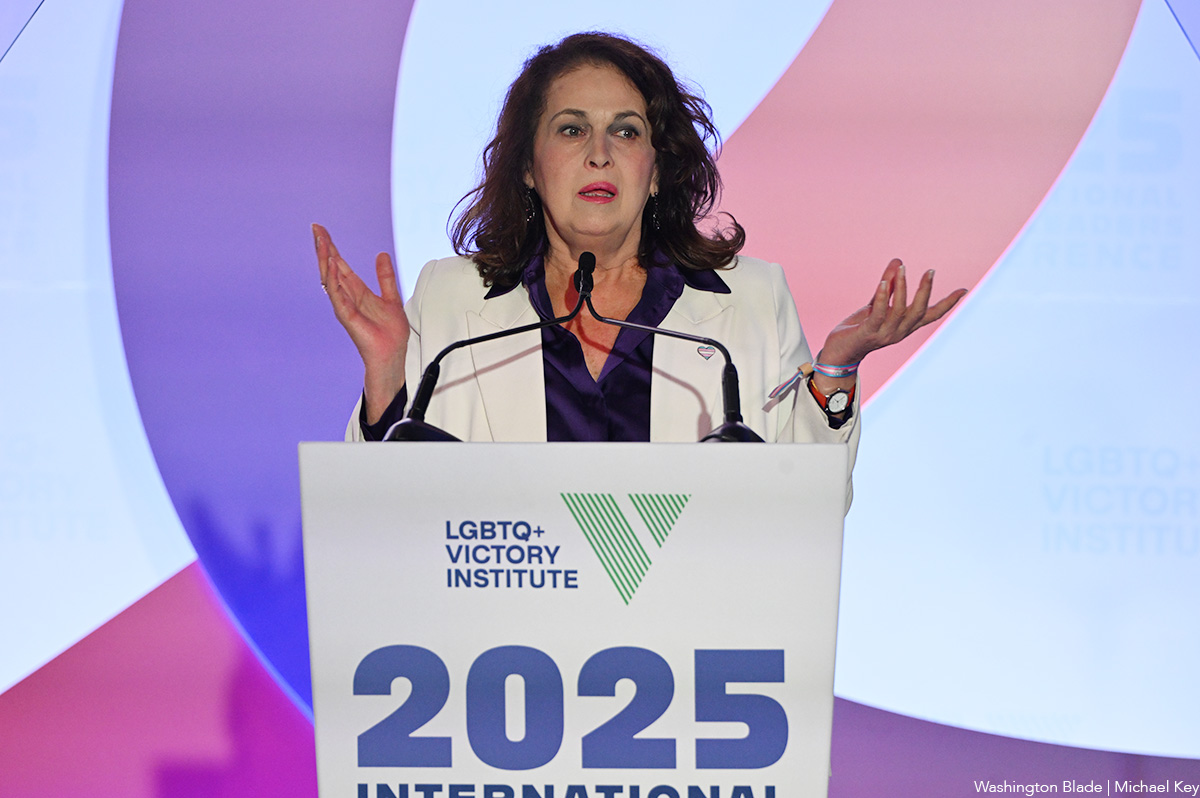
The LGBTQ+ Victory Institute on Dec. 5 inducted Spanish Sen. Carla Antonelli into its LGBTQ+ Political Hall of Fame.
Antonelli in 2011 became the first openly transgender woman elected to a regional legislative office in Spain when she won a seat in the Madrid Assembly.
She left Prime Minister Pedro Sánchez’s leftist Spanish Socialist Workers’ Party in 2022. Antonelli in 2023 became the first openly trans woman in the Spanish Senate when Más Madrid, a progressive regional party, named her Pablo Gómez Perpinyà’s successor in the chamber.
The Hall of Fame induction took place during the Victory Institute’s annual International LGBTQ+ Leaders Conference at the JW Marriott Hotel in downtown D.C. The Washington Blade spoke with Antonelli on Dec. 6.
“We are living in rather turbulent times, hence the importance and necessity of gatherings like this one … to unite in these times, come together, and develop common strategies and policies.”
Antonelli, 66, grew up in Güímar, a municipality on the island of Tenerife in Spain’s Canary Islands.
She said transphobia forced her to leave her hometown in 1977, and she turned to sex work to support herself. Antonelli’s political activism began that year when she joined the campaign against a 1970 law that criminalized consensual same-sex sexual acts and LGBTQ people.
General Francisco Franco, whose regime governed the country from 1936-1975, approved the Law on Social Danger and Rehabilitation. Spain in 1995 removed the statute’s remaining provisions from its penal code.
Antonelli in the 1980s became a well-known actress. She is also a former spokesperson for Federación Estatal de Lesbianas, Gays, Transexuales y Bisexuales, a Spanish LGBTQ advocacy group known by the acronym FELGTB.
‘We will not go back to the margins’
Antonelli in February gave an impassioned speech in support of trans rights on the Senate floor.
She specifically singled out members of Vox, a far-right political party, over their efforts to repeal a landmark 2023 law that allows people who are at least 16 to legally change their gender without medical intervention. Antonelli’s speech — and her proclamation that “we will not go back to the margins” — quickly went viral.
Antonelli told the Blade she received messages of support from people in Algeria, Australia, Turkey, Mauritius, and elsewhere around the world. She added her speech was “the conclusion of everything I can feel at any given moment, also the pride of having lived through all these historical processes.”
“For whatever reason, I was born in ’59, and I lived through the dictatorship in my country,” said Antonelli. “I lived through the dictator’s death and I lived through what Spain was like exactly 50 years ago. It began to walk in freedom, and so freedom must be defended.”
Antonelli feared US would not allow her into the country
The Victory Institute conference took place less than a year after the Trump-Vance administration took office.
Antonelli in June traveled to D.C. and participated in WorldPride 2025. She admitted the White House’s anti-trans policies left her wondering whether the U.S. would allow her into the country as a trans woman.
The White House only recognizes two genders: male and female.
President Donald Trump after he took office signed an executive order that bans the State Department from issuing passports with “X” gender markers. U.S. Citizenship and Immigration Services in August announced it will ensure “male aliens seeking immigration benefits aren’t coming to the U.S. to participate in women’s sports.”
Spain is among the countries that have issued advisories for trans and nonbinary people who are planning to visit the U.S.
“This speaks volumes about the policies of intimidation and targeting they’re implementing, policies that have made trans people scapegoats for all of humanity’s ills,” Antonelli told the Blade.
“In the United States, now with Trump, it’s absolutely terrifying because we’re talking about not just taking away a right, they’re going against our lives, against our very existence,” she added.
Antonelli in June met U.S. Rep. Sarah McBride (D-Del.), the first openly trans woman elected to Congress. Antonelli told the Blade she “watched with sorrow” how U.S. Rep. Nancy Mace (R-S.C.) and other Republicans treated the Delaware Democrat after her historic 2024 election.
“The first thing some vengeful scoundrels, thirsty for evil, do is prohibit her from entering the women’s restrooms,” said Antonelli.
“It’s nothing more than a desire to humiliate, to degrade,” she added. “Behind many of these policies lies a desire to do harm. In other words, these are bad people, evil people whose principles aren’t an ideology. They revel in it. They enjoy thinking about how they are making other human beings suffer.”
Antonelli also stressed “visibility” is “freedom.”
“The more they try to erase us, the more we have to be visible,” she said. “They know perfectly well that visibility inevitably leads to normality, to normalization, which is nothing more than what is repeated daily, routinely. What’s normal is what you see every day, so they’re trying to prevent us from being visible in every way possible, because what they don’t want is for society to accept, to live with this truth.”
Antonelli also offered advice for trans people who want to run for office.
“Always be upfront,” she said. “Don’t hold back, but above all, don’t forget where you come from. Because you might be lucky enough to rise and become a representative of the people, but don’t forget your origins.”
Antonelli noted she is the Más Madrid spokesperson for health, equality, culture, and other issues, but added she “will never, never, never abandon my trans sisters and the LGBTQ+ community.”
“I never severed times with my roots,” Antonelli told the Blade. “My roots are a conservative family, a town I had to flee and to which I didn’t return until 32 years later. My future, my past, is a street corner. My past is being able to make that journey in a democracy and go from that street corner to a seat in the Madrid Assembly and then from there to a seat in the Senate. And that is precisely the greatness of democracy.”
She ended the interview by a quote she gave to El País, a Spanish newspaper.
“Those who used to call us faggots have to now call us ‘your honors,’” said Antonelli.

Spain
Spanish women detail abuses suffered in Franco-era institutions
Barcelona-based photographer Luca Gaetano Pira created ‘Las Descarriadas’ exhibit

A Barcelona-based photographer, audiovisual artist, and activist has created an exhibit that profiles Spanish women who suffered abuse in institutions that Gen. Francisco Franco’s dictatorship established.
Luca Gaetano Pira, who is originally from Italy, spoke with women who the regime, which governed Spain from 1936-1975, sent to Women’s Protection Board institutions.
The regime in 1941 created the board the country’s Justice Ministry oversaw.
Franco named his wife, Carmen Polo, as the board’s honorary president. Then-Prime Minister Felipe González fully dissolved the board in 1985, a decade after Franco’s death.
Gaetano’s exhibit is called “Las Descarriadas” or “The Misguided Women” in English.
“These are women who were detained between 1941 and 1985 for reasons that are unthinkable today: being lesbian, poor, pregnant out of wedlock, rebellious, politically active … or simply considered ‘morally suspect,'” Gaetano noted to the Washington Blade.
Groups affiliated with the Spanish Catholic Church ran these institutions. Gaetano pointed out they were “presented as social assistance centers.”
“In reality, they were spaces of punishment and forced reeducation, where isolation, unpaid work, and psychological violence were the norm,” he said. “Many of the survivors are still alive. Their testimonies are powerful, urgent, and of extraordinary current relevance.”
The regime sent more than 40,000 women to Women’s Protection Board institutions.
“Despite its seemingly benevolent name, it was in fact one of the most powerful instruments of moral and social control over women during and after the dictatorship,” notes the exhibit. “Under the guise of care and re-education, this institution functioned as a repressive apparatus that punished women who deviated from the ideal feminine model imposed by Franco’s regime: submissive, obedient, married, and dedicated to motherhood within the Catholic family structure.”
The Spanish Catholic Church last month issued a public apology, but Gaetano described it as “very soft” and noted “the women did not accept it.” Gaetano also compared the Women’s Protection Board institutions to Ireland’s Magdalene Laundries.
The Associated Press notes tens of thousands of “fallen” women were sent to the laundries that Catholic nuns operated in Ireland from the 18th century until the mid-1990s. Then-Irish Prime Minister Edna Kenny in 2013 issued a formal apology for the abuses that women suffered in the laundries and announced the government would compensate them.
The Spanish government has yet to offer compensation to the women abused in Women’s Protection Board institutions.
“My work focuses on recovering the historical memory of marginalized communities, particularly through the portrayal of survivors of institutional violence and the use of archival materials,” Gaetano told the Blade, noting he has also sought to highlight the repression that LGBTQ people suffered during dictatorships in Portugal and Latin America.
Gaetano’s exhibit can be found here:
Spain
Barcelona bids to host WorldPride in 2030
Activists from Spanish city traveled to D.C. this month
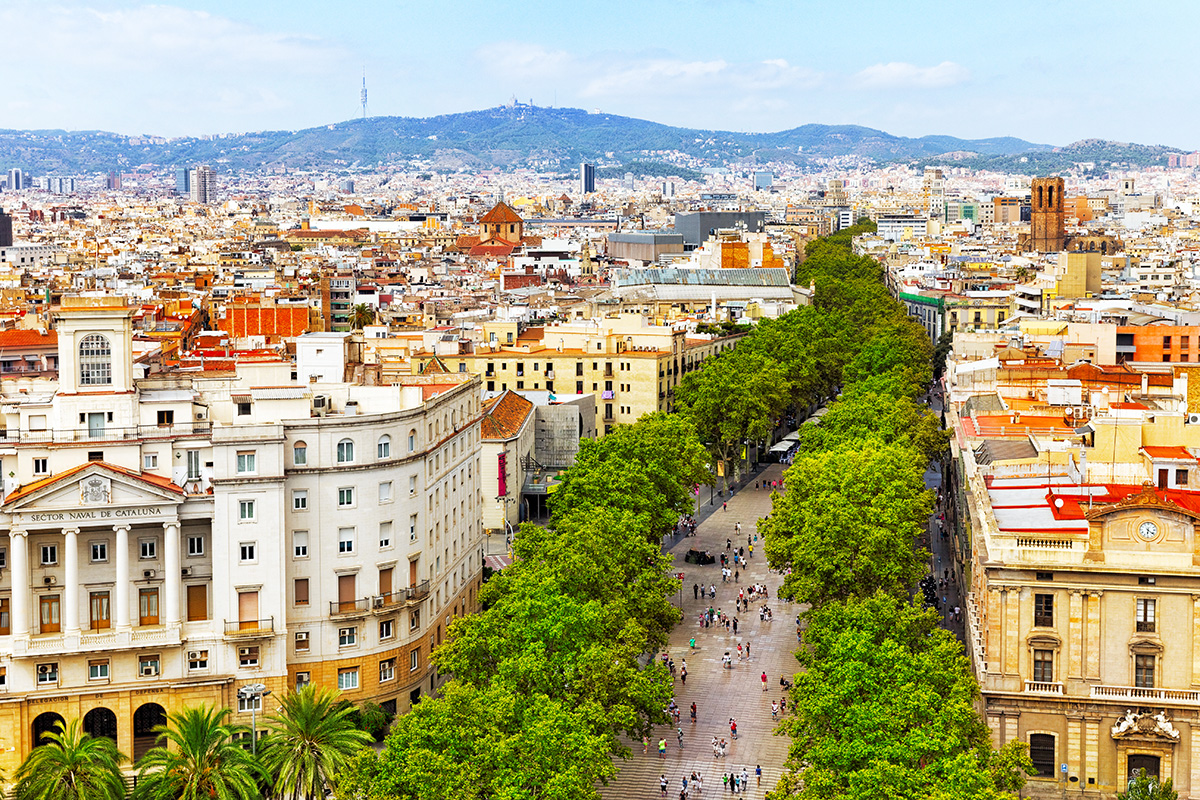
A group of activists from Barcelona traveled to D.C. earlier this month to promote their city’s bid to host WorldPride in 2030.
Pride Barcelona Vice President Maria Giralt, WorldPride Barcelona 2030 Project Manager Andoni Ibáñez, and Pride Barcelona’s Roger Presseguer on June 4 presented the city’s bid at a José Andrés-catered event at the Spanish Cultural Center in Northwest Washington.
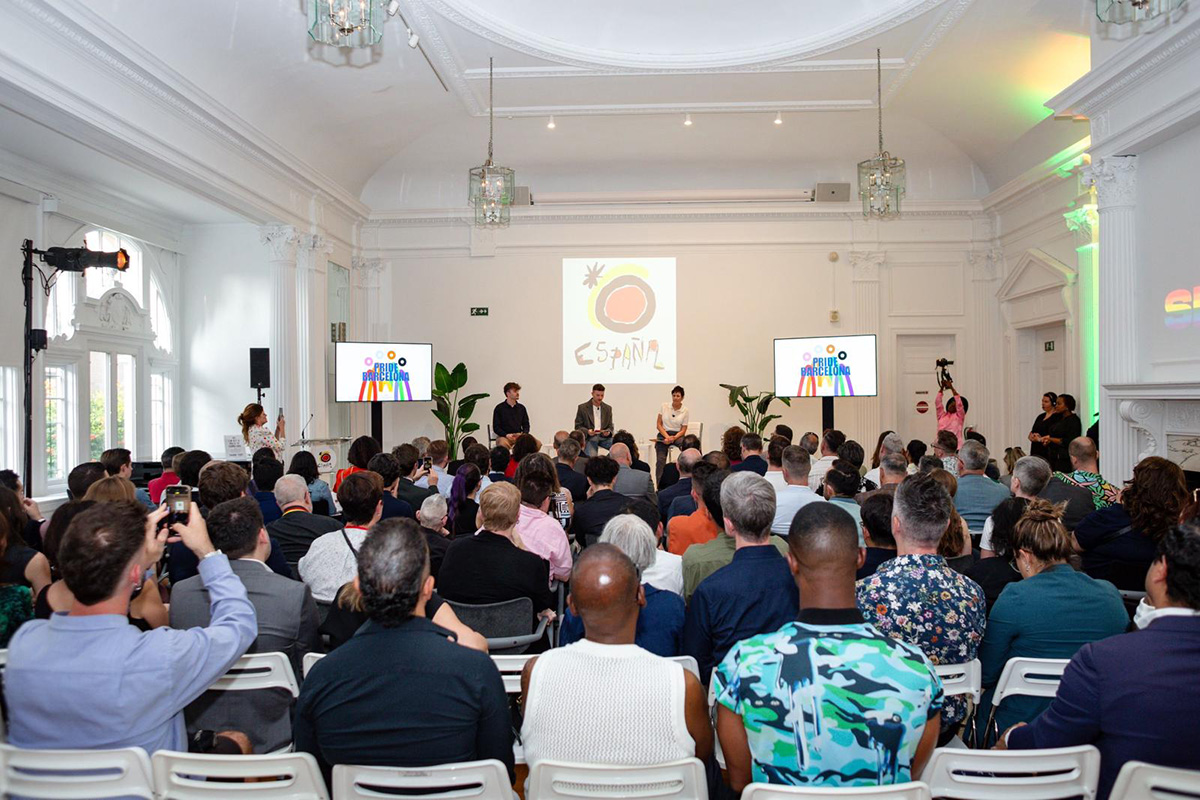
Catalonia LGBTI+ Public Policies General Director Alberto Lacasta, Barcelona City Commissioner Javier Rodríguez, and Barcelona Turisme Director Rosa Bada traveled to D.C. with the activists. Giralt, Ibáñez, and Presseguer visited the Washington Blade’s office on June 6.
“We intended to transmit the spirit of our candidacy,” said Giralt.
Giralt noted 39 LGBTQ groups in Barcelona and throughout Catalonia support the bid. The Catalonian government and Spain’s Tourism Institute, known as Turespaña, have also backed it.
“Spain and the ministry have helped us a lot,” said Giralt.
Madrid, the Spanish capital, hosted WorldPride in 2017. The activists’ trip to D.C. coincided with WorldPride 2025 that took place in the nation’s capital.
Spanish Sen. Carla Antonelli, who is transgender, is among those who participated in the WorldPride 2025 Human Rights Conference. Turespaña also had a booth at the Capital Pride Festival.
Next year’s WorldPride will take place in Amsterdam, while Cape Town will host WorldPride 2028. Montreal, London, and Bangkok are the three other cities that have bid to host WorldPride 2030.
InterPride, the organization that coordinates WorldPride events, will announce the winning bid in 2026.
“What better occasion than to come to Washington to present (the bid) and to also connect with other countries around the world,” said Giralt. “This approval is very important, especially at this time when there is a wave, a drift, toward the extreme right, and we believe it is very important for all the world’s greats to be present, to be clear that the fight. The resistance must continue.”
Spain’s first LGBTQ rights march took place in Barcelona on June 26, 1977, less than two years after long-time dictator Gen. Francisco Franco died. Spain is now one of the world’s most LGBTQ-friendly countries.
“What we’re trying to do from Barcelona is to recover a little of this struggle’s origins,” Giralt told the Blade.
‘A historic moment to be in Washington’
WorldPride 2025 took place less than five months after the Trump-Vance administration took office.
Egale Canada, one of Canada’s largest LGBTQ advocacy organizations, in February announced its members would not participate in WorldPride or any other event in the U.S. because of the White House’s policies. Equality Australia in April issued a travel advisory for transgender and nonbinary people who plan to visit the U.S. in response to President Donald Trump’s executive order that directed the federal government to recognize only “two genders, male and female” and banned the State Department from issuing passports with “X” gender markers.
Phyll Opoku-Gyimah, the co-founder of UK Black Pride known as Lady Phyll, spoke at the WorldPride 2025 Human Rights Conference’s opening plenary virtually after the U.S. revoked her eligibility to enter the country without a visa because she had traveled to Cuba earlier this year.
The U.S. Customs and Border Protection website notes the State Department on Jan. 12, 2021, designated Cuba as a state sponsor of terrorism. The CBP website notes that with “limited exceptions, a traveler who is found to have visited Cuba on or after this date is not eligible for travel under the Visa Waiver Program (VWP) using an Electronic System for Travel Authorization (ESTA) and must apply for a visa to travel to the United States.”
Ibáñez told the Blade that he, Giralt, and Presseguer felt it was important for them to travel to the U.S. for WorldPride.
“We feel that it was a historic moment to be in Washington celebrating and fighting for our rights within the context of Trump,” said Ibáñez.
“It was very important for us to come here and share our values and claim next to your (White House) and say, hey, we’re here and we’re never going to go away,” added Ibáñez.

‘How We Survived’ panel set for March 25

Calendar: March 21-26

Queer American in Israel discusses Iran war’s impact

Housewives take Capitol Hill by storm

Protesters say SAVE Act targets voters, transgender youth

Man charged with carjacking, kidnapping after having sex in D.C. park pleads guilty

D.C. journalist, video producer Sean Bartel dies at 48

‘They took him!’ Gay married couple torn apart by ICE

Meet the Scandals, D.C.’s LGBT rugby team

The rule of law, not the rule of religion
-

 District of Columbia5 days ago
Man charged with carjacking, kidnapping after having sex in D.C. park pleads guilty
-
District of Columbia5 days ago
D.C. journalist, video producer Sean Bartel dies at 48
-
National5 days ago
‘They took him!’ Gay married couple torn apart by ICE
-
Opinions5 days ago
Meet the Scandals, D.C.’s LGBT rugby team