District of Columbia
Norton hailed as champion of LGBTQ rights
D.C. congressional delegate to retire after 36 years in U.S. House
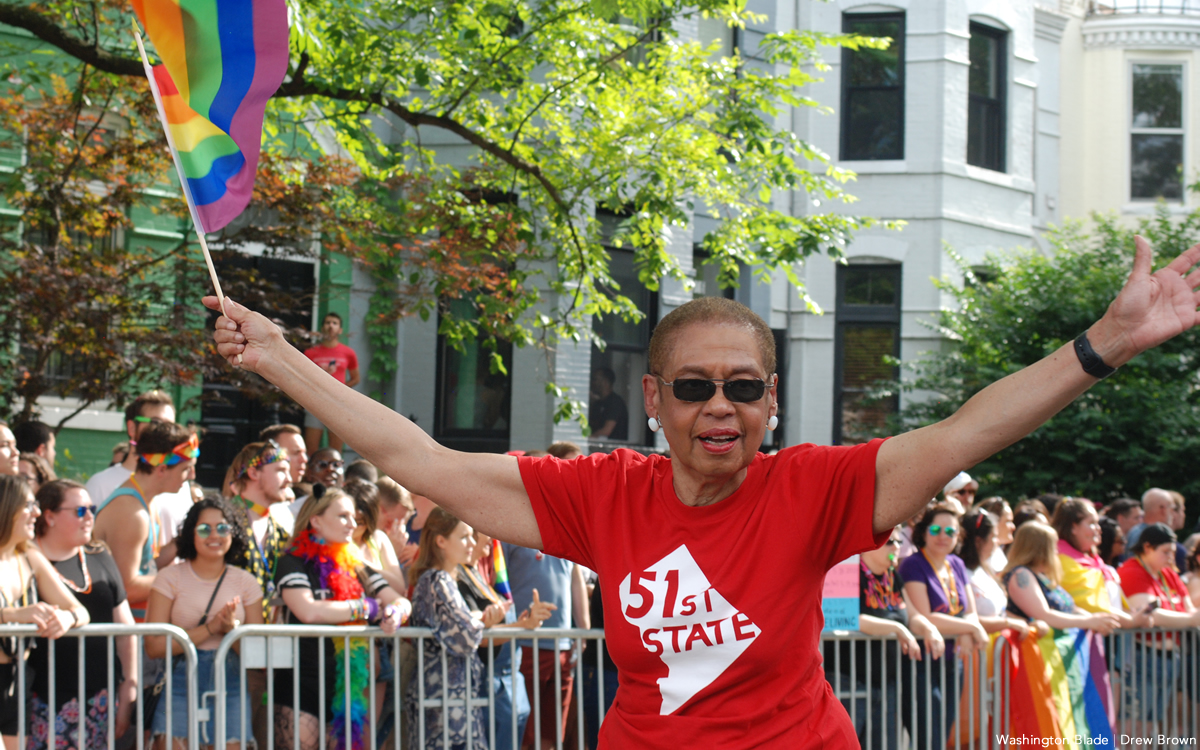
LGBTQ rights advocates reflected on D.C. Congressional Del. Eleanor Holmes Norton’s longstanding advocacy and support for LGBTQ rights in Congress following her decision last month not to run for re-election this year.
Upon completing her current term in office in January 2027, Norton, a Democrat, will have served 18 two-year terms and 36 years in her role as the city’s non-voting delegate to the U.S. House.
LGBTQ advocates have joined city officials and community leaders in describing Norton as a highly effective advocate for D.C. under the city’s limited representation in Congress where she could not vote on the House floor but stood out in her work on House committees and moving, powerful speeches on the House floor.
“During her more than three decades in Congress, Eleanor Holmes Norton has been a champion for the District of Columbia and the LGBTQ+ community,” said David Stacy, vice president of government affairs for the Human Rights Campaign, the D.C.-based national LGBTQ advocacy organization.
“When Congress blocked implementation of D.C.’s domestic partnership registry, Norton led the fight to allow it to go into effect,” Stacey said. “When President Bush tried to ban marriage equality in every state and the District, Norton again stood up in opposition. And when Congress blocked HIV prevention efforts, Norton worked to end that interference in local control,” he said.
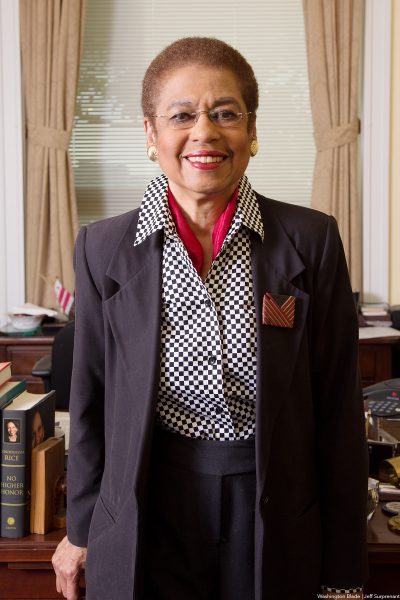
In reflecting the sentiment of many local and national LGBTQ advocates familiar with Norton’s work, Stacy added, “We have been lucky to have such an incredible champion. As her time in Congress comes to an end, we honor her extraordinary impact in the nation’s capital and beyond by standing together in pride and gratitude.”
Norton has been among the lead co-sponsors and outspoken supporters of LGBTQ rights legislation introduced in Congress since first taking office, including the currently pending Equality Act, which would ban employment discrimination based on sexual orientation and gender identity.
Activists familiar with Norton’s work also point out that she has played a lead role in opposing and helping to defeat anti-LGBTQ legislation. In 2018, Norton helped lead an effort to defeat a bill called the First Amendment Defense Act introduced by U.S. Sen. Mike Lee (R-Utah), which Norton said included language that could “gut” D.C.’s Human Rights Act’s provisions banning LGBTQ discrimination.
Norton pointed to a provision in the bill not immediately noticed by LGBTQ rights organizations that would define D.C.’s local government as a federal government entity and allow potential discrimination against LGBTQ people based on a “sincerely held religious belief.”
“This bill is the latest outrageous Republican attack on the District, focusing particularly on our LGBT community and the District’s right to self-government,” Norton said shortly after the bill was introduced. “We will not allow Republicans to discriminate against the LGBT community under the guise of religious liberty,” she said. Records show supporters have not secured the votes to pass it in several congressional sessions.
In 2011, Norton was credited with lining up sufficient opposition to plans by some Republican lawmakers to attempt to overturn D.C.’s same-sex marriage law, that the Council passed and the mayor signed in 2010.
In 2015, Norton also played a lead role opposing attempts by GOP members of Congress to overturn another D.C. law protecting LGBTQ students at religious schools, including the city’s Catholic University, from discrimination such as the denial of providing meeting space for an LGBTQ organization.
More recently, in 2024 Norton again led efforts to defeat an attempt by Republican House members to amend the D.C. budget bill that Congress must pass to eliminate funding for the Mayor’s Office of LGBTQ Affairs and to prohibit the city from using its funds to enforce the D.C. Human Rights Act in cases of discrimination against transgender people.
“The Republican amendment that would prohibit funds from being used to enforce anti-LGBTQ+ discrimination regulations and the amendment to defund the Mayor’s Office of LGBTQ+ Affairs are disgraceful attempts, in themselves, to discriminate against D.C.’s LGBTQ+ community while denying D.C. residents the limited governance over their local affairs to which they are entitled,” Norton told the Washington Blade.
In addition to pushing for LGBTQ supportive laws and opposing anti-LGBTQ measures Norton has spoken out against anti-LGBTQ hate crimes and called on the office of the U.S. Attorney for D.C. in 2020 to more aggressively prosecute anti-LGBTQ hate crimes.
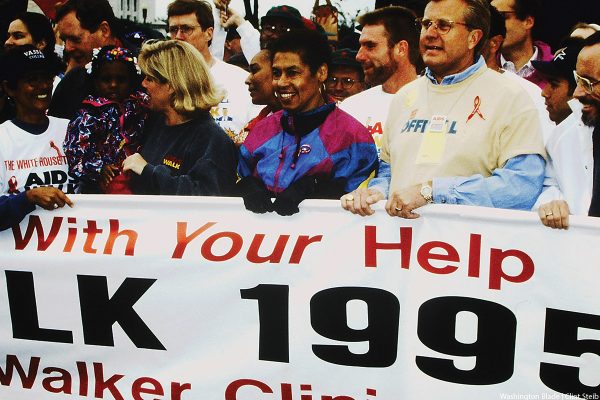
“There is so much to be thankful for Eleanor Holmes Norton’s many years of service to all the citizens and residents of the District of Columbia,” said John Klenert, a member of the board of the LGBTQ Victory Fund. “Whether it was supporting its LGBTQ+ people for equal rights, HIV health issues, home rule protection, statehood for all 700,000 people, we could depend on her,” he said.
Ryan Bos, executive director of Capital Pride Alliance, the group that organizes D.C.’s annual LGBTQ Pride events, called Norton a “staunch” LGBTQ community ally and champion for LGBTQ supportive legislation in Congress.
“For decades, Congresswoman Norton has marched in the annual Capital Pride Parade, showing her pride and using her platform to bring voice and visibility in our fight to advance civil rights, end discrimination, and affirm the dignity of all LGBTQ+ people” Bos said. “We will be forever grateful for her ongoing advocacy and contributions to the LGBTQ+ movement.”
Howard Garrett, president of D.C.’s Capital Stonewall Democrats, called Norton a “consistent and principled advocate” for equality throughout her career. “She supported LGBTQ rights long before it was politically popular, advancing nondiscrimination protections and equal protection under the law,” he said.
“Eleanor was smart, tough, and did not suffer fools gladly,” said Rick Rosendall, former president of the D.C. Gay and Lesbian Activists Alliance. “But unlike many Democratic politicians a few decades ago who were not reliable on LGBTQ issues, she was always right there with us,” he said. “We didn’t have to explain our cause to her.”
Longtime D.C. gay Democratic activist Peter Rosenstein said he first met Norton when she served as chair of the New York City Human Rights Commission. “She got her start in the civil rights movement and has always been a brilliant advocate for equality,” Rosenstein said.
“She fought for women and for the LGBTQ community,” he said. “She always stood strong with us in all the battles the LGBTQ community had to fight in Congress. I have been honored to know her, thank her for her lifetime of service, and wish her only the best in a hard-earned retirement.”


District of Columbia
As mayor’s race takes shape, candidates endorse LGBTQ equality
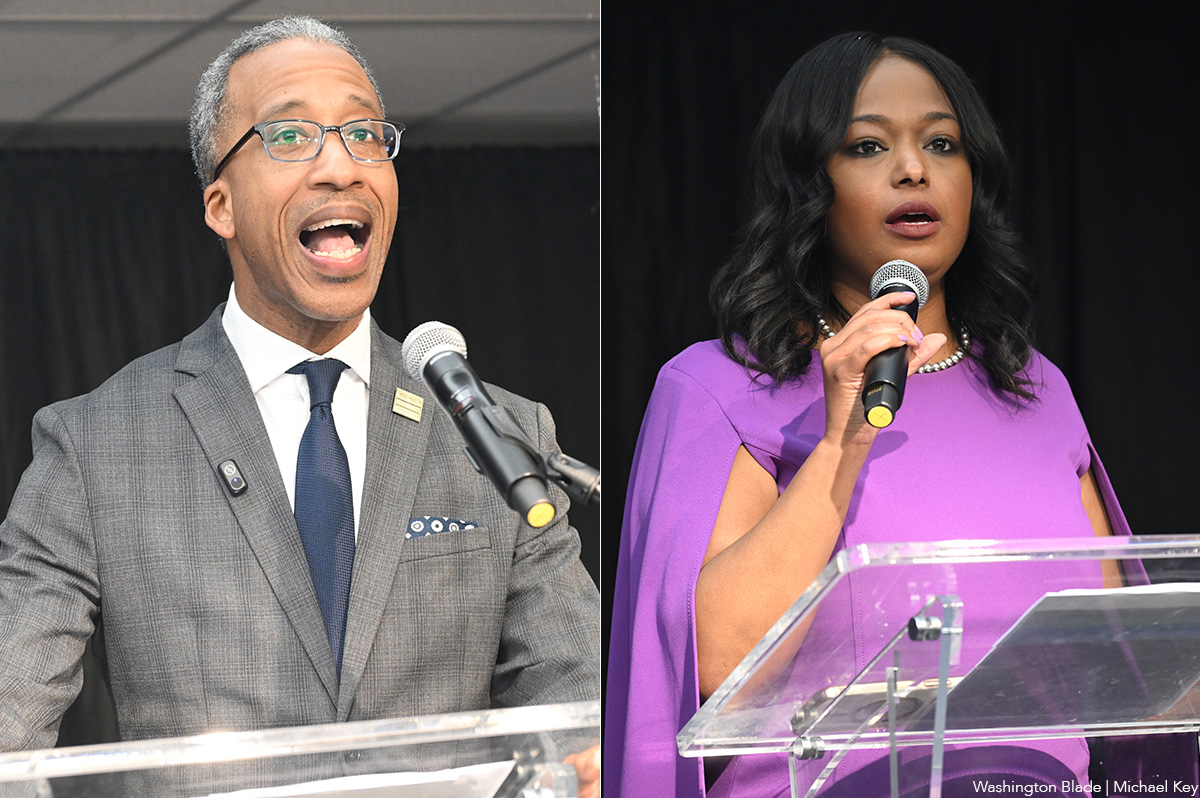
Like nearly all recent D.C. elections, LGBTQ voters will be choosing a candidate for mayor in 2026 from a list of mostly strong LGBTQ rights supporters in the city’s June 16 primary.
As of March 30, the D.C. Board of Elections’ list of candidates who submitted the required number of petition signatures for the June 16 primary ballot included 10 mayoral candidates: nine Democrats and one Statehood Green Party candidate.
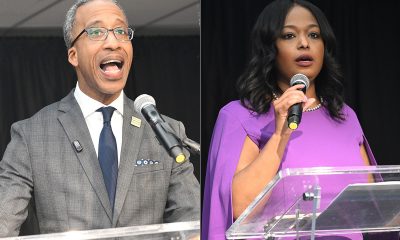
Among those candidates, six, all Democrats, have issued statements expressing strong support for LGBTQ rights, including the two leading Democratic contenders, former D.C. Council member Kenyan McDuffie and current Council member Janeese Lewis George, who represents Ward 4.
One of the lesser-known Democratic candidates who released an LGBTQ supportive statement, Rini Sampath, a cyber security consultant, told the Washington Blade she identifies as queer, becoming one of the first known LGBTQ D.C. mayoral candidates to gain access to a major party primary ballot.
“We’re living in an extremely diverse community, an extremely unique community,” she told the Blade. “And being able to self-label, self-identify as queer is something that I just want to take pride in.”
Similar to McDuffie and Lewis George, Sampath released statements to the Blade and the Capital Stonewall Democrats, the city’s largest LGBTQ local political group, expressing support for LGBTQ rights and outlining plans for LGBTQ supportive policies if elected mayor.
Although many D.C. LGBTQ activists have said they have yet to decide whom to support for mayor, those who have decided appear to be divided between McDuffie and Lewis George. Most D.C. political observers consider McDuffie and Lewis George to be the two leading candidates in the mayoral race.
The other Democratic mayoral contenders who have released statements expressing support on LGBTQ issues include Gary Goodweather, a local real estate manager and developer who has been actively campaigning at LGBTQ events; Vincent Orange, a former At-Large and Ward 5 D.C. Council member; and Kathy Henderson, a longtime Ward 5 community activist and elected Advisory Neighborhood Commissioner.
The remaining two Democratic mayoral candidates, Hope Solomon, a former U.S. Department of Homeland Security contractor and Dupont Circle civic activist; and Ernest Johnson, a real estate broker and Ward 1 community activist, did not respond to inquiries from the Blade and Capital Stonewall Democrats seeking information about their position on LGBTQ related issues.
Robert Gross, the Statehood Green Party candidate who is running unopposed in the June 16 primary, also didn’t respond to inquires from the Blade about his position on LGBTQ issues.
D.C. Board of Elections records show that at least five Republican candidates filed papers to run for mayor in the June 16 GOP primary, but none of them remained as candidates as of March 30, when the election board issued its updated candidate list.
Just one of the five Republican candidates replied to an email message from the Washington Blade sent to all mayoral candidates in early March seeking their position on LGBTQ issues. That candidate, Esa Muhammad, whose website identifies him as an engineer, consultant, and local business owner, sent a reply expressing opposition to LGBTQ rights.
“Unfortunately, I do not support LGBTQ because The God only created 2 genders (Adam/Eve),” he wrote. “Anyway, I will be fair to you all despite your sick way of looking at life,” he stated.
Capital Stonewall Democrats President Stevie McCarty said his group sent questionnaires to all the Democratic mayoral candidates as well as to Democrats running for other offices such as D.C. Council. Information posted on the group’s website shows only four of the mayoral candidates returned a complete questionnaire: McDuffie, Lewis George, Goodweather, and Sampath.
Each of them provides detailed information of their plans for supporting LGBTQ policies if elected and their record of support on LGBTQ issues. McCarty said the questionnaire responses for all candidates that submitted them can be accessed at outvotedc.org.
He said Capital Stonewall Democrats will hold virtual LGBTQ forums in April, including a mayoral forum on April 8. He said the group’s members will vote on the candidate endorsements online from April 20 through May 11, and the group expects to announce its endorsements May 14.
GLAA DC, formerly known as the Gay and Lesbian Activists Alliance of Washington, has issued candidate ratings for most D.C. elections since the 1970s, and the nonpartisan LGBTQ group was expected to issue ratings for mayoral candidates this year. But like in recent years, the group is expected to base its ratings on mostly non-LGBTQ issues, with a progressive, left-leaning perspective, according to a nine-page “Back to Basics GLAA Policy Brief 2026” that the group released in March.
The LGBTQ activists who are backing McDuffie or Lewis George appear to be gravitating to the two based on their political leanings separate from LGBTQ issues, just like voters in general. Lewis George, who identifies as a democratic socialist, is popular among LGBTQ and non-LGBTQ “progressives.”
McDuffie, who is seen as a more moderate candidate along the lines of current D.C. Mayor Muriel Bowser, is being supported by LGBTQ activists who hold those views, some of whom currently work in the Bowser administration.
Among Lewis George’s LGBTQ supporters are longtime Ward 8 community leader Philip Pannell and former Capital Stonewall Democrats president Howard Garrett. Among the LGBTQ McDuffie backers are longtime D.C. Democratic activists John Fanning and David Meadows.
Longtime D.C. LGBTQ Democratic Party activist Peter Rosenstein, who is supporting McDuffie, has raised concerns about Lewis George’s backing by the national group Democratic Socialists of America. In Facebook postings, Rosenstein points to the Democratic Socialists of America’s opposition to Israel as a country and said it is viewed by many in the Jewish community as promoting antisemitism. He has criticized Lewis George for not speaking out against that and for accepting the DSA’s endorsement.
In an interview with the Blade, Lewis George strongly disputed that assessment, saying she has been a strong ally and supporter of the Jewish community.
“I’m a member of the Metro DSA here in D.C. that I work with to fight for labor and for tenant rights,” she said. “I’m also a member of the Democratic Party,” she added, saying, “There are things that the Democratic Party does that I don’t agree with. There are things that the national DSA does that I don’t agree with. That’s a group that I work with.”
“But I want to be clear that I am running for mayor to represent all of our community, and that includes our amazing and historical Jewish community here in D.C.,” she said. “I have had the amazing opportunity to spend time at synagogues and talking to Jewish leaders and groups and institutions. And so, there should be no worry here.”
Following are short excerpts from the detailed statements five of the nine Democratic mayoral candidates submitted to the Capital Stonewall Democrats or the Washington Blade.
Kenyan McDuffie: “As mayor, every piece of legislation I sign, craft, or endorse should also encompass the interest and input of the LGBTQ community members and advocates…From housing to health care and everything in between… We have a dire crisis regarding the rise in homelessness especially among the youth in our LGBTQ communities. In my administration that simply cannot be the status quo and will not be…I have been a consistent champion for our LGBTQ community and will remain so as Mayor of D.C.’
Janeese Lewis George: “As mayor, I will protect our LGBTQ+ neighbors against federal attacks on their identity, including their health care…On the Council I have been a strong supporter of pro-LGBTQ+ bills, including making D.C. a sanctuary for people seeking gender-affirming health care as well as addressing discrimination and harassment in nightlife and hospitality…And as mayor, I am prepared to move up and win those fights – a fight for D.C. statehood, a fight for our true economy, and a real opportunity to uplift our Black queer and trans youth.”
Gary Goodweather: “A Goodweather administration will defend every D.C. law protecting LGBTQ residents. I will establish a Defend DC office to coordinate the District’s legal and public response to federal overreach, with LGBTQ+ protections explicitly within its mandate…My affordable D.C. plan will produce 50,000 new homes with 36,000 affordable units, and I will ensure LGBTQ+ youth housing programs are funded as a budget priority.”
Rini Sampath: “I am an immigrant, proud queer woman, and a 10-year resident of Washington, D.C…For me, LGBTQ+ voters including transgender and nonbinary residents, are not a separate or symbolic constituency; they are a core part of a broader, multiracial, cross-ward coalition rooted in in equity and opportunity.”
Vincent Orange: “I have a long and consistent record of supporting LGBTQ+ equality and inclusion in the District of Columbia, grounded in both policy and personal commitment. As the District’s Democratic Committeeman from 2006 to 2015, I publicly supported marriage equality and voted accordingly … During my time on the D.C. Council, I worked to advance protections for LGBTQ+ residents, including authoring and passing legislation to prohibit discrimination against transgender individuals in the workplace.”
Kathy Henderson: Kathy Henderson has maintained a consistent record of treating all members of the community with dignity, compassion, and respect, regardless of gender, race, ethnicity, sexual orientation, identity, political party, national origin, or ideology. Kathy Henderson embraced the late Wanda Alston as a colleague and good friend…Alston was the first director of the Mayor’s Office of LGBTQ Affairs and Henderson helped to organize and facilitate the first LGBTQ citizens summit.”
District of Columbia
Trans activists gather on National Mall for Transgender Day of Visibility
Upwards of 200 people participated in D.C. event
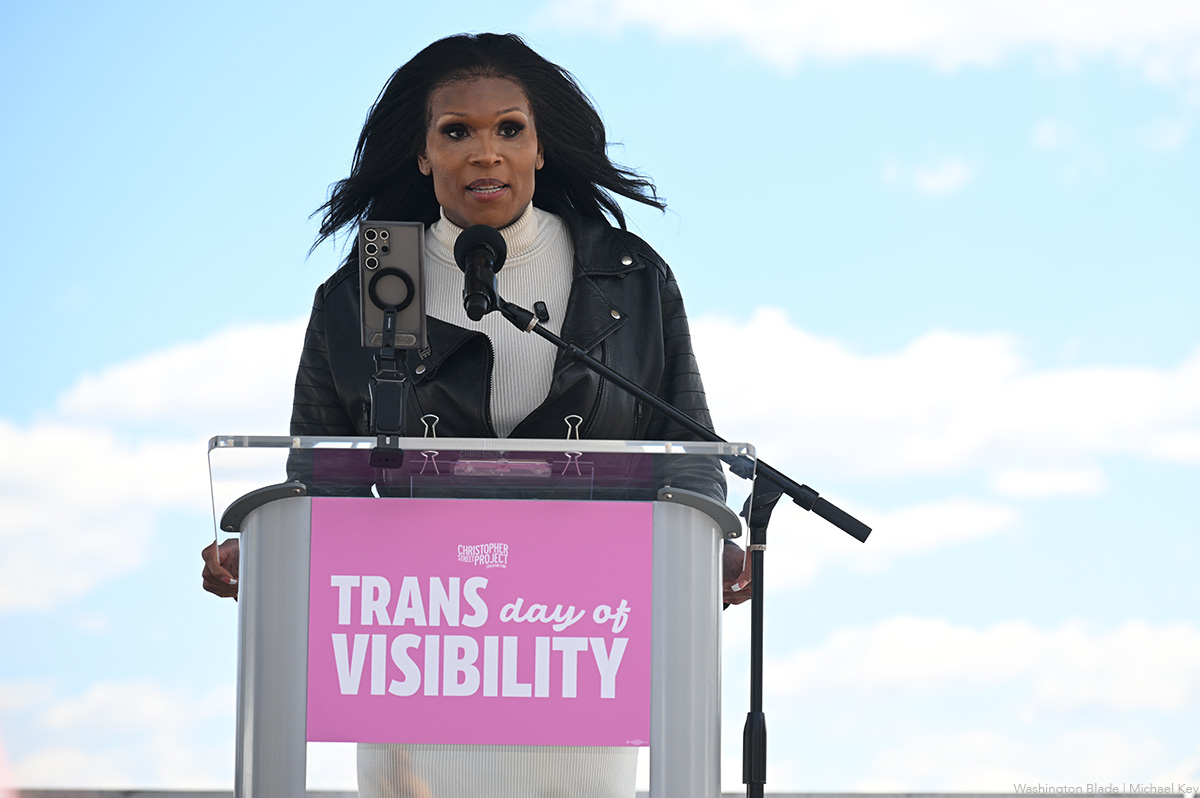
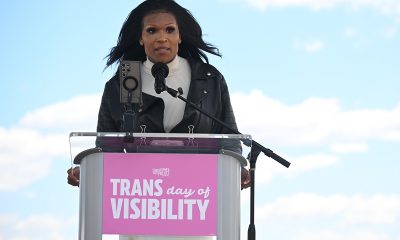
The National Mall was covered in kites on Saturday as transgender activists from around the country gathered to support the annual Transgender Day of Visibility. The event, put on by the Christopher Street Project — whose mission to protect and support trans Americans on the ballot and in streets — brought together around 200 supporters and organizations to honor trans homicide victims and rally for the future of human rights.
Created 17 years ago by psychotherapist and trans activist Rachel Crandall-Crocker, the day was born out of a need to celebrate one of the most marginalized groups in American politics, she told The 19th in 2021.
Since then, the nation has slowly caught up. This year marked the second time the observance has expanded into a multi-day movement, with events ranging from panels and congressional lobbying to organizing efforts, culminating in a rally on the “nation’s front door” — the National Mall.
A recent survey conducted by SRSS, a national research and marketing firm, and commissioned by the Human Rights Campaign Foundation, found that 41 percent of American adults say they personally know someone who is trans. That figure is up from previous estimates of around 30 percent. The study also shows that 27 percent say they have had a regular conversation with a transgender person in the last year. For HRC, this data is confirmation that visibility efforts are working.
“Transgender people are not strangers. They are our neighbors, coworkers, family members, and friends. And this new data shows that as people get to know them, they are more likely to stand by them as allies,” said Kelley Robinson, president of HRC said in a statement. “Defending trans rights is part of defending democracy itself. The more we show up for each other, the stronger our communities and our democracy become.”
Despite this progress and growing positive sentiment, more than 80 anti-trans bills are currently pending in state legislatures across the country, according to HRC, while similar issues are being debated at the national level. Many of the bills seek to restrict trans youth from participating in sports aligned with their gender identity and limit access to gender-affirming medical care.
Tyler Hack, founder and executive director of the Christopher Street Project, who is trans and nonbinary, spoke with the Washington Blade on March 28 about the growing importance of the day.
“We saw that there was a lack of political power for the trans community. We saw that there was a lack of political power for the trans community,” Hack said. “We decided to step up and implement the demand leadership and have galvanized people all across this country for Trans Day of Visibility and our gatherings these last few days we’ve had people come from as far as Hawaii to come celebrate with us, advocate for our rights on the hill, and learn about what it means to fight for all of us.”
Fighting for “all of us,” Hack noted, means showing up where political power is concentrated — in the nation’s capital. The National Mall, a hub for both protest and tourism, draws a wide range of visitors, from political activists brandishing MAGA hats or “You did it, Joe” t-shirts to everyday sightseers.
“I literally just saw a guy in a Trump shirt [at the rally], but we’re not going anywhere,” they said. “Visablity is really important, alongside needing to be an active parts of society, being having public life, and we need to demonstrate that we’re not going anywhere. I mean, we had people from the hill, Congress members come who weren’t even planning to come and did … We are now learning about what it means to fight for and stand up for our rights.”
Hack then looked toward the Capitol after being asked why they believe there are so many negative — and false — statements coming from congressional legislators about trans people. After a pause, they emphasized that the fight for trans rights is often deliberately mischaracterized by Republican opponents try to turn Americans against the community. That, they pointed out, is not what is happening outside the halls of the Hill.
“We are fighting for an America that works for all of us, and we know that,” Hack said. “We know that fighting for all of us is not unpopular. What’s unpopular is genital inspections in schools for girls as young as four years old — who some of our leaders want to transvestigate for not looking feminine enough. What’s unpopular are subpoenas of hospitals so the government can go through your records and decide what they like and don’t like. It is about power.”
That framing — that trans people simply want to live freely and equally under the law — has become central to the movement’s messaging, even as conservative media organizations and political leaders continue to shape public perception in opposing ways.
“We can’t cede any ground because we don’t need to. We are not fighting for a cause that’s inherently unpopular. People know that we shouldn’t throw anyone under the bus, and that’s what we’re here to say to our leaders: we’re paying attention.”
This year’s TDoV was noticeably larger in production than last year’s event, with a bigger stage, more high-profile speakers, increased security, and expanded programming across multiple days.
“We also planned three days of programming. We had dozen panels and workshops on Thursday, and we had over 75 Hill meetings on Friday,” they said. “Now we have this rally, and our capacity hasn’t grown that much — a lot of this was done by two people, but I think it just has come to fruition in a way. I’m happy with it, but I would love to see people with crazy budgets and includes expanded capacity, also we can continue to step out and do the work.”
One moment that stood out to Hack was seeing a parent advocate for her trans child — highlighting what they described as the deeply human nature of these stories.
“The first person to come up to me today was a mom of a trans kid and a nonbinary kid who said she came to our whole convening, going to the Hill to advocate yesterday — for the first time, because we inspired her to act, and that she was too scared to be a part of something,” they said. “She knew that her kids’ lives had been criminalized and that she needed to act and –that really hit me. I also know most of the people who educated our lawmakers, were people who have never been to the Hill before. These people who were also telling their stories, were also fighting for reproductive freedom for all. I mean, we had people from Hawaii, Washington State, California, people who some of them hadn’t been to D.C. Those are the people that we are here to mobilize because they haven’t been galvanized by any project before. I’m just grateful we gave them something that they’re willing to get behind.”
Speakers throughout the rally echoed similar themes of urgency, visibility, and collective action.
Rayceen Pendarvis, a local D.C. trans activist, spoke at the event, emphasizing the history behind the current fight — especially the exclusion of trans people from broader LGBTQ movements — and the need to push back against current political attacks on the most marginalized.
“Trans people in D.C. had to fight for their seat at the table. Trans people were either an afterthought — or left out completely. Now, trans people have become the scapegoat. Ignorance about trans people has been weaponized.”
The lifelong Washingtonian, who had a popular show that ran for 10 seasons with a range of programming covering local and national LGBTQ topics from 2012–2021, continued on the need to stay aware and vocal during the increasingly difficult Trump-Vance administration.
“We have to push back — be as relentless as they are. If your vote was not important, they wouldn’t spend so much time trying to stop you from using it. Voting is not enough — we all must get involved. Let us make our ancestors proud by unifying, organizing, and fighting back.”
She ended her speech with advice to not only strategically spend time advocating, but also build relationships within and around the transgender community.
“Support each other, encourage each other, and help each other. Spend time with your trans elders while you can and learn from them. Give them their flowers, but also give the old dolls some money to pay their bills,” she said to cheers from the crowd. “Allies need to put their money where their mouth is!”
“RuPaul’s Drag Race” contestant, singer-songwriter, and trans activist Peppermint spoke about the mixed feelings the day brings, allowing her to recognize both pride and frustration with the slow-moving progress for the transgender community.
“I love being trans, and it’s inspiring to see more people feel comfortable expressing who they are,” Peppermint said to the crowd. “But I’m disappointed that we have to march for our rights. I’m disappointed that we have to convince people who we are, while we’ve been here supporting them all along. I’m disappointed that not enough people show up when the trans community is under attack.”
Last year, a record number of anti-trans policies passed through state and federal legislatures — many originating from Republican lawmakers who argue such measures are necessary for safety. Idaho voted to make it a criminal offense to use the bathroom aligned with one’s gender identity if it does not match sex assigned at birth, setting up a bounty-style enforcement system. Twenty-seven states have banned sports participation for transgender children, primarily targeting transgender girls, citing fairness and safety — claims that research has shown are not supported by evidence. Last month, Kansas’s state Senate voted to invalidate driver’s licenses and birth certificates of trans residents who had updated their gender markers, while also defining sex strictly as assigned at birth.
Peppermint highlighted the specific cruelty of these policies and echoed the rally’s broader message.
“People are being asked to make an agreement to throw us under the bus. You’re watching our civil rights be stripped away like it’s entertainment. When you empower a government to take rights from some, you empower it to take rights from everyone,” the Broadway performer added. “That’s the reality we’re facing.”
She finished by affirming those present and pointing toward the future of the fight for equal treatment under the law.
“Trans people are women, men, nonbinary, immigrants, disabled — every kind of person. We are here, and we are inevitable. I’m disappointed — but I’m hopeful. I’m grateful — and you should be too,” Peppermint said. “I love you, I’m in awe of you, and I am grateful for you. I’m proud to stand with this diverse trans community. We have always shown up for others, year after year. And we’re still here.”
Rabbi Abby Stein framed the moment through a spiritual and historical lens, offering an alternative to narratives often pushed by conservative lawmakers and commentators.
“They’ve moved past trying to erase us — they’re using us. We have become the rock they’re using to hit the people they want to oppress,” Stein said. “We are visible, but we’ve been forced into a narrow place. That’s the reality of this moment.”
She continued, explaining that, despite what some have said, her trans identity reaffirms her religion and strengthens her Jewish faith.
“For generations, we’ve told stories about leaving narrow places. Those narrow places exist today — in closets, in systems, in the ways people try to restrict us. But we have always found a way out. That is our history and our power.”
“Coming out and being who you are isn’t just okay — it’s a spiritual obligation. It is powerful, and it is necessary. If you try to take away our visibility, our rights, and our joy, you will fail. We are going to win because we will keep fighting together.”
Other activists that spoke included military members who had been forced out of their jobs and benefits following the Trump-Vance administration’s return to banning transgender military members, including SPARTA Pride Executive Director and US Army Major Kara Corcoran and Air Force Master Sgt. Logan Ireland, both focusing their time on stage on sharing how they gave their country their lives, yet the president couldn’t accept their gender identity.
Others who spoke/performed included the queer cheerleading group Cheer DC, local trans DJ and organizer Samson, and Chastity Bowick, Executive Director of Marsha P. Johnson Institute also spoke.
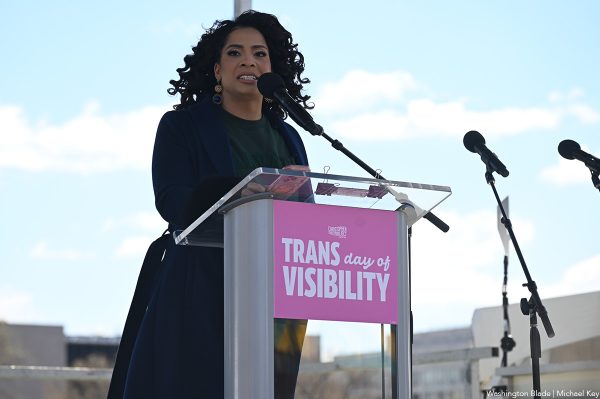
Hack closed with a message centered on their belief in collective action to create a better world for everyone and the resilience of the community.
“We’ve been fighting in the halls of power, and I’m proud of how far we’ve come. This week is about educating, advocating, and rallying. There isn’t one strategy to take back our country. It takes all of us … This is not just about trans people — this is about whether the government gets to decide who is acceptable. When one group is targeted, it never stops there. That’s what history shows us. That’s why this moment matters.”
“We’re being scapegoated and forced out of public life. There are efforts to legislate us out of existence. Our freedoms are intertwined — we can’t leave anyone out. They think we’re small, but they’re wrong.”
“The days of respectability politics are over,” Hack said, with rainbow kites lying overhead, signaling a welcome and powerful reflection of the day’s movement — one that echoed the sentiments of those gathered. “Our movement has never needed permission to exist — and we’re not asking for it now. There is something inevitable about a people who refuse to disappear. It is inevitable that we win.”
District of Columbia
Blade contributor, husband exchange vows in D.C.
Yariel Valdés and Kevin Vega held ceremony at Jefferson Memorial on March 23

Washington Blade contributor Yariel Valdés and his husband, Kevin Vega, exchanged vows at the Jefferson Memorial on March 23.
The couple married in Fort Lauderdale, Fla., on Nov. 24, 2025. The Jefferson Memorial ceremony — which Blade International News Editor Michael K. Lavers and Samy Nemir Olivares officiated — coincided with the third anniversary of Yariel and Kevin’s first date.
Yariel in 2019 asked for asylum in the U.S. because of the persecution he suffered as a journalist in his native Cuba. He spent nearly a year in U.S. Immigration and Customs Enforcement custody before his release on March 4, 2020.
Yariel wrote a series of articles about his time in ICE custody that the Blade published. The series was nominated for a GLAAD Media Award in 2022.
Yariel and Kevin live in South Florida.

Kristi Noem ‘devastated’ as husband’s alleged fetish spending surfaces

Colo. activists condemn SCOTUS conversion therapy ruling

Is Ghana’s selective justice a human rights contradiction?

Supreme Court ruling against conversion therapy bans could affect Md. law

Glisten report details hostile climate for LGBTQ students

‘Out for McDuffie’ event held at D.C. gay bar

The Oscar-losing performance that’s too good to miss

‘Jonah’ an undeniably compelling but unusual memory play

Ghanaian president welcomed to Philadelphia amid backlash over anti-LGBTQ bill

PHOTOS: ‘No Kings’ rally and march
-

 District of Columbia2 days ago
‘Out for McDuffie’ event held at D.C. gay bar
-
Movies3 days ago
The Oscar-losing performance that’s too good to miss
-
Theater3 days ago
‘Jonah’ an undeniably compelling but unusual memory play
-
Ghana2 days ago
Ghanaian president welcomed to Philadelphia amid backlash over anti-LGBTQ bill