Opinions
Time to fix D.C.’s liquor licensing mess
Hank’s Oyster Bar battle illustrates need for regulatory reform

It’s a pity that hearings conducted by the D.C. Alcoholic Beverage Control (ABC) Board are not videotaped.
If they were, every D.C. Council member and the mayor could be strapped in chairs and forced to view the entire mind-numbing 4-1/2 hour alcohol licensing protest hearing held last week that proved to be a stunning illustration of what is wrong with the city’s current regulatory process. District elected officials would eyeball firsthand the mess they have allowed to plague restaurant and bar alcohol licensing procedures for far too long.
The infamous seven-year battle waged by a group of only six Dupont Circle area objectors against respected and award-winning restaurant Hank’s Oyster Bar exemplifies problems inherent in the current licensing system. The popular neighborhood business operated by lesbian chef-owner Jamie Leeds, located adjacent to the corner of 17th and Q streets, was forced to close half of its outdoor patio beginning on the day the recent Capital Pride parade floated by due to the relentless efforts of the required “gang of five or more” license protesters.
At the hearing on June 13, the protagonists in this infuriating tale awkwardly hemmed and hawed on the witness stand as they were repeatedly unable to explain to the board why they had been unresponsive to multiple entreaties by Leeds to meet in early 2010 to discuss the restrictions of a so-called “Voluntary Agreement” they forced upon the business in 2005. Incredulously, they cited only a claim nowhere in evidence for a demanded “Powerpoint presentation” on all details prior to even agreeing to talk.
The original operating restrictions, including seating capacity limits, had allowed the highly anticipated restaurant to finally open but subsequently prevented the opportunity to expand into an adjacent vacant space unexpectedly made possible by modifications to an area licensing moratorium. Leeds had little choice but to seek relief through termination of the agreement, eventually granted later that year.
The latest hearing was required by a May 17 District Court of Appeals remand of the issue for additional ABC Board review resulting from a lawsuit initiated by the protesters. The appeals court ruled that the board had not considered all elements required for a “Voluntary Agreement” termination, acknowledging confusion originating with poorly constructed regulatory language.
Discerning the group’s motivation for intransigence is easy. Obstinacy had conveyed to them inordinate power in years past. If they simply refused to meet, what could the business do? The tiny group understood that, once again and as bestowed by city rules, they held all the high cards.
The questions are simple: How much longer will elected officials permit small and unrepresentative groups to unfairly derail the licensing process and abuse the system? When will city leaders reserve community input to the open and accessible public forum provided by the elected Advisory Neighborhood Commission (ANC) accountable to all residents? Does the District government possess the common sense to put a stop to out-of-balance procedures thwarting local amenities and community small businesses fueling the city’s signature hometown hospitality economy?
As it stands now, small ad hoc groups comprised of only five individuals and self-identified commonly unrepresentative citizens groups – some formed primarily to interject themselves into licensing matters – utilize outsized abilities to delay or deny alcohol licensing approvals or force licensees into signing restrictive “Voluntary Agreements” to survive.
Reforming this madness should be a top priority for Jim Graham, who chairs the Council committee with oversight of alcohol licensing, along with his colleagues and the mayor. Instead of kowtowing to the loud voices of the few, it’s time for Graham to step up and put an end to these ridiculous city rules.
Jack Evans, representing the midtown commercial district stretching from Georgetown to the U.S. Capitol with the largest number of alcohol-licensed businesses, also has a responsibility to initiate reform of current archaic procedures. As Committee on Finance and Revenue chair, he should understand the importance of common sense and fairness in managing local economic development and reaping the revenues generated by the city’s largest private sector business segment.
As both politicians know from the avalanche of correspondence they have received in recent days, concerned constituents are awaiting action.
Council members Graham and Evans, it’s time to fix this folly.
Mark Lee is a local small business manager and long-time community business advocate. Reach him at [email protected].





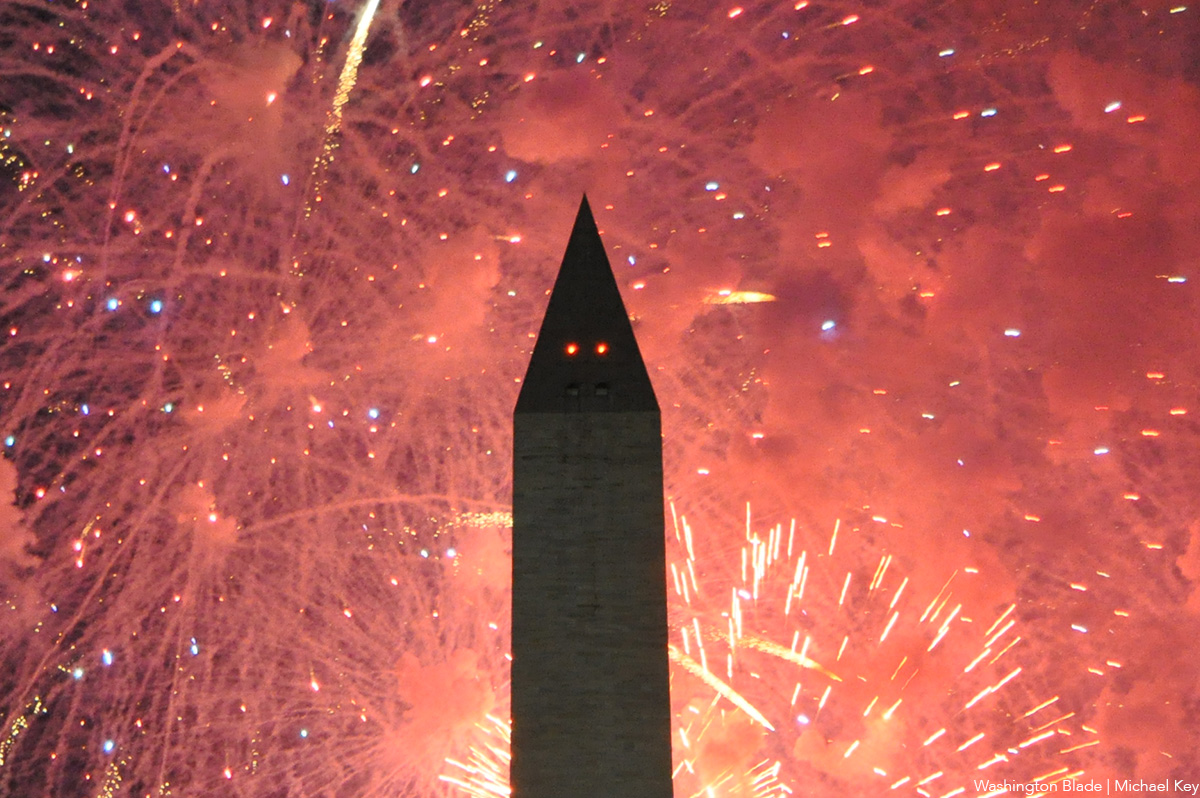
Independence Day, commonly known as the Fourth of July, is a federal holiday commemorating the ratification of the Declaration of Independence by the Second Continental Congress on July 4, 1776, establishing the United States of America. The delegates of the Second Continental Congress declared the 13 colonies are no longer subject (and subordinate) to the monarch of Britain, King George III and were now united, free, and independent states. The Congress voted to approve independence by passing the Lee resolution on July 2, and adopted the Declaration of Independence two days later, on July 4.
Today we have a felon in the White House, who wants to be a king, and doesn’t know what the Declaration of Independence means. Each day we see more erosion of what our country has fought to stand for over the years. We began with a country run by white men, where slavery was accepted, and where women weren’t included in our constitution, or allowed to vote. We have come far, and next year will celebrate 250 years. Slowly, but surely, we have moved forward. That is until Nov. 5, 2024, when the nation elected the felon who now sits in the Oval Office.
There are some who say they didn’t know what he would do when they voted for him. They are the ones who were either fooled, believing his lies, or just weren’t smart enough to read the blueprint which laid out what he would do, Project 2025. It is there for everyone to see. There should be no surprise at what he is doing to the country, and the world. Last Friday his Supreme Court, and yes, it is his, the three people he had confirmed in his first term, gave him permission to be the king he wants to be. The kind of king our Declaration of Independence said we were renouncing. A man who with the stroke of a pen can ruin thousands of lives, and change the course of America’s future. A man who has set back our country by decades, in just a few months.
So, I understand why many are suggesting there is nothing to celebrate this Fourth of July. How do we have parties, and fireworks, celebrating the 249th year of our independence when so many are being sidelined and harmed by the felon and his MAGA sycophants in the Congress, and on the Supreme Court. Yes, there are those celebrating all he is doing. Those who want to pretend transgender people don’t exist, and put their lives in danger; those who think it’s alright to take away a women’s right to control her body, and her healthcare; those who think parents should be able to interfere on a daily basis with their children’s schooling and wipe out the existence of gay people for them. Those who pretend there was a mandate in the last election, when it was only won by about 1 percent. Those who think disparaging veterans, firing them, and taking away their healthcare, is ok. Those in the LGBTQ community like Log Cabin Republicans, who think supporting a racist, sexist, homophobe is the right thing to do.
So, what do we, as decent caring people, do this Fourth of July. What do we say to those who are being harmed as we celebrate. What do we say to those trans people, those women, those immigrants who came here to escape their own dictators, and are now finding they have come to a country with its own would-be dictator. I say to them, please don’t give up on America. Don’t give up on the possibility decent loving people in our country will finally wake up and say, “enough.” That the majority of Americans will remember we fought a revolution to escape a king, and we fought a civil war to end slavery. That we moved forward and gave women the right to vote, and gave the LGBTQ community the right to marry. Don’t give up on the people that did all that, and think they won’t rise up again, and tell the felon, racist, homophobe, misogynist, found liable for sexual assault, now in the White House, and his sycophants in congress, and his cult, that we will take back our country in the 2026 midterm elections. That we will vote in large numbers, and demand our freedom from the tyranny that he is foisting on our country.
So yes, I will celebrate this Fourth of July not for what is happening in our country today, but rather for what our country actually stands for. Not for birthday parades, and abandonment of the heroes in Ukraine in support of dictators like Putin. But for the belief the decent people in our country will rise up and vote. That is what I will celebrate and pray for this Fourth of July. That is what I think the fireworks will mean this July Fourth. I refuse to accept defeat the same way our revolutionary soldiers wouldn’t, and the way our troops in the civil war wouldn’t till the confederacy was defeated.
I will celebrate this Fourth of July because I refuse to accept we will not defeat those who would destroy our beautiful country, and what it really stands for.
Peter Rosenstein is a longtime LGBTQ rights and Democratic Party activist.
Opinions
Is it time for DC to have new congressional representation?
Del. Eleanor Holmes Norton will turn 89 in June
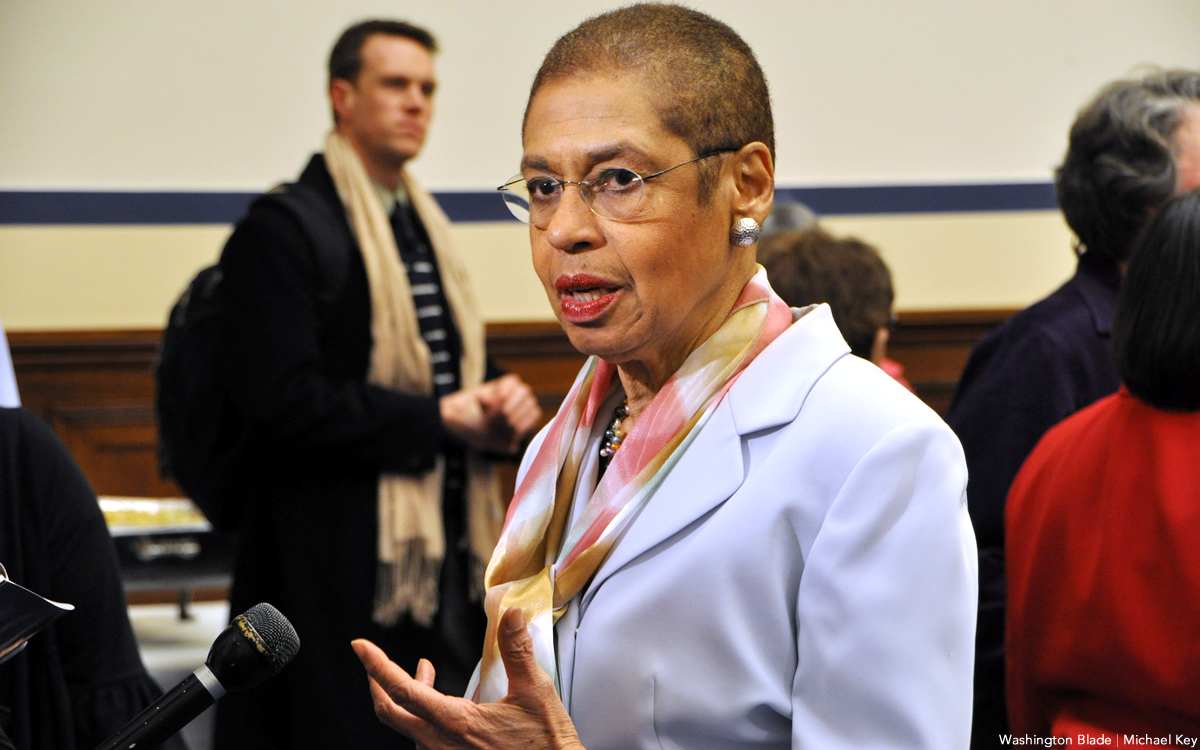
With WorldPride, Supreme Court decisions, military parades in our streets, mayor and City Council discussions about a new football stadium, it is entirely understandable if we missed the real local political story for our future in the halls of Congress. Starting this past May, the whispered longtime discussions about the city’s representation in Congress broke out. Stories in Mother Jones, Reddit, Politico, Axios, NBC News, the New York Times, and even the Washington Post have raised the question of time for a change after so many years. A little background for those who may not be longtime residents is definitely necessary.
Since the passage of the 1973 District of Columbia Home Rule Act, we District residents have had only two people represent us in Congress, Walter Fauntroy and Eleanor Holmes Norton, who was first elected in 1990 after Mr. Fauntroy decided to run for mayor of our nation’s capital city.
No one can deny Mrs. Norton’s love and devotion for the District. Without the right to vote for legislation except in committee, she has labored hard and often times very loud to protect us from congressional interference and has successfully passed District of Columbia statehood twice in the House of Representatives, only to see the efforts fail in the U.S. Senate where our representation is nonexistent.
However, the question must be asked: Is it time for a new person to accept the challenges of working with fellow Democrats and even with Republicans who look for any opportunity to harm our city? Let us remember that the GOP House stripped away millions of OUR dollars from the D.C. budget, trashed needle exchange programs, attacked reproductive freedoms, interfered with our gun laws at a moment’s notice, and recently have even proposed returning the District to Maryland, which does not want us, or simply abolishing the mayor and City Council and returning to the old days of three commissioners or the very silly proposal to change the name of our Metro system to honor you know you.
Mrs. Norton will be 89 years old next year around the time of the June 2026 primary and advising us she is running for another two-year term. Besides her position there will be other major elected city positions to vote for, namely mayor, several City Council members and Board of Education, the district attorney and the ANC. Voting for a change must not be taken as an insult to her. It should be raised and praised as an immense thank you from our LGBTQ+ community to Mrs. Norton for her many years of service not only as our voice in Congress but must include her chairing the Equal Employment Opportunity Commission, her time at the ACLU, teaching constitutional law at Georgetown University Law School, and her role in the 1963 March on Washington.
Personally, I am hoping she will accept all the accolades which will come her way. Her service can continue by becoming the mentor/tutor to her replacement. It is time!
John Klenert is a longtime D.C. resident and member of the DC Vote and LGBTQ+ Victory Fund Campaign boards of directors.
Opinions
Supreme Court decision on opt outs for LGBTQ books in classrooms will likely accelerate censorship
Mahmoud v. Taylor ruling sets dangerous precedent
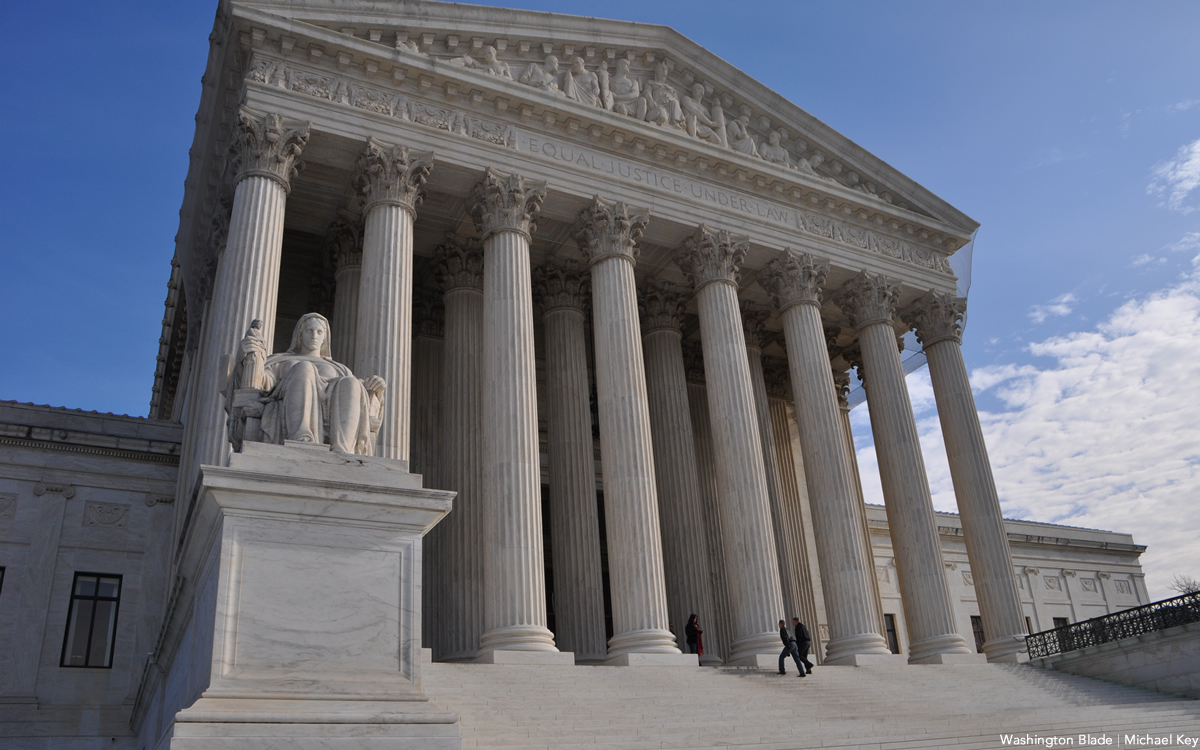
With its ruling Friday requiring public schools to allow parents to opt their children out of lessons with content they object to — in this case, picture books featuring LGBTQ+ characters or themes — the Supreme Court has opened up a new frontier for accelerating book-banning and censorship.
The legal case, Mahmoud v. Taylor, was brought by a group of elementary school parents in Montgomery County, Md., who objected to nine books with LGBTQ+ characters and themes. The books included stories about a girl whose uncle marries his partner, a child bullied because of his pink shoes, and a puppy that gets lost at a Pride parade. The parents, citing religious objections, sued the school district, arguing that they must be given the right to opt their children out of classroom lessons including such books. Though the district had originally offered this option, it reversed course when the policy proved unworkable.
In its opinion the court overruled the decisions of the lower courts and sided with the parents, ruling that books depicting a same-sex wedding as a happy occasion or treating a gay or transgender child as any other child were “designed to present … certain contrary values and beliefs as things to be rejected.” The court held that exposing children to lessons including these books was coercive, and undermined the parents’ religious beliefs in violation of the free exercise clause of the First Amendment.
This decision is the latest case in recent years to use religious freedom arguments to justify decisions that infringe on other fundamental rights. The court has used the Free Exercise Clause of the First Amendment to permit companies to deny their employees insurance coverage for birth control, allow state-contracted Catholic adoption agencies to refuse to work with same-sex couples, and permit other businesses to discriminate against customers on the basis of their sexual orientation.
Here, the court used the Free Exercise Clause to erode bedrock principles of the Free Speech Clause at a moment when free expression is in peril. Since 2021, PEN America has documented 16,000 instances of book bans nationwide. In addition, its tracking shows 62 state laws restricting teaching and learning on subjects from race and racism to LGBTQ+ rights and gender — censorship not seen since the Red Scare of the 1950s.
Forcing school districts to provide “opt outs” will likely accelerate book challenges and provide book banners with another tool to chill speech. School districts looking to avoid logistical burdens and controversy will simply remove these books, enacting de facto book bans that deny children the right to read. The court’s ruling, carefully couched in the language of religious freedom, did not even consider countervailing and fundamental free speech rights. And it will make even more vulnerable one of the main targets of those who have campaigned for book bans: LGBTQ+ stories.
When understood in this wider context, it is clear that this case is about more than religious liberty — it is also about ideological orthodoxy. Many of the opt-out requests in Montgomery County were not religious in nature. When the reversal of the opt-out policy was first announced, many parents voiced concerns that any references to sexual orientation and gender identity were age-inappropriate.
The decision could allow parents to suppress all kinds of ideas they might find objectionable. In her dissent, Justice Sotomayor cites examples of objections parents could have to books depicting patriotism, interfaith marriage, immodest dress, or women’s rights generally, including the achievements of women working outside the home. If parents can demand a right to opt their children out of any topic to which they hold religious objections, what is to stop them from challenging books featuring gender equality, single mothers, or even a cheeseburger, which someone could theoretically oppose for not being kosher? This case throws the door open to such possibilities.
But the decision will have an immediate and negative impact on the millions of LGBTQ+ students and teachers, and students being raised in families with same-sex parents. This decision stigmatizes LGBTQ+ stories, children, and families, undermines free expression and the right to read, and impairs the mission of our schools to prepare children to live in a diverse and pluralistic society.
Literature is a powerful tool for building empathy and understanding for everyone, and for ensuring that the rising generation is adequately prepared to thrive in a pluralistic society. When children don’t see themselves in books they are left to feel ostracized. When other children see only people like them they lose out on the opportunity to understand the world we live in and the people around them.
Advocates should not give up but instead take a page from the authors who have written books they wished they could have read when they were young — by uplifting their stories. Despite this devastating decision, we cannot allow their voices to be silenced. Rather, we should commit to upholding the right to read diverse literature.
Elly Brinkley is a staff attorney with PEN America.

Can we still celebrate Fourth of July this year?

Ritchie Torres says he is unlikely to run for NY governor

GenOUT Chorus offers solace, strength to LGBTQ teens

Is it time for DC to have new congressional representation?

UPenn erases Lia Thomas’s records as part of settlement with White House

Spanberger touts equality, reproductive rights in Arlington

Two new books on dining out LGBTQ-style

‘Andy Warhol in Iran’ a charming look at intersection of art, politics

Pragmatic presidents invest in America