Hungary
Upwards of 100K people march in Budapest Pride
Participants defined Hungarian government’s ban on public LGBTQ events
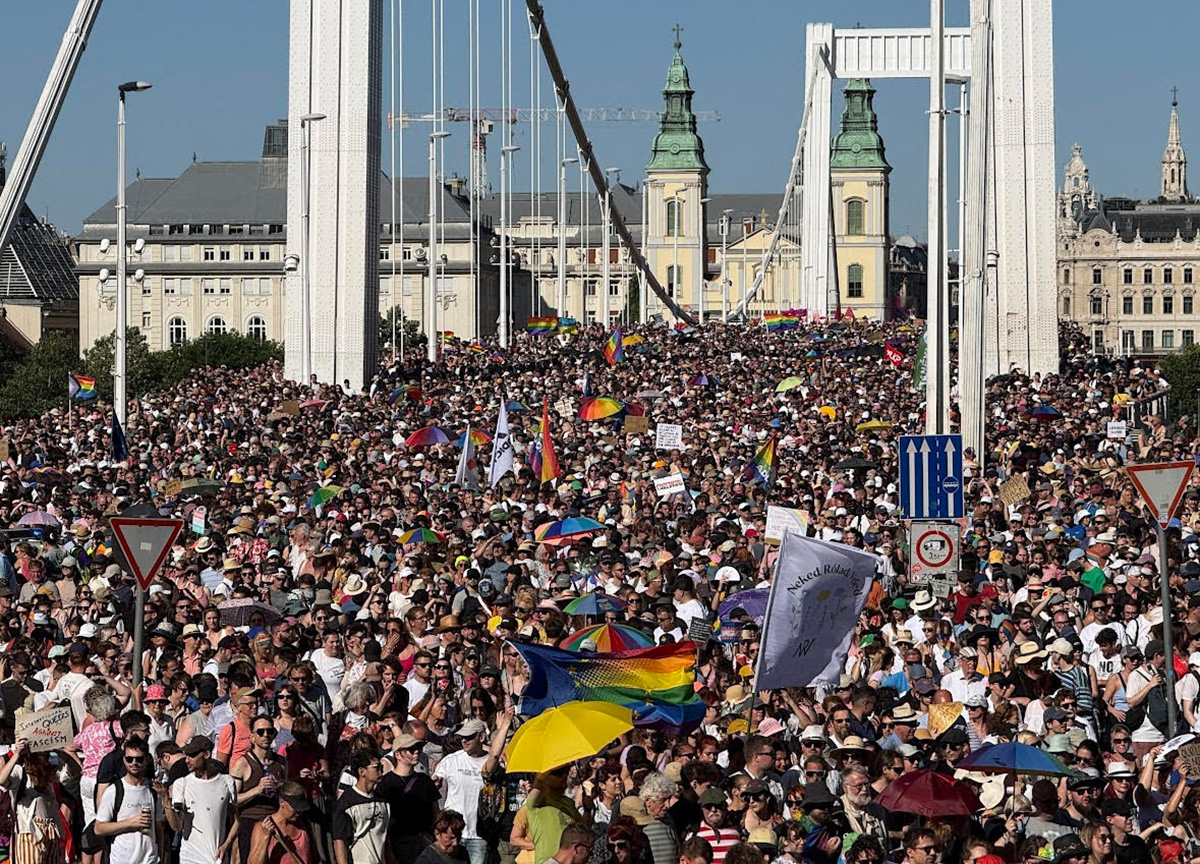
More than 100,000 people on Saturday defied the Hungarian government’s ban on public LGBTQ events and participated in the 30th annual Budapest Pride parade.
The New York Times published a picture that shows throngs of people marching on Budapest’s Erzsébet Bridge over the Danube River. Openly gay MEP Krzysztof Śmiszek, who was previously Poland’s deputy justice minister, is among the dozens of European lawmakers who participated in the march that began at Budapest City Hall.
The New York Times reported Hungarian police officers stood along the march, but they did not try to stop it. Śmiszek described the march to the Washington Blade as “beautiful and huge.”
“[It was] very peaceful and political,” he said.
Prime Minister Viktor Orbán and his Fidesz-KDNP coalition government have faced widespread criticism over its anti-LGBTQ crackdown.
Hungarian lawmakers in March passed a bill that bans Pride events and allow authorities to use facial recognition technology to identify those who participate in them. MPs in April amended the Hungarian constitution to ban public LGBTQ events.
Budapest Mayor Gergely Karácsony endorsed the march, even though Orbán’s government threatened to arrest him and fine participants.
“Today a country shows that no ruling party can tell it on what topic, for what cause it is allowed to march and why not,” said Budapest Pride President Viktória Radványi on Saturday in a Facebook post. “A country demonstrates that whoever will be in government can count on us: dedicated, persistent citizens intolerant to oppression, who will organize themselves and stand against tyranny with their heads held high.”
More than two dozen activists in D.C. who protested outside the Hungarian Embassy on Friday expressed their support for Budapest Pride.
(Washington Blade video by Michael K. Lavers)






Hungary
New Hungarian government to scrap anti-LGBTQ adoption law
Prime Minister Peter Maygar ousted Viktor Orbán in April

Hungarian Prime Minister Peter Maygar has said his government will amend a law that essentially bans same-sex couples from adopting children.
Lawmakers approved the effective adoption ban in 2020, when then-Prime Minister Viktor Orbán’s government was in power. Maygar announced plans to amend the law on Saturday when he was speaking to supporters in Budapest, the Hungarian capital.
Orbán and his government faced widespread criticism over its anti-LGBTQ crackdown that also included laws banning Pride events.
Maygar in April ousted Orbán in Hungary’s elections.
Hungary
Tens of thousands participate in post-Orbán Budapest Pride march
New government allowed event to take place without restrictions

Tens of thousands of people on Saturday took part in the annual Budapest Pride march in the Hungarian capital.
The march took place less than two months after new Prime Minister Péter Maygar took office.
Hungarian lawmakers in 2025 passed a bill that banned Pride events and allowed authorities to use facial recognition technology to identify participants. MPs later amended the Hungarian constitution to ban public LGBTQ events.
More than 100,000 people defied the ban and participated in last year’s Budapest Pride parade. The event became one of the largest protests against then-Prime Minister Viktor Orbán and his government since he took office in 2010.
Magyar’s center-right Tisza party ousted Orbán’s Fidesz-KDNP coalition in elections that took place on April 12. The European Union’s top court, the EU Court of Justice, days after Orbán’s ouster struck down Hungary’s anti-LGBTQ propaganda law that MPs approved in 2021.
Hungarian police last month announced they would allow the Budapest Pride march to take place without restrictions.
Authorities subsequently dropped charges against Budapest Mayor Gergely Karácsony over his role in organizing the city’s 2025 Pride march. Officials in Pécs, a city near Hungary’s border with Croatia, have also dropped charges against Géza Buzás-Hábel, who organized a 2025 Pride event.
Hungary
Charges against Budapest mayor for organizing Pride march dropped
Country’s new government took office last month
Hungarian authorities on Thursday dropped charges against Budapest Mayor Gergely Karácsony over his role in organizing the city’s 2025 Pride march.
Karácsony spoke at the event, even though then-Prime Minister Viktor Orbán’s government banned it.
More than 100,000 people defied the ban and participated in the march that took place on June 28, 2025. The Associated Press notes the Budapest Chief Prosecutor’s Office in January charged Karácsony with “organizing the unlawful assembly despite a prohibition order.”
Karácsony, who has been Budapest’s mayor since 2019, described himself as a “proud defendant” after his indictment.
“It seems that in this country, this is the price you pay if you stand up for your own freedom and the freedom of others,” he said in a statement, according to the AP. “If anyone thinks they can ban me, deter me, or prevent me and my city from doing so, they are gravely mistaken.”
Budapest is Hungary’s capital and largest city.
Prime Minister Péter Magyar took office last month after his center-right Tisza party ousted Orbán’s Fidesz-KDNP coalition in elections that took place on April 12.
Hungarian police on May 29 announced they will allow the Budapest Pride march to take place this year.
The European Union’s top court, the EU Court of Justice, days after Orbán’s ouster struck down Hungary’s anti-LGBTQ propaganda law that MPs approved in 2021. The BBC notes Hungarian authorities cited the decision in their decision to drop the charges against Karácsony.
Authorities in Pécs, a city near Hungary’s border with Croatia, have also dropped charges against Géza Buzás-Hábel, who organized a 2025 Pride event.

Essential queer horror classics for Halloween

Solidarity beyond the parade: the actual cost of Pride

Physician: addiction doesn’t always look the way you think it does

Calendar: October 9-15

ICC unseals arrest warrants for Taliban officials accused of persecuting LGBTQ people, women

Alianza para la Inclusión fortalece la defensa de derechos LGBTQ en Centroamérica

The facts about Victory Fund’s investigation and the path forward

In Ga., 2 trans candidates believe voters are ready for them

Bessent says Trump chose him for his qualifications, not his sexuality

‘Some Like It Hot’ a wild ride at renovated Bernard Family Theatre
-

 Central America4 days ago
Alianza para la Inclusión fortalece la defensa de derechos LGBTQ en Centroamérica
-
Opinions4 days ago
The facts about Victory Fund’s investigation and the path forward
-
Georgia4 days ago
In Ga., 2 trans candidates believe voters are ready for them
-
Federal Government4 days ago
Bessent says Trump chose him for his qualifications, not his sexuality