Colombia
Colombia avanza hacia la igualdad para personas trans
Fue aprobado en Comisión Primera de la Cámara la Ley Integral Trans

En un hecho histórico para los derechos humanos en Colombia, la Comisión Primera de la Cámara de Representantes aprobó en primer debate el Proyecto de Ley 122 de 2024, conocido como la Ley Integral Trans, que busca garantizar la igualdad efectiva de las personas con identidades de género diversas en el país. Esta iniciativa, impulsada por más de cien organizaciones sociales defensoras de los derechos LGBTQ, congresistas de la comisión por la Diversidad y personas trans, representa un paso decisivo hacia el reconocimiento pleno de derechos para esta población históricamente marginada.
La Ley Integral Trans propone un marco normativo robusto para enfrentar la discriminación y promover la inclusión. Entre sus principales ejes se destacan el acceso a servicios de salud con enfoque diferencial, el reconocimiento de la identidad de género en todos los ámbitos de la vida, la creación de programas de empleo y educación para personas trans, así como medidas para garantizar el acceso a la justicia y la protección frente a violencias basadas en prejuicios.
Detractores hablan de ‘imposición ideológica
Sin embargo, el avance del proyecto no ha estado exento de polémicas. Algunos sectores conservadores han señalado que la iniciativa representa una “imposición ideológica”. La senadora y precandidata presidencial María Fernanda Cabal anunció públicamente que se opondrá al proyecto de Ley Integral Trans cuando llegue al Senado, argumentando que “todas las personas deben ser tratadas por igual” y que esta propuesta vulneraría un principio constitucional. Estas declaraciones anticipan un debate intenso en las próximas etapas legislativas.
El proyecto también establecelineamientos claros para que las instituciones públicas respeten el nombre y el género con los que las personas trans se identifican, en concordancia con su identidad de género, y contempla procesos de formación y sensibilización en entidades estatales. Además, impulsa políticas públicas en contextos clave como el trabajo, la educación, la cultura y el deporte, promoviendo una vida libre de discriminación y con garantías plenas de participación.
¿Qué sigue para que sea ley?
La Ley aún debe superar varios debates legislativos, incluyendo la plenaria en la Cámara y luego el paso al Senado; pero la sola aprobación en Comisión Primera ya constituye un hito en la lucha por la igualdad y la dignidad de las personas trans en Colombia. En un país donde esta población enfrenta altos niveles de exclusión, violencia y barreras estructurales, este avance legislativo renueva la esperanza de una transformación real.
Desde www.orgullolgbt.co, celebramos este logro, invitamos a unirnos en esta causa impulsándola en los círculos a los que tengamos acceso y reiteramos nuestro compromiso con la visibilidad, los derechos y la vida digna de las personas trans. La #LeyIntegralTrans bautizada “Ley Sara Millerey” en honor de la mujer trans recientemente asesinada en Bello, Antioquia (ver más aquí); no es solo una propuesta normativa: es un acto de justicia que busca asegurar condiciones reales para que todas las personas puedan vivir con libertad, seguridad y respeto por su identidad.





Colombia
Colombia withdraws from Equal Rights Coalition
International LGBTQ group ‘not a priority’ for country’s new government
Colombia last week withdrew from a coalition of more than 40 countries that pledges to champion LGBTQ and intersex rights.
The Bogotá Post, an English-language news website in the Colombian capital, reported the country officially withdrew from the Equal Rights Coalition on Sept. 17.
The Equal Rights Coalition formed in 2016.
The group’s current members are Albania, Argentina, Australia, Austria, Belgium, Brazil, Canada, Cabo Verde, Chile, Costa Rica, Cyprus, the Czech Republic, Denmark, Ecuador, Estonia, Finland, France, Germany, Greece, Iceland, Ireland, Israel, Italy, Lithuania, Luxembourg, Malta, Mexico, Montenegro, Netherlands, New Zealand, North Macedonia, Norway, Portugal, Serbia, Slovenia, Spain, Sweden, Switzerland, Thailand, Ukraine, the U.K., and Uruguay. Civil society organizations from Colombia and dozens of other countries, including the U.S., work with the Equal Rights Coalition.
Colombia had co-chaired the group alongside Spain.
The decision to withdraw from the Equal Rights Coalition took place less than two months after far-right Colombian President Abelardo de la Espriella took office.
El Páis, a Spanish newspaper, reported Colombian Vice Minister for Consular and Migration Affairs Pedro Agustín Roa said the Equal Rights Coalition “is not a priority” for his government and the country’s participation in it was “something from a previous government.”
Caribe Afirmativo is a Colombian LGBTQ advocacy group that works with the Equal Rights Coalition. Wilson Castañeda, its director, criticized his country’s withdrawal from it.
Colombia
Abelardo de la Espriella elected Colombia’s next president
Far-right lawyer has pledged to end ‘gender ideology’ in the country

Abelardo de la Espriella on Sunday narrowly defeated Iván Cepeda in the second round of Colombia’s presidential election.
De la Espriella, a far-right lawyer who has praised U.S. President Donald Trump and Salvadoran President Nayib Bukele, beat Sen. Iván Cepeda, a member of outgoing President Gustavo Petro’s Historic Pact party, by a 49.7-48.7 percent margin. De la Espriella will take office on Aug. 7.
Secretary of State Marco Rubio on Sunday spoke with De la Espriella, who has pledged to end so-called “gender ideology” in Colombia, and congratulated him on his victory.
“This result reflects the will of the Colombian people and their commitment to democracy,” said State Department spokesperson Tommy Piggott in a statement. “The Trump administration looks forward to working closely with his incoming administration to advance our bilateral and regional security cooperation, end illegal immigration to the United States, and strengthen the economic ties between our two countries. Through our close bilateral cooperation, and under the leadership of President-elect De la Espriella, Colombia’s best days are ahead.”
The election’s first round took place on June 1.
Former Bogotá Mayor Claudia López, a centrist who ran as an independent, finished fifth. She would have become Colombia’s first female and first lesbian president if she had won the election.
De la Espriella and Cepeda faced off in the runoff because neither received a majority of votes in the first round.
Colombia
Claudia López comes up short in Colombian presidential election
Former Bogotá mayor would have been country’s first lesbian head of government
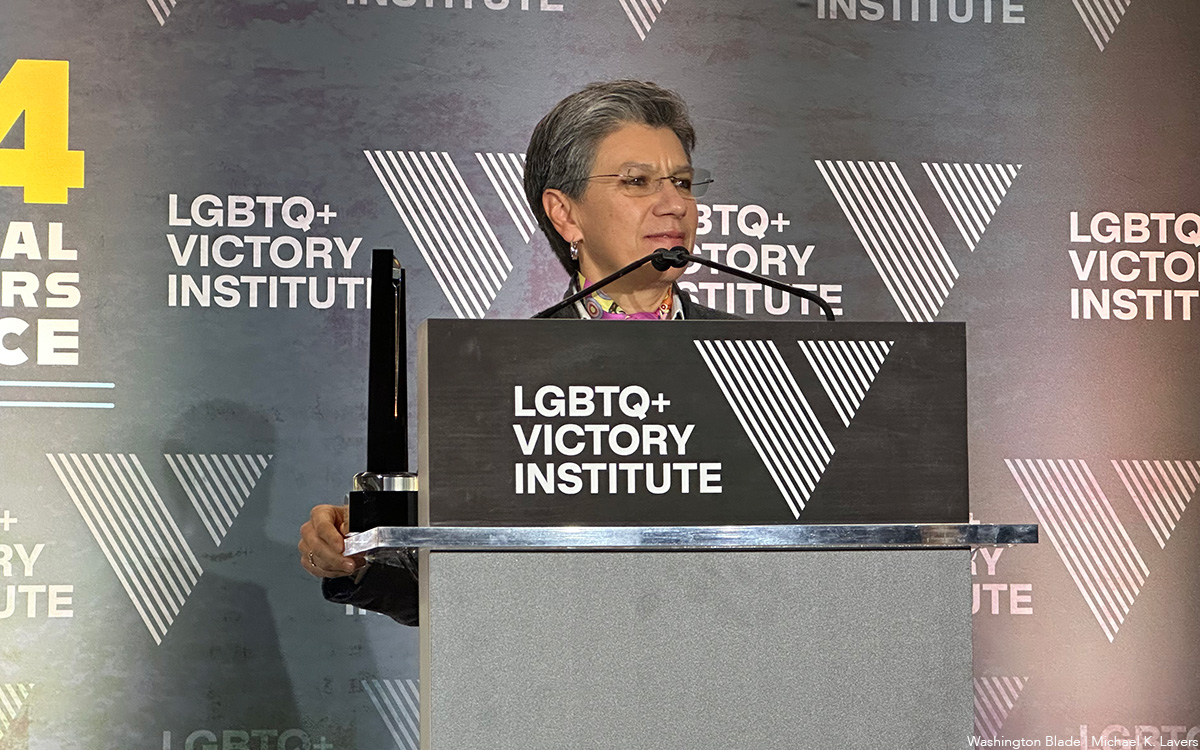
Former Bogotá Mayor Claudia López on Sunday finished fifth in the first round of Colombia’s presidential election.
López, a centrist who ran as an independent, received 225,517 votes. This figure is .95 percent of the total votes cast.
López was the Colombian capital’s mayor from 2020-2023. She was a member of the Colombian Senate from 2014-2018. López, whose wife is outgoing Colombian Sen. Angélica Lozano, would have become the country’s first female and first lesbian president if she would have won the election.
The LGBTQ+ Victory Institute honored López in D.C. in 2024.
“We need to listen to each other again, we need to have a coffee with each other again, we need to touch each other’s skin,” she told the Washington Blade during an interview. She hadn’t yet declared her candidacy, and did not specifically discuss her plans to run.
Runoff to take place June 21
Abrelardo de la Espriella, a far-right lawyer who has praised U.S. President Donald Trump and Salvadoran President Nayib Bukele, on Sunday finished first with 43.74 percent of the vote. Senator Iván Cepeda, a member of outgoing President Gustavo Petro’s Historic Pact party, came in second with 40.9 percent of the vote.
Neither men received a majority of votes. A runoff between them will take place on June 21.

Annapolis Pride arrives this weekend

Calendar: October 2-8

Renee Good’s family files two federal lawsuits

House Democrats urge White House to confront Turkish government over anti-LGBTQ crackdown

988 restores crisis services for LGBTQ youth

HRC National Dinner 2026: A night of music, activism, LGBTQ history

Lesbian Bar Project co-founder: purity politics could destroy our remaining spaces

529 openly LGBTQ candidates running in Brazilian election

HRC report: LGBTQ students face ‘far greater challenges’ in non-supportive states

Meet the LGBTQ candidates running for U.S. House, Senate
-

 LGBTQ Non-Profit Organizations5 days ago
HRC National Dinner 2026: A night of music, activism, LGBTQ history
-
Bars & Parties5 days ago
Lesbian Bar Project co-founder: purity politics could destroy our remaining spaces
-
Brazil4 days ago
529 openly LGBTQ candidates running in Brazilian election
-
National5 days ago
HRC report: LGBTQ students face ‘far greater challenges’ in non-supportive states