Connect with us

Arts & Entertainment

Whitman’s Washington

Local group honors gay poet with lecture/discussion
Published

on

Walt Whitman, Peter Doyle, gay news, Washington Blade

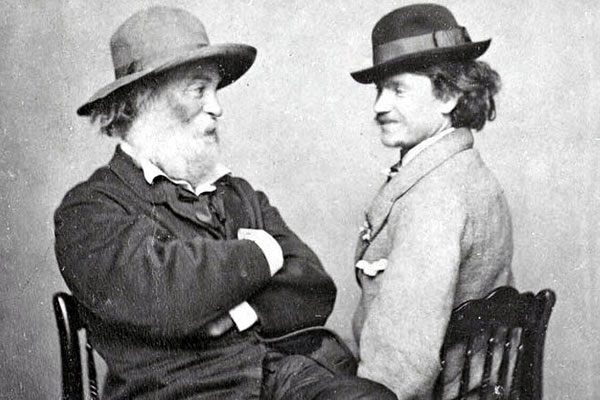
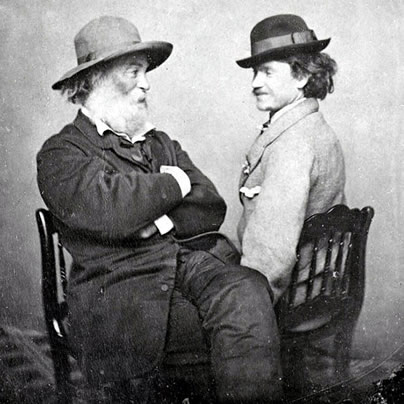
Walt Whitman, left, with his companion Peter Doyle. (Photo by M.P. Rice public domain)

Overbeck History Lecture Series

Walt Whitman in Washington

Washington Friends of Walt Whitman

Naval Lodge Hall

330 Pennsylvania Ave., S.E.

Tuesday at 7:30 p.m.

RSVP requested to [email protected]
Whitmandc.org

Martin Murray, Dupont Circle, Metro, Walt Whitman, gay news, Washington Blade

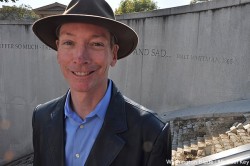
Martin Murray, a local gay Walt Whitman scholar, at the north entrance of the Dupont Circle Metro stop where a Whitman quote is prominently displayed. (Washington Blade photo by Michael Key)

Local historian Martin Murray is founder of the Washington Friends of Walt Whitman, a group that conducts tours showing spots in the District that are significant to the late, great poet who was spent a large portion of his adult life here from 1862-1873.

On Tuesday, Murray will lecture at the Naval Lodge Hall in a discussion of the gay poet’s many roles here. Here are a few highlights from a lengthy conversation with Murray this week about why the “Leaves of Grass” author still matters. His comments have been heavily edited for length.

WASHINGTON BLADE: How did you come to be so interested in Whitman?

MURRAY: I was introduced to him in 1976 when I was a student at Rutgers. It was the year of the Bicentennial and there was a series on famous Americans. One was on Walt Whitman in which he was portrayed by Rip Torn. I was in college and coming to terms with my own sexuality. The portrayal was very sensitively drawn, but they made it clear he was gay… which I thought was pretty forward for 1976. I hadn’t studied him much in school, but after that, I was very interested.


BLADE: You’ve done some substantial research on Whitman. What are some of the things you’ve discovered?

MURRAY: I had been interested in his role as a journalist during the war and I found about a dozen additional pieces of Whitman’s journalism that hadn’t been noted before. … Also in some of the things he jotted down during his time visiting wounded soldiers, he would often jot down their names or initials. I thought it would be interesting to find out more about them, so by doing some research at the National Archives where military service records are held and pension records as well, I was able to find a lot. This was about 15 years ago. … I also wrote a biographical essay on (Whitman confidante and probably lover) Peter Doyle that was published in the Walt Whitman Quarterly Review.


BLADE: Whitman lived here many years. What was his view of his life in Washington?

MURRAY: He was basically here from the last week of December of 1862 until July of 1873. As the war was ending, he got more secure government work. … He had a lot of connections here and worked until he had a stroke in January of 1873 in his office at the Treasury Building where he worked in the Attorney General’s office. He was basically paralyzed I believe on the left side. He tried as best he could to recover but eventually realized he couldn’t stay, so he went to Camden, New Jersey where he lived with his brother. … I think he would have stayed if his health had allowed.


BLADE: Do we know if there were any networks of gay men in Washington at the time or if they had any way of finding each other outside of random encounters?

MURRAY: It’s really hard to say. There probably were networks like that but trying to find firm evidence of it is really difficult. We know Whitman was writing poems about romance among gay soldiers, that there were references in the press suggesting his homosexuality and people he was intimate with in D.C., but it’s hard to say if there was any kind of gay society in that day.


BLADE: What significance does it hold for gays today to have historical figures such as Whitman be recognized as gay forefathers?

MURRAY: Even with the great progress that’s been made, there’s always a struggle, always something to grapple with when we start to realize we’re gay. People need to be able to look back and realize we’re not freaks. People of my kind have always existed and there’s a continuity there that goes all the way back through recorded time.
Advertisement
FUND LGBTQ JOURNALISM
SIGN UP FOR E-BLAST

Movies

‘Hedda’ brings queer visibility to Golden Globes

Tessa Thompson up for Best Actress for new take on Ibsen classic

Published

on

Tessa Thompson is nominated for Best Performance by a Female Actor in a motion picture for ‘Hedda’ at Sunday’s Golden Globes. (Image courtesy IMDB)

The 83rd annual Golden Globes awards are set for Sunday (CBS, 8 p.m. EST). One of the many bright spots this awards season is “Hedda,” a unique LGBTQ version of the classic Henrik Ibsen story, “Hedda Gabler,” starring powerhouses Nina Hoss, Tessa Thompson and Imogen Poots. A modern reinterpretation of a timeless story, the film and its cast have already received several nominations this awards season, including a Globes nod for Best Actress for Thompson.

Writer/director Nia DaCosta was fascinated by Ibsen’s play and the enigmatic character of the deeply complex Hedda, who in the original, is stuck in a marriage she doesn’t want, and still is drawn to her former lover, Eilert. 

But in DaCosta’s adaptation, there’s a fundamental difference: Eilert is being played by Hoss, and is now named Eileen.

“That name change adds this element of queerness to the story as well,” said DaCosta at a recent Golden Globes press event. “And although some people read the original play as Hedda being queer, which I find interesting, which I didn’t necessarily…it was a side effect in my movie that everyone was queer once I changed Eilert to a woman.”

She added: “But it still, for me, stayed true to the original because I was staying true to all the themes and the feelings and the sort of muckiness that I love so much about the original work.”

Thompson, who is bisexual, enjoyed playing this new version of Hedda, noting that the queer love storyline gave the film “a whole lot of knockoff effects.”

“But I think more than that, I think fundamentally something that it does is give Hedda a real foil. Another woman who’s in the world who’s making very different choices. And I think this is a film that wants to explore that piece more than Ibsen’s.”

DaCosta making it a queer story “made that kind of jump off the page and get under my skin in a way that felt really immediate,” Thompson acknowledged.

“It wants to explore sort of pathways to personhood and gaining sort of agency over one’s life. In the original piece, you have Hedda saying, ‘for once, I want to be in control of a man’s destiny,’” said Thompson.

“And I think in our piece, you see a woman struggling with trying to be in control of her own. And I thought that sort of mind, what is in the original material, but made it just, for me, make sense as a modern woman now.” 

It is because of Hedda’s jealousy and envy of Eileen and her new girlfriend (Poots) that we see the character make impulsive moves.

“I think to a modern sensibility, the idea of a woman being quite jealous of another woman and acting out on that is really something that there’s not a lot of patience or grace for that in the world that we live in now,” said Thompson.

“Which I appreciate. But I do think there is something really generative. What I discovered with playing Hedda is, if it’s not left unchecked, there’s something very generative about feelings like envy and jealousy, because they point us in the direction of self. They help us understand the kind of lives that we want to live.”

Hoss actually played Hedda on stage in Berlin for several years previously.

“When I read the script, I was so surprised and mesmerized by what this decision did that there’s an Eileen instead of an Ejlert Lovborg,” said Hoss. “I was so drawn to this woman immediately.”

The deep love that is still there between Hedda and Eileen was immediately evident, as soon as the characters meet onscreen.

“If she is able to have this emotion with Eileen’s eyes, I think she isn’t yet because she doesn’t want to be vulnerable,” said Hoss. “So she doesn’t allow herself to feel that because then she could get hurt. And that’s something Eileen never got through to. So that’s the deep sadness within Eileen that she couldn’t make her feel the love, but at least these two when they meet, you feel like, ‘Oh my God, it’s not yet done with those two.’’’

Onscreen and offscreen, Thompson and Hoss loved working with each other.

“She did such great, strong choices…I looked at her transforming, which was somewhat mesmerizing, and she was really dangerous,” Hoss enthused. “It’s like when she was Hedda, I was a little bit like, but on the other hand, of course, fascinated. And that’s the thing that these humans have that are slightly dangerous. They’re also very fascinating.”

Hoss said that’s what drew Eileen to Hedda.  

“I think both women want to change each other, but actually how they are is what attracts them to each other. And they’re very complimentary in that sense. So they would make up a great couple, I would believe. But the way they are right now, they’re just not good for each other. So in a way, that’s what we were talking about. I think we thought, ‘well, the background story must have been something like a chaotic, wonderful, just exploring for the first time, being in love, being out of society, doing something slightly dangerous, hidden, and then not so hidden because they would enter the Bohemian world where it was kind of okay to be queer and to celebrate yourself and to explore it.’”

But up to a certain point, because Eileen started working and was really after, ‘This is what I want to do. I want to publish, I want to become someone in the academic world,’” noted Hoss.

Poots has had her hands full playing Eileen’s love interest as she also starred in the complicated drama, “The Chronology of Water” (based on the memoir by Lydia Yuknavitch and directed by queer actress Kristen Stewart).

“Because the character in ‘Hedda’ is the only person in that triptych of women who’s acting on her impulses, despite the fact she’s incredibly, seemingly fragile, she’s the only one who has the ability to move through cowardice,” Poots acknowledged. “And that’s an interesting thing.”

Continue Reading

Arts & Entertainment

2026 Most Eligible LGBTQ Singles nominations

We are looking for the most eligible LGBTQ singles in the Washington, D.C. region.

Published

on

We are looking for the most eligible LGBTQ singles in the Washington, D.C. region.

Are you or a friend looking to find a little love in 2026? We are looking for the most eligible LGBTQ singles in the Washington, D.C. region. Nominate you or your friends until January 23rd using the form below or by clicking HERE.

Our most eligible singles will be announced online in February. View our 2025 singles HERE.

Continue Reading

Photos

PHOTOS: Freddie’s Follies

Queens perform at weekly Arlington show

Published

on

The Freddie's Follies drag show was held at Freddie's Beach Bar in Arlington, Va. on Saturday. (Washington Blade photo by Michael Key)

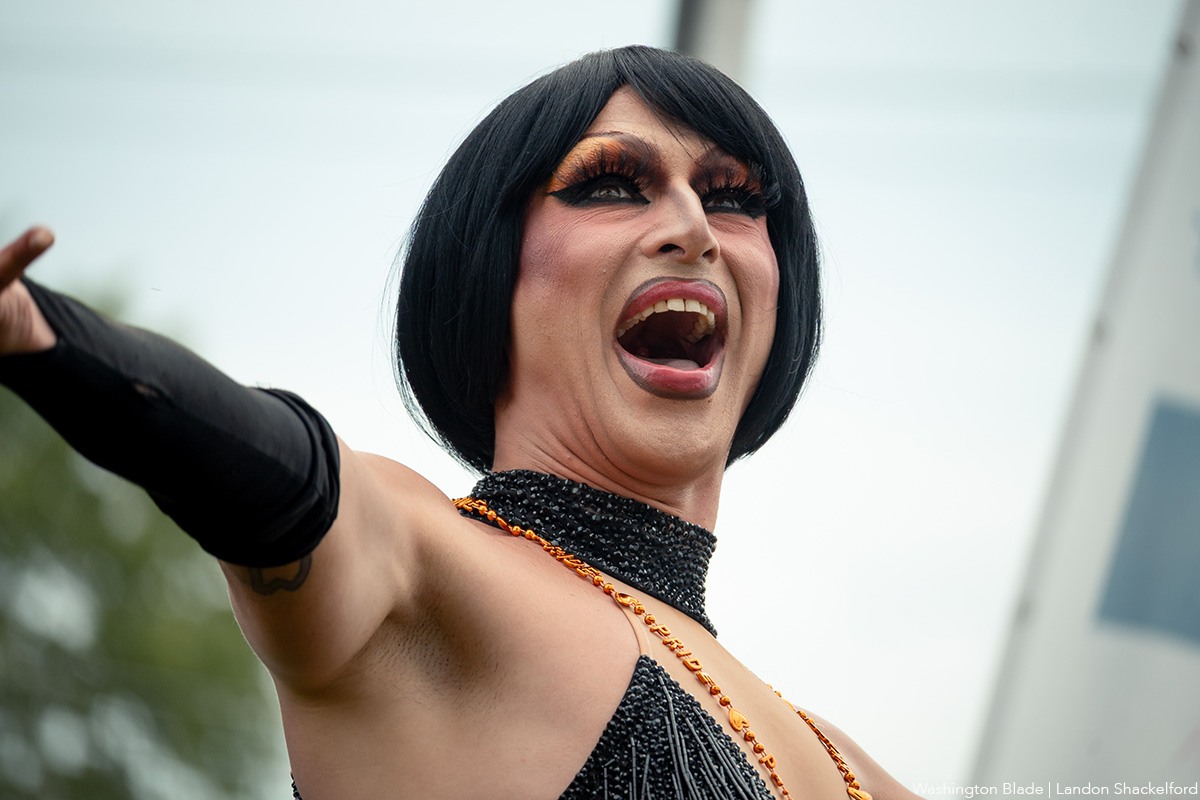
The Freddie’s Follies drag show was held at Freddie’s Beach Bar in Arlington, Va. on Saturday, Jan. 3. Performers included Monet Dupree, Michelle Livigne, Shirley Naytch, Gigi Paris Couture and Shenandoah.

(Washington Blade photos by Michael Key)

Continue Reading

Popular