News
Una ciudad cubana que no quiere ser gueto
Santa Clara se debate espacios exclusivos para la comunidad LGBT
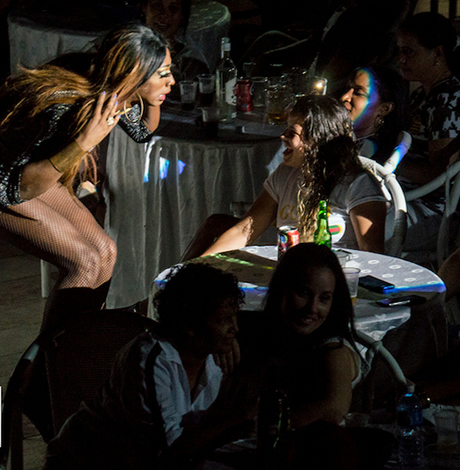
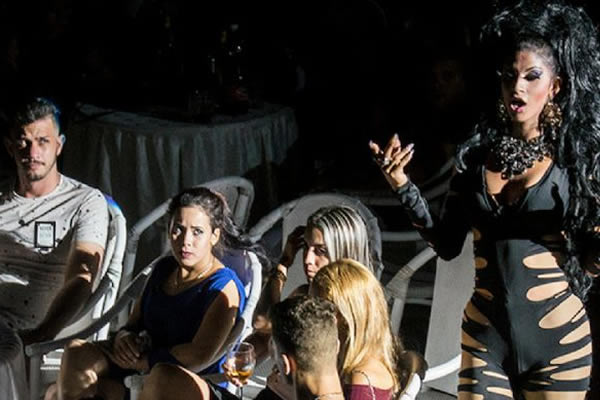
Una noche de sábado en el Cabaret Cubanacán, de Santa Clara. (Foto por Yariel Valdés González/Tremenda Nota)
Esa nota salió originalmente en el sitio web de Tremenda Nota.
SANTA CLARA, Cuba — Una de las ciudades cubanas más hospitalarias con las personas LGBTI+ también se debate entre la demanda de espacios exclusivos para las minorías sexuales y las desigualdades económicas que crecen en la Isla.
Cada sábado Miguel Antonio Castillo viaja cerca de dos kilómetros para encontrar una discoteca.
En San Diego del Valle, su primer destino, hay pocos lugares para bailar o simplemente disfrutar de espectáculos culturales. Por eso, desde que supo que existía una “noche para las personas LGBTI+” en Santa Clara, la capital de la provincia, Miguel Antonio decidió alargar su travesía por más de 30 kilómetros hasta el Cabaret Cubanacán.
“Las actividades que hacen allá [en San Diego del Valle] son muy generales,” se queja. “Y tampoco hay un día específico para los homosexuales.”
Al joven le seduce que “en las fiestas gais todos son gais.” Además, allí puede “encontrar amigos e intercambiar con personas que tienen gustos sexuales, estéticos o musicales similares, sin riesgo de sufrir homofobia.”
Más allá de las cabeceras municipales cubanas la recreación se reduce a una discoteca improvisada y a un parque central donde la gente se reúne a “cotillear.” Las fiestas concebidas para personas LGBTI+ tampoco son comunes más allá de La Habana y de algunas capitales provinciales.
En la pequeña ciudad de Camajuaní, a 20 kilómetros de Santa Clara, nunca ha prosperado una “fiesta diversa,” aseguran varias personas LGBTI+ entrevistadas por Tremenda Nota.
Según Leonel Jacomino Jiménez, promotor del proyecto Hombres que tienen sexo con otros hombres (HSH), las gestiones para crear un espacio inclusivo “tienen que hacerse sobre la base de cartas y tocando puertas para molestar a algunos funcionarios del gobierno.”
En otros casos, como ocurrió el pasado año en Sagua la Grande, una de las principales ciudades de la provincia, las fiestas LGBTI+ fracasan por falta de público o de buenas estrategias de promoción.
Solo el proyecto itinerante “Me incluyo,” organizado por el promotor cultural Ramón Silverio, creador y director de El Mejunje, ha presentado espectáculos de transformismo y otras actividades inclusivas en poblados y zonas apartadas.
Santa Clara, por su parte, cuenta con tres espacios que celebran las llamadas “fiestas gais,” y que incluyen shows de transformismo. El Centro Recreativo El Bosque, el Cabaret Cubanacán y El Mejunje de Silverio son los únicos lugares que introducen en su cartelera semanal una “noche diversa.”
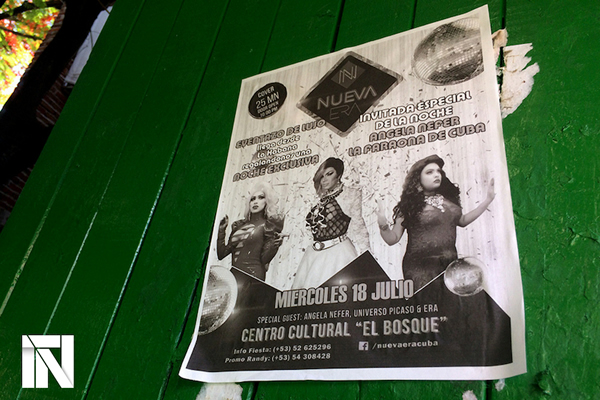
En la última década las “fiestas diversas” han alcanzado varias ciudades cubanas, aunque todavía La Habana y Santa Clara son las que ofrecen más opciones recreativas “exclusivas” para las personas LGBTI+. (Foto por Yariel Valdés González/Tremenda Nota)
¿Gueto homosexual?
Junto al Cabaret Cubanacán funciona otro espacio recreativo nombrado Disco Isla. Los públicos se muestran segregados cada sábado. De un lado hacen fila las personas gais, trans y lesbianas; del otro aparecen jóvenes heterosexuales que evitan mezclarse con “sus vecinos.” Las personas LGBTI+ permanecen en el gueto “asignado” socialmente.
“La creación de espacios exclusivos genera también una especie de exclusión,” cree Félix Izaguirre, un joven que hace fila para entrar a otra de las “fiestas diversas” de la ciudad.
“Mucha gente no va al Cabaret los sábados ni vienen a El Mejunje, precisamente porque saben que es noche gay,” dice. “Siempre existen heterosexuales que tienen amigos gais y los acompañan sin prejuicios, pero son los menos.”
Ramón Silverio creó hace más de tres décadas el centro cultural El Mejunje, acusado en sus primeros años de ser un “club exclusivo para personas gais.” Sin embargo, la institución sobrevivió el paso del tiempo y, en vez de apartar en un gueto a las personas LGBTI+, abrió las puertas al resto de la sociedad.
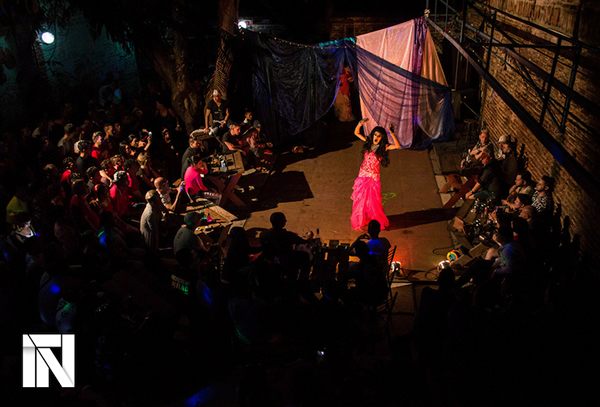
El público asiste a un show de transformismo en El Mejunje. (Foto por Yariel Valdés González)
Aun así, muchas personas homosexuales y transgéneros prefieren acudir a “espacios exclusivos para gais.” Javier Olivera, transformista que se presenta en el escenario de El Mejunje como Cinthia, aseguró que en sitios “aparentemente para heterosexuales” suele encontrarse conflictos entre la clientela homofóbica y los gais.
Por eso, Denet Oliva Triana, colega de Javier conocida como Blacuchini, respalda la existencia de lugares dedicados a la comunidad LGBTI+, aunque siente que está “en un círculo” que le lleva siempre al mismo sitio con la misma gente.
Si es caro no es incluyente
A pesar del éxito del Cabaret Cubanacán y del Centro Recreativo El Bosque ― actualmente en reparación ―, el sitio más popular para la comunidad LGBTI+ de Santa Clara sigue siendo El Mejunje, por sus razonables precios y su cercanía al centro de la ciudad.
“Cada uno se divierte donde le permiten sus ingresos,” aseguran varios entrevistados. Las incipientes clases sociales que se consolidan en Cuba hace más de una década también dividen a las minorías sexuales.
Al Cubanacán, al Bosque, van quienes cuentan con mejor economía, pues solo la entrada cuesta como mínimo 25 pesos (1 CUC, equivalente a un dólar). Ese precio, por ejemplo, quintuplica el valor del boleto de entrada a El Mejunje.
En un país donde el salario medio es 767 pesos mensuales (poco más de 30 dólares estadounidenses), “no se puede decir que un lugar sea inclusivo si cobra cuarenta pesos por la entrada,” advierte Ramón Silverio.
Reinaldo Gil, un joven artista plástico, confirma que “al Cubanacán va la gente que tiene un poco más de dinero.” Al principio, cuando acababan de abrir la “noche diversa” en el cabaret, “los mismos trabajadores de allí te discriminaban un poco, existía homofobia.”
“En el Carishow — una céntrica discoteca de la cadena de servicios extrahoteleros Palmares — a veces no aceptan que entren los homosexuales,” denuncia Gil.
Sin embargo, uno de los agentes de seguridad del Carishow aseguró a Tremenda Nota que allí nunca han existido manifestaciones de homofobia y que “se trata a todos los clientes por igual,” en tanto se comporten de acuerdo a “las normas generales establecidas” en el centro recreativo.
Hace algunos meses dos jóvenes fueron expulsados de Efe Bar, en La Habana, supuestamente por besarse dentro del establecimiento privado. También el KingBar, otro centro nocturno bastante frecuentado de la capital, invocó el derecho de admisión para negar la entrada al poeta Norge Espinosa y un grupo de activistas LGBTI+ en 2015.
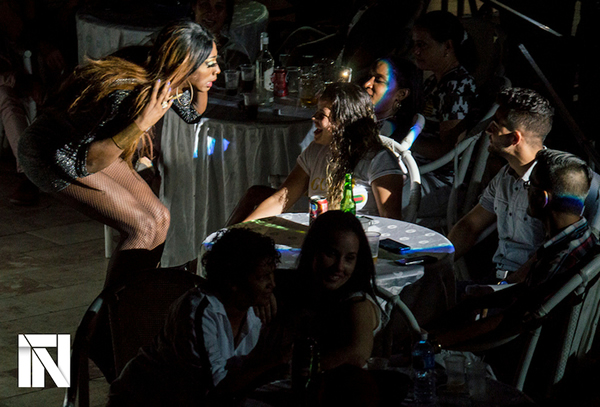
La transformista Blancuchini (a la izquierda) durante una de sus presentaciones en el Cabaret Cubanacán de Santa Clara (Foto por Yariel Valdés González)
Orlando Reinoso Castillo, barman del bar Tacones Lejanos de El Mejunje, se atreve a asegurar que este resulta el único sitio en la ciudad frecuentado a diario por personas gais que se mezclan sin dificultad con la población heterosexual, o con las chicas trans, o con los “pepillos.”
“A este lugar le llaman el bar de los escachados,” comenta, en alusión a los bajos ingresos de muchos clientes. “Además, aquí vienen las parejas, se besan y no pasa nada. La diversidad es tan natural en El Mejunje como sus ladrillos.”



Minnesota
Flanagan beats Craig in Minn. Senate primary after winning key LGBTQ endorsements
The race highlights a growing ideological shift within the Democratic Party, as Democrats increasingly seek a more robust pushback against Trump.
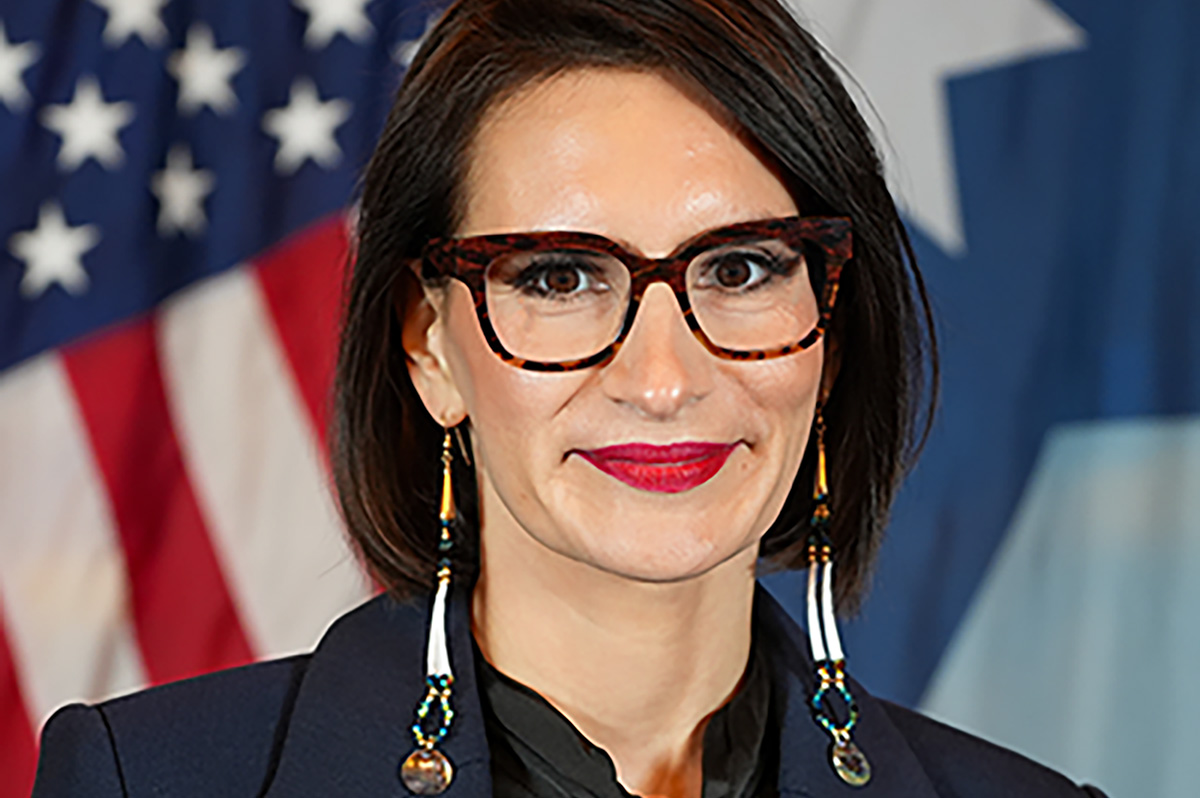
Lt. Gov. Peggy Flanagan won the Democratic primary for the Senate in Minnesota, as progressive Democrats continue to clinch nominations across the country.
On Tuesday night, NBC News called the race for Flanagan, who received 59.0% of the state’s Democratic primary vote, while her opponent, Rep. Angie Craig, received 39.4%. Flanagan ran against Craig for retiring Sen. Tina Smith’s seat.
Smith, along with Sens. Bernie Sanders, I-Vt., and Elizabeth Warren, D-Mass., endorsed Flanagan, while House Minority Leader Hakeem Jeffries, D-N.Y., and former House Speaker Nancy Pelosi, D-Calif., backed Craig.
Flanagan also received the endorsement of the Christopher Street Project, a transgender rights organization that has been at the center of efforts to counter the Republican Party’s push against transgender rights. The group chose Flanagan over Craig in part because Craig has not co-sponsored the Trans Bill of Rights, legislation that has been introduced multiple times in Congress and seeks to establish federal protections for transgender Americans.
The endorsement underscored a key difference between the two Democrats on LGBTQ issues. While Craig is the first openly lesbian mother in Congress, the Christopher Street Project said LGBTQ identity alone is not enough without a strong commitment to transgender rights as they are increasingly debated in legislative offices around the country.
In 2022, the Human Rights Campaign, the largest LGBTQ advocacy organization in the U.S., endorsed Flanagan’s re-election campaign for lieutenant governor alongside Tim Walz, calling the duo “Champions of Equality.”
Flanagan called the race an expensive fight of the “many versus the money,” Flanagan told NBC News’ “Meet the Press Now.” Craig and her allies combined to spend nearly $20 million on the airwaves, while Flanagan and her allies spent $4.7 million, according to AdImpact and NBC.
“I’m running to make sure that people can afford the lives they want to live,” Flanagan said. “I want to get big money out of our politics, and I want to fight for things like ‘Medicare for All’ so that people aren’t just paying for health insurance but actually have access to health care.”
Flanagan criticized Craig, who is in her fourth term, for not standing up enough to President Donald Trump’s administration, a characterization Craig disputed. Craig flipped a competitive House seat in the Twin Cities metro area and had argued that she was the best candidate to win in November.
Craig faced criticism for voting for the Laken Riley Act, an immigration detention measure that Trump signed into law shortly after he started his second term in January 2025. Craig said she later regretted that vote.
Flanagan has been vocal about her stance on abolishing U.S. Immigration and Customs Enforcement. In a recent Minnesota Public Radio debate she said that ICE “has to be ripped apart.” Flanagan said she does support immigration enforcement to ensure secure borders.
Immigration and ICE debates are especially pertinent in the Twin Cities, as ICE agents fatally shot two U.S. citizens, Renee Good and Alex Pretti, in Minneapolis during an enforcement crackdown at the behest of President Trump.
Despite the contested race, Craig made it clear that Democrats are committed to unifying.
“We have an existential crisis in our nation with Trump and Republicans, and so I would be right by the lieutenant governor’s side asking my supporters to support her,” Craig said. “The most important thing in this election is that we beat Republicans. That’s what matters.”
On the Republican side, former NFL sideline reporter Michele Tafoya won the Senate primary. Considered an outsider to the Republican Party structure, she did not win the state GOP’s endorsement at the May convention, where delegates instead backed retired Navy SEAL Adam Schwarze.
She has run her campaign on a slew of issues Republicans have deemed worthy — including transgender sports participation, corruption, and minimizing illegal immigrants in the area.
This recent pattern of moderate and centrist Democrats raising huge funds — in many instances backed by major PACs — only to lose to more progressive and less experienced candidates is growing as more people grow disillusioned with the Democratic Party’s inability to push back against Trump and Republicans. A similar outcome happened in Michigan’s Democratic primary last week when progressive physician Abdul El-Sayed won over incumbent U.S. Rep. Haley Stevens (D-Mich.).
Democratic Gov. Tim Walz, who decided not to run for re-election, stayed neutral in the Senate primary but his wife, Gwen, backed Craig over Flanagan, the governor’s ticketmate.
The Senate seat will be determined in the election on Tuesday, November 3, later this year.
District of Columbia
Gay ANC commissioner sues D.C. over police ‘failure’ to pay reward money
Lawsuit says information led to conviction in murder, armed robbery cases

Gay D.C. Advisory Neighborhood Commissioner Tom Donohue on Aug. 11 filed a lawsuit in D.C. Superior Court charging that D.C. police acted improperly and violated a local law by not paying him $30,000 in reward money for his role in helping police identify and arrest — and obtain the subsequent conviction — of one man charged with murder and another man charged with armed robbery in separate cases.
Although the lawsuit alleges improper action by D.C. police in carrying out the city’s Crime Solvers reward program, it names as defendants the District of Columbia and the Office of the Attorney General for D.C., which, among other things, defends the city against lawsuits.
Donohue, who is a member of the city’s ANC Rainbow Caucus consisting of LGBTQ elected ANC members, held a news conference outside the D.C. Superior Court building on Aug. 11 to talk about the lawsuit before entering the courthouse to officially file it.
The lawsuit states that Donohue “provided key video evidence that led to the arrest and conviction” of a man initially charged with first degree murder for allegedly running over a bicyclist with his car after the two got into an argument.
The lawsuit states that police had offered a $25,000 reward for information leading to the arrest and conviction of the defendant in that case, but police “arbitrarily slashed the payment to $5,000 without prior notice or policy justification.”
Court records show that D.C. resident Eric Beasley was charged with first degree murder for killing David Farewell, 45, by hitting him with his car on Sept. 4, 2020, on the 2100 block of Young Street, S.E. The records show the evidence for the case was based in large part on video camera footage of the incident obtained by police. Donohoe has said he provided that video camera evidence.
The records show that during Beasley’s October 2023 trial a jury was unable to reach the required unanimous verdict, and the judge declared a mistrial.
According to the records, Beasley later agreed to an offer by prosecutors to plead guilty to a lesser charge of involuntary manslaughter and was sentenced in September 2024 to eight years in prison, a development that angered the victim’s family members who called it a “slap on the wrist,” according to a Fox 5 News report.
Donohue’s lawsuit says the second case in which he provided police with pivotal information involved a series of armed robberies known as the Fairlawn Serial Armed Robbery Spree that occurred in the Fairlawn neighborhood in Southeast D.C. in 2023 near where Donohue lives.
The lawsuit says evidence consisting of video surveillance footage provided by Donohue to police enabled police to determine they initially wrongfully arrested an 18-year-old male for the robberies. “Using Plaintiff’s security video, MPD identified, arrested, and convicted the actual robber, David Crocker, who was sentenced to 18 years in federal prison,” the lawsuit states.
It says one of the detectives investigating the case recommended a $10,000 reward for Donohue’s help in the case based on the police Crime Solvers reward program. The detective’s recommendation was approved by then-Assistant D.C. Police Chief Kyle Ramey on Aug. 4, 2025, according to the lawsuit.
But it adds, “Nevertheless, MPD improperly withheld payment.”
When contacted by the Washington Blade for comment on Donohue’s lawsuit allegations, a D.C. police spokesperson said “MPD does not comment on pending or ongoing litigation.”
Gabriel Shoglow-Rubenstein, who serves as press secretary for the D.C. Office of the Attorney General, which will be defending the city against the Donohue lawsuit, said he would look into obtaining a possible comment but said the office has a similar longstanding policy of not commenting on pending litigation.
“This action arises from the District of Columbia Metropolitan Police Department’s arbitrary, bad-faith, and legally unsupportable failure to honor its public reward promises and administrative obligations to Plaintiff,” the lawsuit states.
It says the MPD violated the city’s Freedom of Information Act or FOIA law by not responding to Donohue’s request for information and documents related to the decision not to pay him the full reward money.
“MPD’s reduction of Plaintiff’s homicide reward from $25,000 to $5,000, and its withholding of his approved $10,00 robbery reward, were undertaken completely devoid of written standards, making such decisions inherently arbitrary, capricious, and an abuse of administrative discretion,” it says.
It calls for Donohue to be awarded $30,000 in compensatory damages consisting of the $20,000 “unpaid balance” for the homicide case reward and $10,000 for the robbery case reward. It also calls for reimbursement for “reasonable” litigation costs and attorney’s fees. Donohue told the Washington Blade that at this time he is representing himself without an attorney.
Donohue told the Blade that the refusal by D.C. police to pay him the full reward money also limited his plans to donate some of that money to the family of murder victim David Farewell to help pay for a burial stone. He said that due to the family’s limited resources Farewell is buried in an unmarked grave
Delaware
New LGBTQ visitor center slated for Wilmington, Del.
The Collective to feature gift shop, queer museum, more

During Pride month this year, the Delaware Sexuality and Gender Collective (DSGC) announced plans for The Collective, which will become Delaware’s first LGBTQIA+ visitor center and Wilmington’s first dedicated LGBTQIA+ space in nearly 40 years.
“We’ve been talking about the concept of a brick-and-mortar space for a long time,” said Noah Duckett, co-founder of DSGC.
A licensed clinical social worker, Duckett co-founded DSGC with his mother, Julissa Coriano, in 2018. DSGC is an independent nonprofit organization that provides vital clinical and educational support, social programming and direct-need support to the LGBTQIA+ community.
Some of the programs DSGC offers include a free clothing closet for the trans community, meal support for people recovering from gender-affirming surgery, connections to pro bono legal services, a biannual Pride Market featuring over 100 LGBTQIA+-owned small businesses, and more.
“Our vision for The Collective is a place where our community can come to learn, create, work and be inspired,” said Coriano.
The Collective will feature a visitor center and gift shop highlighting LGBTQIA+-owned businesses in Delaware.
“I think that this is something that’s going to benefit our community so much,” said Duckett.
Some of the LGBTQIA+-owned businesses that DSGC has already partnered with include Stress Induced Art Attack, Moonbeam Art Collaborative, Voce Coffee, Groovy Gemini Co., Scout Cafe, Macaron Social and Huxley and Hiro.
“Specifically in Wilmington, we haven’t had an LGBTQIA+-dedicated space in almost 40 years,” said Duckett.
The Griffin Community Center, which operated from 1986 to 1990, was Delaware’s first LGBTQ+ community center. The Griffin was founded by Ivo Dominguez Jr. and James C. Welch and provided a range of community services during the height of the HIV/AIDS crisis, including AIDS hotlines, organizational offices and meeting space. The center ultimately closed because of a lack of financial support.
Duckett said DSGC hopes The Collective will carry on The Griffin’s legacy while building a sustainable space for the LGBTQIA+ community.
“I think now more than ever, there’s more and more spaces closing their doors. More and more spaces are losing funding, seeing reduced funding and reduced access, especially LGBTQ+ organizations and communities,” said Duckett.
The Collective will also feature Delaware’s first LGBTQ+ history museum, curated by LGBTQ+ historian Carolanne Deal.
“We don’t have any permanent displays in the state about Delaware’s queer history, and we want people to be able to access that history any day of the year, not just during Pride Month,” said Deal.
With a master’s degree in art history for museum professionals, Deal has more than seven years of experience in curatorial work and hands-on collections care.
“It’s mainly going to be a graphic display with photographs, articles and accessible text that draws people in and creates a story for the community,” said Deal.
Although the museum will not initially have an object collection, Deal said she hopes to add physical archival pieces in the future.
“Delaware has been at the forefront of a lot of queer civil rights, and it’ll be really amazing to have that enshrined in a permanent display that’s not only up for Pride Month,” said Deal.
Duckett said DSGC is currently raising funds with the goal of beginning construction this summer and opening by the end of the year.
Duckett told the Blade that fundraising efforts have reached just under $29,000 and that the organization is awaiting several major donations from community partner organizations.
However, he said DSGC continues to be denied many grants tied to federal or state funding because of restrictions on those funds being used for LGBTQ+-serving organizations.
“Private and corporate donations are absolutely vital,” said Duckett.
Anyone interested in supporting the construction and renovation of The Collective can donate online or contact [email protected] for more information.ose funds being used for LGBTQ-serving organizations.
“Private and corporate donations are absolutely vital,” said Duckett.
Anyone interested in supporting the construction of The Collective can donate online or contact [email protected] for more information.

Flanagan beats Craig in Minn. Senate primary after winning key LGBTQ endorsements

Gay ANC commissioner sues D.C. over police ‘failure’ to pay reward money

New LGBTQ visitor center slated for Wilmington, Del.

Jason DePuy on coping with homophobia in ‘Big Brother’ house