National
Down to the wire in N.Y.
All eyes on GOP caucus in N.Y. marriage debate; tense negotiations over marriage bill in Albany

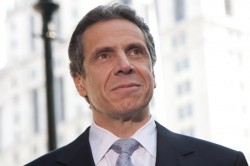
New York Gov. Andrew Cuomo encountered delays this week trying to get a same-sex marriage bill passed in the state Senate. As of Blade press time Thursday morning, the bill hadn't been voted on. (Photo by Pat Arnow; courtesy of Wikimedia)
New York’s same-sex marriage bill was in limbo as of Blade press time Thursday morning, as the legislative session was extended and lengthy negotiations took place over which religious exemptions would be included in the final language.
The state’s top political leaders said they supported several religious exceptions that had been added on Wednesday. The Democratic-led Assembly has already approved the bill but will need to approve any revised version that may come out of the Senate.
New York Gov. Andrew Cuomo said late Wednesday that negotiations over the exemptions were going well.
“We are going back and forth on language,” the AP quoted Cuomo as saying. “But we have not hit any obstacles.” Negotiations were expected to continue Thursday, many New York-based media outlets said.
Negotiators are trying to include enough protections in the bill so that religious groups can not be sued for discrimination if the bill passes.
Though the New York Assembly, the state legislature’s lower house, is controlled by Democrats, Republicans have a slight majority (32-30) in the Senate. The measure needs only one more vote to pass the Senate after being approved by the Assembly last week. Senate Majority Leader Dean Skelos said this week that Senate Republicans had not discussed the marriage proposal because they were sidetracked by other issues like rent control laws and caps on property tax increases. Cuomo said this week he was “cautiously optimistic” the marriage bill will pass.
The religious protections weren’t available by Blade deadline but were expected to include protection for religious groups such as adoption agencies and marriage counselors who oppose gay marriage.
Among Democrats in the Senate, 29 of the 30 say they’ll vote for gay marriage meaning only three Republican votes would be needed for it to pass the 62-seat chamber. Two have said they’ll vote for it. Two others are undecided on the record, though some reports from New York say the needed Republican votes are there.
New Yorkers United for Marriage, a coalition group of LGBT groups including Empire State Pride Agenda, Freedom to Marry, Human Rights Campaign and others, said Wednesday in a statement, it is pleased with the way things are unfolding.
“We are pleased that thoughtful discussion on marriage equality are ongoing and that progress continues to be made,” the release said. “The voices of the overwhelming majority of New Yorkers who support marriage for all have clearly been heard and momentum is on our side. The people of the state of New York expect and deserve a vote on this important issue.”
Gay Manhattan resident Lou Weiss, who wed his partner Danny Martin in Canada in 2005, said Wednesday he’s optimistic.
“It’s moved away from the sinning and the man-and-woman argument to the argument of how can we protect the church from these evil gays,” Weiss said. “That’s a major shift. We’re not discussing where it’s going but a minute portion of it. These religious exemptions have been in the bill for years. It should be clear we’re talking about civil ceremonies. They want a promise they won’t get sued. Well anybody can sue anybody. Nobody can give them a guarantee of that.”
Weiss said he’s embarrassed his city, usually a leader on progressive issues, is lagging behind on marriage, especially since the Stonewall riots happened there.
“I have friends say, ‘Oh, we thought New York would be the first to get it,’ but instead we’ll be number seven. We’ve had great domestic partner benefits for years, but I’m disappointed that it’s taken this long and that we’ll be number seven and not in our usual first place. It’s easy to forget, it’s not all that liberal outside of Manhattan.”
Weiss predicts it will pass in either this session or next. If it does, he and Martin plan to reaffirm their vows.
Vermont, New Hampshire, Connecticut, Massachusetts, Iowa and D.C. allow gay marriage. Of them, all but Massachusetts and D.C. allow at least limited religious exemptions.
New York’s legislative session had been scheduled to end Monday.



California
Gay San Diego mayor elected US Conference of Mayors president
Todd Gloria spoke with the Blade earlier this month in D.C.
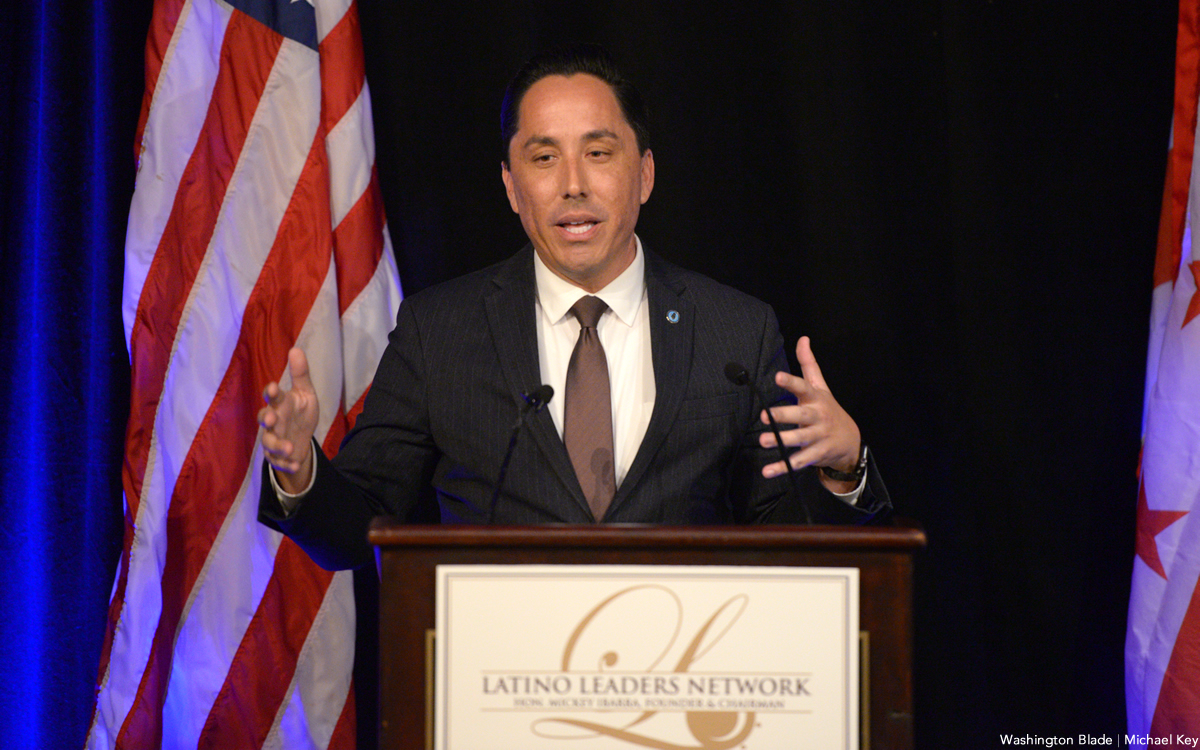
Todd Gloria has had a whirlwind two decades as a public servant.
Beginning with his successful 2008 San Diego City Council election, followed up by his second successful campaign in 2012 — this time as president of the San Diego City Council — Gloria has been strapped to a rocket headed to public servant fame that would make Leslie Knope’s head spin, with no signs of slowing down.
Just one year into his tenure as president of the San Diego City Council, Bob Filner, the then-mayor of the city, resigned from his role following multiple allegations of sexual harassment. In that moment of political uncertainty, Gloria stepped up, becoming the interim mayor of San Diego, and the leader of one of the largest cities in the U.S. .
While his term as interim mayor — lasting from August 2013 to March 2014 — was not long, it was a sign to the people of San Diego — and to himself — that Gloria could do good things for San Diego. When the newly elected Mayor Kevin Faulconer was sworn in in March 2014, Gloria continued working hard to keep the city he grew up in in caring hands.
Gloria started to look past “America’s Finest City” and began looking toward Sacramento. It was there that some of the state’s most capable minds were attempting to tackle problems that the entire Golden State faced. In 2016, he ran for the California State Assembly’s 78th District seat, representing San Diego, where he won with an impressive margin and started championing the city’s climate action plan. Shortly after assuming office, he was chosen to become a member of the Democratic leadership — as assistant majority whip — where he helped pass his and the Democratic Party’s legislative goals in the most populous state in the nation.
It should be no surprise that, with a growing reputation as someone bent on making his city better for the more than 400,000 residents who live within the 78th District, Gloria won re-election in 2018 with more than 70 percent of the vote in both the primary and general elections. There, he was tapped once again to be an integral part of the Democratic Party’s legislative mission and was, in January 2018, made majority whip.
In 2019, Gloria announced he would no longer seek the 78th District seat when his term was up, but would return from Sacramento to San Diego — this time as mayor. He ran his campaign on issues that San Diegans faced: the housing crisis, affordability, public transportation, and climate change.
In November 2020, Gloria was elected mayor of the city he grew up in, where he broke barriers — his win also made him the first Native American and the first Filipino American to hold this position in a U.S. city with more than a million people, becoming San Diego’s first mayor of color. He was also the city’s first openly gay mayor.
The Washington Blade sat down with Gloria when he visited Washington earlier this month for the U.S. Conference of Mayors, where he was elected president of the organization. The presidency lasts for one year and alternates between political parties to ensure bipartisanship.
Gloria, has served as mayor of San Diego since 2020, will lead the nearly century-old bipartisan organization as a proud out gay man at a time when many LGBTQ Americans are concerned about the future of their rights and protections.
“Well, a lot. I think the first thing that comes to mind is that this time that we’re all living in, the stakes feel particularly high, and I think number one, I’d want your readers to understand that this is a conference of bipartisan mayors from all across the country who supported me to lead the organization that’s nearly 100 years old,” he explained.
“I think at a time when we definitely wonder, as queer people, where we sit in our nation and in our society, that my fellow mayors of all different political stripes are willing to allow me to be their voice as leader of this organization. I hope it somehow validates the notion that we are still making progress, that particularly the political process is still possible.”
Gloria framed his election as evidence that progress remains possible, even amid growing political polarization. He noted that the U.S. Conference of Mayors was founded during the Great Depression, another period when local leaders stepped forward to address challenges they felt were not being adequately addressed at the federal level.
Throughout the interview, Gloria repeatedly emphasized the unique role cities can play in advancing LGBTQ equality. He pointed to the U.S. Conference of Mayors’ long history of supporting civil rights, HIV/AIDS advocacy, and LGBTQ inclusion, and his belief that mayors often find common ground on issues where Washington remains divided as a clear thesis to his presidency.
“It’s building on the history. It’s one of the reasons I’m very proud of this organization. Why I’ve been an active member for years now is that it has this storied history of speaking up and helping to advance change in this country. Everything from direct aid to cities in the Great Depression to civil rights in the 1960s to equality, HIV/AIDS advocacy during a time of great stigma and shame,” Gloria said. “This conference, again a bipartisan organization, has been willing to sort of be able to find a common ground that maybe isn’t always possible in Washington.”
Gloria also highlighted San Diego’s own LGBTQ political history, noting that the city has maintained continuous LGBTQ representation on its City Council since the early 1990s. He credited generations of local activists for helping create a political environment where LGBTQ elected officials have been able to thrive.
With Pride Month unfolding amid continued battles over LGBTQ rights nationwide, Gloria argued that cities remain important centers of progress and power, even when state and federal politics become more hostile.
“We have quite a bit [of power] because we can often do things within our own communities, but also we can band together and lend our voices to try and either stop bad things from happening or help advance good things that we’d like to see come to pass.”
He added that cities provide opportunities to continue advancing equality — even when, at a national level, conditions seem unfavorable.
“Cities provide avenues to say ‘No, we can actually make progress, maybe not at the scale, maybe not as broad as we would like, but it can still happen.’”
While Gloria has championed LGBTQ rights throughout his political career, he said housing affordability has emerged as the defining civil rights challenge facing many communities, including LGBTQ residents.
“The biggest civil rights issue right now is housing,” Gloria said.
He argued that many LGBTQ people can now legally live and work openly in places like San Diego, but increasingly struggle to remain in those communities because of rising housing costs.
“You know, we are a very affirming city. We have a gay mayor. 1/3 of our city council is LGBT. We have all of the protections that you would hope a city would provide in a state that provides those same protections, but we’re horrifically expensive, and our housing costs are unattainable to so many people of all walks of life.”
As president of the U.S. Conference of Mayors, Gloria said he hopes to elevate housing affordability as a national issue and encourage local leaders to adopt policies that increase housing production and reduce costs.
On LGBTQ-specific initiatives, Gloria pointed to his work co-chairing the organization’s LGBTQ Alliance alongside Madison, Wis., Mayor Satya Rhodes-Conway. Under their leadership, the alliance created a municipal toolkit designed to help mayors implement LGBTQ-inclusive policies, ranging from Pride Month proclamations to nondiscrimination protections and fair housing measures.
“We have a lot of allies and come to our meetings, we meet four times a year, and you want to be supportive of the community. This is what this looks like.”
Beyond policy, Gloria described the alliance as an important support network for LGBTQ elected officials navigating increasingly hostile political rhetoric.
“When the attacks on trans people, specifically trans children start happening, that was an issue that we discussed at length in the alliance.”
Despite his optimism, Gloria acknowledged that recent years under the current federal leadership have challenged assumptions many LGBTQ Americans once held about the inevitability of continued progress — and the idea that rights gained were forever.
“I think for someone who you know came up in the movement in the 90s and early 2000s you know, I’ve seen marriage equality, I’ve seen the progress with HIV and AIDS, you know, ability to work and live where you want, you know, all that stuff. It kind of felt like, for me, it felt like it was inevitable that we would keep ascending to greater and greater equality,” he said. “Obviously, recent years have made you not only stop some of that progress, but really question if we’re not going to start falling backwards.”
Still, Gloria urged LGBTQ Americans not to retreat from civic engagement or get quiet about the problems they face, given the constant barrage of attacks — both executive and cultural — that leaves some feeling as if the battle for equality is waning.
“This is not a time to back away. This is not a time to fold inward. We have to truly double down and continue forward doing the work. Leaning forward will mean that the progress may be less than what we want, but still progress will be made.”
Gloria also said he has noticed a change in the tone of political discourse directed at elected officials, including LGBTQ leaders. While he said hostile rhetoric has increased, he views his position as an opportunity to model resilience for younger LGBTQ people.
“You can either absorb it the way I did in middle school and feel kind of crummy and maybe a little bit sorry for myself, or you can realize that every time I’m called that, there’s a young person in a school who does not have the perspective I have, and they’re counting on me to figure out some way forward.”
As he begins his year leading the U.S. Conference of Mayors, Gloria said his priorities will focus on housing affordability, public safety, and economic issues affecting cities nationwide — issues he is familiar with. Success, he said, will ultimately be measured not by political messaging or narratives spun, but instead by tangible results.
Results that matter — even if they aren’t seen as glamorous. These are results that show the city is being effectively run for its citizens, he explained.
“The question is, did the garbage get picked up? Did the road get paved? Did the homeless person find housing?”
Addressing the relationship between cities and the Trump-Vance administration, Gloria said local leaders have had to navigate a political environment defined by unpredictability.
“The only thing that’s certain about this administration is the uncertainty,” he said, though he was clear that such uncertainty does not give the administration a pass to act unjustly. “My city has sued the Trump administration, I believe, eight times at this point, and we’ll continue to do that when it’s necessary or appropriate.”
Even so, Gloria maintained that mayors are uniquely positioned to cut through political rhetoric because residents judge them on day-to-day outcomes rather than partisan talking points.
“I think we are a bit more pragmatic, I think, a bit more focused on making sure that what we’re doing is improving people’s lives, not harming it.”
For Gloria, that practical focus — and the willingness of mayors from across the political spectrum to work together — offers reason for optimism despite the challenges ahead.
When asked what he thinks about the future of not only San Diego, but of the country given the increasingly hostile political climate, he provided a chance to peer into his mind: the mind of a public servant who is determined to make his place better than the day before, even if it does boil down to ensuring trash is collected and housing is affordable for all.
“Being an elected official is in itself an act of optimism. It’s a belief that you can help make things better, and it’s difficult to be in this line of work and be pessimistic.”
That goes hand-in-hand with making every city a better place for those who will enjoy the fruits of the labor sewn well after the mayors at this year’s conference have come and gone. That is why Gloria is doing what he is doing.
“I think for every kid, wherever they are, they’re wondering if they can be their full selves.It’s incumbent on us to do, because every one of these terrible headlines that we see may be frustrating to those of us that have seen some of that progress,” he said. “I think it could be devastating for these young people who have not known anything different, and we owe it to them to find better headlines to give them, both in the short and long term.”
California
Calif. governor’s race spotlights Becerra’s LGBTQ advocacy
Former HHS secretary to face Republican Steve Hilton
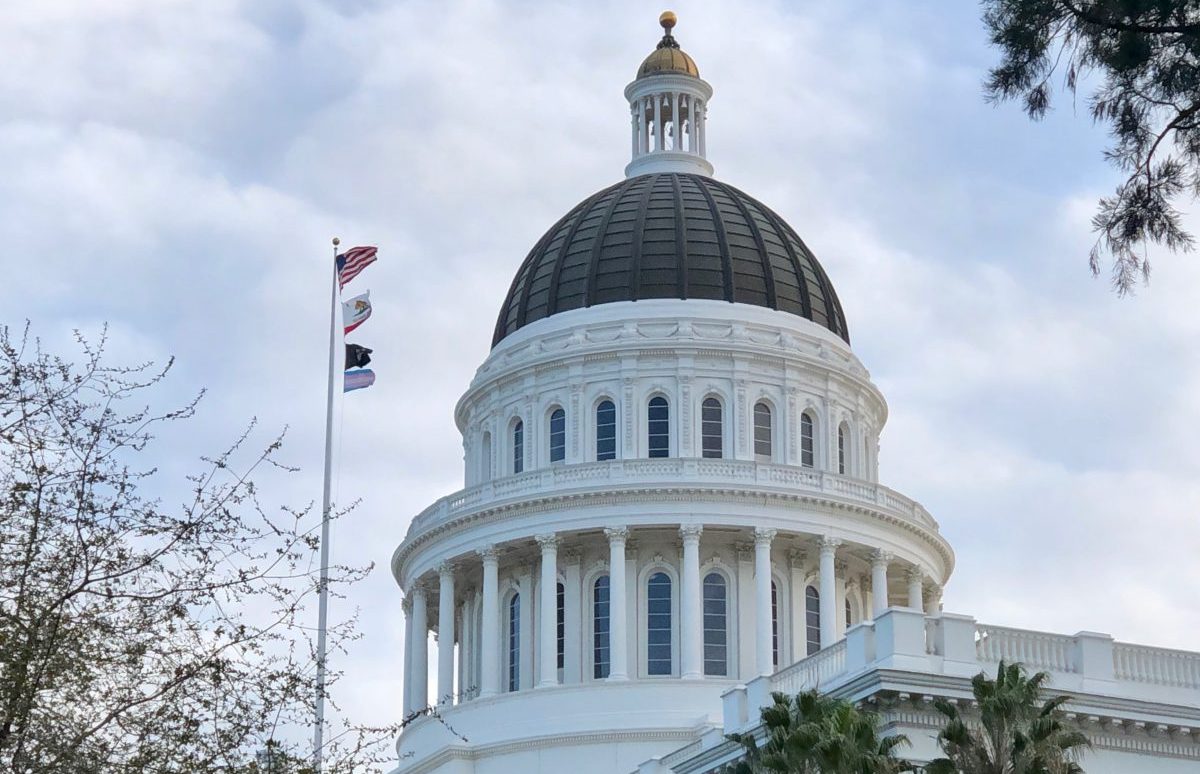
California voters selected its two front runners for the state’s open governor seat following the second election of Gavin Newsom.
Last week former U.S. Secretary of Health and Human Services Xavier Becerra became the Democratic nominee for governor, setting up a general election matchup against Republican nominee Steve Hilton, a former political adviser in the UK and Fox News commentator.
Becerra, the son of Mexican immigrants, has spent nearly three decades in public service. Over the course of his career, he has served as California attorney general, U.S. secretary of Health and Human Services, a member of the U.S. House of Representatives, and a member of the California Assembly.
Hilton comes from a very different background.
Raised by Hungarian parents who fled communism and settled in the UK, Hilton entered politics after graduating from Oxford University. He worked within the Conservative Party — beginning during the era of former Prime Minister Margaret Thatcher and later served as Director of Strategy for Prime Minister David Cameron. After relocating to California in 2012 with his wife, Hilton taught at Stanford University, became a U.S. citizen, and later established himself as a Fox News political commentator.
As the race enters the general election phase, policy questions surrounding healthcare, civil rights, and the future of LGBTQ protections in California are expected to feature prominently in both campaigns. The Washington Blade sat down with former Biden-Harris administration health officials who worked under Becerra’s leadership and also with LGBTQ advocates. Both paint a clear picture of Becerra — a longtime ally whose support for LGBTQ rights and health equity has spanned multiple decades and offices.
“For Equality California, he has been a staunch ally over his decades of service serving California. From his time in Congress to attorney general to HHS secretary, he’s been a partner to the LGBTQ community at large, and specifically to Equality California, advancing LGBTQ equality,” Tony Hoang, executive director of Equality California told the Blade. “As he’s been the front-runner making the top two, we’re excited to get behind him in the race so that he wins the general election in November.”
Hoang argued that California’s next governor will play a critical role in protecting LGBTQ rights amid continued attacks from the Trump-Vance administration.
“It is critical that California remains a bulwark against what’s happening from the Trump administration. That’s why we were so supportive of Secretary Becerra’s campaign for governor,” Hoang said. “He has been there in that fight. When he was attorney general, he sued the Trump administration over 100 times, including a lawsuit where Equality California was an organizational plaintiff around the transgender military ban. Over the remainder of Trump’s term, it’s critical that California continues to fight to stand up for our values, including LGBTQ people in all facets of equality.”
Former HHS official Adrian Shanker, who oversaw LGBTQ health initiatives during the Biden-Harris administration, pointed to Becerra’s emphasis on health equity as one of the defining characteristics of his leadership.
“As Secretary, Xavier Becerra required all of us to include a health equity lens in all policies. No matter what the policy was, he wanted health equity to be centered. Health equity means ensuring that all people can attain their highest levels of health,” Shanker explained. “One of his priorities was clinical trial diversity. He wanted to make sure that new drug modalities and treatments were studied on all kinds of bodies, including populations that had historically been excluded from research.”
Shanker also emphasized that while leading HHS, Becerra consistently relied on scientific expertise rather than political considerations when making policy decisions.
“He really believed that we can’t politicize science. We have to let science drive the policy. He established a very strong scientific integrity policy for the department. That’s important for LGBTQ health, but it’s also important for everyone’s health.”
Shanker expanded on the multiple HIV prevention efforts including making the medication covered by nationwide subsidy programs allowing for americans of all income levels to get this life saving healthcare during Becerra’s tenure at HHS.
“We worked to make PrEP free for anyone on Medicare. The secretary trusted the scientists in the department to determine what was safe and effective and then championed the results,” Shanker said.
For many LGBTQ advocates, California’s role as a refuge state has become increasingly important as Republican-led states enact restrictions affecting transgender people and LGBTQ healthcare access.
Admiral Rachel Levine (ret.), the first openly trans person confirmed by the U.S. Senate and Becerra’s former assistant secretary for health, said California’s next governor will be central to those fights.
“We have an increasingly hostile federal environment against the LGBTQIA community in general, but particularly against the transgender and nonbinary communities. They have targeted the most vulnerable among us, especially trans youth, their families, and their medical providers. California is a refuge, and no one is a stronger supporter of our broader community and our transgender community than Secretary Xavier Becerra,” she told the Blade.
“He articulated his strongest and most enthusiastic support for our community throughout his time at HHS. Health equity was really principle number one for Secretary Becerra, and that includes health equity for our LGBTQIA+ community.”
Levine, who worked directly under Becerra, also praised his leadership style.
“Xavier Becerra really is an outstanding leader. I worked for him and with him when he was secretary and I was assistant secretary for health. He’s so down to earth and unassuming, and he talks a lot about his background, his parents, and his family. He exhibits all the traits you would want in a leader. He is personable, always professional, always compassionate, organized, and knowledgeable.
“I think that he will make an outstanding governor of California. He has local experience in California, where he served as attorney general, and he also has experience in Washington as a member of Congress and as Secretary of Health and Human Services. His background and his character make him an outstanding choice for governor.”
Shanker similarly pointed to Becerra’s engagement with LGBTQ communities and transgender advocates during his time at HHS as one of his strong suits — one that shows he is willing to commit to the right thing even if it is what some in higher powers, disagrees with.
“Secretary Becerra visited LGBT centers. He spoke at our HHS Pride Summit each year. He met directly with transgender health leaders and advocates.”
One meeting in particular stood out to Shanker– where Becerra’s leadership and tenacious dedication to committing to serving the American public.
“He said that his policy is to never do anything mild. He wanted actual policy change that advances the health and well-being of all Americans. He wasn’t looking for small, little tweaks. He wanted structural improvements.”
Shanker went on explaining that Becerra’s approach to all things — but especially very trivialized trans healthcare thoughts remained rooted in scientific evidence.
“He wasn’t reading the tea leaves to determine what policy we should enact. He was trusting the science and wanted to do the right thing for the people affected by our decisions,” Shanker said.
Hoang said that commitment to the evidence — and what LGBTQ advocates have point blanked asked from him has continued throughout Becerra’s gubernatorial campaign.
“I will say that he has done everything that we’ve asked of him and continues to speak proudly in support of the trans community. Full stop. We were lucky enough to work with him during his time as attorney general, but also as HHS secretary, ensuring that decisions are based upon science versus the rhetoric coming from MAGA extremists.”
As a recent example, Hoang pointed to Becerra’s support for trans student-athlete AB Hernandez.
“Just last week, he put out a statement that was read at the track meet for AB Hernandez, the trans athlete who was competing in the track and field championships.”
He added: “He has been a staunch ally, a proven staunch ally, of the LGBTQ community and specifically trans people.”
Levine said the importance of the California governor’s race extends far beyond state borders.
“I think it’s very important because states like California, New York, Massachusetts, Oregon, Washington, and others are ground zero for these battles. They serve as places of refuge, particularly for trans youth and nonbinary youth who may have to leave their states because of these attacks and hateful laws,” she said. “The governors of those states, including the governor of California, could not be more important. We could have no better defender than Xavier Becerra.”
For Hoang, the stakes of this election are difficult to overstate.
“I think because we see that the stakes are high. It’s trite to say, but this is truly one of the elections of our lifetimes, where you are seeing access to essential health care being denied to trans youth, having billions of federal dollars being up for grabs, and ensuring life-saving programs. Ensuring that LGBTQ Californians understand what’s at stake in this governor’s race is really critical, and we’re going to do all that we can to ensure that Xavier is our next governor.”
Hoang said many LGBTQ Californians are feeling anxious about the current political climate.
“It’s all over the place. I think in this time where it is a relentless onslaught of attacks from the federal government, folks feel disillusioned and feel scared.
“That is why it’s imperative that we ensure that LGBTQ people and our allies understand that even though there’s so much misinformation out there, it’s critical that folks turn out to vote — not just for the governor’s race — but ensuring that we take back Congress into pro-equality hands, and that they have strong champions in state legislatures all the way down to school boards.”
Looking ahead, both advocates pointed to healthcare access as a major challenge facing LGBTQ Californians.
“One area that we’re working on now, and that we know will continue, is backfilling dollars from the state government to the extent that the federal government continues to strike funding from things like HIV prevention programs, funding for trans health care, among others,” Hoang said.
“Ensuring that California does not let our communities get thrown under the bus is critical. Particularly when you have some folks in the broader Democratic Party who think that our rights are expendable, ensuring that the governor continues to step up and work with the state legislature to advance pro-equality legislation and budget priorities.”
Levine specifically pointed to the closure of some gender-affirming care programs in California.
“Even though California has tried to protect access to gender-affirming care for youth, a number of academic medical centers have closed their programs. It would be great for a governor to work with those programs, universities, deans, and presidents to see if they can reopen them.
Levine clarified that although there is currently no legislation in California restricting gender-affirming care, there is always a chance with the strike of the president’s pen or a conservative legislator to bring that to California.
“There is no law or regulation currently forcing those programs to close. There are threats—threats from executive orders, threats involving Medicaid—but those matters are still being fought through the courts.”
She concluded:
“Secretary Becerra is a fighter for health equity. He’s a fighter for disadvantaged communities, and I’m sure that he will take this on.”
Asked why LGBTQ voters should trust Becerra, both Shanker and Hoang pointed to his record.
“Actions speak louder than words. He has a record of action in terms of advancing the health and well-being, and in prior roles, the legal rights, of LGBTQI people,” Shanker said.
“It’s easy to say what you think you need to say to win political office. It’s harder to point to a record of results, which is what he can do because of his years in Congress, his years as attorney general, and his four years as secretary of Health and Human Services.”
Hoang offered a similar assessment.
“Especially in this moment, where there are a lot of platitudes out there, we have a candidate who has shown proven leadership in support of our community when it wasn’t popular. Looking back to his days in Congress, when he was one of 67 members of Congress who voted against the Defense of Marriage Act, and when he stood up to the Trump administration as attorney general by suing over LGBTQ rights, he has shown time and time again that he will reach out to the most vulnerable and use his platform to serve.”
Levine, meanwhile, declined to weigh in on political strategy but reiterated her confidence in Becerra’s support for LGBTQ Americans.
“I’m not a politician. I’ve always been a physician and public health professional. Even though I was in a politically appointed position, my job was health equity and the protection of public health. It’s hard for me to comment on the politics of it. But all I can tell you is that there’s no bigger supporter of our community than Xavier Becerra.”
The Blade reached out to both the Becerra and Hilton campaigns seeking comment on their LGBTQ policy platforms, including how they would address trans rights in California as the federal government has taken an increasingly adversarial approach toward transgender Americans. Neither campaign responded to requests for comment by press time.
National
UFC fighter says ‘Michelle Obama is a man’ at White House event
Josh Hokit attacks former first lady in comment to Joe Rogan
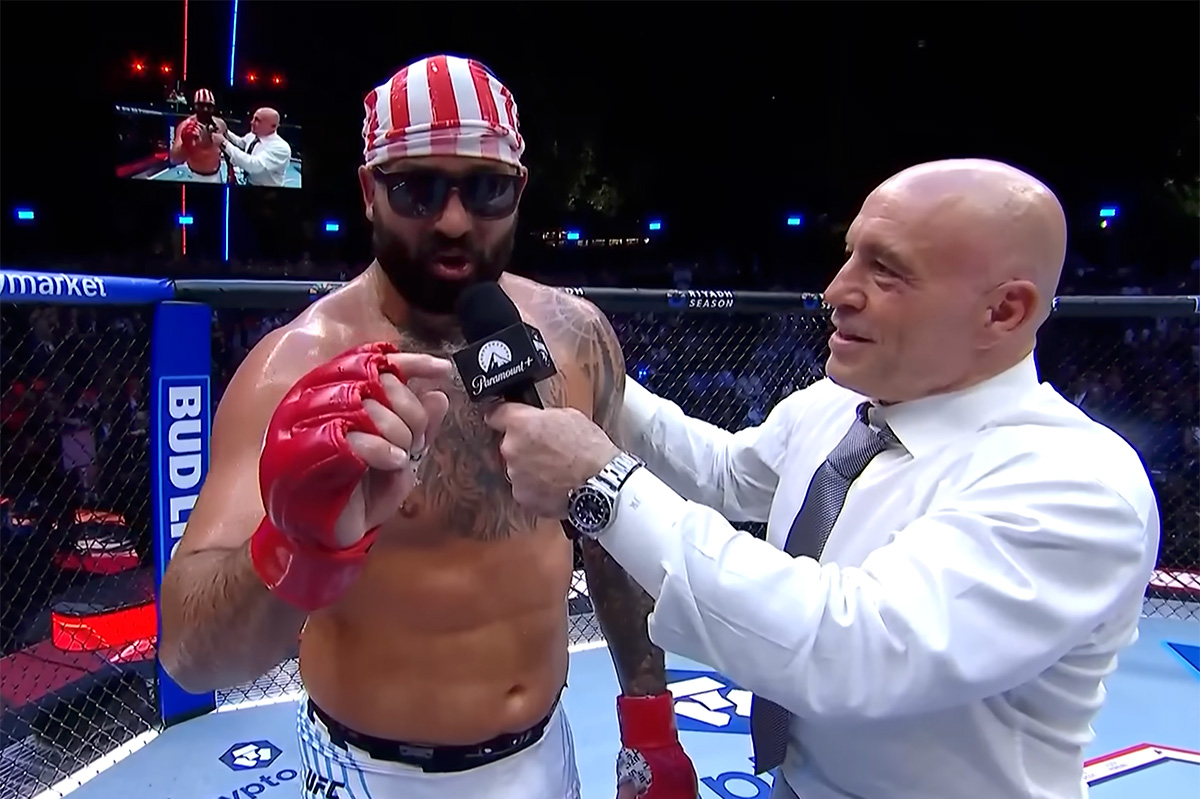
UFC fighter Josh Hokit, in a crude post-match stunt, told podcaster Joe Rogan that, “Michelle Obama is a man. Am I right America?”
The incident occurred as part of President Trump’s UFC Freedom 250 event held on the White House lawn on Sunday night. Hokit won his fight then gave an interview to Rogan on stage when he made the remark.
Trump has not addressed the incident but has a history of attacking the Obamas using racist imagery.
White House spokesperson Steven Cheung responded to questions by saying, “He had a great win last night. He showed toughness and the ability to pressure his opponent both on his feet and on the ground.”
BET’s report on the incident noted, “The ‘Michelle Obama is a man’ claim is not new. It is a transphobic and racist conspiracy theory that has been used against the former First Lady since 2007, weaponizing both transphobia and the misgendering of Black women, who are often targets of similar attacks.”

Confronting homophobia at school

57 towns in 57 hours: Rep. McBride kicks off re-election campaign

D.C. nude dance club Archibald’s to feature male strippers beginning Pride weekend

LGBTQ seniors honored at D.C. Silver Pride event

South Korea marriage equality movement gaining momentum

Gender-bending buddy film gets 4K restoration for 25th anniversary

Baltimore Pride is here

D.C. Council approves expanded grant funding for Mayor’s Office of LGBTQ Affairs

Congressional Cemetery hosts Gays & Graves

PHOTOS: The Audacity Brunch
-

 Movies5 days ago
Gender-bending buddy film gets 4K restoration for 25th anniversary
-
Out & About5 days ago
Baltimore Pride is here
-
District of Columbia4 days ago
D.C. Council approves expanded grant funding for Mayor’s Office of LGBTQ Affairs
-
Out & About5 days ago
Congressional Cemetery hosts Gays & Graves