Local
Police chief joins rally, walk against anti-LGBT violence
Residents of Bloomingdale, Eckington denounce attack on gay couple
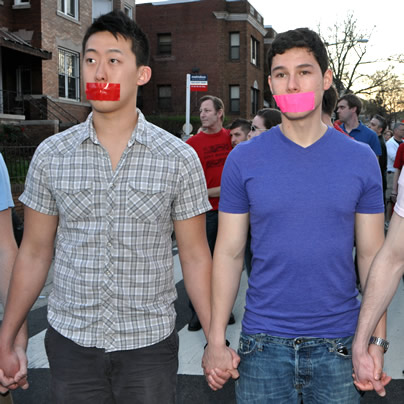
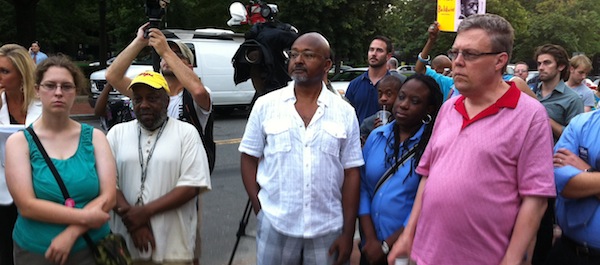
Attendees of the Eckington ‘safety walk’ march listen as speakers call for an end to anti-gay violence. (Washington Blade photo by Lou Chibbaro, Jr.)
D.C. Police Chief Cathy Lanier, a contingent of police officials, two members of the City Council, and civic activists from the city’s Bloomingdale and Eckington neighborhoods participated in a rally and walk Thursday night against anti-LGBT violence.
Chanting “From Ward 1 to Ward 8, stop the violence, stop the hate,” about 100 people gathered outside the Big Bear restaurant in Bloomingdale at First and R Street, N.W., where organizers staged a rally.
A smaller contingent of about 60 people then walked several blocks to Third Street and Lincoln Road, N.E., in Eckington near where a gay male couple was attacked and beaten on July 22.
“We are here in response and defense against what happened on the 22nd and the prevailing rise of violence in the District of Columbia in general,” said gay activist Nick McCoy, the lead organizer of the event.
“We’re here today to showcase the broad support of our community that represents black, white, LGBT, artistic, business, and heterosexual,” McCoy said. “Tonight, instead of silence, we’re raising our voices together.”
Police said yoga instructor Michael Hall, 29, and his partner Michael Roike, 28, were attacked by three unidentified youths who shouted anti-gay names before punching and kicking the two men. Hall suffered a fractured jaw and broken face bone and underwent surgery at Howard University Hospital as a result of his injuries.
No arrests have been made in the incident. Lanier said an active investigation continues and police are appealing to the community for witnesses to help identify the attackers.
Hall and Roike didn’t attend the rally and walk. McCoy said the two were invited but declined, saying they were not ready to participate in such an event.
A.J. Singletary, chair of Gays and Lesbians Opposing Violence (GLOV) told the rally that D.C. has the highest rate of anti-LGBT violence in the nation and that between 2005 and 2011 anti-gay crime increased 86 percent.
He said police statics show 21 hate crimes based on the victim’s sexual orientation have been reported so far this year, compared to 15 reported as of August 2011.
“This is absolutely unacceptable,” Singletary said. “The only way we can change this is to work together as one community.”
Lanier joined the walk at the site near where the attack against the gay couple took place. She praised organizers and participants for rallying the community against crime.
“I wish we could do this more often because it sends a message that communities were formed for the protection of the community,” she said. “Sometimes we forget that. So I think that when anybody in the neighborhood is victimized we should stand up and come together and say, no, this is not tolerable. This is not going to happen in our community.”
Others who spoke at the rally or during the walk were Commander Andy Soleberg of the Fifth Police District, which has jurisdiction over Bloomingdale and Eckington; and D.C. Council members Kenyan McDuffie (D-Ward 5) and Vincent Orange (D-At-Large).
Other speakers included Jeffrey Richardson, director of the Mayor’s Office of GLBT Affairs; and Lateefah Williams, president of the Gertrude Stein Democratic Club, the city’s largest LGBT political group.
Captain Edward Delgado, director of the police Special Liaison Division, which oversees the Gay and Lesbian Liaison Unit; Sgt. Carlos Mejia, supervisor of the GLLU; and several GLLU members participated in the walk and rally.
McCoy said he was especially pleased that Bloomingdale and Eckington residents, LGBT and straight, turned out for the event and expressed strong support for the neighborhoods’ LGBT residents.
E. Gail Anderson Holness, a Bloomingdale civic activist and minister, led the crowd in the chant, “Fired up, we won’t take no more.”
“When injustice happens to one of us, injustice happens to all of us,” she said. “Let’s walk together and stand together and tell this community and all communities in Washington D.C. that we’re all standing together – lesbian and gay, bisexual, tri-sexual, any sexual, no sexual. We’re all standing together and we’re not going to tolerate crime of any sort in our community.”


District of Columbia
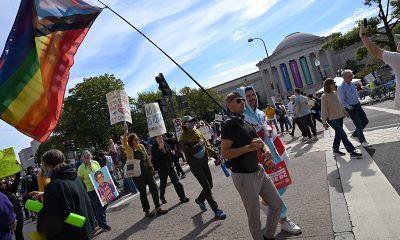
‘No Kings’ protests set for D.C.
Anti-Trump demonstrations to take place across country on Saturday

As President Donald Trump and his administration escalate rhetoric targeting transgender youth and student athletes, push efforts to restrict voting access for millions of Americans, and pursue foreign policy decisions that critics say bypass congressional authority, organizers across the country are once again mobilizing in protest.
For many LGBTQ advocates, the moment feels especially urgent.
In recent months, activists have pointed to a surge in anti-trans legislation, attacks on gender-affirming care, and efforts to roll back nondiscrimination protections as direct threats to the safety and visibility of queer and trans communities. Organizers say the demonstrations are not just about policy, but about defending the right of LGBTQ people — particularly trans youth and people of color — to live openly and safely.
Thousands of “No Kings” protests are planned nationwide, with multiple demonstrations set to take place in D.C.
One of the primary events, “No Kings Washington,” will be held in Anacostia, an overwhelmingly Black area of D.C. that is often at the center of conversations around racial justice, policing, and access to resources in the nation’s capital.
The protest in Anacostia is focused on what organizers describe as the “power behind the throne,” specifically Stephen Miller, the White House Deputy Chief of Staff for Policy and Homeland Security Advisor. Miller has been closely associated with the administration’s “zero tolerance” immigration policy, including the family separation practice that resulted in thousands of children being separated from their parents at the Southern border.
Activists have also linked immigration enforcement policies to broader concerns about LGBTQ migrants, including queer asylum seekers who often face heightened risks of violence and discrimination both in their home countries and within detention systems.
Anacostia protest details:
Participants are asked to gather starting at 1:30 p.m. on the southeast side of the Frederick Douglass Bridge. The closest Metro station is Anacostia on the Green Line, about an 8-minute walk from the starting point. Organizers strongly encourage attendees to use public transportation, as street parking is limited.
The march will proceed past Fort McNair and conclude near the Waterfront Metro station.
D.C. icon and LGBTQ activist Rayceen Pendarvis is set to speak at the protest around 2 p.m.
Kalorama protest details:
A separate protest will take place earlier in the day in Kalorama, a neighborhood long associated with political power and home to presidents, cabinet officials, and foreign ambassadors. Demonstrators are expected to gather at 10 a.m., with a march running until approximately noon near the intersection of Connecticut Avenue and Kalorama Road.
Arlington/National Mall protest details:
Another group is expected to assemble at Memorial Circle near Arlington National Cemetery at 10 a.m. before crossing the Memorial Bridge into D.C., passing the Lincoln Memorial and continuing on to the Washington Monument. Organizers say the march is intended to defend “American democracy, the rule of law, and a healthy planet.”
Unlike last June — when organizers discouraged large-scale demonstrations in D.C. due Trump’s military/birthday parade — activists are now explicitly calling on people to show up in the nation’s capital and surrounding areas.
The protests also coincide with Transgender Day of Visibility weekend, which includes additional gatherings and celebrations on the National Mall. At the same time, peak bloom for the National Cherry Blossom Festival is expected to draw large crowds to the city. With multiple major events happening simultaneously, officials and organizers anticipate significant congestion, increased traffic, and crowded public transit throughout the weekend.
Organizers are urging participants to plan ahead and come prepared.
“Bring your signs, noisemakers, music, and creative ideas, and gather in joyful, nonviolent protest,” they said. “Children are very welcome.”
For more information, visit nokings.org.
District of Columbia
Gay priest credited with boosting church support for LGBTQ Catholics
Fr. Tom Oddo’s biographer speaks at Dignity Washington event
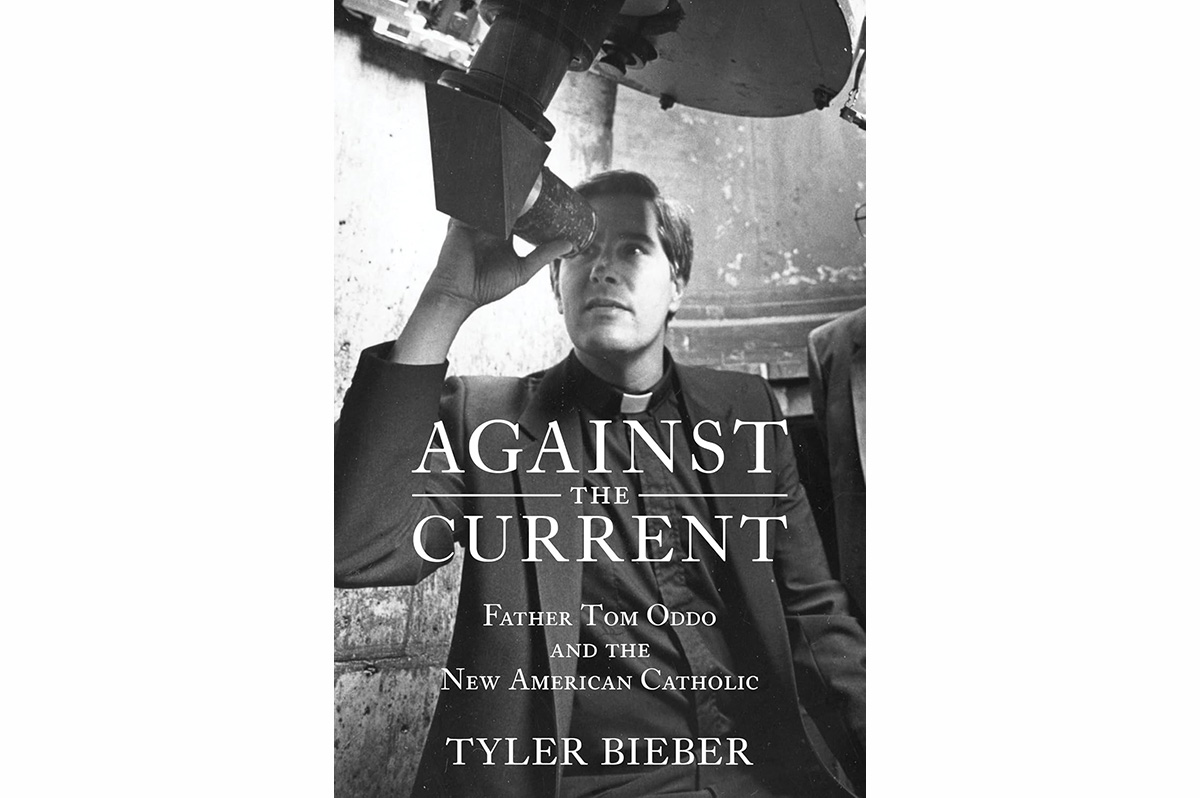
The author of a biography of a U.S. Catholic priest said to have advocated for support by the Catholic Church of gay Catholics in the early 1970s has called Father Thomas ‘Tom’ Oddo a little known but important figure in the LGBTQ rights movement.
Tyler Bieber, author of the recently published book “Against The Current: Father Tom Oddo And the New American Catholic,” told of Oddo’s life and work on behalf of LGBTQ rights at a March 22 talk before the local LGBTQ Catholic group Dignity Washington.
Among Oddo’s important accomplishments, Bieber said, was his role as a co-founder of the national LGBTQ Catholic group Dignity U.S.A. in 1973 at the age of 29.
But as reported in the prologue of his book, Bieber presented details of the sad news that Oddo died in a fatal car crash in 1989 at the age of 45 in Portland, Ore., where he was serving as the highly acclaimed president of the University of Portland, a Catholic institution.
“He was a major figure in the gay rights movement in the 1970s, an unsung hero of that movement,” Bieber told Dignity Washington members, who assembled for his talk in a meeting room at St. Margaret Episcopal Church near Dupont Circle, where they attend their weekly Catholic mass on Sundays.
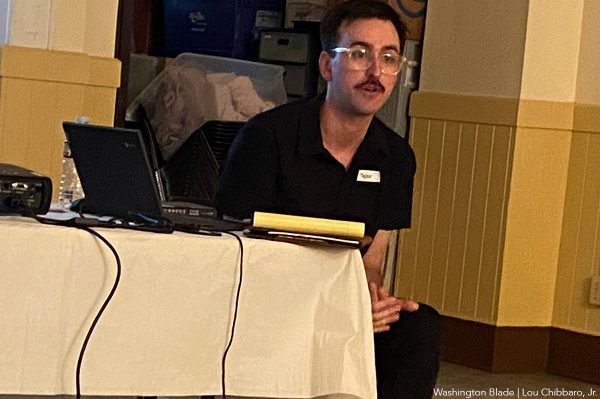
“And Dignity U.S.A. saw intense growth in membership and visibility” during its early years under Oddo’s leadership, Bieber said. “The story of Father Tom and his contemporaries is a story largely untold in the history of the gay rights movement, but one worth knowing and considering,” he said.
As stated in his book, Bieber told the Dignity Washington gathering Oddo was born and raised in a Catholic family on Long Island, N.Y., and attended a Catholic high school in Flushing Queens. It was at that time when he developed an interest in becoming a priest, according to Bieber.
After studying at the University of Notre Dame and completing his religious studies he was ordained as a priest in 1970 and began his work as a priest in the Boston area, Bieber said. It was around that time, Bieber told the Dignity Washington audience, that gay Catholics approached Oddo to seek advice on how they should interact with the Catholic Church. It was also around that time that Oddo became involved in a group supportive of then gay Catholics that later became a Dignity chapter in Boston.
In a development considered unusual for a Catholic priest, Bieber said Oddo in 1973 testified in support of gay rights bill before a committee of the Massachusetts Legislature and collaborated with then Massachusetts gay and lesbian rights advocate Elaine Noble.
In 1982, at the age of 39, Oddo was selected as president of the University of Portland following several years as a college teacher in the Boston area, Bieber’s book states. It says he was seen as a “vibrant and capable administrator who delivered real results to his campus,” adding, “His magnetism was obvious. One student described him as ‘John Kennedyesque’ to the university’s student newspaper.”
Bieber said that although Oddo was less active with Dignity U.S.A. during his tenure as UP president, he continued his support for gay Catholics and what is now referred to as LGBTQ rights.
“For those that knew him prior to his term at UP, though, he represented something greater than an accomplished university administrator and educator,” Bieber’s book states. “He was a new kind of priest, a gay man living and ministering in a world set loose from tradition by the Second Vatican Council,” the book says.
It was referring to the Vatican gathering of worldwide Catholic leaders from 1962 to 1965 concluding under Pope Paul VI that church observers say modernized church practices to allow far greater participation by the laity and opened the way for sympathetic consideration of gay Catholics.
District of Columbia
HRC to host National Rainbow Seder
Bet Mishpachah among annual event’s organizers
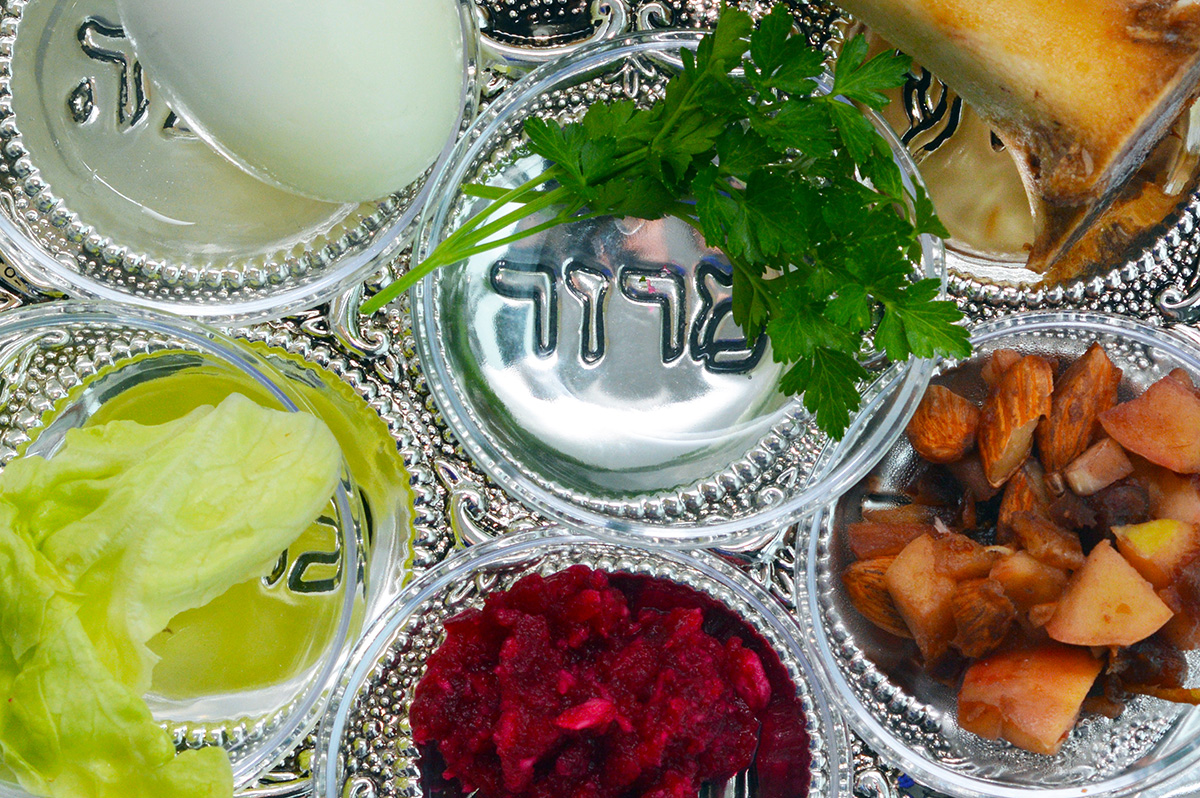
The 18th National Rainbow Seder will take place at the Human Rights Campaign on Sunday.
The sold out event is the country’s largest Passover Seder for the Jewish LGBTQ community.
Organizations behind the event include Bet Mishpachah, a local D.C. LGBTQ synagogue that Rabbi Jake Singer-Beilin leads, and GLOE, an Edlavitch DC Jewish Community Center program that sponsors events for the queer Jewish community. The theme for this year’s Seder is “Liberation For All Who Journey: Remembering, Resisting, Rebuilding.” Rabbis Atara Cohen, Koach Frazier, and Avigayil Halpern will lead it.
The Seder will honor the late GLOE co-chair Michael Singer. Singer also served on the Edlavitch DC Jewish Community Center’s board.
“This Seder is both a celebration of how far we have come and a call to continue building a more just and inclusive world.” Bet Mishpachah Executive Director Joshua Maxey told the Washington Blade.

Lorato ke Lorato: marriage equality, democracy, and the unfinished work of justice in Botswana

‘No Kings’ protests set for D.C.

Border to border: modern slavery and human trafficking in refugee movements across East Africa

New IOC policy bans trans women from Olympics

Introducing the Torchbearers Awards honoring queer, trans women and nonbinary people

PHOTOS: Capital Stonewall Democrats 50th anniversary

‘Inherit the Wind’ isn’t about science vs. religion, but the right to think

Small is beautiful: subcompact SUVs

Polish court rules country must recognize same-sex marriages from EU states

Capital Stonewall Democrats 50th anniversary gala draws sold out crowd
-

 Photos4 days ago
PHOTOS: Capital Stonewall Democrats 50th anniversary
-
Theater5 days ago
‘Inherit the Wind’ isn’t about science vs. religion, but the right to think
-
Autos5 days ago
Small is beautiful: subcompact SUVs
-
Poland4 days ago
Polish court rules country must recognize same-sex marriages from EU states