Local
Roommate charged in murder of D.C. man
Sources say victim was gay; judge released suspect from jail three weeks before killing
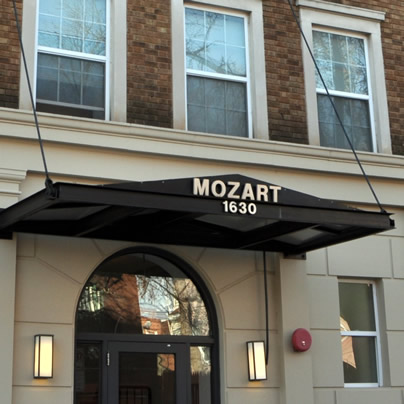
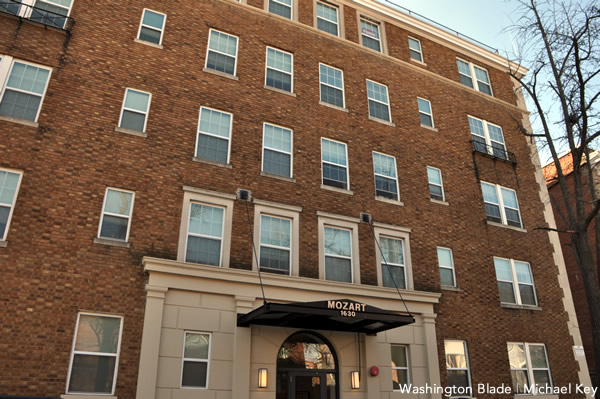
1630 Fuller St., N.W. (Washington Blade photo by Michael Key)
A 21-year-old D.C. man charged with stabbing his 68-year-old roommate to death on Feb. 2 was released from jail three weeks before the murder when a D.C. Superior Court judge dismissed an unrelated assault and robbery charge pending against him.
D.C. police on Feb. 3 charged David Jamal Wilson with first-degree felony murder while armed for the alleged fatal stabbing of Howard Venable, Jr., inside Venable’s apartment at 1630 Fuller St., N.W.
Court records show the U.S. Attorney’s office, which is prosecuting the case, lowered the charge to second-degree murder while armed when prosecutors filed charging papers in D.C. Superior Court.
Two sources familiar with the case told the Washington Blade that Venable had been having an affair with Wilson and was providing financial support for him during the time Wilson was living with him.
Court charging documents list Wilson’s address as 1400 Fairmont St., N.W., where he had been living in the past with his mother, sources said. WhitePages.com, an online phone and address directory, lists a David Wilson and Sertira Wilson as residing in the same apartment at 1400 Fairmont St., N.W., sometime in the recent past.
D.C. police spokesperson Gwendolyn Crump confirmed that Wilson had been living with Venable at the time of the murder and that homicide detectives were investigating the nature of the relationship between the two men.
Court records show that Wilson and two other men were charged with armed robbery on Aug. 22, 2012 for allegedly stealing a bicycle from another man at knifepoint in Meridian Hill Park. Court records show that Wilson was initially held in jail following his arrest and later released through a court supervised release program while awaiting trial.
According to court records, prosecutors lowered the charge against Wilson from robbery while armed, which is classified as a felony, to second-degree theft and simple assault, which are misdemeanor offenses.
The court records show Wilson was returned to jail after prosecutors told the judge he violated the terms of his release.
But the case unraveled a short time later, court records show, when Superior Court Judge Marisa J. Demeo dismissed the case and ordered Wilson released from jail on Jan. 10, 2013, on grounds of “want of prosecution.”
William Miller, a spokesperson for the U.S. Attorney’s office, told the Blade on Tuesday that Demeo dismissed the case on the day the trial was scheduled to begin when the victim, who was to be the lead witness, failed to show up in court for the trial.
“The case was dismissed without prejudice, which would allow us to bring the case up again,” Miller said. He said prosecutors have been unable to locate the victim.
Miller declined to comment on Wilson’s latest arrest for the murder of Venable, saying the U.S. Attorney’s office never comments on pending criminal cases.
Details of the murder allegations against Wilson were filed in court on Feb. 4 as part of an arrest affidavit. The document says police found Venable lying face down in a pool of blood on the floor of his apartment under the bedroom doorway at 6:48 p.m.
Personnel from the D.C. Fire and Emergency Medical Service Department determined there were no signs of life when they arrived on the scene, the affidavit says. An autopsy later found that Venable suffered “multiple slashing wounds to the neck, minor cuts to both hands consistent with defensive wounds, and two stab wounds to the upper torso.”
One of the stab wounds to the torso struck his aorta, leading the D.C. Medical Examiner’s office to conclude the cause of death was “sharp force wounds to the neck and torso.”
The affidavit says two witnesses who knew Venable told a homicide detective a male roommate was living with Venable. One of the witnesses identified the roommate as Wilson, the affidavit says.
It says the apartment was locked and there were no signs of a forced entry or a struggle when someone from the building initially entered the apartment and found Venable lying on the floor unconscious.
A short time later, detectives discovered that money was withdrawn from Venable’s checking account shortly after the murder through an ATM in a convenience store at a BP gas station in District Heights, Md., the affidavit says. It says detectives viewed a surveillance video from the gas station and store and saw Wilson enter and place at least two different cards into the ATM in several separate transactions. The video shows him placing cash obtained from the ATM into his pockets, the affidavit says.
Without saying how police learned where to find Wilson, the affidavit says detectives on Feb. 3 arrived at a residence at 1841 Addison Road in District Heights, Md., where Wilson was staying. It says Wilson agreed to go with detectives to the D.C. police homicide office in Southwest D.C., where he was questioned about Venable’s murder.
“During the course of the interview, the defendant provided numerous inconsistent accounts of his involvement in the decedent’s murder,” the affidavit says. It says Wilson initially said he had not been in Venable’s apartment since Jan. 10 but later said he entered the apartment on Jan. 31 before leaving for work and returned later and found Venable’s body lying in the doorway to the victim’s bedroom.
He denied taking Venable’s bank cards and later claimed someone else he knows told him that person planned to rob Venable. The other person, whom Wilson identified as “Stacks,” invited him to meet him in Maryland and gave him Venable’s bankcards and persuaded him to use them to withdraw money from the ATM at the gas station convenience store, the affidavit says.
“The defendant, who was 47 years younger than the decedent, finally said he was involved in an argument with the decedent inside the apartment and that the decedent went to the kitchen and retrieved a knife,” says the affidavit. “The defendant said he and the decedent wrestled for control of the knife and the decedent fell to the floor stabbing himself,” it says.
“The defendant was then placed under arrest,” it says.
Wilson, who is being held without bond, is scheduled for a preliminary hearing on Feb. 20.



District of Columbia
Mayor Bowser signs bill requiring insurers to cover PrEP
‘This is a win in the fight against HIV/AIDS’

D.C. Mayor Muriel Bowser on March 20 signed a bill approved by the D.C. Council that requires health insurance companies to cover the costs of HIV prevention or PrEP drugs for D.C. residents at risk for HIV infection.
Like all legislation approved by the Council and signed by the mayor, the bill, called the PrEP D.C. Amendment Act, was sent to Capitol Hill for a required 30-day congressional review period before it takes effect as D.C. law.
Gay D.C. Council member Zachary Parker (D-Ward 5) last year introduced the bill.
Insurance coverage for PrEP drugs has been provided through coverage standards included in the Affordable Care Act, known as Obamacare. But AIDS advocacy organizations have called on states and D.C. to pass their own legislation requiring insurance coverage of PrEP as a safeguard in case federal policies are weakened or removed by the Trump administration, which has already reduced federal funding for HIV/AIDS-related programs.
Like legislation passed by other states, the PrEP D.C. Amendment Act requires insurers to cover all PrEP drugs approved by the U.S. Food and Drug Administration.
Studies have shown that PrEP drugs, which can be taken as pills or by injection just twice a year, are highly effective in preventing HIV infection.
“I think this is a win for our community,” Parker said after the D.C. Council voted unanimously to approve the bill on its first vote on the measure in February. “And this is a win in the fight against HIV/AIDS.”
District of Columbia
Blade editor to be inducted into D.C. Society of Professional Journalists Hall of Fame
Kevin Naff marks 24 years with publication this year

Longtime Washington Blade Editor Kevin Naff will be inducted into D.C.’s Society of Professional Journalists Hall of Fame in June, the group announced this week.
Hall of Fame honorees are chosen by the Society of Professional Journalists’ Washington, D.C., Pro Chapter. Naff and two other inductees — Seth Borenstein, a Washington-based national science writer for the AP and Cheryl W. Thompson, an award-winning correspondent for National Public Radio — will be celebrated at the chapter’s Dateline Awards dinner on Tuesday, June 9, at the National Press Club. The dinner’s emcee will be Kojo Nnamdi, host of WAMU radio’s weekly “Politics Hour.”
“I am tremendously honored by this recognition,” Naff said. “I have spent a lifetime in the D.C. area learning from so many talented journalists and am humbled to be considered in their company. Thank you to SPJ and to all the LGBTQ pioneers who came before me who made this possible.”
Naff joined the Blade in 2002 after years in print and digital journalism. He worked as a financial reporter for Reuters in New York before moving to Baltimore in 1996 to launch the Baltimore Sun’s website. He spent four years at the Sun before leaving for an internet startup and later joining the mobile data group at Verizon Wireless working on the first generation of mobile apps.
He then moved to the Blade and has served as the publication’s longest-tenured editor. In 2023, Naff published his first book, “How We Won the War for LGBTQ Equality — And How Our Enemies Could Take It All Away.”
Previous Hall of Fame inductees include luminaries in journalism like Wolf Blitzer, Benjamin Bradlee, Bob Woodward, Andrea Mitchell, and Edgar Allen Poe. The Blade’s senior news reporter Lou Chibbaro Jr. was inducted in 2015.
Maryland
Supreme Court ruling against conversion therapy bans could affect Md. law
Then-Gov. Larry Hogan signed statute in 2018
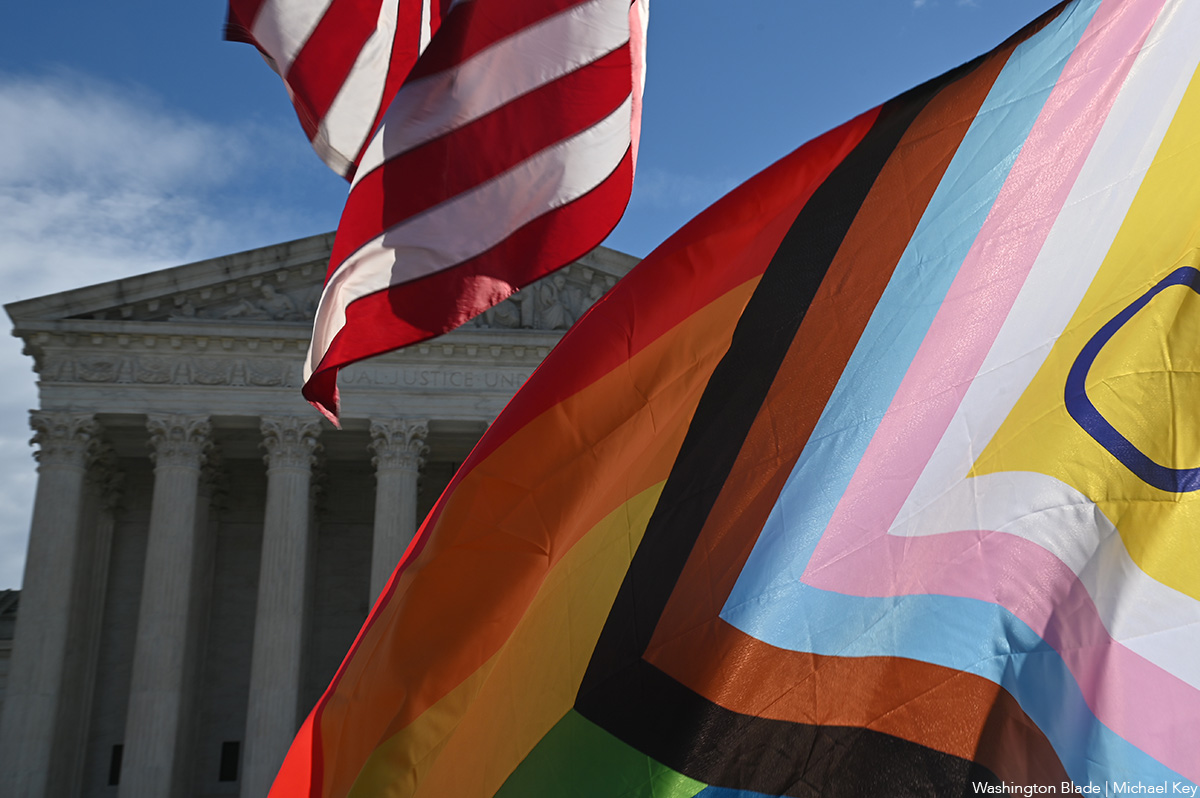
By PAMELA WOOD, JOHN-JOHN WILLIAMS IV, and MADELEINE O’NEILL | The U.S. Supreme Court on Tuesday ruled against a law banning “conversion therapy” for LGBTQ kids in Colorado, a ruling that also could apply to Maryland’s ban on the discredited practice.
An 8-1 high court majority sided with a Christian counselor who argues the law banning talk therapy violates the First Amendment. The justices agreed that the law raises free speech concerns and sent it back to a lower court to decide whether it meets a legal standard that few laws pass.
Justice Neil Gorsuch, writing for the court’s majority, said the law “censors speech based on viewpoint.” The First Amendment, he wrote, “stands as a shield against any effort to enforce orthodoxy in thought or speech in this country.”
The rest of this article can be read on the Baltimore Banner’s website.

Mayor Bowser signs bill requiring insurers to cover PrEP

JD Vance to travel to Hungary next week

Pam Bondi ousted as attorney general

VIDEO: Gay journalist detained for booing Trumps at ‘Chicago’ opening night

Idaho Gov. signs harshest anti-trans bathroom bill in the country

‘Out for McDuffie’ event held at D.C. gay bar

‘Jonah’ an undeniably compelling but unusual memory play

The Oscar-losing performance that’s too good to miss

Thousands attend ‘No Kings’ protests in D.C.