National
Rash of alleged anti-LGBT attacks spark outrage in Chile
Esteban Parada Armijo died in a Santiago hospital on Jan. 30
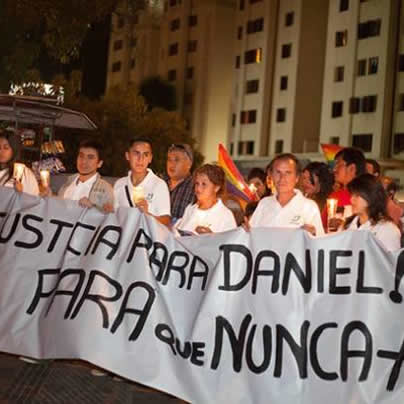
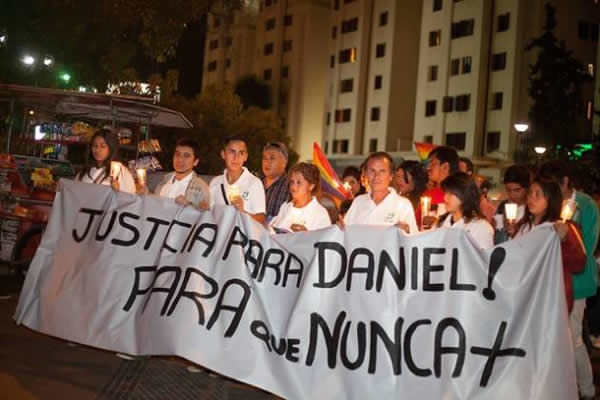
Chilean LGBT rights advocates maintain hate crimes remain a serious problem in the country nearly two years after Daniel Zamudio’s death. (Photos courtesy of Fundación Daniel Zamudio.)
Esteban Parada Armijo, 22, died in a hospital in Santiago, the Chilean capital, on Jan. 30, nearly two weeks after two men stabbed him in the city’s Bellavista neighborhood where a number of gay bars and clubs are located. The Movement for Homosexual Integration and Liberation (Movilh), a Chilean LGBT advocacy group, said Parada suffered a punctured right lung and broken ribs that damaged arteries and blood vessels during the Jan. 17 attack that took place after he left the bar where he worked.
Authorities have detained one of Parada’s alleged assailants whom Movilh identified as Fernando Medina Medina.
Movilh said Parada told his relatives before his death that his alleged assailants attacked him because he was gay. The LGBT advocacy group noted he was able to identify those whom he said assaulted him.
“My brother did not rob anyone,” said Parada’s sister, Camila Armijo, in a Movilh press release. “They only attacked him.”
Chilean media reports indicate hundreds of people attended Parada’s funeral in Santiago on Sunday.
“Todo Mejora Foundation laments the death of yet another young Chilean, Esteban Parada, in the hands of hatred and violence,” Juan Pablo Fuentealba of the Chilean It Gets Better Foundation (Fundación Todo Mejora in Spanish) told the Washington Blade on Saturday while in New York with a group of seven Latin American LGBT rights advocates who are currently in the U.S. on a State Department-sponsored trip. “Our condolences go to his family and loved ones.”
Parada died less than a month after Guillermo Aguilera Guerrero, 18, allegedly stabbed Alejandro Alfredo Bustamante Godoy in the head, throat and leg during an attack inside his home in the coastal city of Valparaíso. Movilh and Bustamante’s relatives said Aguilera had previously taunted the fast food restaurant owner because of his sexual orientation.
Bustamante, 59, succumbed to his injuries on Jan. 15.
Willian Villanueva, a small-time drug dealer, reportedly said he was going to “kill a faggot” before he allegedly shot Arturo Lomboi to death in the Santiago suburb of Puente Alto in December.
Doctors last June amputated Esteban Navarro Quinchevil’s leg after a group of six men attacked him in the Santiago suburb of Peñalolén because he is gay. A transgender teenager from the coastal city of Cartagena the month before lost an eye during an alleged anti-trans attack.
President Sebastián Piñera in 2012 signed into law a hate crimes and anti-discrimination bill that includes both sexual orientation and gender identity and expression. The statute is named in honor of Daniel Zamudio Vera, a 24-year-old whom a group of self-described neo-Nazis beat to death in a Santiago park earlier that year because he was gay.
The convicted mastermind of the attack against Zamudio last October received a life sentence for his role in the crime.
“Attacks against lesbian, gay, bisexual and transsexuals have not stopped,” said Movilh President Rolando Jiménez during the Jan. 20 dedication of a Santiago memorial to honor Zamudio, referring to Bustamante and Lomboi. “They continue with cruel violence.”
Jiménez reiterated his calls for the Chilean government to do more to prevent these attacks – including advancing “more and better conditions of equality in a country where everything indicates that abuses against sexual minorities are on the one hand less, but at the same time more bloody and violent.”
The Chilean Senate last month advanced two bills that would allow same-sex couples to enter into civil unions and permit trans people to legally change their name and sex without sex-reassignment surgery, hormonal treatments and psychiatric or psychological evaluations.
Fuentealba pointed out to the Blade that Chile has the highest rate of school bullying in Latin America.
“If this tide of violence is to change, decision makers must allocate funds for the prevention [of] bullying and violence based on gender identity and sexual orientation,” he said.
Santiago Archbishop Ricardo Ezzati Andrello also spoke out against Parada’s death, but Movilh pointed out the Roman Catholic Church remains a vocal opponent of LGBT rights in the South American country.
“Any person, regardless of their life choices, regardless of their deeds, is a person and therefore for us is an image and likeness of God,” said Ezzati. “Everything that opposes the dignity of people is for us a grave offense; not only for this person or these people, but is also a grave offense to God who has made us in his image and likeness.”
President-elect Michelle Bachelet supports efforts to strengthen the country’s anti-LGBT hate crimes law. She also backs the trans rights bill and nuptials for gays and lesbians.
Federal Government
Protesters say SAVE Act targets voters, transgender youth
Bill described as ‘Jim Crow 2.0’
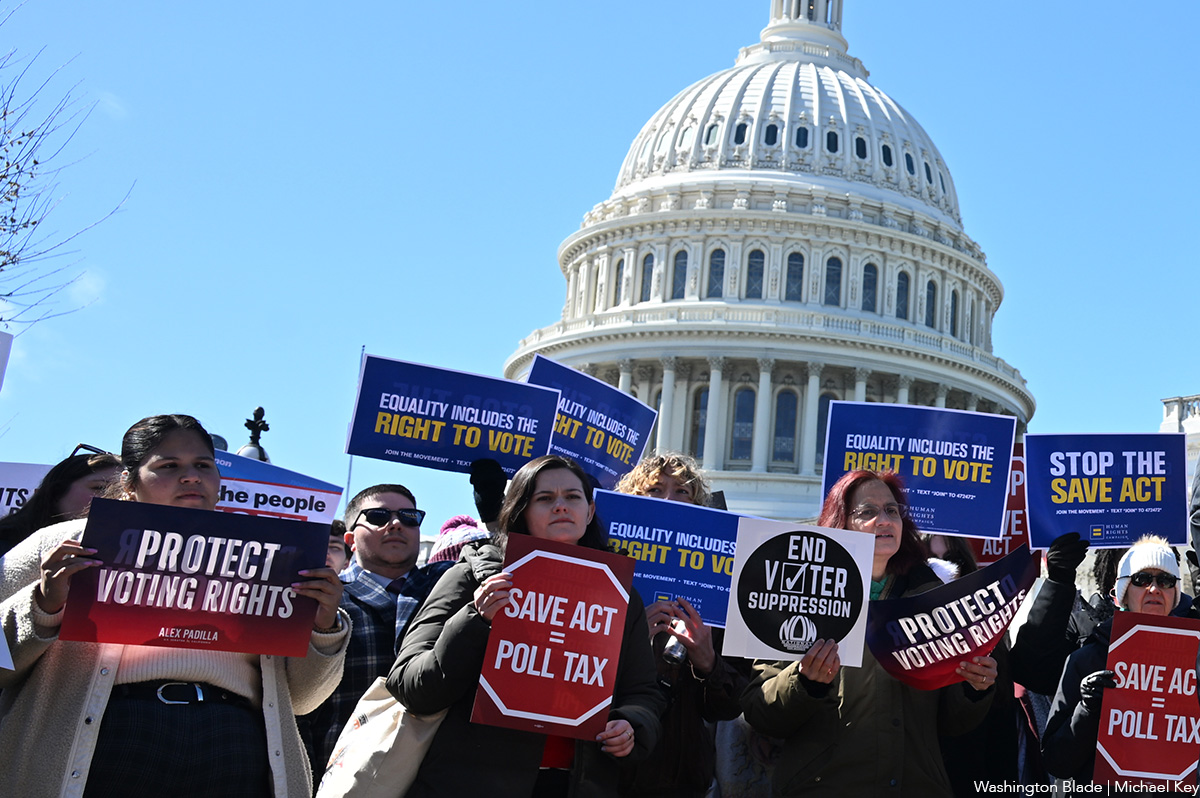
Members of Congress, advocates, and people from across the country gathered outside the U.S. Capitol on Tuesday to protest proposed federal legislation that voting rights activists have deemed “Jim Crow 2.0.”
The Safeguard American Voter Eligibility (SAVE) Act would amend the National Voter Registration Act of 1993 to require in-person proof of citizenship for anyone seeking to vote in U.S. elections.
President Donald Trump has also pushed for the proposed legislation to include a section that would ban gender-affirming medical care for transgender minors, even with parental consent, and prohibit trans people from participating in school or professional sports consistent with their gender identity rather than their sex assigned at birth.
In addition to changing voter registration requirements, the bill would limit acceptable forms of identification to documents such as a birth certificate or passport — records that the Brennan Center for Justice estimates more than 21 million Americans do not have — effectively restricting access to the ballot. It would also ban online voter registration, DMV voter registration efforts, and mail-in voter registration.
A 2021 investigation by the Associated Press found that fewer than 475 people voted illegally or improperly, a tiny fraction of the estimated 160 million Americans who voted in the 2020 election.
Senate Minority Leader Chuck Schumer (D-N.Y.) spoke at the event.
“It will kick millions of American citizens off the rolls. And they don’t even require you to be told,” the highest-ranking Democrat in the Senate told protesters and reporters outside the Capitol. “If this law passes — and it won’t — you’re gonna show up in November … and they’ll say… sorry, you’re no longer on the voting rolls.”
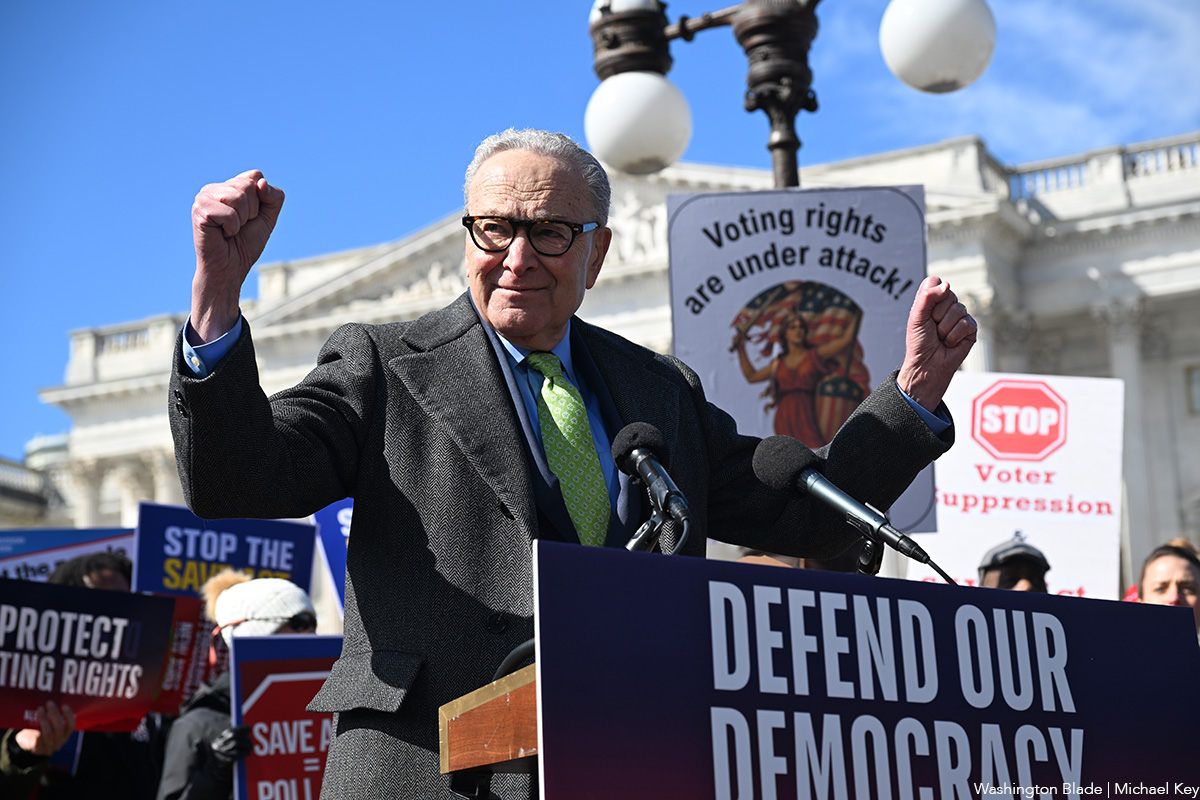
He, like many other speakers, emphasized the bill in the context of American history, pointing to what he described as its racist roots and its impact on Black and brown Americans.
“I have called this act, over and over again, Jim Crow 2.0 … because they know it’s the truth.”
U.S. Sen. Alex Padilla (D-Calif.) was one of the lawmakers leading opposition to the legislation and spoke at the rally.
“It’s not just voting rights that are on the line — our democracy is on the line,” the California lawmaker said. “It’s not a voter I.D. bill. It’s a bait and switch bill.”
He added historical context, noting the significance of voting rights legislation passed more than 60 years ago. In 1965, Alabama civil rights activists marched to protest barriers to voter registration. Alabama state troopers violently attacked peaceful demonstrators at the Edmund Pettus Bridge in Selma, using tear gas, clubs, and whips against more than 500 — mostly Black — protesters.
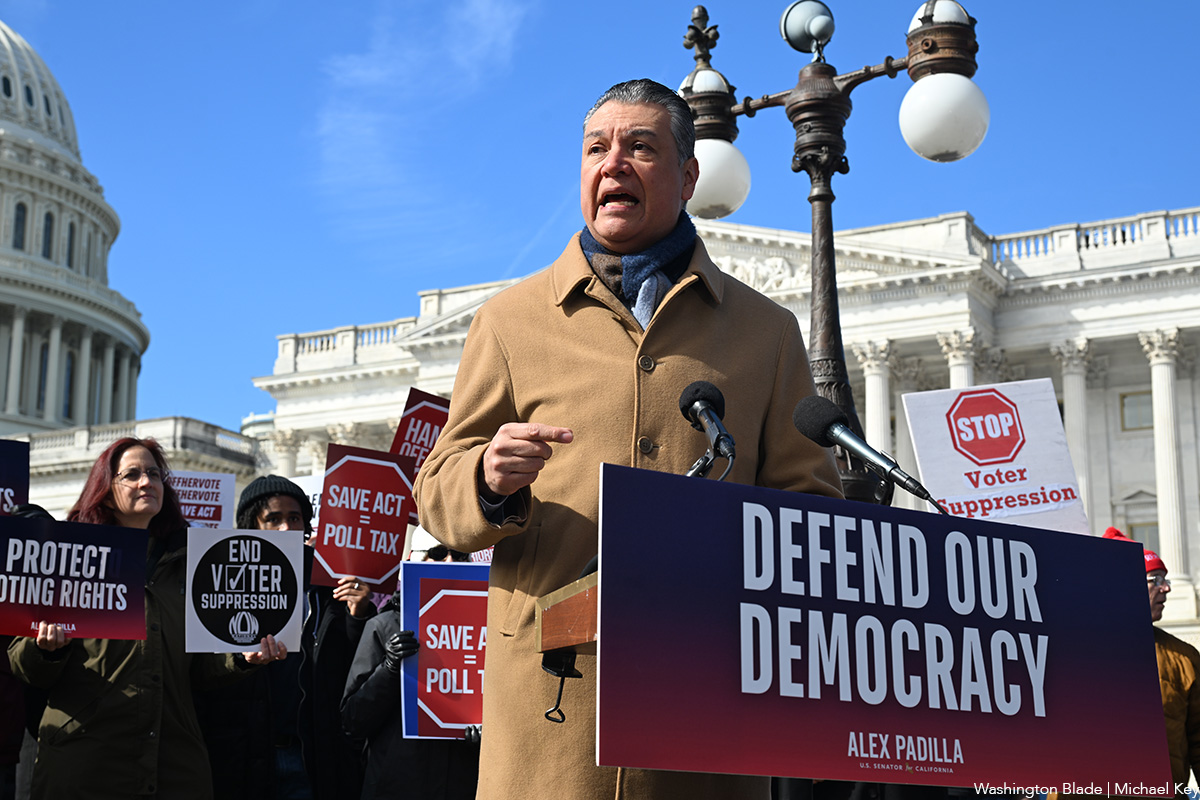
“61 years ago — not to the day — but this week, President Lyndon Johnson came to the Capitol and addressed a joint session of Congress in the wake of Bloody Sunday and pushed Congress to pass the Voting Rights Act,” Padilla said. “61 years later, Donald Trump and this Republican majority wants to take us backwards. We’re not gonna let that happen.”
U.S. Sen. Ben Ray Luján (D-N.M.) also spoke, emphasizing that he views the effort as a Republican-led and Trump-backed attempt to restrict voting access, particularly among Black, brown, and predominantly Democratic communities.
“President Trump told Republicans when they were meeting behind closed doors that ‘The SAVE Act will guarantee Republicans win the midterms and ensure they do not lose an election for 50 years,’” Luján said. “The first time I think Donald Trump’s been honest … This voter suppression bill is only that. Taking away vote by mail? I hope my Republican colleagues from states that voted for Donald Trump or where vote by mail is popular have the courage and the backbone to stand up and say no to this nonsense, because their constituents are going to push back.”
U.S. Sen. Lisa Blunt Rochester (D-Del.) also spoke.
“Our Republican colleagues have already cut Medicaid, Medicare, people don’t know how they’re gonna be able to afford energy,” she said, providing context for the broader political moment. “We’re in the middle of a war that they can’t even get straight while we’re in it and don’t have a way to get out of it. And we are now faced with defending our democracy?”
She then showed the crowd something that she said has been with her throughout her political journey in Washington.
“I brought with me something that I carried on the day that I was sworn into the House of Representatives when I was elected in 2016, and I carried it with me on the day that I was sworn in as United States senator. And I also carried it with me when I was trapped up in the gallery on Jan. 6 and all I could think to do was pray … This document allowed my great great great grandfather, who had been enslaved in Georgia, to have the right to vote. We took this and turned it into a scarf. It is the returns of qualified voters and reconstruction code from 1867. This is my proof of what we’ve been through. This is also our inspiration.”
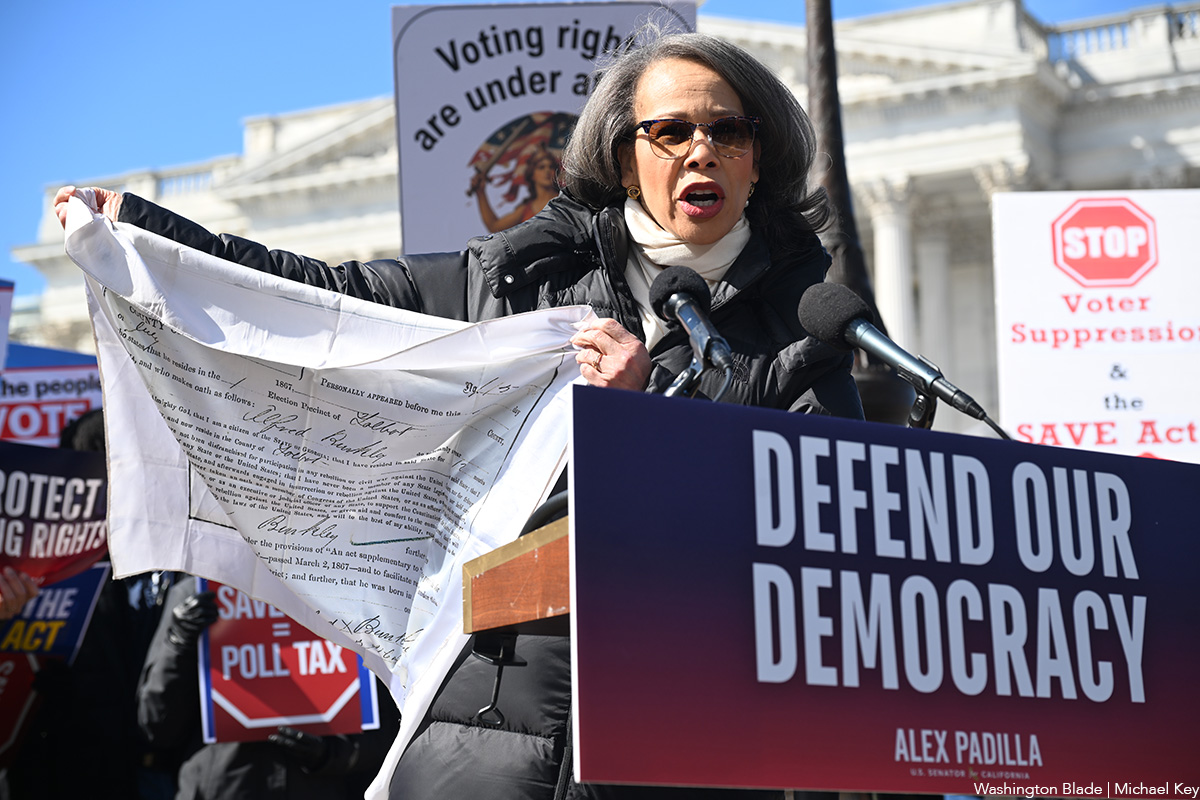
“I got to travel between the Edmund Pettus Bridge two times. And even as I thought about this moment, I recognized that while we wish we weren’t in it, while we don’t know why we’re in it, I do know we were made for it … So I came today to tell you that, um, just like the leader said, that he calls it Jim Crow 2.0. I call it Jim Crow 2.NO.”
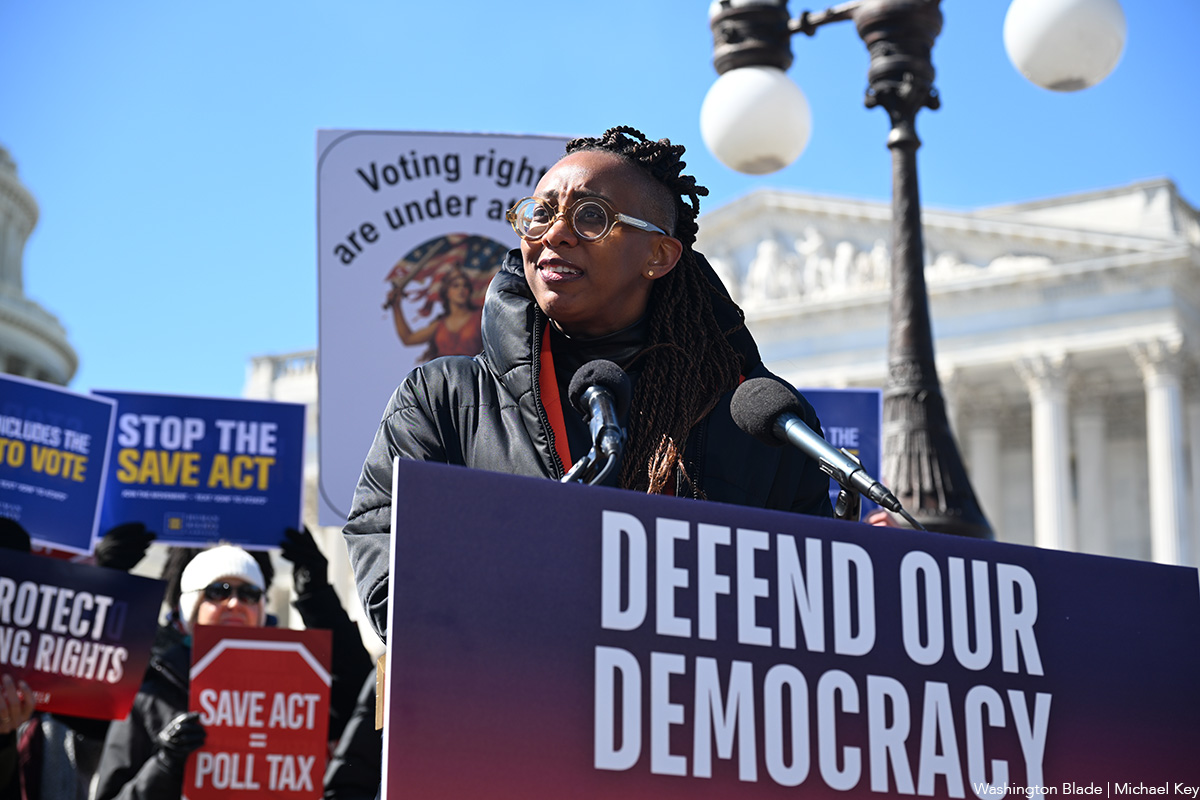
Kelley Robinson, president of the Human Rights Campaign, the largest LGBTQ advocacy organization in the U.S., also spoke, highlighting the impact of the bill’s proposed provisions affecting trans people.
“This bill is not about saving America. This bill is about stealing an election. This bill is about suppressing voters,” Robinson said. “This bill not only tries to disenfranchise voters that deserve their right to vote, it also tries to criminalize trans kids and their families … It tries to criminalize doctors providing medically necessary care for our trans youth.”
The SAVE Act passed the U.S. House of Representatives on Feb. 11 but has not yet been considered in the U.S. Senate.
Idaho
Idaho advances bill to restrict bathroom access for transgender residents
HB 752 passed in state House of Representatives on Monday
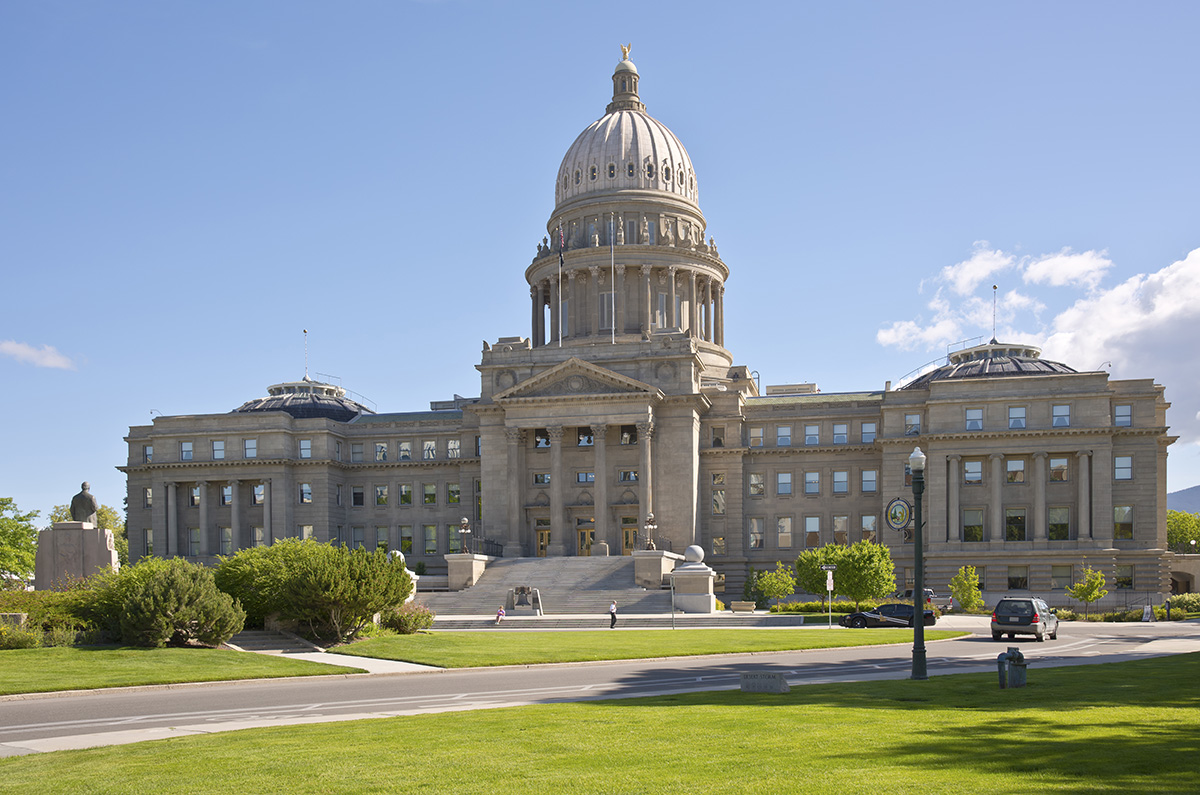
The Idaho House of Representatives passed House Bill 752 on Monday, a measure that would make it a crime for a person to use a bathroom other than the one designated for their “biological sex.”
The story was first reported by the Idaho Capitol Sun after the bill cleared the House.
House Bill 752 would make it a criminal offense — either a misdemeanor or a felony, depending on the number of prior offenses — for individuals who “knowingly and willfully” enter a bathroom or changing room designated for the opposite sex.
The bill would apply to public buildings, including government-owned spaces, and places of “public accommodation,” a category that includes private businesses.
According to the bill’s text, it would “prohibit a person from entering a restroom or changing room designated for the opposite sex; provide a penalty; provide exceptions; define terms; and declare an emergency and provide an effective date.”
A first offense would be a misdemeanor, punishable by up to one year in prison. A second or subsequent offense within five years would be a felony, punishable by up to five years in prison.
The bill passed in a 54–15 vote on Monday. Six Republicans broke with their party’s majority to join nine Democrats in opposing the measure.
The bill’s sponsor, state Rep. Cornel Rasor, a Republican from Sagle near the Washington-Idaho border, told House lawmakers that the legislation is intended to protect women and girls.
“It prevents discomfort and voyeurism escalation and assaults, while preserving single-user options and narrow exceptions so no one is denied access for emergency aid,” Rasor said.
State Rep. Chris Mathias, a Democrat from Boise, disagreed, arguing that the legislation would unfairly target transgender Idahoans.
“The truth of the matter is — and I know a lot of people don’t want to say it — but forcing people who don’t look like the sex they were assigned at birth, or transgender folks, to use other people’s bathrooms is going to put a lot of people in danger,” Mathias said.
The Idaho American Civil Liberties Union made a statement about the bill following its passage.
“Idaho lawmakers continue pushing these harmful, invasive bathroom laws, yet cannot present credible evidence that transgender people using gender-aligned bathrooms threaten public safety,” the Idaho ACLU said. “The bill does nothing to address real criminal acts, such as sexual assault or voyeurism, and disregards concerns from law enforcement about the burden enforcement would place on local resources.”
In addition to human rights advocates, who have spoken out against similar bills advancing in state legislatures across the country, Idaho law enforcement groups have also opposed the measure. They argue that the way the legislation is written would “pose significant practical enforcement challenges,” noting that officers are tasked with maintaining public safety — not conducting gender checks or policing bathroom access.
During a committee hearing last week, law enforcement representatives and several trans Idahoans testified that the bill would make many residents less safe.
“Officers responding to a complaint would be placed in the difficult position of determining an individual’s biological sex in order to enforce the statute,” Idaho Fraternal Order of Police President Bryan Lovell wrote. “In many circumstances, there is no clear or reasonable way for officers to make that determination without engaging in questioning or investigative actions that could be viewed as invasive and inappropriate.”
The Idaho Sheriffs’ Association requested that lawmakers amend the bill to require that individuals be given an opportunity to leave a bathroom immediately before facing potential prosecution.
The bill now heads to the Idaho Senate for consideration. To become law, it must pass both chambers and avoid a veto from the governor.
A separate bathroom bill, House Bill 607, which would be enforced through civil lawsuits, passed the House last month but has not yet received a committee hearing in the Senate.
State Department
Report: US to withhold HIV aid to Zambia unless mineral access expanded
New York Times obtained Secretary of State Marco Rubio memo
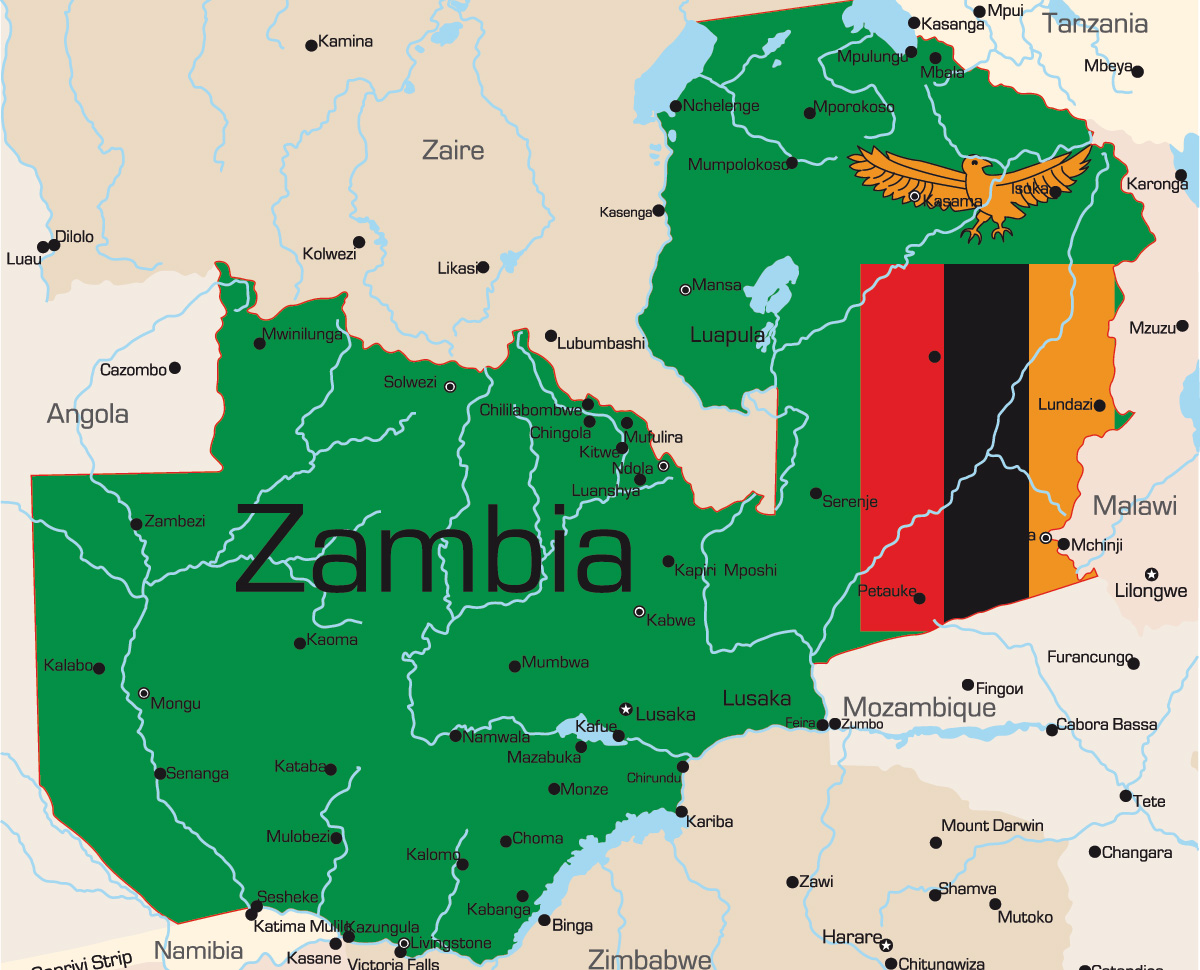
The State Department is reportedly considering withholding assistance for Zambians with HIV unless the country’s government allows the U.S. to access more of its minerals.
The New York Times on Monday reported Secretary of State Marco Rubio in a memo to State Department’s Bureau of African Affairs staffers wrote the U.S. “will only secure our priorities by demonstrating willingness to publicly take support away from Zambia on a massive scale.” The newspaper said it obtained a copy of the letter.
Zambia is a country in southern Africa that borders Tanzania, Malawi, Mozambique, Zimbabwe, Botswana, Namibia, Angola, and the Democratic Republic of Congo.
The Times notes upwards of 1.3 million Zambians receive daily HIV medications through PEPFAR. The newspaper reported Rubio in his memo said the Trump-Vance administration could “significantly cut assistance” as soon as May.
“Reports of (the) State Department withholding lifesaving HIV treatment in return for mining concessions in Zambia does not make us safer, stronger, or more prosperous,” said U.S. Sen. Jeanne Shaheen (D-N.H.), the ranking member of the Senate Foreign Relations Committee, on Tuesday. “Monetizing innocent people’s lives further undermines U.S. global leadership and is just plain wrong.”
The Washington Blade has reached out to the State Department for comment.
Zambia received breakthrough HIV prevention drug through PEPFAR
Rubio on Jan. 28, 2025, issued a waiver that allowed PEPFAR and other “life-saving humanitarian assistance” programs to continue to operate during a freeze on nearly all U.S. foreign aid spending. HIV/AIDS service providers around the world with whom the Blade has spoken say PEPFAR cuts and the loss of funding from the U.S. Agency for International Development, which officially closed on July 1, 2025, has severely impacted their work.
The State Department last September announced PEPFAR will distribute lenacapavir in countries with high prevalence rates. Zambia two months later received the first doses of the breakthrough HIV prevention drug.
Kenya and Uganda are among the African countries have signed health agreements with the U.S. since the Trump-Vance administration took office.
The Times notes the countries that signed these agreements pledged to increase health spending. The Blade last month reported LGBTQ rights groups have questioned whether these agreements will lead to further exclusion and government-sanctioned discrimination based on sexual orientation and gender identity.

Gay man murdered in Va.

Trans Day of Visibility events planned

Virginia General Assembly’s 2026 legislative session ends

Polish court rules country must recognize same-sex marriages from EU states

Capital Stonewall Democrats 50th anniversary gala draws sold out crowd

Protesters say SAVE Act targets voters, transgender youth

Housewives take Capitol Hill by storm

Queer American in Israel discusses Iran war’s impact

‘How We Survived’ panel set for March 25