Sports
World Cup draws attention to Russia’s anti-LGBT policies
Arrests, harassment, beatings reported
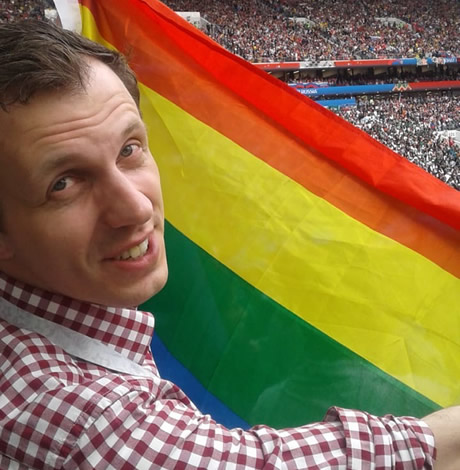
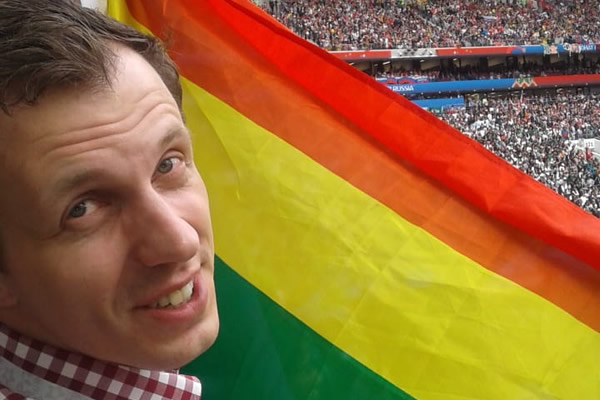
Russian LGBT Sports Federation President Alexander Agapov holds a rainbow flag during Russian President Vladimir Putin’s speech at the World Cup. (Photo courtesy Agapov)
Russian LGBT Sports Federation President Alexander Agapov was at Moscow’s Luzhniki Stadium on June 14 for the first game of the 2018 World Cup.
A picture that Agapov sent to the Washington Blade shows him holding a rainbow flag during Russian President Vladimir Putin’s speech. Apagov on July 2 said during a Facebook Messenger interview that a group of men from the North Caucasus region were the only people who “weren’t happy with the flag.”
“At the stadium everything was quite fine,” said Apagov.
Russia is hosting the World Cup against lingering criticism over a host of issues that include its LGBT rights record, the 2014 annexation of Crimea and the Kremlin’s interference in the 2016 U.S. presidential election.
The Moscow Times last month reported Cossacks — paramilitary groups that have previously targeted LGBTI and feminist groups — were planning to report to the police same-sex couples who are kissing during the World Cup in Rostov-on-Don.
Russian police on June 14 arrested Peter Tatchell, a prominent British LGBTI rights advocate, as he protested against Russia’s human rights record outside the Kremlin. Media reports also indicate a gay couple from France who traveled to St. Petersburg for the World Cup was attacked.
Apagov told the Blade he questions whether the couple’s sexual orientation motivated the attack.
“I tend to think this was fake news,” he said.
The Fare Network — an organization that fights against discrimination based on sexual orientation, gender identity, race, ethnicity, disability and other factors in soccer — has opened two Diversity Houses in Moscow and St. Petersburg for World Cup fans with FIFA’s support. These Diversity Houses have also hosted meetings, presentations and other events with Russian human rights organizations.
Fare Network Eastern Europe Development Officer Pavel Klymenko on July 2 confirmed to the Blade during a telephone interview from Moscow the landlord of the building in which the St. Petersburg Diversity House was located told his organization the night before it was scheduled to open that it had to move. Klymenko added the Fare Network has not “had any issues” in their new location in the city.
Andrea Ayala, executive director of Espacio de Mujeres Lesbianas por la Diversidad, a Salvadoran advocacy group known by the acronym ESMULES, visited the FARE Network’s Diversity House in Moscow while she was in Russia for the World Cup.
Ayala told the Blade during a WhatsApp interview from Nizhny Novgorod that she met a transgender Russian woman, a Russian woman with HIV, a pansexual woman and a woman from Chechnya. She added she did not feel “safe openly showing her diverse sexuality” outside the Diversity House.
“It was very shocking for me,” said Ayala, referring to the Russians she met. “The bravery of these people is really admirable.”
Putin in 2013 sparked worldwide outrage when he signed a law that bans the promotion of so-called gay propaganda to minors in Russia. The Kremlin has also faced criticism over its response to the anti-gay crackdown in Chechnya that Novaya Gazeta, an independent Russian newspaper, broke in 2017.
Elena Kostyuchenko, who is a Novaya Gazeta reporter, is among the 10 LGBTI activists who were arrested in Moscow’s Red Square as they sang the Russian national anthem before the opening ceremony of the 2014 Winter Olympics that took place in Sochi. A bomb threat, a smoke bomb that was detonated during a basketball tournament and venues that abruptly cancelled events are among the disruptions the Russian LGBT Sports Federation faced when it held the Russian Open Games in Moscow a few weeks later.
The Russian government did not respond to the Blade’s requests for comment for this story.
A FIFA spokesperson in response to the Blade’s question about Cossacks in Rostov-on-Dan said the organization has “a zero-tolerance approach to discrimination.” The spokesperson specifically pointed to Article 4 of the FIFA Statute.
“Non-discrimination, gender equality and stance against racism discrimination of any kind against a country, private person or group of people on account of race, skin color, ethnic, national or social origin, gender, disability, language, religion, political opinion or any other opinion, wealth, birth or any other status, sexual orientation or any other reason is strictly prohibited and punishable by suspension or expulsion,” it reads.
FIFA on June 20 fined Mexico $10,000 after its fans used an anti-gay chant during a match against Germany. FIFA in recent years has also fined Chile, Honduras and other countries for similar fan conduct.
“FIFA is committed to fighting all forms of discrimination in football, including homophobia,” a FIFA spokesperson told the Blade in 2017.
Ayala defended FIFA’s efforts combat discrimination.
“I think FIFA is beginning to focus more on diversity,” she told the Blade.
The Russian LGBT Sports Federation and the Fare Network are also hoping to work with the Russian Football Union to address homophobia and other forms of discrimination in Russian soccer.
“We’re trying to influence them to work more seriously on the issues of discrimination,” said Klymenko.
Agapov told the Blade he met with Russian Football Union representatives a few months ago. Agapov said he “had a very good impression and expected a lot of support from them.”
“But when I asked for support…they said not this time because this topic is too specific in Russia to support our football festival,” he added.
The Russian Football Union did not respond to the Blade’s request for comment.
Klymenko said the World Cup “feels like a bit of a bubble, a breath of freedom” for Russians. He expressed concern the Kremlin will once again target LGBTI activists, among others, once the World Cup ends.
“Obviously our biggest worry is when the World Cup is over, the situation will go back to normal,” said Klymenko.
Apagov agreed, noting his organization’s events are “now supervised” by Russia’s Federal Security Services. He pointed out to the Blade they “caused problems for us” during the Russian Open Games.
“They are interested in the high-profile guests’ security,” said Apagov. “That’s normal and true, but remembering all the troubles we had in the past with the police and so-on, I don’t think we can feel safe when the World Cup is over.”




Sports
New IOC policy bans trans women from Olympics
New regulation to be in effect at 2028 summer games in Los Angeles
The International Olympic Committee on Thursday announced it will not allow transgender women from competing in female events at the Olympics.
“For all disciplines on the Sports Program of an IOC event, including individual and team sports, eligibility for any Female Category is limited to biological females,” reads the new policy.
The policy states “eligibility for the Female Category is to be determined in the first instance by SRY Gene screening to detect the absence or presence of the SRY Gene.”
“On the basis of the scientific evidence, the IOC considers that the SRY (sex-determining Region Y) Gene is fixed throughout life and represents highly accurate evidence that an athlete has experienced or will experience male sex development,” it reads. “Furthermore, the IOC considers that SRY Gene screening via saliva, cheek swab or blood sample is unintrusive compared to other possible methods. Athletes who screen negative for the SRY gene permanently satisfy this policy’s eligibility criteria for competition in the Female Category.”
The policy states the test “will be a once-in-a-lifetime test” unless “there is reason to believe a negative reading is in error.”
The new regulation will be in place for the 2028 Summer Olympics in Los Angeles.
“I understand that this a very sensitive topic,” said IOC President Kirsty Coventry on Thursday in a video. “As a former athlete, I passionately believe in the rights of all Olympians to take part in fair competition.”
“The policy that we have announced is based on science and it has been led by medical experts with the best interests of athletes at its heart. The scientific evidence is very clear: male chromosomes give performance advances in sport that rely on strength, power, or endurance,” she added. “At the Olympic Games, even the smallest margins can be the difference between victory and defeat. So, it is absolutely clear that it would not be fair for biological males to compete in the female category. In addition, in some sports it would simply not be safe.”
(Video courtesy of the IOC)
Laurel Hubbard, a weightlifter from New Zealand, in 2021 became the first trans woman to compete at the Olympics.
Imane Khelif, an Algerian boxer, won a gold medal at the 2024 Summer Olympics in Paris. Khelif later sued JK Rowling and Elon Musk for cyberstalking after they questioned her gender identity.
Ellis Lundholm, a mogul skier from Sweden, this year became the first openly trans athlete to compete in any Winter Olympics when he participated in Milan Cortina Winter Olympics in Italy.
President Donald Trump in February 2025 issued an executive order that bans trans women and girls from female sports teams in the U.S.
The U.S. Olympic and Paralympic Committee last July banned trans women from competing in female sporting events. Republican lawmakers have demanded the IOC ban trans athletes from women’s athletic competitions.
“I’m grateful the Olympics finally embraced the common sense policy that women’s sports are for women, not for men,” said U.S. Sen. Tom Cotton (R-Ark.) on X.
An IOC spokesperson on Thursday referred the Washington Blade to the press release that announced the new policy.
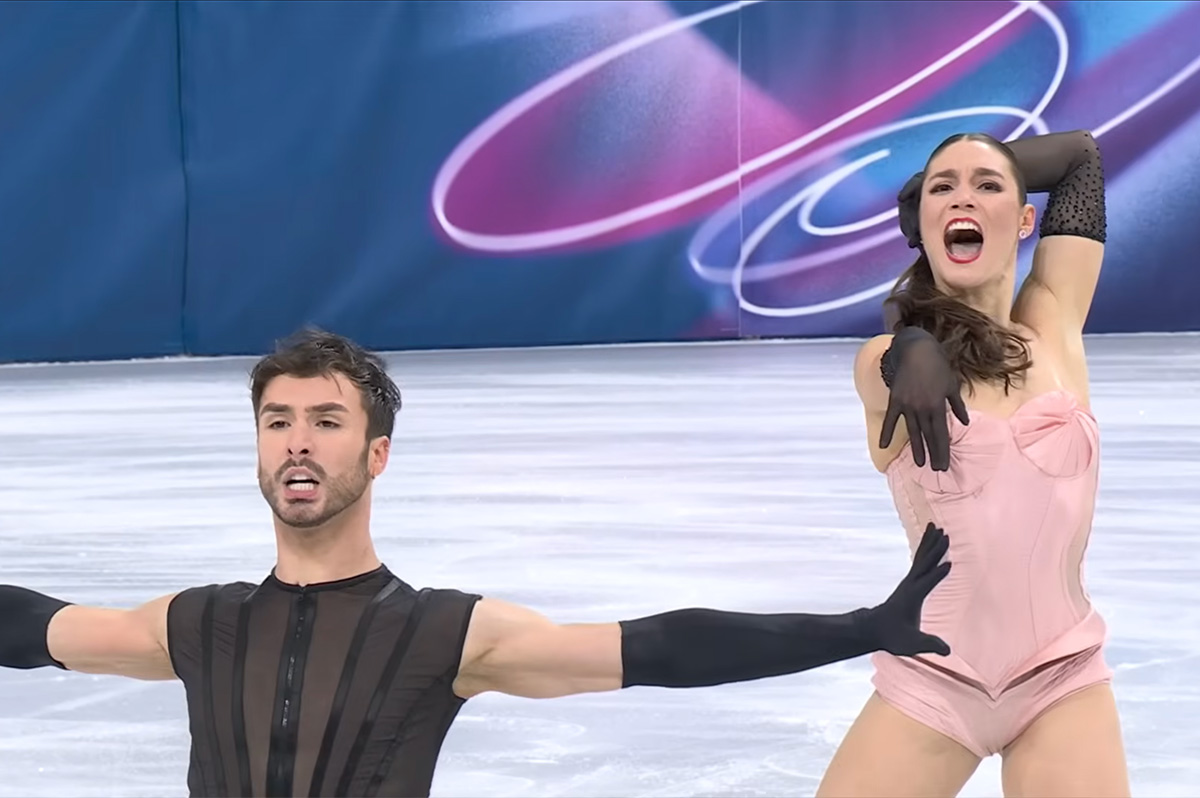
More than a dozen LGBTQ athletes won medals at the Milan Cortina Winter Olympics that ended on Sunday.
Cayla Barnes, Hilary Knight, and Alex Carpenter are LGBTQ members of the U.S. women’s hockey team that won a gold medal after they defeated Canada in overtime. Knight the day before the Feb. 19 match proposed to her girlfriend, Brittany Bowe, an Olympic speed skater.
French ice dancer Guillaume Cizeron, who is gay, and his partner Laurence Fournier Beaudry won gold. American alpine skier Breezy Johnson, who is bisexual, won gold in the women’s downhill. Amber Glenn, who identifies as bisexual and pansexual, was part of the American figure skating team that won gold in the team event.
Swiss freestyle skier Mathilde Gremaud, who is in a relationship with Vali Höll, an Austrian mountain biker, won gold in women’s freeski slopestyle.
Bruce Mouat, who is the captain of the British curling team that won a silver medal, is gay. Six members of the Canadian women’s hockey team — Emily Clark, Erin Ambrose, Emerance Maschmeyer, Brianne Jenner, Laura Stacey, and Marie-Philip Poulin — that won silver are LGBTQ.
Swedish freestyle skier Sandra Naeslund, who is a lesbian, won a bronze medal in ski cross.
Belgian speed skater Tineke den Dulk, who is bisexual, was part of her country’s mixed 2000-meter relay that won bronze. Canadian ice dancer Paul Poirier, who is gay, and his partner, Piper Gilles, won bronze.
Laura Zimmermann, who is queer, is a member of the Swiss women’s hockey team that won bronze when they defeated Sweden.
Outsports.com notes all of the LGBTQ Olympians who competed at the games and who medaled.
Sports
US wins Olympic gold medal in women’s hockey
Team captain Hilary Knight proposed to girlfriend on Wednesday
The U.S. women’s hockey team on Thursday won a gold medal at the Milan Cortina Winter Olympics.
Team USA defeated Canada 2-1 in overtime. The game took place a day after Team USA captain Hilary Knight proposed to her girlfriend, Brittany Bowe, an Olympic speed skater.
Cayla Barnes and Alex Carpenter — Knight’s teammates — are also LGBTQ. They are among the more than 40 openly LGBTQ athletes who are competing in the games.
The Olympics will end on Sunday.

Award-winning D.C. chef reaching new culinary heights

Trans-driven ‘Serpent’s Skin’ delivers campy sapphic horror

Now more than ever: the importance of LGBTQ activism

D.C. not the place for antisemitic Democratic Socialists of America

Blade editor to be inducted into D.C. Society of Professional Journalists Hall of Fame

‘Out for McDuffie’ event held at D.C. gay bar

‘Jonah’ an undeniably compelling but unusual memory play

The Oscar-losing performance that’s too good to miss

PHOTOS: ‘No Kings’ rally and march