Arts & Entertainment
‘Rosie O’Donnell Show’ returns for one-night only special to benefit Actors Fund
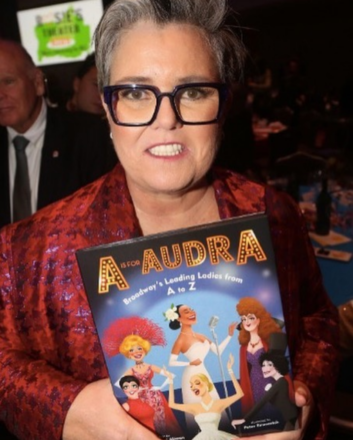
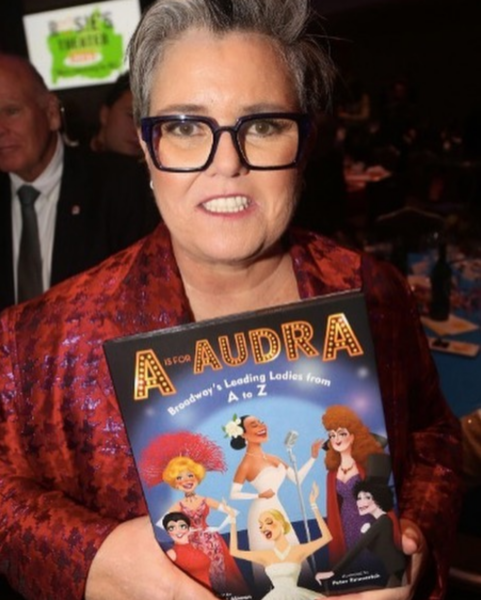
Rosie O’Donnell is bringing her beloved 1990s talk show back to your screens for one night only, to benefit arts and entertainment industry workers who have been financially impacted by the coronavirus pandemic.
The out actress and comedian told The Hollywood Reporter in a statement on Thursday that she would host a one-night revival of “The Rosie O’Donnell Show” this weekend as a fundraiser in support of The Actors Fund and the legion of performing arts and entertainment professionals who have found themselves unemployed indefinitely because of the cancellations and shutdowns caused by the COVID-19 outbreak. The special installment will broadcast live, on YouTube and Broadway.com, and promises a roster of A-lister guests that have pledged to appear – while practicing safe social distancing, of course, via live video from their homes.
O’Donnell told THR, “Everybody who knows me knows that Broadway has been one of the brightest lights in my life since the time I was a little girl. It has also been the lifeblood of New York City for generation after generation. After all Broadway has given to the world, now – in this time of tremendous need – it’s our turn to give something back. There is no better way to support this community than via The Actors Fund. And, with a lineup like this, I dare you not to tune in.”
The LGBTQ icon has lined up a lot of talent for the unprecedented event. Scheduled to appear so far are Sebastian Arcelus, Skylar Astin, Beth Behrs, Erich Bergen, Nate Berkus, Stephanie J. Block, Tituss Burgess, Norbert Leo Butz, Kristin Chenoweth, Gavin Creel, Darren Criss, Gloria Estefan, Jesse Tyler Ferguson, Harvey Fierstein, David Foster, Morgan Freeman, Neil Patrick Harris, Megan Hilty, Judith Light, Barry Manilow, Rob McClure, Audra McDonald, Katharine McPhee, Alan Menken, Idina Menzel, Brian Stokes Mitchell, Kelli O’Hara, Lauren Patten, Ben Platt, Billy Porter, Randy Rainbow, Andrew Rannells, Chita Rivera, Seth Rudetsky, Lea Salonga, Miranda Sings, Jordin Sparks, Ben Vereen, Adrienne Warren, James Wesley – and, incredibly, an even further list of yet-to-be-revealed names. She’s also brought John McDaniel, her original music director, composer and producer, back on board.
Producer Erich Bergen says, “This is the ultimate win-win proposition. The Actors Fund needs our support, and we’re all desperate for some fabulous entertainment we can enjoy from the safety of our own homes. I’m so grateful to Rosie, and to this truly jaw-dropping array of talent that have agreed to participate.”
Actor and Actors Fund chairman Brian Stoke Mitchell says, “Because social distancing is so important right now, this amazing benefit is an incredible show of support to lift spirits, bring us all together virtually and help The Actors Fund help those in need. Now more than ever, people in our community are depending on The Fund’s vital services. It’s critical that we be there for those in need, in particular our seniors and the immunocompromised individuals who need our help, as well as those in financial distress.”
No word yet on whether safely-sanitized koosh balls will be used.
The one-night only live airing, which is presented in partnership with Revelations Entertainment and Broadway.com, is set for Sunday, March 22, at 7pm ET.
You can make a tax-deductable donation to The Actors Fund here.
Out & About
Congressional Cemetery hosts Gays & Graves
Daylong Pride celebration blends history, remembrance, art and community

Historic Congressional Cemetery will host the second annual “Gays & Graves: A Big Gay Festival” on Sunday, June 14 at 11 a.m.
The event will feature pioneering activist Randy Wicker, the Gay Men’s Chorus of Washington, and new public art installations and programs celebrating LGBTQ+ history. Gays & Graves is an official partner event of Capital Pride 2026.
This event is a daylong Pride celebration blending history, remembrance, art and community. Visitors can shop from LGBTQ+ and allied artists and makers, experience performances and interactive installations, and engage with programs exploring LGBTQ+ history and lived experience.
For more details, visit the cemetery’s website.
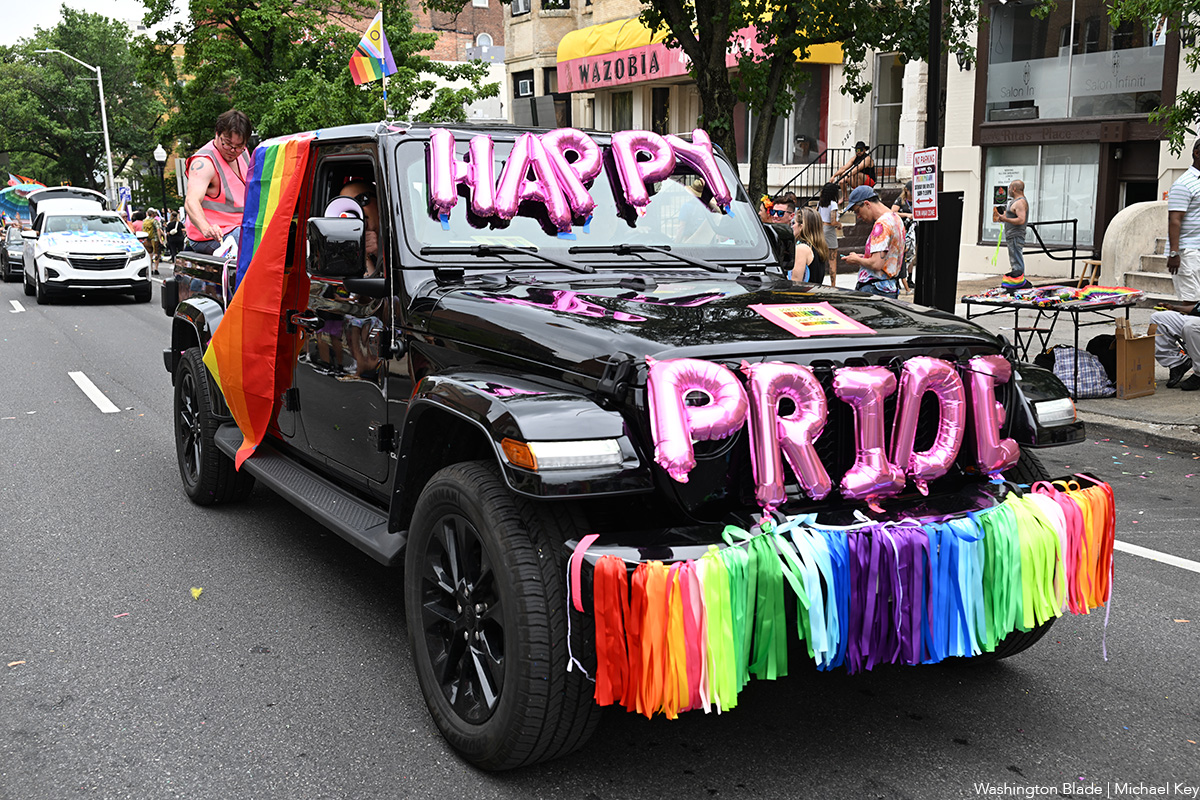
Baltimore Pride is underway, taking place from June 8-14.
The Pride Parade will be on Saturday, June 13 at 12 p.m. at Charles Street & North Avenue, followed by the Pride Block Party at 1 p.m. at Druid Hill Park. And then the Pride Festival will be held on Sunday, June 14 at 12 p.m. at Druid Hill Park.
There will be an array of additional events including: a fashion show, a “Suits and Sneakers” reception and a 5k race, among many other events.
For more details, visit Baltimore Pride’s website.
Friday, June 12
Bet Mishpachah will host “Pride Shabbat Happy Hour” at 6 p.m. at Edlavitch DC Jewish Community Center. This is an in-person happy hour with an open wine and beer bar, great company, and joyful conversation. Attendance is free and more details are available on Eventbrite.
Women in their Twenties and Thirties will meet at 8 p.m. on Zoom. This is a social discussion group for queer women in the Washington, D.C. area. For more details, visit Facebook.
Saturday, June 13
Out N Bad will host “SWEET WHINE: DC Pride Queer Caribbean Slow Whine Function” at 9 p.m. at Decades DC. This is a late-night escape into slow and steamy Dancehall & Kompa only. No splits. No headtops. No pressure. Tickets are $22.14 and are available on Eventbrite.
The DC LGBTQ+ Community Center will host a screening of “10s Across the Borders,” a bold pan-Asian queer film that confronts homophobia, transphobia, and racism while celebrating Southeast Asia’s underground ballroom scene. For more details, visit the DC Center’s website.
Sunday, June 14
Beth A Wolfe Yoga will host “Pride Baby Goat Yoga” at 1 p.m. at Faith Lutheran Church in Arlington, Va. The goats will be decked out in their finest Pride apparel, and human participants are welcome to do the same. Proceeds from this event will go to the Trevor Project. Tickets cost $44.52 and are available on Eventbrite.
Monday, June 15
“Center Aging: Monday Coffee Klatch” will be at 10 a.m. on Zoom. This is a social hour for older LGBTQ+ adults. Guests are encouraged to bring a beverage of choice. For more information, contact Adam ([email protected]).
Tuesday, June 16
“Self-Defense Class with Avi Rome” will be at 12:30 p.m. Rome is a proud member of the LGBTQ+ community and a full-time Martial Arts instructor with 25 years of teaching experience. He holds a 5th Degree Black Belt in Jhoon Rhee Tae Kwon Do and is the director of the studio’s Adaptive Tae Kwon Do program for students with special needs. He has also run numerous self-defense workshops for various groups and situations. For more details, visit the center’s website.
Center Bi+ Roundtable will be at 7 p.m. on Zoom. This is an opportunity for people to gather in order to discuss issues related to bisexuality or as Bi individuals in a private setting.Visit Facebook or Meetup for more information.
Wednesday, June 17
Job Club will be at 6 p.m. on Zoom upon request. This is a weekly job support program to help job entrants and seekers, including the long-term unemployed, improve self-confidence, motivation, resilience and productivity for effective job searches and networking — allowing participants to move away from being merely “applicants” toward being “candidates.” For more information, email [email protected] or visit thedccenter.org/careers.
Thursday, June 18
The DC Center’s Fresh Produce Program will be held all day at the DC LGBTQ+ Community Center. People will be informed on Wednesday at 5:00 pm if they are picked to receive a produce box. No proof of residency or income is required. For more information, email [email protected] or call 202-682-2245.
Virtual Yoga Class will be at 7 p.m. on Zoom. This free weekly class is a combination of yoga, breathwork and meditation that allows LGBTQ+ community members to continue their healing journey with somatic and mindfulness practices. For more details, visit the DC Center’s website.

D.C. Council approves expanded grant funding for Mayor’s Office of LGBTQ Affairs

Congressional Cemetery hosts Gays & Graves

Baltimore Pride is here

Calendar: June 12-18

Gender-bending buddy film gets 4K restoration for 25th anniversary

‘Mighty Real’ explores history of LGBTQ music

D.C.’s housing reality: Cautious optimism meets landlord strain

Hundreds of thousands expected to attend D.C. Pride events

PHOTOS: Pride Run