National
U.S. Senate to consider apology for past anti-LGBTQ discrimination
Report shows 70-year history of gov’t persecution, purges of ‘sex deviates’

U.S. Sens. Tammy Baldwin (D-Wisc.) and Tim Kaine (D-Va.) are preparing to introduce a first-ever resolution calling on the Senate to acknowledge and apologize for the federal government’s discrimination against LGBTQ federal workers and members of the military over a period of at least 70 years.
The two senators have agreed to introduce the proposed resolution at the request of the Mattachine Society of Washington, D.C., an LGBTQ group that specializes in archival research into the federal government’s decades-long policy of banning LGBTQ people from working in federal jobs and serving in the U.S. military and purging them when found to be in those positions.
The Mattachine Society, in partnership with the international law firm McDermott Will & Emery, prepared a 28-page white paper reporting in extensive detail the U.S. government’s history of what it calls discrimination and persecution of LGBTQ federal workers and LGBTQ military service members.
The white paper is entitled, “America’s Promise of Reconciliation and Redemption: The Need for an Official Acknowledgement and Apology for the Historic Government Assault on LGBT Federal Employees and Military Personnel.”
In a statement, the Mattachine Society says the paper is the product of a two-year research project involving a team of five attorneys with the McDermott Will & Emery firm and Mattachine Society.
“Over many decades, the United States government, led by teams within the Federal Bureau of Investigation (FBI), the Office of Personnel Management (OPM), and nearly every agency and branch of government, began the process of investigating, harassing, interrogating, court-martialing, terminating, hospitalizing, and, in some cases, criminally prosecuting LGBT Americans for no other reason than their sexual orientation or gender expression,” the paper says.
“This wholesale purging left tens of thousands in financial ruin, without jobs, with personal lives destroyed, and, in many cases, completely estranged from their own families,” the paper states.
“A straightforward acknowledgement of the mistreatment of these military and civilian employees and an official apology is overdue,” the paper continues. “Both the Congress and the Executive Branch were complicit in this pervasive mistreatment of LGBT citizens.”
The paper points out that over the past 30 years Congress has officially acknowledged and apologized on six different occasions for U.S. mistreatment of other marginalized groups.
Among the subject areas of those apologies were the enslavement of African Americans, the failure to enforce anti-lynching laws to protect African Americans, the internment of Japanese Americans during World War II, the mistreatment of Native Hawaiians, the mistreatment of Native Americans, and government polices of exclusion of Chinese immigrants.
The paper says the time has come for the federal government to issue its own “acknowledgement and apology” to the LGBT community by following the precedent established by Congress with respect to apologies to the other marginalized groups.
Jeff Trammell, a Mattachine Society board member who led the project to prepare the white paper, said Baldwin and Kaine were in the process of lining up other senators to sign on as co-sponsors of the resolution.
Baldwin is the Senate’s only out lesbian member. Kaine is a longtime supporter of LGBTQ rights.
Trammell said Mattachine of Washington considers the Senate resolution the first step in an ongoing effort to obtain a similar resolution in the U.S. House of Representatives and a possible similar statement of acknowledgement and apology from the executive branch, including the Biden administration.
He said he and the resolution’s supporters were hopeful that most senators, including Republicans, would view it as non-controversial and as a nonpartisan measure because it seeks only the acknowledgement of historical facts. Trammell noted that unlike other resolutions of apology pertaining to other minorities approved by Congress in the past, the LGBT apology resolution does not call for any financial reparations.
The eight-page proposed resolution addresses that question by stating, “Nothing in this resolution…authorizes or supports any claim against the United States or serves as a settlement of any claim against the United States.”
Trammell noted that under the Obama administration, John Berry, the director of the U.S. Office of Personnel Management, issued an official government apology for the firing of D.C. gay rights pioneer Frank Kameny from his government job in the late 1950s. But Trammell said the apology to Kameny, which was considered important and groundbreaking, did not extend to the thousands of other LGBTQ employees fired or harassed in the years before and after Kameny’s firing.
The white paper also points out that at least seven U.S. allied nations have issued apologies for past mistreatment of their own LGBTQ citizens. Among them are Spain, Canada, United Kingdom, Australia, Germany, Brazil, and The Netherlands.
“We believe the time has come to understand and acknowledge the historical animus that LGBT federal employees and military personnel faced for generations from their own government to ensure it can never happen again,” Trammell said.
The white paper can be accessed here.





Pennsylvania
Pa. House passes bill to codify marriage equality in state law
Governor supports gay state Rep. Malcolm Kenyatta’s measure
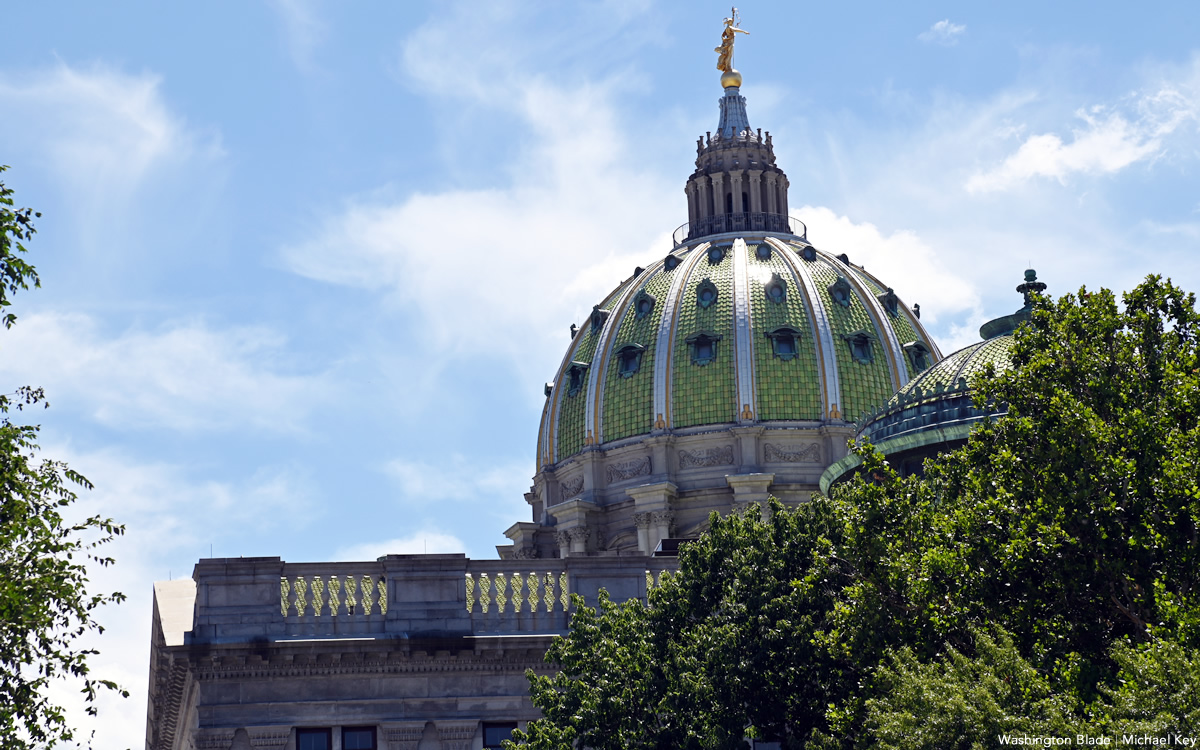
The Pennsylvania House of Representatives on Wednesday passed a bill that would codify marriage equality in state law.
House Bill 1800 passed by a 127-72 vote margin. Twenty-six Republicans voted for the measure.
The Republican-controlled Pennsylvania Senate will now consider the bill that state Rep. Malcolm Kenyatta (D-Philadelphia), who is the first openly gay person of color elected to the state’s General Assembly, introduced. Democratic Gov. Josh Shapiro supports the measure.
“Here in Pennsylvania, we believe in your freedom to marry who you love,” said Shapiro on Wednesday. “Today, the House has stepped up to protect that right.”
BREAKING: The Pennsylvania House just passed @RepKenyatta's bill to codify marriage equality into law in PA — and they did it with broad bipartisan support.
— Governor Josh Shapiro (@GovernorShapiro) March 25, 2026
Here in Pennsylvania, we believe in your freedom to marry who you love. Today, the House has stepped up to protect that…
Florida
DeSantis signs emergency bill that restores Fla. ADAP funding
Temporary funds to last through June 30
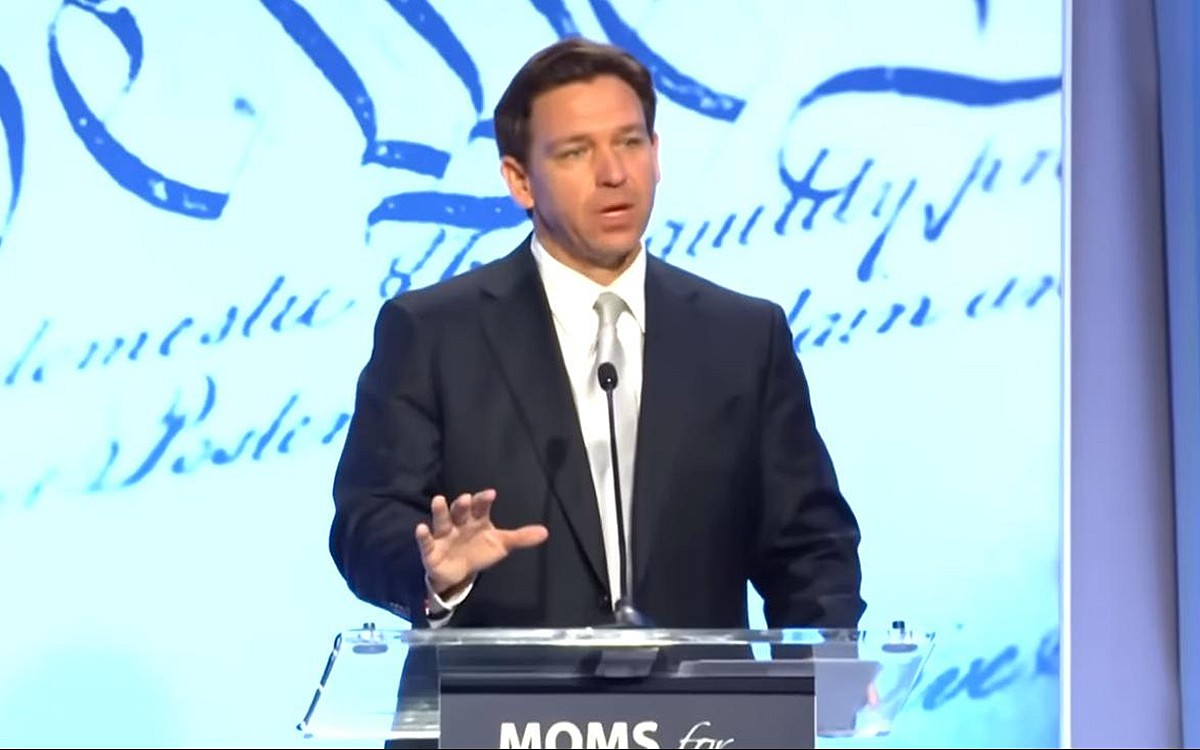
After the Florida Department of Health made huge cuts to the AIDS Drug Assistance Program in January, Republican Gov. Ron DeSantis has signed emergency legislation restoring HIV access to more than 12,000 Floridians.
Two months ago, as the Washington Blade reported, the Sunshine State cut the vast majority of those in ADAP by shifting the income levels required for eligibility — without following standard procedure when changing government policy outside of legislative or executive action.
The bill, signed by DeSantis on Tuesday, passed both chambers of the Florida Legislature unanimously and appropriates $30.9 million in emergency bridge funding through June 30, 2026. It restores Florida’s ADAP income eligibility to 400 percent of the Federal Poverty Level — the level it was prior to the January cuts. The legislation also requires the FDOH to submit detailed monthly financial reports to legislative leadership beginning April 1.
Under the old policy, eligibility would have been limited to those making no more than 130 percent of the federal poverty level, or $20,345 per year.
“For 10 weeks, 12,000 Floridians living with HIV did not know if they could fill their next prescription. Today, they can,” Esteban Wood, director of advocacy and legislative affairs at AIDS Healthcare Foundation, said in a statement.
The detailed reports now required to be sent to legislative leadership must include all federal revenues and expenditures, including manufacturer rebates; enrollment figures by county and insurance status; prescription utilization by drug class; and any projected funding shortfalls. This is the first time the Legislature has required this level of financial transparency from the program.
DeSantis signed the legislation one day after a Leon County Circuit Court judge denied AIDS Healthcare Foundation’s request for an injunction to block the significant changes the DeSantis administration is making to the program, which it claims faces a $120 million shortfall for calendar year 2026.
AIDS Healthcare Foundation, a national organization focused on protecting and expanding HIV healthcare access and prevention methods, filed a lawsuit over the change in eligibility, arguing the Florida Department of Health did not follow the laid out path for formally changing policy and was acting outside established procedures.
Typically, altering eligibility for a statewide program requires either legislative action or adherence to a multistep rule-making process, including: publishing a Notice of Proposed Rule; providing a statement of estimated regulatory costs; allowing public comment; holding hearings if requested; responding to challenges; and formally adopting the rule. According to AIDS Healthcare Foundation, none of these steps occurred.
The long-term structure of ADAP will be determined by the 2026–2027 fiscal year state budget, something that lawmakers have until June 30 to finish.
Federal Government
Markwayne Mullin confirmed as next DHS secretary
Okla. senator to succeed Kristi Noem
The U.S. Senate confirmed Markwayne Mullin as the next secretary of Homeland Security on Monday, as the agency continues to grapple with what lawmakers have described as a “never-ending” funding standoff, with Democrats attempting to withhold funding from one of the nation’s largest and most costly agencies.
Mullin — a Republican senator from Oklahoma, former mixed martial arts fighter, and plumbing business owner — was confirmed in a 54–45 vote. Two Democrats — U.S. Sens. John Fetterman (D-Pa.) and Martin Heinrich (D-N.M.) — sided with Republicans in supporting his confirmation.
The new agency head is expected to follow the policy direction set by President Donald Trump, emphasizing stricter immigration enforcement. This includes proposals to support immigration agents at polling sites and to cut funding to so-called “sanctuary cities.”
Mullin replaces Kristi Noem, who was fired earlier this month following a widely scrutinized 2-day congressional hearing on Capitol Hill.
During the hearing, Noem faced intense questioning over her response to several crises, including the fatal shooting of two American citizens in Minneapolis by U.S. Immigration and Customs Enforcement agents, a $220 million border security advertising campaign that featured her on horseback near Mount Rushmore amid one of the largest federal workforce reductions in U.S. history, and the federal response to major natural disasters such as the July 2025 Texas floods and Hurricane Helene in 2024.
Noem had previously drawn criticism for a series of policy decisions in South Dakota that broadly focused on restricting the rights of LGBTQ individuals. In 2023, she signed House Bill 1080, banning gender-affirming medical care for transgender minors. She also signed legislation and executive orders restricting trans athletes’ participation in women’s sports, as well as the state’s “Religious Freedom Restoration Act,” which critics argued enabled discrimination against LGBTQ individuals. Additionally, the state canceled contracts related to LGBTQ support services — including suicide prevention and health care navigation programs‚ and later agreed to a $300,000 settlement with trans advocacy group, The Transformation Project.
Despite her removal from DHS, Noem will remain in the Trump-Vance administration as a special envoy for the “Shield of the Americas,” an initiative aimed at promoting U.S. influence in the Western Hemisphere, including efforts to counter cartel networks, reduce Chinese influence, and manage migration.
The new head of DHS has served in Congress since 2013, in both houses of the federal legislature. While in the Senate and a member of the Health, Education, Labor, and Pensions (HELP) Committee, Mullin has been a vocal critic of policies aimed at expanding LGBTQ inclusion. He led a group of lawmakers in urging the Administration for Community Living to reverse a rule requiring states to prioritize Older Americans Act services based on sexual orientation and gender identity, arguing the policy could have unintended consequences.
Mullin also makes history as the first Native American — and a citizen of the Cherokee Nation — to lead the Department of Homeland Security. He was also among the 147 Republicans who voted to overturn the 2020 presidential election results despite no evidence of widespread fraud, and was present in the U.S. House of Representatives chamber on Jan. 6.

‘No Kings’ protests set for D.C.

Border to border: modern slavery and human trafficking in refugee movements across East Africa

New IOC policy bans trans women from Olympics

Introducing the Torchbearers Awards honoring queer, trans women and nonbinary people

Pa. House passes bill to codify marriage equality in state law

PHOTOS: Capital Stonewall Democrats 50th anniversary

Small is beautiful: subcompact SUVs

‘Inherit the Wind’ isn’t about science vs. religion, but the right to think

Polish court rules country must recognize same-sex marriages from EU states

Capital Stonewall Democrats 50th anniversary gala draws sold out crowd
-

 Photos4 days ago
PHOTOS: Capital Stonewall Democrats 50th anniversary
-
Autos5 days ago
Small is beautiful: subcompact SUVs
-
Theater5 days ago
‘Inherit the Wind’ isn’t about science vs. religion, but the right to think
-
Poland4 days ago
Polish court rules country must recognize same-sex marriages from EU states