Local
Hundreds of students ask Fairfax schools to return LGBTQ books to libraries
Parents’ complaints prompted two titles’ removal for ‘detailed review’

A total of 426 LGBTQ students and allies from more than 30 Fairfax County public high schools sent a letter on Thursday to the county school board and the school system’s superintendent urging them to reject requests that two LGBTQ themed books be removed from the school libraries.
The two books, “Lawn Boy,” a novel by author Jonathan Evison, and “Gender Queer: A Memoir,” an illustrated autobiography by non-binary author Maia Kobabe, each contain graphic descriptions of sexual acts, including sexual acts between consenting juveniles.
Following strong objections to the books by parents at a Sept. 23 meeting of the Fairfax County School Board, officials with Fairfax County Public Schools announced they had removed the books from the school libraries to reassess their suitability for high school students.
The books have received favorable reviews in various literary publications, and both have received the American Library Association’s Alex Award, an annual award that recognizes the year’s 10 books written for adults that the association says have a special appeal to young adults ages 12 through 18.
“We are a group of over 425 queer students and allies across the Fairfax County Public Schools who are part of the Pride Liberation Project, a coalition of students working to uplift the Queer community,” the student letter says.
“Student representatives from over 30 schools, including nearly every high school in Fairfax County Public Schools, have signed this letter, and many of us are students of color, low-income, gender expansive and not out to our families and communities,” the letter says.
“We are writing to ask you to reject calls to remove Maia Kobabe’s ‘Gender Queer’ and Jonathan Evison’s ‘Lawn Boy’ from Fairfax County Public Schools libraries,” it says.
Each of the 426 students who joined the letter signed with their initials rather than their full names while also writing the name of the school they attend.
Aaryan Rawal, co-founder of the Pride Liberation Project, which initiated the student letter, told the Washington Blade the group decided to allow students to sign with their initials because many LGBTQ students are fearful of possible negative repercussions if they come out publicly at school or to their parents.
“We have students who are even afraid to sign these names with their initials because they worry about what’s going to happen if their teacher finds out who’s not supportive or what happens if a classmate finds out who’s not supportive,” Rawal said.
“What’s going to happen if my parents find out if they’re not supportive?” Rawal said, expressing the concern of students with whom he has spoken. “We have students who have experienced homelessness because they’ve been outed to their parents,” he said. “And so, it is very much a real threat. We’re not exaggerating that whatsoever.”
The student letter states that “hundreds of books in our schools already depict heterosexual relationships and physical intimacy.” It names several of them, including Simone Elkeles’ “Rules of Attraction,” Stephen King’s “It,” Meg Cabot’s “Ready or Not,” and John Green’s “Looking for Alaska.”
“By holding books that describe LGBTQIA+ relationships to a different standard compared to these novels, Fairfax County Public Schools creates an inequitable, exclusionary, and heteronormative educational environment for queer students,” the letter states.
“As students, we are tired of being scrutinized and targeted for who we are,” says the letter. “We simply want to be treated equally in our schools, including in our libraries. Please reject attacks against LGBTQIA+ literature and allow ‘Gender Queer’ and ‘Lawn Boy’ to remain in our schools,” the letter concludes.
Julie Moult, a spokesperson for the Fairfax County Public Schools, told the Blade in an Oct. 8 email that the review process for the two books by school officials, including two committees appointed by Supt. Scott Brabrand, would take up to 45 days to complete from the time it began shortly after the Sept. 23 school board meeting.
Moult said it would be inappropriate for the superintendent to comment on the student letter until the outcome of the review process becomes known.
“The recommendation of the committees will be put forward to the assistant superintendent of instructional services who will make a final decision as to whether Fairfax County Public Schools continues to provide access to these books in our high school libraries,” school officials said in a statement released last month.
Rawal said students who helped write the letter they sent to the school board and the superintendent strongly dispute claims by several parents who described the two books in question as a form of pornography that’s unsuitable for high school students.
“I mean that’s just not accurate,” Rawal said. “We’ve read both books cover to cover, and I don’t see how there is a debate here. Mentioning sex does not make something pornography,” he said. “These books reference sex certainly but relegating the content of these books just to sex is a gross misrepresentation of what they’re really about.”




Rehoboth Beach
Officials raise troubling concerns about Rehoboth mayoral candidate Suzanne Goode
Homophobic emails, ‘aggressive’ behavior cited: ‘It just seems to be getting worse’

As Rehoboth Beach voters prepare to elect a new mayor on Aug. 8, some city officials and local residents are raising new concerns about the behavior of City Commissioner and mayoral candidate Suzanne Goode.
In addition to a history of troubling emails in which she has used homophobic language and criticized the city’s rainbow crosswalks, Goode is being accused of inappropriate behavior by a neighbor and a fellow Commissioner related to a dispute on the Nextdoor online platform.
The Blade spoke to City Manager Taylour Tedder, Commissioner Chris Galanty, and others about Goode’s behavior during her time as commissioner.
Goode was elected commissioner in August 2024. Fellow commissioner Susan Stewart, who is also running for mayor, criticized Goode’s behavior in a March 9, 2026 meeting, bringing up emails outlining Goode’s offensive conduct toward city staff.
In one email, Goode wrote to Rehoboth Beach City Solicitor Lisa Borin Ogden: “I am sorry that I learned from Google when you were first interviewed [in the] spring [of] 2025 that you are Jewish. My opinion of my fellow Jews declined significantly thanks to you since last summer. Actually would have thought you would have more compassion than the average person, based on your late brother. Except you don’t. I am sick of your haughty attitude toward me.”
In other emails, Goode questions why city officials encouraged CAMP Rehoboth and Clear Space Theatre to apply for grant funds. She has denigrated both institutions, referring to CAMP as a “questionable non-profit” and Clear Space as “second rate” with a “woke, drag queen bent” at times. She accuses Rehoboth’s LGBTQ community of displaying “their sex lives in public view” and fears physical violence from LGBTQ activists.
Goode disputed the claims and called for the city to remove Stewart’s remarks from the website.
The following statements were included in the emails sent by Goode:
• “Gays and theatre aficionados can donate as much as they like to these pet causes. Some taxpayers think the theatre is second-rate as community theatres go, and many dislike the RB emphasis on LGBTQ when heterosexuals don’t demand equivalent display of their sex lives in public view.”
• “Just because the LGBTQ community feels oppressed and discriminated against, that doesn’t mean that those who identify as LGBTQ are better able to recognize racial discrimination than someone like myself. It might surprise some of you to learn that I briefly dated an African American fellow college student.”
• “A performing arts and LGBTQ agenda isn’t appropriate for BOC spending when the city faces over $60M in debt.”
• “But there are some folks in town, who ironically have to remain in the closet (conservatives now have to do what gays had to do in the 20th century — ah, the irony) who object to the woke, drag queen bent of Clear Space at times. They have confided this in me, and thanked me for fighting for their tax dollars. Maybe I will regret speaking up, as some LGBTQ activist will attack me physically, even though I am a complete supporter of gay rights, and have as many gay male friends as female friends now that I live in RB with a large gay population.”
In the emails, Goode also referred to City Manager Tedder as “the mayor’s whore.”
Stewart told the Blade that the troubling behavior has since escalated.
Commissioner Chris Galanty spoke to the Blade about Goode’s behavior as commissioner and her issues with the rainbow crosswalks in town.
“Suzanne told me on two separate occasions that she didn’t like the rainbow crosswalks, and she said that she didn’t understand why they had to exist, and she didn’t understand why gay people had to advertise their sexuality, and she said straight people don’t have to do that.”
Galanty said that when he challenged her on this, she “moved very quickly to another topic.” He said that she has now shifted her perspective and is more concerned that the rainbow crosswalks are an issue of labor costs.
Goode told the Blade that, “Unfortunately, the rainbow crosswalks have potentially reduced the upkeep of the conventional crosswalks. But the rainbow crosswalks are attractive in and of themselves, and they do add to our recognition of Rehoboth’s longstanding status as a gay-friendly town.”
Accusations of “aggressive” behavior by Goode aren’t limited to emails. Last summer, Goode came to the home of Diana Jones, a property owner in Rehoboth Beach who is a neighbor of Galanty’s. Jones spoke to the Blade to share her experience with Goode.
Jones is active on Nextdoor, an online social network for neighborhoods. She said that she got involved on the platform during the time of the commissioners election last summer, in which her neighbor, Chris Galanty, was elected as commissioner.
Jones said that she made posts supporting Galanty. She said that someone posted a link of a lawsuit that involved Goode’s husband, Jeffrey Goode, who lost his race for commissioner last summer. Jones said that she reposted the link after it was taken down.
Jones said that the lawsuit was “very relevant to somebody who is running for city commissioner.”
Jones said that Suzanne Goode showed up at her house as a result of the post. Jones was out walking her dog nearby so Goode briefly spoke with Jones’s husband who was home.
“She came over to my house because she was saying I was doxing him,” said Jones. Jones said that Goode then found her as she was walking her dog and tried to talk to her about her Nextdoor posts, saying that she “brought up a very painful time in her life.”
Jones said that she has not had any communication with Goode since.
When asked for comment on the situation with Jones, Goode responded by saying “Diana Jones’s behavior toward me was despicable, and the way she has chosen to give her side of the story to news media says more about her than it will ever say about me.”
Galanty told the Blade that Goode came to his house in late June of this year when he was not home. She then called him about Jones.
“She relayed to me that she was having a disagreement with my neighbor on the Nextdoor platform, and she asked me to intercede with the neighbor,” said Galanty. “She said, ‘Please speak to her because I am frustrated with what she is saying. She needs to stop, and you need to say something to her.'”
Galanty said that Goode called him four times and texted him 32 times in the span of three and a half hours the next day.
Galanty said that he responded the next day, telling her that her behavior was inappropriate.
“Eventually it took a couple of weeks, but she apologized in her own way. She just said we just need to let it go.”
From his perspective as commissioner, Galanty said, “She likes to re-litigate things that have happened, six months ago, nine months ago. She likes to rehash issues that are in the past.”
“She can be really aggressive, and people are just really turned off by her,” said Galanty.
Tedder, who has accused Goode of creating a “hostile work environment,” told the Blade about his experiences working with Goode.
“She does not support the staff, and constantly tells us to resign,” said Tedder.
Tedder said that Goode texted City Solicitor Ogden at 7:45 a.m. on a Saturday, telling her to resign.
“Sometimes she does have good ideas. It’s just it gets so lost in these pages and pages of emails and thousands of emails that she sends,” said Tedder.
In regards to Goode’s behavior, Tedder said it has been going on since the beginning. “It just seems to be getting worse.”
Maryland
Advocates for trans students urge Md. to fight White House threats
Four school districts under federal investigation

By JESSICA CALEFATI | Allies of transgender children are urging state education officials to fight back against the Trump-Vance administration, which has threatened to punish a growing number of Maryland school districts over local policies that affirm students’ gender identities.
The advocates testified Tuesday morning before the Maryland State Board of Education — one day after the U.S. Education and Justice departments alleged that Anne Arundel County’s school system violated federal student privacy law by withholding a student’s gender identity from their parents. A spokesperson for the district said Monday legal counsel had not yet reviewed the claims and that the district had no further comment.
School districts in Prince George’s, Montgomery, and Frederick Counties were already under investigation for allegedly violating Title IX, the civil rights law that prohibits sex-based discrimination. The federal government last month threatened to revoke funding from the districts because they allow trans students to use restrooms and locker rooms that align with their identities.
The rest of this article can be read on the Baltimore Banner’s website.
Maryland
White House threatens Anne Arundel schools over gender identity policy
District faces possible legal action or loss of federal funding
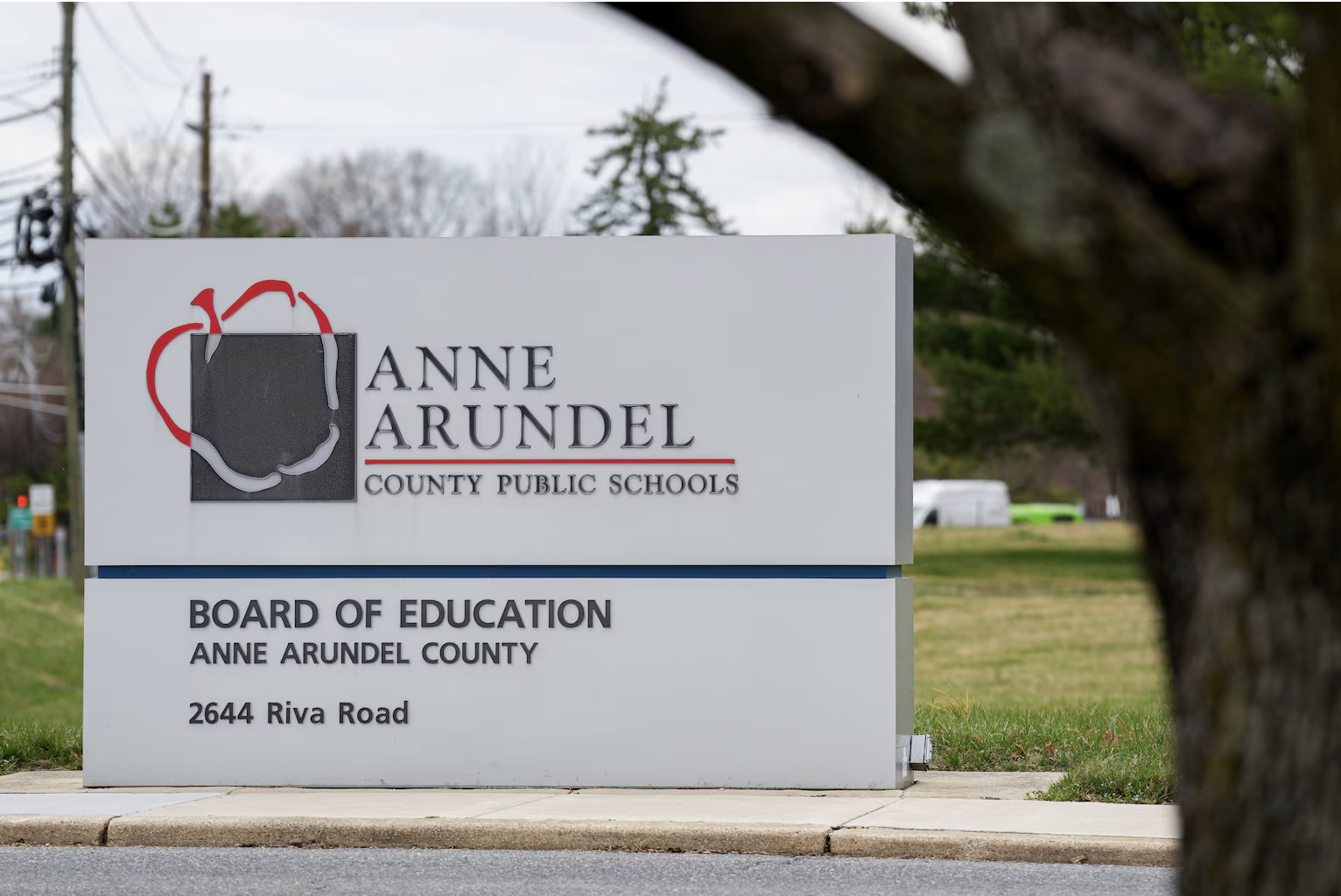
By JESSICA CALEFATI | The Trump-Vance administration on Monday threatened to punish Anne Arundel County’s school system with legal action or the loss of federal funding for allegedly withholding information about a student’s gender identity and transition from the child’s parents.
The U.S. Education and Justice Departments together determined that the suburban Maryland district treats students’ gender identities as confidential medical information that cannot be shared with parents, in violation of federal student privacy law, according to a news release. A federal lawsuit filed against the district earlier this month made similar claims.
“As a mother and a grandmother, it is unconscionable that any school district would hide the most sensitive information about children in their care from their own parents,” U.S. Secretary of Education Linda McMahon said in a statement. “This is not only an affront to basic moral principles, but also to parents’ rights under federal law.”
The rest of this article can be read on the Baltimore Banner’s website.

PHOTOS: Petal Release Party

Madonna headlines World Pride Music Festival in Amsterdam

Reggie White relishing first season as artistic director of Woolly Mammoth

PHOTOS: Amsterdam Pride Canal Parade

Amsterdam Pride Canal Parade draws hundreds of thousands

Matthew Rosenstein in ‘Make Me French’ a hit at Clear Space Theatre

‘Heartstopper Forever’ delivers satisfying conclusion

Madonna to perform at World Pride in Amsterdam

BLADE ENDORSEMENT: Susan Stewart for mayor of Rehoboth Beach

PHOTOS: Lambda Legal in the Pines
-

 Opinions5 days ago
Matthew Rosenstein in ‘Make Me French’ a hit at Clear Space Theatre
-
Movies5 days ago
‘Heartstopper Forever’ delivers satisfying conclusion
-
Celebrity News4 days ago
Madonna to perform at World Pride in Amsterdam
-
Opinions4 days ago
BLADE ENDORSEMENT: Susan Stewart for mayor of Rehoboth Beach