World
Fmr. Vatican ambassador: Ukraine’s Zelensky promotes LGBTQ ideology
Vigano alleges that Zelensky promulgates policies to embrace, including gender equality, abortion and the green economy
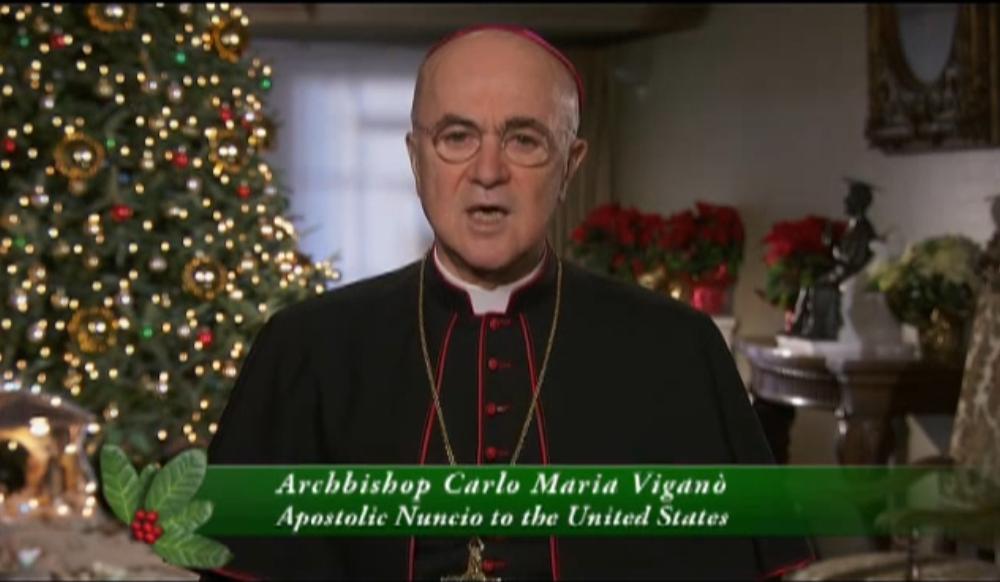
ROME – Italian Catholic-Archbishop Carlo Maria Vigano, the Vatican’s former papal nuncio to the United States, in an over 10,000 word essay published Monday, accused Ukrainian President Volodymyr Zelensky of catering to a “reform” agenda and using his presidency to promote “LGBTQ ideology.”
Vigano also took the Ukrainian leader to task alleging that Zelensky promulgates policies to embrace, including gender equality, abortion and the green economy. The prelate then categorized the acceptance of LGBTQ people as a leading cause for the invasion by Russia along with rhetoric echoing Russian President Vladimir Putin’s justifications for attacking Ukraine.
The Archbishop writes that the Ukrainian President was a mediocre actor and comedian who rose to power as he blamed “deep state” forces in the United States, the European Union and NATO for triggering the current war and demonizing Russia.
Vigano claims that “Neo-Nazi movements engaged in military and paramilitary actions operate freely in Ukraine, often with the official support of public institutions.” This echoing the lies of the Russian President who invoked World War II to justify Russia’s invasion of Ukraine, saying in televised remarks last week that his offensive aimed to “denazify” the country — whose democratically elected president is Jewish, and lost relatives in the Holocaust, NPR reported.
“The purpose of this operation is to protect people who for eight years now have been facing humiliation and genocide perpetrated by the Kyiv regime,” Russian President Putin said, according to an English translation from the Russian Mission in Geneva. “To this end, we will seek to demilitarize and denazify Ukraine, as well as bring to trial those who perpetrated numerous bloody crimes against civilians, including against citizens of the Russian Federation.”
The Archbishop’s essay mounting a defense of Russia’s invasion followed Patriarch Kirill the head of the Russian Orthodox Church and an ally of Putin, who repeated a long-held contention that the West wants to enforce the practice of holding gay pride parades as a test of loyalty to its values, which include the acceptance of homosexuality. The Ukraine war, he said Sunday in his sermon, resulted from the eastern regions’ refusal to acquiesce.
“If humanity accepts that sin is not a violation of God’s law, if humanity accepts that sin is a variation of human behavior, then human civilization will end there,” Kirill said on the pre-Lenten celebration known as Forgiveness Sunday.
Viganò’s letter portrayed the Ukrainian leader as an E.U. puppet;
“The image of Zelenskyy is an artificial product, a mediatic fiction, an operation to manipulate consensus that was nonetheless able to create a political character in the Ukrainian collective imagination and who in reality, not in fiction, was able to seize power,” the Archbishop wrote of the Ukrainian president.
Vigano was forced to resign after he arranged Pope Francis’ controversial 2015 meeting with Kim Davis, the Rowan County Kentucky clerk who went to jail rather than comply with a court order to issue same-sex marriage licenses.
A New York Times story reported the backstory behind some of the later Vatican drama after the Pope was informed as to the true nature of Kim Davis and the meeting.
The newspaper’s reporting suggests the rift between Francis and Archbishop Carlo Maria Viganò, who wrote a bombshell accusatory letter about Francis’ knowledge of the abuse, could have been exacerbated by Viganò arranging a meeting between Francis and Davis during his 2015 trip to the United States.
The invitation “directly challenged Francis’ inclusive message and prompted a controversy that nearly overshadowed the trip,” the Times reported. An abuse survivor who had spoken to Francis at length told the newspaper that Francis told him Viganò nearly sabotaged the trip.
“I didn’t know who that woman was, and he snuck her in to say hello to me — and of course they made a whole publicity out of it,” Juan Carlos Cruz recalled Francis saying, according to the New York Times.
“And I was horrified and I fired that nuncio,” Francis said, according to the Times article.
In July of 2020, Archbishop Viganò accused Pope Francis of heresy for promoting the “legitimization of homosexuality.”
Newsweek magazine reported: “Vigano is well known for his anti-gay views and has previously called for the pope to resign. In a recent interview with Italian journalist and Vatican expert Marco Tosatti, Vigano insisted that Pope Francis, who he refers to using his given name of Jorge Bergoglio, is involved with a plot to “corrupt” the church by promoting homosexuality.”
“For Bergoglio and his entourage sodomy is not a sin that cries out for vengeance in the presence of God, as the Catechism teaches,” said Vigano. “Bergoglio’s words on this topic – and even more the actions and words of those who surround him – unfortunately confirm that an operation of legitimization of homosexuality is currently underway.”
“Let’s not forget that the legitimization of homosexuality is part of the agenda of the New World Order – to which the Bergoglian church adheres openly and unconditionally,” he later added. “Not only for its destabilizing value in the social body, but also because sodomy is the principal instrument with which the Enemy intends to destroy the Catholic priesthood, corrupting the souls of the Ministers of God.”




Netherlands
Dutch PM: More needs to be done to defend trans rights
Rob Jetten on Friday was on World Pride Human Rights Conference panel

Editor’s note: International News Editor Michael K. Lavers and Photo Editor Michael Key will be on assignment in Amsterdam until Aug. 10.
AMSTERDAM — Dutch Prime Minister Rob Jetten on Friday said more needs to be done to defend transgender people and their rights.
“Everywhere in the Western world, it’s definitely the group that’s the most vulnerable in the moment and it’s rather well-picked also by our advisories,” he said during a panel at the World Pride Human Rights Conference in Amsterdam that Ying Xin and Diego García Blum of Global LGBTQI+ Human Rights Program at the Harvard Kennedy School’s Ryan-Carr Center for Human Rights Policy moderated. “They’ve chosen the smallest group within our broader community (trans people) to attack them, to ensure that we can strip their rights and if they’ve done with that, they’ll go after the next group within our community, so we shouldn’t be naïve about what’s behind it.”
“It’s very well-funded. It’s very well-organized and we have to organize as well to fight back and to win this fight,” added Jetten. “We also need to be more open in conversations that we are having within the community and also dive into it much deeper and maybe even have more difficult and annoying conversations.”
Jetten in February became the Netherlands’ first openly gay prime minister.
He appeared on the panel alongside former Irish Prime Minister Leo Varadkar, who in 2017 became his country’s first openly gay head of government, and former San Marino Captain Regent Paolo Rondelli, who was his country’s ambassador to the U.S. from 2007-2016.
Several other current former heads of government who are gay or lesbian also participated in the panel. They include former Icelandic Prime Minister Jóhanna Sigurðardóttir, former Luxembourgish Prime Minister Xavier Bettel, and Andorran Prime Minister Xavier Espot Zamora. California Congressman Mark Takano, who chairs the Congressional Equality Caucus, and LGBTQ+ Victory Fund CEO Evan Low were among those who attended.
Jetten in his remarks said he was “very surprised” to learn that “not only in the U.S. but also in some European countries that we’ve let them decide what the gay group looked like.” The Dutch prime minister further pointed out that conservatives began “to attack the debate on toilets or starting this debate about trans people in Olympic games.”
“That is, of course, a ridiculous debate to start, but we’ve got distracted because we were so busy having this debate on Olympians, and then we actually forgot the real fight was about access to healthcare, just being yourself, being able to enlist in the army, or being able to be a young trans boy or girl in school,” said Jetten. “We got distracted by some fresh meat that was thrown into the area by some very conservative people.”
“We have to open our eyes and have very in-depth conservations within our community, and come up with a much better strategy to win this fight and to protect all our trans brothers and sisters, dolls, whatever,” he added. “Because if we don’t win this fight for trans people, we’re going to lose the bigger fight for all LGBTQ people in the world.”
Varadkar noted Ireland in 2015 passed a law that allows people to legally change their gender without surgery or other medical interventions.
He conceded there was “a liberal wind blowing across the world at the time, and it was largely uncontested.”
“It would be harder now, quite frankly, to do that legislation,” said Varadkar.

Scottish lawmakers in 2022 passed the Gender Recognition Reform Bill, which lowered the age for anyone to legally change their gender without medical intervention from 18 to 16. Then-British Prime Minister Rishi Sunak’s government later blocked the measure from taking effect.
The U.K. Supreme Court in 2025 ruled the legal definition of a woman under the country’s Equality Act is limited to “biological women.” Author J.K. Rowling is among those who praised the decision that stemmed from a case that challenged the Scottish government’s decision to include trans women in its definition of women when it sought to increase the number of women on government boards.
The Trump-Vance administration on Jan. 20, 2025, the first day it was in office, issued a sweeping executive order that, among other things, declared the federal government would only recognize two genders: male and female. The White House earlier this year in its counterterrorism strategy said it “will also prioritize the rapid identification and neutralization of violent secular political groups whose ideology is anti-American, radically pro-transgender, and anarchist.”
“We have to stay united,” said Rondelli. “The strategy was, since the beginning, was a Nazi strategy to create groups, target groups, and to create maximum distractions to avoid discussion about some sort of policies.”
“Trans people are the target at the moment,” he added. “But after them it will probably be some others, so we have to stay united.”

Netherlands
Dutch prime minister opens World Pride Human Rights Conference
Rob Jetten is country’s first openly gay head of government

Editor’s note: International News Editor Michael K. Lavers and Photo Editor Michael Key are on assignment in Amsterdam through Aug. 10.
AMSTERDAM — Dutch Prime Minister Rob Jetten on Wednesday opened the World Pride Human Rights Conference in Amsterdam.
Jetten — who in February became the country’s first openly gay prime minister — began his remarks with an acknowledgment that the July 25 terrorist attack at Berlin’s Christopher Street Day that left one person dead and more than two dozen others injured “filled me with anger and sorrow.”
He started to speak after a group of activists began to shout at him over his government’s position on Palestine — the International Criminal Court, which is based in The Hague, has issued arrest warrants for Israeli Prime Minister Benjamin Netanyahu and Hamas leaders in connection with crimes against humanity it says they committed in the Gaza Strip and Israel after Oct. 7.
Jetten stood silently and allowed them to protest before security personnel removed them from the room.
View on Threads
Jetten in his speech acknowledged this year marks 25 years since the Netherlands became the first country to extend marriage rights to same-sex couples. He also pointed out 2025 marks Amsterdam Pride’s Canal Parade‘s 30th year.
“More and more in recent years, we’ve seen hard won progress being eroded,” conceded Jetten. “We’ve seen countries backsliding in equal rights legislation. We’ve seen homophobic hate speech becoming more overt and aggressive, and not only out in the real world, but online as well.”
Jetten pointed out “online hatred is one of the biggest threats facing the LGBTQIA+ people today.”
“All around the world … misinformation and disinformation can be spread in the blink of an eye with a single mouse click, reaching much further and much faster than NGOs, youth workers and health organizations can,” he said. “This is always how hatred takes hold. First in the shadows, outside the spotlight of society, underestimated by everyone, until, having grown into a many headed monster, it crawls out of the darkness.”
Jetten said his government this fall will launch “a social dialog on online discrimination and offering specific guidance on action to take.” This will include “training courses for municipalities and civil society organizations to help them deal with online hate speech.”
His government over the next three years will invest €7.5 million each year “in improving the safety of the queer community in our cities with an alliance of organizations committed to safety, both in the public space and in the workspace for LGBTQI+ people, and with a public information campaign to combat discrimination and disinformation.” Jetten also said the government will promote a campaign in Dutch schools that encourages students and teachers to wear purple as a way to show their support for the LGBTQ community.
’Equal rights are not a Western agenda’
Jetten in his speech also singled out “conservative forces” in Uganda, Senegal, and in other countries who are framing LGBTQ rights “developments as a neocolonial Western agenda.”
“Under the pretense of resisting so-called Western moral decadence, horrendous laws are enacted and promoted, laws that put the rights of free people under severe pressure,” he said. “But in reality, many communities in these countries have a long history of diversity and freedom, and the laws that impose the restrictions were in fact put in place by the colonial powers.”
“No matter how hard those conservative forces try to pull the wool over people’s eyes, queer communities around the world know that equal rights are not a Western agenda,” added Jetten. “They are first and foremost a human agenda.”
Amsterdam Mayor Femke Halsema and Nayyab Ali, co-chair of the Ending Violence Against Women and Girls Alliance Pakistan, are among those who also spoke on Wednesday. Lady Phyll, co-founder of UK Black Pride, and Camiel Welling, supervisor of the Amsterdam Trans Clinic, are co-hosting the conference that ends Friday.

Celebrity News
My evening with Madonna
Gay icon headlined the World Pride Music Festival in Amsterdam

Editor’s note: International News Editor Michael K. Lavers and Photo Editor Michael Key will be on assignment in the Netherlands through Aug. 10. They will be covering World Pride in Amsterdam.
AMSTERDAM — Madonna and 6,000 of her closest friends celebrated World Pride at Amsterdam’s AFAS Live concert hall early Sunday morning. I was fortunate enough to be one of them.
Madonna last Wednesday nearly broke the internet when she said on social media in Dutch that “I got somethin’ I wanna talk about,” referring to an opening line in “Danceteria,” one of the tracks on her “Confessions II” album that has received rave reviews since its July 2 release. The track has been on near constant replay on my playlist since I first heard it.
— Madonna (@Madonna) July 28, 2026
MISTR — a telehealth platform that offers free access to PrEP, Doxy PEP, STI testing, and long-term care that has organized Madonna’s Club Confessions shows in the U.S. and the U.K. — later confirmed the rampant speculation. I woke up on July 30 to an email in my inbox from MISTR and the World Pride Music Festival PR team that said I was on the press list.
Madonna was indeed going to headline the World Pride Music Festival that Jake Resnicow and Insomniac produced, and I was going to be there. OMFG!!!!
The gay icon had one more surprise in store.
The Dutch internet on Saturday once again broke over speculation that Kylie Minogue was going to appear alongside Madonna. I was getting ready to leave our hotel in Amsterdam on Saturday night when I saw a video of the two of them together.
“Madonna is now teasing Kylie Minogue on her social media … she may be one of her ‘special guests’ tonight,” I wrote in a text to Washington Blade Editor Kevin Naff at 8:46 p.m.
“Have fun! This is turning into the gayest concert ever,” he responded.
I arrived at AFAS Live shortly before 11 p.m. My press contact walked me and two other Dutch journalists into the venue’s cavernous main room known as the Black Box. We made small talk for a few minutes before I started to walk around and listen to Josh Harrison who was on the decks.
Madonna was scheduled to take the stage at 1:30 a.m., but she is known for being late — she is Madonna and she does what she wants. Hayla, a British singer, and Bebe Rexha are among those who performed ahead of Madonna. Thousands of sweaty men — including a group of Australians next to me who were eagerly awaiting Kylie’s anticipated appearance — packed the Black Box and were dancing, anticipating what was to come.

MISTR CEO Tristan Schukraft at one point came on stage and declared Madonna was indeed in the building. The moment for which we were all eagerly waiting finally came shortly before 2:30 a.m.
“Mother is here and this is gay heaven,” said Madonna when she took the stage.
Stuart Price, who produced her “Confessions on a Dance Floor” album in 2005, manned the decks during Madonna’s set.
She opened it with “I Feel So Free” from “Confessions II.” Madonna then sang “Bring Your Love” and “Danceteria” to which this reporter — and everyone else — sang along.
Madonna then teased a surprise before she began to perform “Love Sensation.” Kylie soon appeared on stage. It was nearly too much for my fellow partygoers from Australia. It was indeed the gayest concert ever!
Madonna and Kylie performed “Love Sensation” together. They then sang “Hung Up” and “Sorry” from “Confessions on a Dance Floor” to round out the set that ended shortly after 3 a.m.
Madonna and I share the same birthday — Aug. 16 — and I would like to think she and Kylie gave me an early birthday present. In all seriousness though, it was an amazing night for me and for everyone else who was fortunate enough to be there.
“On the dance floor I feel so free,” says Madonna in the opening of “I Feel So Free.”
For those few precious hours at AFAS Live I did not think about the Trump-Vance administration and the myriad ways it is destroying the U.S. I did not think about the National Guard troops deployed to D.C. I did not think about the pointless wars that continue to ravage Ukraine and other countries around the world. I simply lost myself on the dance floor and celebrated an icon who has always stood with my community.
Thank you, Madonna.

PHOTOS: Daddy Issues at Kiki

Something’s off about Dad. When is it time to step in?

New book chronicles gay man’s life in hippie commune

HRC condemns DoE removal of LGBTQ bullying data from federal survey

Dutch PM: More needs to be done to defend trans rights

My evening with Madonna

Buttigieg indicates he may run for president in 2028

Remembering Elliot Leonard, generous visionary who helped LGBTQ communities thrive

Dutch prime minister opens World Pride Human Rights Conference

Progressives score victory as El-Sayed wins Mich. Senate primary
-

 Celebrity News4 days ago
My evening with Madonna
-
Politics4 days ago
Buttigieg indicates he may run for president in 2028
-
Obituary4 days ago
Remembering Elliot Leonard, generous visionary who helped LGBTQ communities thrive
-
Netherlands3 days ago
Dutch prime minister opens World Pride Human Rights Conference