Texas
Transgender families sue to stop Texas youth healthcare ban
New law slated to take effect Sept. 1
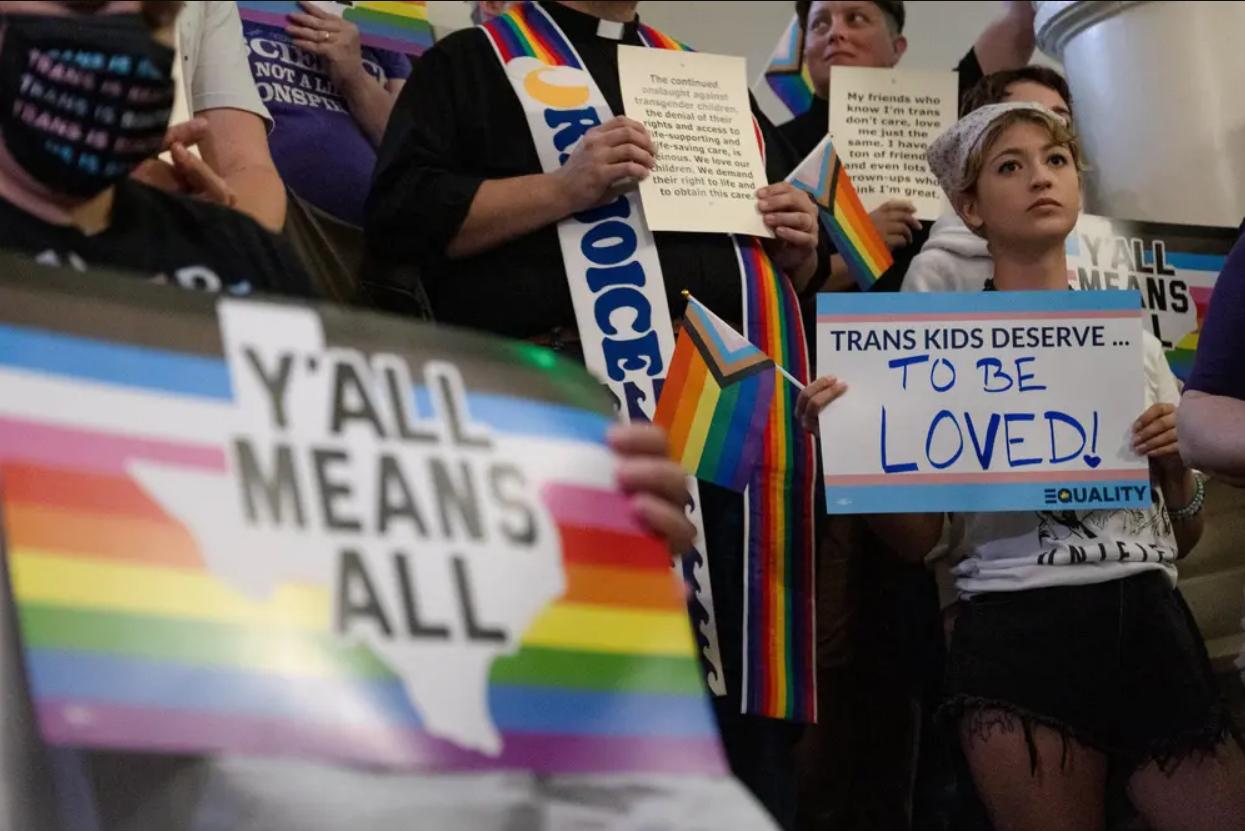

By Eleanor Klibanoff and William Melhado | Several families with transgender children are asking a judge to block a new Texas law that would stop minors from accessing many types of transition-related health care, including puberty blockers and hormone therapies.
The families argue the new law, which goes into effect Sept. 1, violates their parental rights by stopping them from providing medical care for their children and discriminates against transgender teens on the basis of sex. Several doctors have also joined the lawsuit, arguing the law interferes with their licensure and ability to practice medicine.
The lawsuit, which was filed in state court Wednesday, relies on legal arguments similar to those that have halted or blocked restrictions in several states, including Florida, Arkansas and Tennessee.
“The attack that Texas legislators and the governor have launched against transgender youth and their families and providers is stunning in its cruelty,” said Paul D. Castillo, senior counsel for Lambda Legal, which filed the lawsuit. “They are actively ignoring the science, dismissing best-practice medical care, intervening in a parent’s right to care for and love their child, and explicitly exposing trans youth in Texas to rampant discrimination. This law is not just harmful and cruel, it is life-threatening.”
All major medical associations support the use of puberty blockers and hormone therapy to treat gender dysphoria, the distress someone feels when their gender identity doesn’t match the sex they were assigned at birth. But in recent years, conservative groups have launched an all-out war on gender-affirming care, branding it “genital mutilation.”
Earlier this year, Republicans in the Texas Legislature passed Senate Bill 14, which Gov. Greg Abbott signed into law in June. The law stops transgender minors from accessing puberty blockers, hormone therapies or transition-related surgeries, which medical experts say are rarely performed on children. Children already receiving this care are required to be weaned off in a “medically appropriate” manner, the law says, which many doctors say would be unethical.
“The science on gender dysphoria lacks sufficient high-quality evidence documented, and there’s a growing list of harms, established side effects that accompany patients,” state Rep. Tom Oliverson, a Cypress Republican who sponsored the bill in the House, said during debate on the bill. Oliverson has said the bill was written to withstand expected court challenges.
After the lawsuit was filed, Republican state Rep. Jeff Leach of Plano tweeted that the challenge was expected: “What should also be expected is the State of Texas vigorously defending this law that protects children from dangerous and irreversible modification and mutilation procedures. We will fight. And we will win.”
The Texas attorney general’s office did not immediately respond to request for comment.
Although the law has yet to go into effect, health care options for transgender minors are already narrowing in Texas. In May, Houston-based Texas Children’s Hospital announced it would discontinue hormone therapy and other gender-affirming care treatments. The same month, adolescent health specialists at Dell Children’s Medical Center in Austin parted ways with the hospital after Attorney General Ken Paxton announced an investigation into the hospital.
“I can’t tell you what it feels like to be on the end of a call of a parent who has lost their child because their child looks out into the world and sees a world [where], overwhelmingly, adults are telling them and bullying them that they do not belong here, that they are not well, that they are not who they are,” said Emmett Schelling, executive director of the Transgender Education Network of Texas. “Then you strip away what’s already a thin layer of the system of health care to support our communities here in the state of Texas. And it’s an even worse outcome.”
Schilling said the law’s “chilling effect” is also diminishing health care options for transgender adults. Some families have decided to leave Texas to ensure their children can continue to receive health care.
“Because my daughter might need puberty blockers in the next few months, I am temporarily relocating out of state with her and my other child,” said one of the plaintiffs, identified in the lawsuit as Mary Moe, who is the mother of a 9-year-old transgender daughter. “I am heartbroken to have to take my children away from their home and their father, even temporarily. But I know that Texas is not a safe place for my daughter if this law forbids her access to this care.”
Texas is the largest of 18 states that have recently passed restrictions on gender-affirming care for minors. But these laws, which mostly sailed through Republican-dominated statehouses, are running into significant barriers in the courtroom.
In June, a federal judge ruled that Arkansas’ ban on gender-affirming care for minors is unconstitutional because it violates the due process and equal protection rights of transgender children and their families.
“Rather than protecting children or safeguarding medical ethics, the evidence showed that the prohibited medical care improves the mental health and well-being of patients and that, by prohibiting it, the State undermined the interests it claims to be advancing,” the judge wrote.
Federal judges in Florida, Kentucky and Tennessee have also blocked those states’ laws from going into effect, although an appeals court intervened to allow Tennessee to implement its ban.
This lawsuit is filed in state court, citing parental-right protections laid out in the Texas Constitution.
“The Texas Constitution provides stronger rights for parents, stronger rights in the guarantees of equality … and much stronger rights with respect to the individual rights of autonomy,” Lambda Legal senior counsel Paul Castillo said. “Those decisions that rest with parents are at their apex when they are made in consultation with physicians who recommend this medically necessary care.”
************************************************************************************
Read the suit here: (Link)
************************************************************************************
The preceding article was previously published by the Texas Tribune and is republished by permission.
The Texas Tribune is a nonprofit, nonpartisan media organization that informs Texans — and engages with them — about public policy, politics, government and statewide issues. Disclosure: The ACLU of Texas has been a financial supporter of the Texas Tribune, a nonprofit, nonpartisan news organization that is funded in part by donations from members, foundations and corporate sponsors. Financial supporters play no role in the Tribune’s journalism. Find a complete list of them here.
**********************
Quality journalism doesn’t come free
Perhaps it goes without saying — but producing quality journalism isn’t cheap. At a time when newsroom resources and revenue across the country are declining, the Texas Tribune remains committed to sustaining our mission: Creating a more engaged and informed Texas with every story we cover, every event we convene and every newsletter we send. As a nonprofit newsroom, we rely on members to help keep our stories free and our events open to the public. Do you value our journalism? Show us with your support.
Donation Link Here





Texas state Rep. James Talarico won a hard-fought primary Tuesday to become the state’s Democratic nominee for U.S. Senate, defeating U.S. Rep. Jasmine Crockett in one of the year’s most closely watched and competitive Democratic contests.
Talarico, a Presbyterian seminarian and three-term lawmaker from Round Rock, was declared the winner by the Associated Press early Wednesday morning after a closely tracked vote count that drew national attention.
“Tonight, the people of our state gave this country a little bit of hope,” Talarico told the AP. “And a little bit of hope is a dangerous thing.”
With 52.8% of the vote to Crockett’s 45.9%, Talarico secured the nomination outright, avoiding a runoff and capping months of sharp contrasts between the two candidates over strategy, messaging, and how best to compete statewide in Texas. Democrats hope the competitive primary — and the relatively narrow margin — signals growing momentum in a state that has not elected a Democrat to the U.S. Senate since 1988.
Talarico has long expressed support for the LGBTQ community, a position he highlights prominently on his campaign website. Under the “Issues” section, he directly addresses assumptions that might arise from his faith and background as a seminarian in a deeply conservative state.
“My faith in Jesus leads me to reject Christian Nationalism and commit myself to the project of democracy,” his website reads. “Because that’s the promise of America: a democracy where every person and every family — regardless of religion, race, gender, sexual orientation, or any other difference between us — can truly be free and live up to their full potential.”
Crockett struck a conciliatory tone following her defeat, emphasizing party unity ahead of November.
“This morning I called James and congratulated him on becoming the Senate nominee,” Crockett told Politico. “Texas is primed to turn blue and we must remain united because this is bigger than any one person. This is about the future of all 30 million Texans and getting America back on track.”
Talarico also drew national attention earlier in the race when “Late Show” host Stephen Colbert said he was initially unable to air an interview with the state legislator due to potential FCC concerns involving CBS. The episode sparked a broader political debate.
Brendan Carr, chair of the Federal Communications Commission, appointed by President Donald Trump, told reporters the controversy was a “hoax,” though he also acknowledged Talarico’s ability to harness the moment to build support as an underdog candidate. The interview was later released online and garnered millions of views, boosting Talarico’s national profile.
In November, Talarico will face the winner of the Republican primary between incumbent Sen. John Cornyn and Texas Attorney General Ken Paxton, who have been locked in a bruising GOP contest. Rep. Wesley Hunt was also in the Republican primary field. The GOP race is expected to head to a May runoff.
In a joint statement, Senate Minority Leader Chuck Schumer and Democratic Senatorial Campaign Committee Chair Kirsten Gillibrand praised Talarico’s victory and framed him as a candidate capable of broad appeal.
“As an eighth-generation Texan, former middle school teacher, and Presbyterian seminarian, James will be a fighter for Texans from all walks of life and of all political stripes,” they said. “In November, Texans will elect a champion for working people: James Talarico.”
Texas
Texas Supreme Court rules judges can refuse to marry same-sex couples
Decision published on Oct. 24.

Texas judges will now be permitted to refuse to officiate same-sex weddings based on their “sincerely held religious beliefs,” following a ruling issued Oct. 24 by the Texas Supreme Court.
The state’s highest court — composed entirely of Republican justices — determined that justices of the peace who decline to marry LGBTQ couples are not violating judicial impartiality rules and therefore cannot be sanctioned for doing so.
In its decision, the court approved an official comment to the Texas Code of Judicial Conduct clarifying that judges may opt out of performing weddings that conflict with their personal religious convictions. This clarification appears to directly conflict with existing provisions that prohibit judges from showing bias or prejudice toward individuals based on characteristics such as race, religion, or sexual orientation.
“It is not a violation of these canons for a judge to publicly refrain from performing a wedding ceremony based upon a sincerely held religious belief,” the court’s comment states.
The original code explicitly bars judges from showing favoritism or discrimination, declaring that they must not “manifest bias or prejudice, including but not limited to bias or prejudice based upon race, sex, religion, national origin, disability, age, sexual orientation, or socioeconomic status.”
The case traces back to McLennan County Justice of the Peace Dianne Hensley, who was publicly reprimanded in 2019 after refusing to marry same-sex couples while continuing to perform ceremonies for heterosexual ones, the Texan reported.
The State Commission on Judicial Conduct found that her actions cast doubt on her ability to act impartially, but Hensley has spent the past six years challenging that reprimand in court, arguing that she was punished for adhering to her Christian beliefs.
In a statement responding to the Oct. 24 ruling, Texas House LGBTQ Caucus Chair Jessica González expressed disappointment with the decision.
“The Texas House LGBTQ Caucus is disappointed, but not surprised, to learn that the Texas Supreme Court is not willing to stand up for the rights of LGBTQIA+ Texans,” she said. “Our right to marriage should never depend on someone else’s religious beliefs. This change in the Judicial Conduct Code will only further erode civil rights in Texas.”
The Texas Supreme Court is also currently reviewing a related matter referred by the 5th U.S. Court of Appeals. That case involves another judge, Keith Umphress, who similarly refused to perform same-sex weddings for religious reasons. The 5th Circuit has asked the Texas justices to clarify whether the state’s judicial conduct code actually forbids judges from publicly declining to officiate same-sex weddings while continuing to perform ceremonies for straight couples — a question that could further define the boundaries between religious liberty and judicial impartiality in Texas.
Texas
Democrats block anti-trans legislation by breaking quorum in Texas
Lawmakers flee state to halt GOP-backed redistricting and anti-trans policies
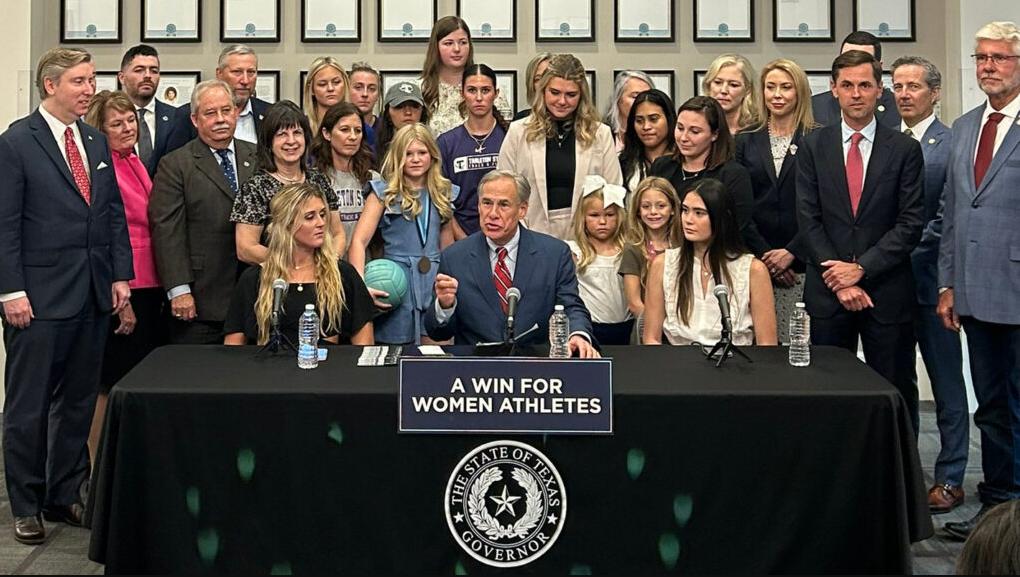
As Texas House Democrats fled the state to prevent Republicans from gerrymandering Democratic-held districts to flip seats, they also blocked anti-transgender legislation from being considered simply by not showing up.
More than 50 House Democrats left Texas on Sunday in an attempt to pause—if not kill—recent Republican-proposed and Trump-encouraged measures making their way through the state House.
This move by Democrats is called “breaking quorum,” and means the Texas House has fewer than the required minimum number of representatives present to conduct business. In total, the Texas House has 150 seats. Republicans hold only 88 seats—less than the 100 required to meet quorum—pausing the legislative session.
The Democratic legislators traveled to Illinois and New York, two Democratic strongholds with outspoken governors vowing to protect them and prevent Republicans from gaining an unfair advantage in the middle of the legislative calendar—at Trump’s behest.
The major issue Texas Democrats are drawing attention to is the recent redistricting plan, which would flip five Democratic U.S. House of Representatives seats to Republican ones through the use of gerrymandering, or strategic manipulation of district boundaries. This gerrymandering would likely result in Republicans retaining control of the U.S. House in the 2026 midterms.
In addition to redistricting, Republicans have proposed Senate Bill 7 (SB7), also known as “The Trans Bathroom Ban.” This bill mandates that people use the bathroom in government buildings, schools, and women’s violence shelters that corresponds with their sex at birth, rather than their gender identity. The bill would also require incarcerated individuals to be placed in facilities that match their sex at birth.
Proponents of the bill, like Fran Rhodes, the president of True Texas Project—a hardline conservative group that opposes LGBTQ rights and immigration—argue that without SB7, “we put women and girls at risk.”
This proposed legislation has been denounced by Equality Texas, which says it would not only put trans women at risk, but also cis women, who would be subject to “invasive gender inspections.” They argue this would undermine the Republicans’ stated intent of the bill by subjecting women to unnecessary scrutiny rather than protecting them.
Multiple cis women have come out in opposition to the bill, including Wendy Davis, a lawyer and former member of the Texas State Senate, who called the bill “a solution without a problem.”
Davis continued, saying that “Our trans sisters deserve to be safe in the restroom, just like we deserve to be safe in the restroom.”
Additionally, some Black Texans have sounded the alarm on this bill, likening it to Jim Crow-era segregation legislation—but instead of skin color, it uses gender identity to discriminate.
As the clock runs out on this 30-day special session ending Aug. 19, there is a chance Republican Gov. Greg Abbott could extend the session, as it is within his power as governor.
Texas Democrats hope this will pressure Republicans to work with them to reach a compromise on both redistricting and killing the anti-trans bill.

D.C.’s affirming congregations to mark Holy Week, Easter

Trans activists gather on National Mall for Transgender Day of Visibility

The cost of speaking one’s mind

Senegalese president signs bill that further criminalizes homosexuality

Md. lawmakers reaffirm legislative priorities

Celebrate cherry blossoms the drag way

Lorato ke Lorato: marriage equality, democracy, and the unfinished work of justice in Botswana

Japanese Supreme Court to consider marriage equality

The outrage economy is not the LGBTQ community

Trump tells Fox News he won the ‘gay vote’ — but polls tell a different story
-

 Out & About5 days ago
Celebrate cherry blossoms the drag way
-
Botswana5 days ago
Lorato ke Lorato: marriage equality, democracy, and the unfinished work of justice in Botswana
-
Japan5 days ago
Japanese Supreme Court to consider marriage equality
-
Opinions5 days ago
The outrage economy is not the LGBTQ community