National
Book bans are ‘dangerous, insidious’
Movement to prohibit LGBTQ-specific material in libraries gains traction
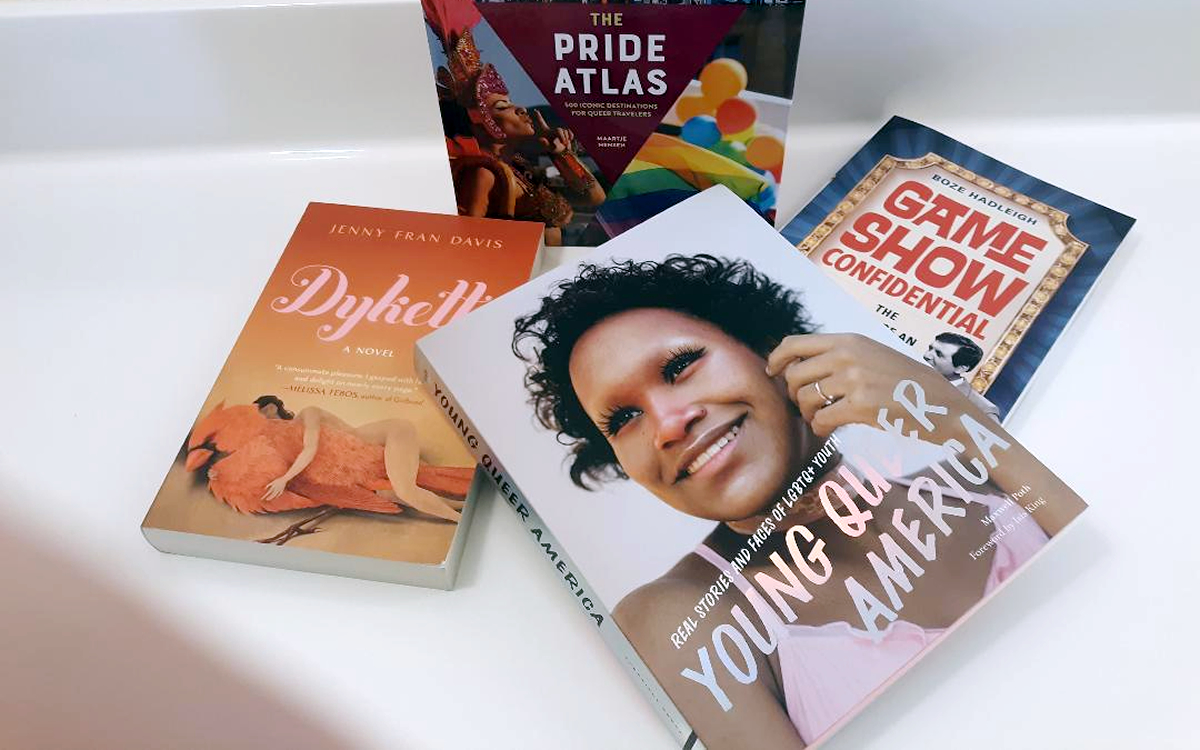
The executive director of Equality Virginia this week reiterated her sharp criticism of efforts to ban books with LGBTQ-specific content.
“There is a dangerous, insidious trend developing in states around the country where innocuous and inclusive books are being removed from libraries and curricula, including and especially books and resources about LGBTQ+ people,” Narissa Rahaman told the Washington Blade on Tuesday in a statement. “We should not be pursuing book bans in a pluralistic democracy, but rather seeking to provide more information, more resources, more points of view for anyone seeking it out.”
Robert Rigby, Jr., a spokesperson for FCPS Pride, a group that represents LGBTQ employees of the Fairfax County School District, echoed Rahaman.
“Libraries and are places where children can and should be welcomed, safe, respected and included. Books and librarians literally save lives,” Rigby told the Blade on Wednesday. “Practically, inclusive book and materials collections improve attendance, scores, graduation rates and well-being. FCPS Pride respects and trusts our professional librarians. They are heroes who make schools a better place for all.”
Rahaman and Rigby spoke with the Blade against the backdrop of continued efforts to ban books with LGBTQ-specific content as students return to the classroom in Virginia and around the country.
A group of parents who want the ability to allow their children to opt-out of classes in which books with LGBTQ-specific books are read have filed a federal lawsuit against the Montgomery County Board of Education and Montgomery County Public Schools Supt. Monifa McKnight. A hearing in the case took place in U.S. District Court in Greenbelt on Wednesday.
“The Montgomery County Board of Education took away parental notice and opt-outs for storybooks that advocate pride parades, gender transitioning and pronoun preferences for kids as young as pre-kindergarten,” said Becket, a conservative law firm that advocates for religious freedom, in a statement about the case. “Becket is helping a group of Muslim, Catholic and Ethiopian Orthodox parents who want to restore their ability to raise their children consistent with their faith.”
NBC Washington on Tuesday reported Michelle Ross, director of the Samuels Public Library in Front Royal, Va., has resigned after she and her staff faced harsh criticism from a group that wants to ban books with LGBTQ-specific content. Donald “Mac” Scothorn, chair of the Botetourt County (Va.) Board of Supervisors, on July 31 proposed adult supervision for anyone under 18-years-old who visits the county’s four libraries.
The Hillsborough County School District in Florida ahead of the 2023-2024 school year has prohibited teachers from teaching their students about William Shakespeare, citing the state’s “Don’t Say Gay” law that Republican Gov. Ron DeSantis signed. The Urbandale Community School District in Iowa has removed a Transportation Secretary Pete Buttigieg biography and nearly 400 other books from school libraries and classrooms.
“We even see extremists ban books and attempt to erase, and even rewrite, the ugly parts of our history,” said Vice President Kamala Harris in Orlando, Fla., on Aug. 1 in response to the Florida Board of Education’s new Black history curricula standards that suggest slavery had benefits. “Right here in Florida, they plan to teach students that enslaved people benefited from slavery. They insult us in an attempt to gaslight us, in an attempt to divide and distract our nation with unnecessary debates.”
A federal judge in Texas in April ordered Llano County officials return books — many of which had LGBTQ-specific content — they removed from their public libraries.
Republican Arkansas Gov. Sarah Huckabee Sanders earlier this year signed a law that would have made it a crime for librarians and booksellers to provide access to books and other materials deemed “harmful to minors.” The statute was to have taken effect on Aug. 1, but a federal judge blocked it.
The College Board on Aug. 3 said the Florida Department of Education had effectively banned the teaching of Advanced Placement Psychology classes in the state’s schools because the course includes discussions about sexual orientation and gender identity. Florida Education Commissioner Manny Diaz, Jr., in a letter he sent to the Florida Association of District School Superintendents the following day said the course could be taught “in its entirety.”
California officials — Democratic Gov. Gavin Newsom, Attorney General Rob Bonta and State Superintendent of Public Instruction Tony Thurmond — in a June 1 letter to the state’s public school superintendents and charter school administrators told them not to ban books. The Prince George’s County Memorial Library System the day before announced the launch of its Rock Banned Book Club.
“Here in Virginia, we were founded in response to government overreach,” Rahaman told the Blade. “As this conversation moves throughout state legislatures, we’re hopeful that our founding principles and open society outweigh the fear-mongering from opportunistic politicians and government officials.”
Brody Levesque and Christopher Kane contributed to this article.



National
Queen Jean is Tony’s first transgender winner
Designer/activist wins for work on ‘Cats: The Jellicle Ball’
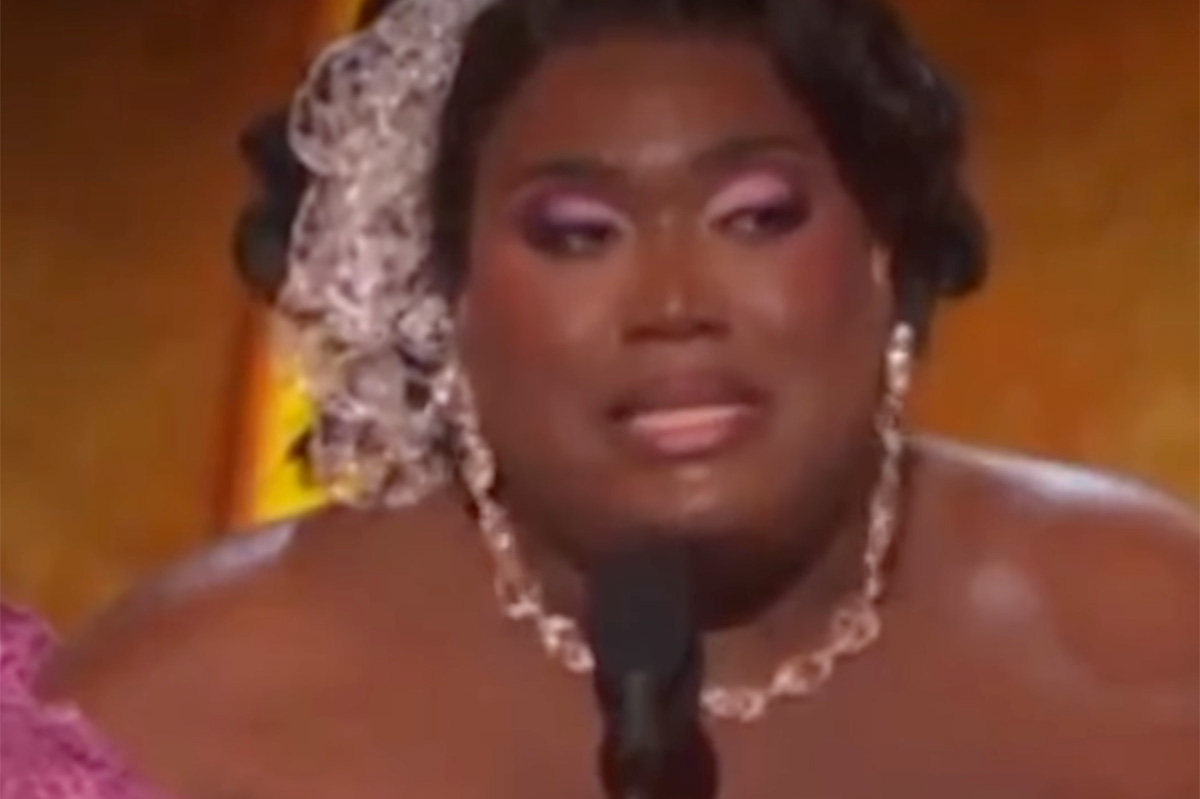
It was a historic night at the 79th annual Tony Awards on Sunday as Queen Jean won the award for Best Costume Design of a Musical, making her the first out transgender person to win a Tony.
“This experience has been monumental. We are here for the legacy of queer people, trans people,” she said. “We are taking up space in ways we have to take up space. We have to shift the paradigm. So I just want to say, thank you all so much for this incredible honor. The world right now is deeply, deeply combating so many ailments, and we know as a society that when we come together, we can make real, permanent change.”
She won the award for her work on “Cats: The Jellicle Ball” and was also nominated for best costume design of a play for “Liberation.”
In addition to her stage work, Queen Jean is the founder of Black Trans Liberation, an organization that supports trans and gender-nonconforming people in New York City.
National
Madonna turns Times Square into massive dance floor
Pop icon celebrates Pride month with surprise performance
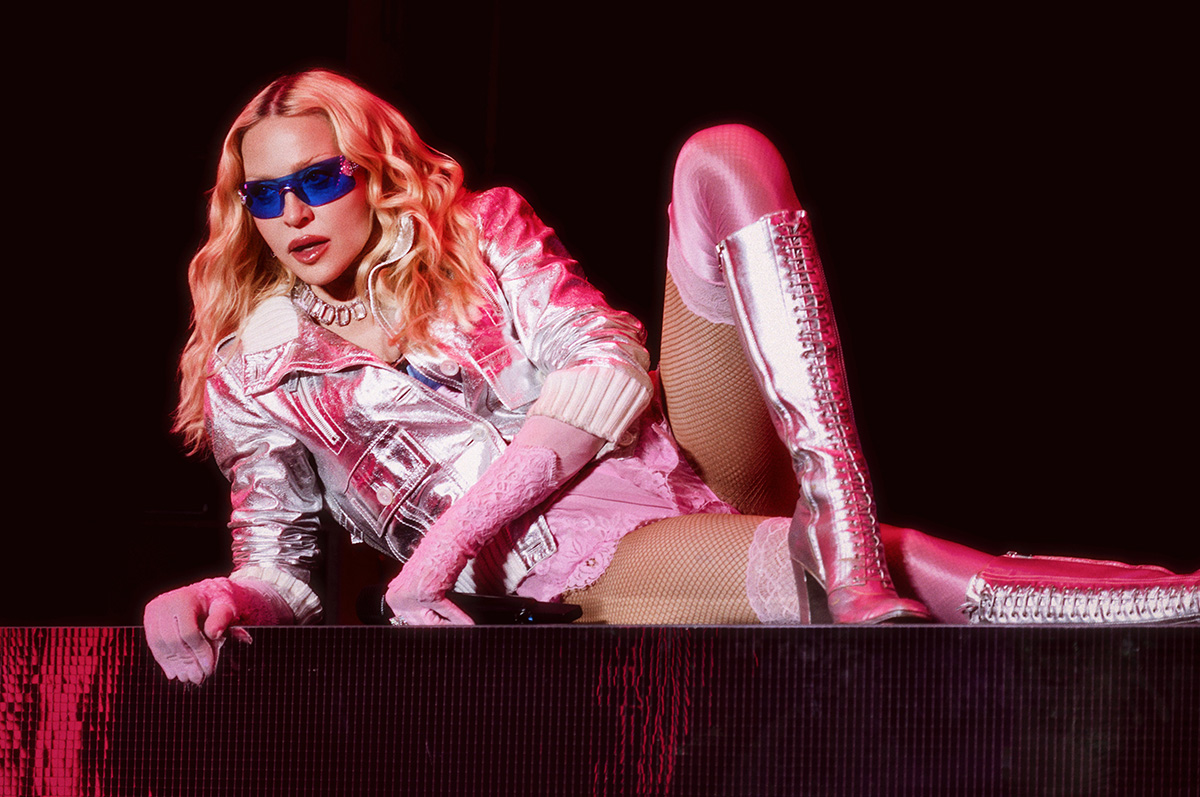
Pop icon Madonna celebrated Pride month with a pop-up performance in New York City’s Times Square on Thursday to the delight of 50,000 fans.
She performed for about 15 minutes high above street level, including several songs from her new album “Confessions II” due on July 3, along with a trio of songs from the first “Confessions on a Dance Floor.”
In addition to the brand new “Love Sensation,” she performed “I Feel So Free” and “Bring Your Love,” plus “Hung Up,” “Get Together” and “I Love New York.” She wished the crowd a happy Pride season; the event was shared with audiences through Grindr’s first-ever livestream.


National
Gallup finds LGBTQ support among Americans is dropping
Marriage equality support lowest since 2016
Gallup, one of the leading organizations in public opinion polling, has found that LGBTQ support among Americans is dropping.
The poll, whose data was collected using Gallup’s annual Values and Beliefs survey, was conducted in May and was published on Wednesday. The data was collected through telephone interviews from a sample of more than 1,000 adults living in all 50 states and D.C. using random digit dialing.
It highlights declining attitudes surrounding LGBTQ issues in multiple areas — from support for same-sex marriage to views on gender identity and the morality of one’s sexuality.
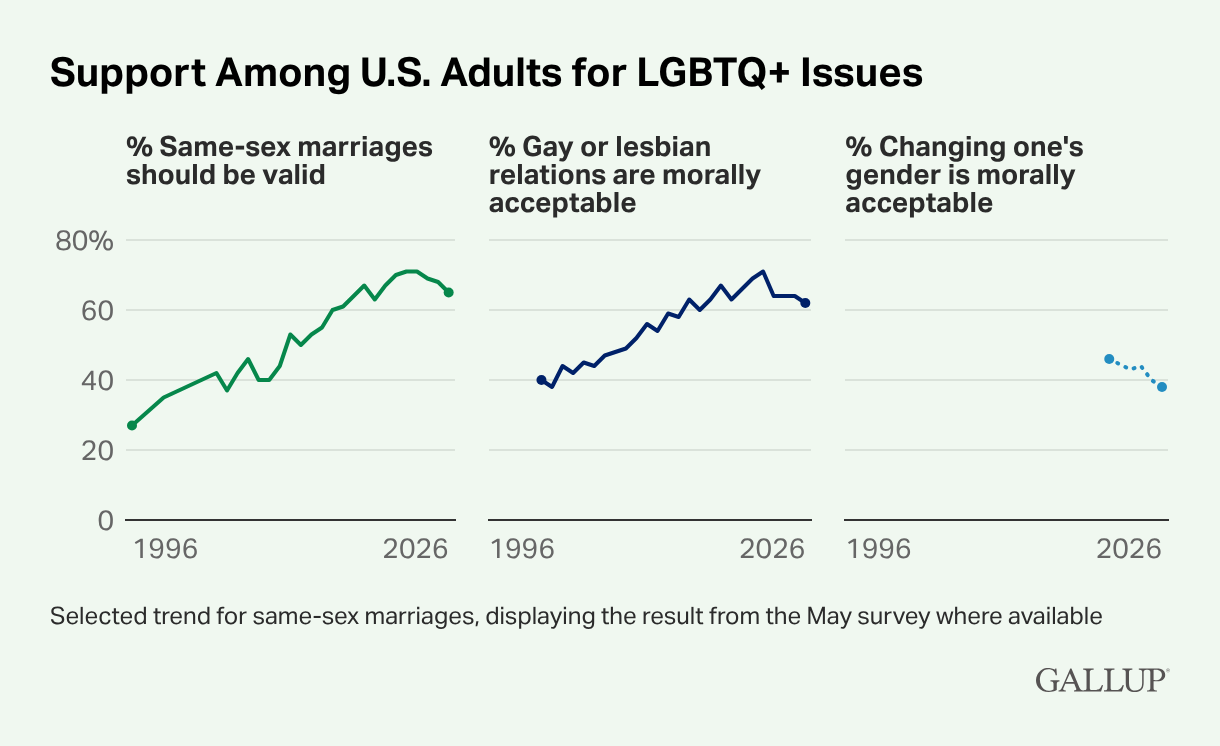
One of the most striking findings was that support for marriage equality fell six points from its 2022-2023 high.
The survey also found that 62 percent of Americans view gay and lesbian relations as morally acceptable, the lowest level since 2016 just after same-sex marriage was legalized nationwide by the U.S. Supreme Court.
One newer question on the poll found that the perceived morality of changing one’s gender has dropped eight points since 2021, indicating the American public is less supportive of transgender people.
The data attributes much of the decline to shifting Republican views alongside the party itself. Conservative leaders have pushed back against diversity, equity, and inclusion programs that were intended to foster greater acceptance of LGBTQ people and other historically disadvantaged groups.
President Donald Trump has been a guiding force behind waves of anti-LGBTQ sentiment, particularly when it comes to trans rights. The president has enacted multiple executive orders, including Executive Order 14168, “Defending Women from Gender Ideology Extremism and Restoring Biological Truth to the Federal Government,” which mandates that gender be defined by one’s sex assigned at birth. He also signed Executive Order 14183, “Prioritizing Military Excellence and Readiness,” which barred qualified trans applicants from joining the military and led to the removal of trans service members already serving in the armed forces.
Additionally, he signed Executive Order 14201, “Keeping Men Out of Women’s Sports,” which prohibits trans female athletes from participating on women’s and girls’ sports teams.
In February, Gallup found that an estimated 9 percent of Americans identified as part of the LGBTQ community in some form.
The organization also found that 23 percent of adults under age 30 identify as LGBTQ, compared with 10 percent of those ages 30 to 49 and 3 percent or less among those ages 50 and older.

PHOTOS: Fairfax City Pride

EXCLUSIVE: Pelosi reflects on four decades of LGBTQ advocacy

D.C. prepares to party as Pride celebrations kick off Saturday

David Archuleta, Monroe Alise named D.C. Pride parade marshals