Movies
‘Nyad’ stays afloat thanks to stellar performances
An engaging story that provides visibility for strong, authentic queer characters
Biopics are the thing this year, it seems.
So far, 2023 has brought us big-and-buzzy movies about a world-changing scientist (“Oppenheimer”), a pop culture princess (“Priscilla”), and an unsung hero of the Civil Rights movement (“Rustin”), with the much-anticipated “Napoleon” from Ridley Scott, starring Joaquin Phoenix in the title role, soon to come. All of these have centered on more-or-less well-known real-world figures. Even Rustin, whose long-obscured historical contributions have been amplified since the Obama era, can safely be said to have a more famous name than the woman whose story (or, at least, part of it) is told in “Nyad.”
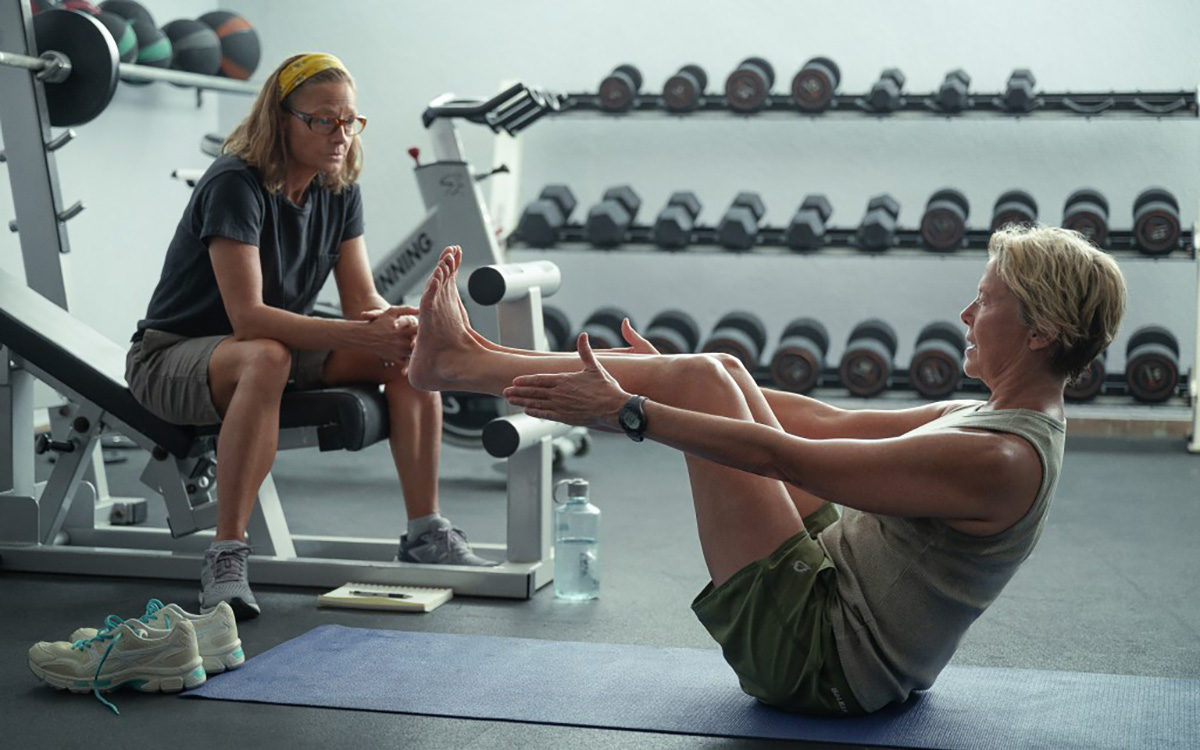
That film, produced by Netflix and released on its platform Nov. 3, relates the saga of marathon swimmer – also author, journalist, and motivational speaker – Diana Nyad, who in 1978, at age 28, attempted and failed to become the first person to complete the swim from Cuba to Florida. Someone else (equipped with a shark cage) would go on to claim that record, but the movie picks up the saga when Nyad (Annette Bening), now 60, decides to try the swim again. To make her unlikely dream come true she enlists the aid of her best friend and former coach Bonnie Stoll (Jodie Foster), who reluctantly agrees to the challenges.
Bolstered by confidence, drive, and a determination to complete what she started long ago – not to mention a seasoned sea captain (Rhys Ifans) to guide her course and a team of experts brought in to help protect her from the dangers of the deep – Nyad embarks on a late-life quest to accomplish her seemingly impossible goal, refusing to give up the effort despite failure, fate, and the uncontrollable forces of nature itself.
As written by Julia Cox and co-directed by husband-and-wife team Jimmy Chin and Elizabeth Chai Vasarhelyi (“Free Solo”), “Nyad” fully embraces all the conventions of the sports-bio subgenre, from training montages to heartbreaking disappointments to adrenalin-pumping suspense, and – to its credit – manages to do so without feeling like a cookie-cutter repetition of formula. Part of this, of course, can be attributed to the “edginess” points it earns by focusing on an athletic hero that is not only female, but a 60-something gay female at that.
Another key factor is its adventurous environment and setting, which puts us into a world that most of us will never visit and forces us to imagine a feat almost none of us could hope to achieve. The thrill of the ride is more than enough reason to take the journey, and it’s easy to be sucked into the vicarious experience as we root the movie’s eponymous real-life heroine on toward a hoped-for triumph.
Still, it’s impossible not to observe a certain rote quality to the film’s approach. Even for those who go into “Nyad” without knowing her story (which, with the exception of those with an interest in the world of competitive long-distance swimming, is likely to describe most of us), it seems unthinkable that Diana Nyad won’t accomplish what she sets out to do – after all, why would a movie about her exist had she not done so? Presumably recognizing the same point, Chin and Vasarhelyi angle their movie toward the visceral, attempting to immerse us in a first-person experience instead of keeping us hanging on the eventual outcome. This is a story about a personal journey, about the friendship and teamwork that make it possible, and not a “will she make it or not?” nail-biter.
To that end, “Nyad” benefits most from the two stars who anchor it. As Nyad, Bening is an indomitable – sometimes imperious – spirit, driven to the point of obsession, and might well come off as something less than likable were it not for the perfectly balanced counterweight provided by Foster’s breezy, down-to-earth Stoll. There’s an easy chemistry between them, a symbiotic alignment that works to both their benefits. We like Nyad better because Stoll likes her, and we respect the easy-going Stoll more because Nyad does. These two film veterans allow us to see their characters reflected through each other’s eyes, heightening the emotional connection we feel toward both and giving the movie a loving heart – albeit a platonic one, since “Nyad” refreshingly focuses on a story of female friendship without imposing a perfunctory and unnecessary “Hollywood” love story into the middle of it – with which we can all relate even if we can’t wrap our heads around the intense physical and psychological pressure of being a long-distance open sea swimmer.
Yet even with two superb performances leading the charge, there’s still an air of disingenuousness to “Nyad,” a showy, exaggerated sense of drama that feels designed to keep things exciting. After all, no matter how intense a real-life marathon swim might be for the person in the water, watching it from the perspective of an observer would mostly be a monotonous affair, and the film tries hard to keep itself moving briskly, leaning heavily into edgy cutting and a rapid-fire narrative style as it elides its way over the routine stuff between the obstacles and setbacks. It’s an understandable approach, but one that fails to generate real suspense, because (as noted above), Nyad’s eventual success feels like a foregone conclusion from the beginning, even when things lean hard into the stakes-raising drama of swimming with hungry sharks and poisonous jellyfish. As a result, when these things happen, they feel manufactured.
Indeed, some of the events in the narrative are manufactured, and while such examples of artistic license have always been standard practice in “fictionalizing” true stories on the screen, there have been criticisms leveled at the film’s representation of events – particularly its depiction of Nyad’s final swim, some details of which were poorly logged and subject to conflicting accounts from members of her support team. Those controversies are omitted or glossed over here, which can’t help but tarnish the movie’s clear intent to celebrate a queer hero.
Nevertheless, as a piece of old-fashioned, inspirational Hollywood entertainment, it works well enough, thanks largely to Bening and Foster, who elevate it to awards-worthy status in spite of itself. And if, in the long run, it doesn’t rise to the level of their performances, it’s still an engaging story that provides all-too-rare visibility not just for strong and authentic queer characters, but for strong and authentic older ones, too.
In Hollywood, that’s got to be almost as remarkable a feat as swimming 100 miles in the open ocean.





Movies
30 years on, ‘The Birdcage’ remains a landmark
A reminder that the only thing required to make a family is love

In 1996, after the AIDS epidemic had cast its shadow over the gay community for a decade and a half, the breakthrough finally came: the success of antiretroviral medication turned a fatal disease into a manageable and survivable condition — and suddenly, “queer joy” began to feel like a possibility again.
The year 1996 also saw the release of “The Birdcage,” a remake of the farcical French film comedy “La Cage aux Folles,” about a gay couple who attempt to “play it straight” when their son brings his fiancée’s conservative parents over for dinner, starring Robin Williams and Nathan Lane — in one of his first (non-animated) film roles — as the couple. It was notable as one of the rare studio films of the era to center on gay characters, and the fact that it was a certified box office hit represented a welcome cultural shift after the years of homophobic stigma fostered by Reagan-era “moral majority” conservatism.
These two landmarks were coincidental, of course, and obviously the significance of the first (though it came a few months later) was, in the scheme of things, far more monumental. Nevertheless, there’s something about the timing that marked a definitive moment in the ongoing struggle for queer acceptance. It was a palpable turn of the tide, a moment in time when we could collectively “unclench” — and 30 years later, in the midst of a whole new onslaught of conservative bigotry that threatens to erode the progress of the intervening years, it’s a moment worth celebrating, if for no other reason than to remind ourselves of what is possible when we refuse to hide who we are.
That, after all, is the central conflict in “The Birdcage,” just as it was in the earlier French play (by Jean Poiret) and film that inspired it, as well as the hit Broadway musical (“La Cage aux Folles” (adapted by queer writer Harvey Fierstein and queer composer Jerry Herman) that came in between. Set in the famously gay Miami neighborhood of South Beach, it centers on a popular queer nightclub owned by longtime partners Armand (Williams), who runs the business, and Albert (Lane), a flamboyant drag performer known as “Starina” who serves as the club’s headlining act; as a result of a long-ago one-night stand, Armand is father to Val (Dan Futterman), whom the couple have raised together, and who has become engaged to Barbara (Calista Flockhart), the daughter of a prominent conservative senator (Gene Hackman). Fearing that knowledge of his parents’ true relationship will prevent the senator from allowing the marriage, Val convinces Armand and Albert to temporarily “straightwash” themselves for a dinner party with the would-be future in-laws. Naturally, things do not go as planned (this is a farce, after all), but by the end, the gays “save the day,” as they say, by helping the senator and his wife (Dianne Wiest) avoid a scandal, and the kids get to have their wedding, after all.
It’s true that “The Birdcage” has invited criticism from within the community over the years for offering exaggerated stereotypes, especially in its depictions of “femme” characters like Albert and Agador (Hank Azaria), the couple’s Guatemalan housekeeper — and, in more recent times, from younger queer viewers who brand Val as “the real villain” of the movie for his insistence on making his parents pretend to be straight. There’s also the quibble that two of the film’s leading gay characters are played by heterosexual actors (Williams and Azaria) and that neither the writer nor director of the film were queer themselves. We can’t dispute the validity of such positions, but we can certainly suggest that they might be missing the point.
The director, Mike Nichols, was a man who had transitioned from being a comedian to becoming a celebrated director for both stage and screen, responsible for (among many other films) “Who’s Afraid of Virginia Woolf?” and “The Graduate,” and the script was by Elaine May, his former comedy partner, known for her witty, sophisticated, and savvy screenwriting. Both came with a pedigree that included extensive collaboration with queer performers and creators, and a track record that clearly showed their dedication for humanity and truth over the social constructs they repeatedly undermined with shrewd observational satire.
Williams, known then and now for his manic, over-the-top cartoonishness, plays Armand with complete sincerity, balancing his signature lunacy (like the classic “Fosse, Fosse” moment as he directs a new act for the club) with a deeply considered emotional solidity that never strikes a false note; and Azaria, whose performance became an instantly iconic fan favorite of outrageous femme-boy camp, is lovable precisely because his iteration of the cliché is so completely un-self-conscious, and is still beloved arguably as much for this as for his decades of voice work on “The Simpsons” — not because he is ridiculous (he is, and hilariously so) but because he is so recognizably real.
As for Lane, Albert’s character is explicitly written as a “diva,” the kind of gay male “show queen” stereotype that never quite offends because we all know someone — or are someone — who fits that profile to a tee; underneath it all is a person determined to live life on their own terms, and it makes his emergence as an eleventh-hour hero/heroine all the more satisfying. Let’s face it, when the chips are down, none of us could ask for a better mom than he turns out to be.
Of course, the participation of incomparable actors Hackman and Wiest is invaluable, allowing even their stodgy characters enough grace to keep them from coming off as complete buffoons (though Hackman’s reprehensible senator, appropriately enough, comes close); for good measure, there’s even the delicious Christine Baranski as Val’s biological mother.
All those performances — along with the fabulous explosion of Miami decor in the scenic design, the depictions of vibrant queer nightlife, and a soundtrack that includes both spicy nuggets of iconic club music and a handful of songs by the great gay genius Stephen Sondheim — are enough to make “The Birdcage” a classic, but the reason it continues to resonate with queer joy emanates from the material itself.
Wrapped up in all the absurdity of its humor, “La Cage aux Folles” (in all its forms) proffers a simple story in which — despite misunderstandings, hurt feelings, and all the various kerfuffles which erupt throughout — everyone shows up for each other. It’s a portrait of a household built on love, about a family willing to leap hurdles and place the happiness of those dear to them above their own inconveniences. In the end, the queerness is really not the point; but the fact that it’s a queer family who embodies these values (and a messy one, at that) is, as the queer expression goes, everything.
Thirty years ago, “The Birdcage” was a fun celebration; today, in a world that once more feels weaponized against queerness, it’s more than that: It’s a great film that reminds us that our greatest victories arise from being ourselves, unapologetically — and that the only thing required to make a family is unconditional love.
Movies
‘She’s the He’ brings gender-bending twist to teen comedy genre
Recreating raunchy nostalgia through a queer eye

No matter which generation you belong to, you have nostalgic memories of “teen comedy” movies from your adolescent years, even though you’re a little embarrassed about it today.
This is particularly true for the Gen X and Millennial crowd, who grew up with raunchy teen movies from “Fast Times at Ridgemont High” to “Porky’s” to “American Pie,” and have lived long enough to experience the shock of watching younger generations deploring them for the very raunchiness and toxic behavior that made them appealing to us in the first place.
These are exactly the type of films that are channelled in “She’s the He,” a SXSW hit and Independent Spirit Award nominee that hit VOD platforms on June 30, which strikes a nostalgic chord that conjures both the extreme “political incorrectness” and heartfelt sensitivity of the movies that inspired it – but updates the formula to add an edge that’s especially relevant in our current time.
In other words, it recreates the “raunchy teen comedy” genre through a queer eye (with a focus on the fine points of gender identity), and it’s every bit as messy, awkward, inappropriate, and “cringey” as you might hope it to be.
Written and directed by trans/nonbinary filmmaker Siobhan McCarthy, it’s a movie that might result in mixed feelings from many audiences over a story that centers on two cis-male high school seniors, Ethan (Misha Osherovich) and Alex (Nico Carney), who pretend to “come out” as trans together as a way to get close to girls.
Actually, it’s mostly Alex’s scheme to gain “access” to his crush, Sasha (Malia Pyles), and quell the rampant rumors that he and lifelong BFF Ethan are gay, reasoning that being “trans” would technically make them girls, too. It works, incredibly, in the beginning, but as a burgeoning friendship with nonbinary Forest (Tatiana Ringsby) distracts Alex from his rampant teen hormones, Ethan begins to realize that she really is trans, after all. What started out as a juvenile ploy suddenly becomes a complicated mess, and the two best friends must try to navigate their way out of it; unfortunately, Alex can’t stop scheming for sex and Ethan is struggling with the prospect of coming out to her transphobic mother (Suzanne Cryer), and needless to say, it puts a strain on their friendship. Meanwhile, there’s a whole locker room full of testosterone-charged jocks who want in on the scam themselves.
If all that sounds incredibly problematic to you, you’re not wrong – it definitely is. The entire premise, with all its nonconsensual shadiness and its hormone-driven gaslighting, seems like enough to trigger calls for “cancellation” from both sides of our divided social mediaverse; add to that the fact that the whole thing is played for laughs, as a crass and foul-mouthed sex farce about high school kids, and the movie opens itself up to an even greater level of pearl-clutching.
Like most of those teen raunch-fests of earlier generations, however, “She’s the He” is doing it all on purpose. McCarthy’s wildly “inappropriate” movie is not just some cheap sexploitation comedy, but a savagely campy assault on the attitudes and expectations of the very people that might be offended by it.
As McCarthy says in their director’s notes for the film, “By taking conservative talking points at face value and playing out their worst fears on screen, ‘She’s the He’ seeks to undermine and defang these harmful ideas while satirizing the very media that has fueled this fear-mongering.”
Among the most obvious “conservative talking points” their movie lampoons is the whole obsession around gender and bathrooms (it is, after all, a story about two cis males who essentially disguise themselves as trans so that they can get into the girl’s locker room), but there are a whole lot of others, too: the excessive concern over pronouns, the obsession over genitalia, the assumption that gender identity and sexuality are somehow synonymous, the sexed-up male fantasy of what happens between girls when they’re behind closed doors – all the typical exaggerated tropes are there, and exaggerated even further for full effect. In fact, it’s the film’s not-so-subtle subversion of the “male gaze” through a queer and feminist lens that might be its most satisfying flourish, underscoring the already absurd parody provided by Alex’s single-minded (and hilariously “incel”-ish) prioritization of his sex drive above all other considerations.
Yet what really raises “She’s the He” above the level of the crude humor it deploys has nothing to do with making fun of people, nor is it even about pushing against uptight social boundaries around sexual and/or gender expression; all the irreverent zaniness is wrapped around a deeper story about friendship, love, and growth, a journey of self-discovery and finding the courage to embrace who you really are. And at the center of it is a transgender nonbinary actor in the leading role – in itself a bold challenge to rigid expectations – with not just the talent, but the grace, nuance, and bravery to play it with full authenticity. Osherovich earned a well-deserved nomination for Best Breakthrough Performance at this year’s Independent Spirit Awards, and they’re the heart of the film.
In fact, it might be McCarthy’s deliberate choice to cast their film entirely with actors who identified in some way as queer that fuels its transgressive energy and keeps it feeling “real” even when it’s at its most ludicrously excessive. They make for a great ensemble of players, but naturally there are standouts: co-star Carney (who is also a successful standup comic, known for mining his own transmasculine experience for laughs) does a great job as Alex, endearingly unconcerned and frequently clueless about his shortcomings as he single-mindedly pursues the loss of his virginity, and his chemistry with Oserovich makes them a winning pair whenever they share the screen; Cryer brings a dose of needed maturity to the mix, while also conveying the struggle of a mom trying to navigate her child’s coming out; Pyles and Ringsby both bring the intelligence and depth to undercut our expectations of their characters; comedian Aparna Nancherla earns plenty of chuckles as a teacher haplessly trying to keep up with all the changing identities (and pronoun protocols) of her students; and knowing that the school’s entire male sports team is played by transmasculine actors adds a delicious flavor to the movie’s overall parody of conventional gender presentation that helps make its climactic “locker room showdown” scene all the more hilarious.
It’s worth noting that “She’s the He” is targeted mainly for Gen Z audiences – it’s their generation’s turn to put their stamp on the genre, after all – but older audiences needn’t feel left out; there’s plenty here that should feel universal enough for any age to enjoy; and if you’re afraid it will be too extreme, rest assured: the most shocking thing about it is that it might be the sweetest teen sex comedy you’ll ever see.
Considering they’ve been making them for decades, that’s saying a lot.
Movies
Ethereal ‘Camp’ a moody allegory for queer shame
An unsentimental yet empathetic exploration of guilt

When one watches movies for a living, it’s as easy to fall into routine as it is with any job. Each movie is different, of course, each with its own characters, its own viewpoint, and its own story – (or at least its own variation on one), but in so many other ways, they have a tendency to be very much the same.
This is because there is an entire “language” of filmmaking, established from the earliest days of cinematic storytelling, a process so subtle that most of us are barely aware of it: the image directs our attention, the script provides the shape and structure of the story, and the actors are our stand-ins, allowing us to “experience” the reality of the film through a transference of identity that occurs so reflexively that we don’t even notice it’s happened.
That’s why it can be such a jolt when we come across a movie that doesn’t follow the expected rules, and we can’t think of a better recent example than Avalon Fast’s “Camp,” which drew attention as it made the rounds at last year’s festival circuit and embarked on a series of screenings in select cities beginning on June 26.
Fast, 26, is a queer Canadian filmmaker who specializes in “Girl Horror” (a genre that centers female experience), and who has already become a prominent force in the “new queer indie” movement. Her first feature, “Honeycomb,” got a Slamdance “virtual” screening, and she’s appeared as a performer in films like Alice Maio Mackay’s “The Serpent’s Skin” and leading trans filmmaker Jane Schoenbrun’s yet-to-be-released Cannes hit, “Teenage Sex and Death at Camp Miasma.” With “Camp,” however, she stakes her claim to territory in a burgeoning field of queer/trans/feminist cinema to establish herself as a formidable “brand” of her own.
Rooted in a blend of trope-ish horror conventions and presented in a dreamy, ethereal style that elevates feeling over cognition, it’s the story of Emily (Zola Grimmer), a young woman accidentally responsible for two horrific tragedies, who feels hopelessly trapped by guilt and shame. At the suggestion of her father (Mike Tan), she takes a summer job as a counselor at a camp for “troubled” young people like herself, where she is quickly embraced and assimilated by the core group of female counselors – most of them “hot weirdos” who are more interested in all-night partying and a kind of home-grown witchcraft than they are in the wholesome camp activities they supervise during the day. Her initial response to this new environment is guarded, but as the summer goes on she comes to feel a strong connection to her fellow counselors, beginning to hope that she has – at last – found her place among a “family” that accepts her despite the life-shattering incidents that have come to define her sense of self. Yet at the same time, she becomes ever more aware of a call to confront and quiet the ghosts of her misfortunate past – even if it requires an unthinkable sacrifice.
Dreamy and purposefully opaque when it comes to differentiating between real experience and metaphysical reflection, Fast’s movie draws us in from the start with its edgy mix of visual atmosphere, blending an aesthetic that combines home-movie nostalgia with the ironically whimsical flourishes of the digital age to establish a tone that feels like a half-forgotten memory reconstructed in the form of an Instagram “reel.” It’s a potent effect, creating a milieu of surreal impressionism in which the plot advances more through mood and fragments of subjective experience than through concrete narrative form; at times, it feels untethered, yes, but it always manages to orchestrate its seemingly disjointed perspective into a shape that makes sense — even if we’re not quite sure how or why, or even what is actually happening.
The effect is cumulative, as the story becomes less bound to logic and realism while leaning further into a perspective that favors the arcane and mysterious over the rational and concrete. And while that might prove frustrating for viewers expecting a more traditional kind of “horror,” it provides for an experience that’s more likely to satisfy the kind of fans who appreciate being left to provide their own interpretations. The most obvious comparison would be with the work of David Lynch; there’s clearly an influence there for Fast’s darkly intuitive approach, which goes beyond the obvious parallels of its “Twin Peaks”-ish setting (the forest is most definitely a character here) to emulate the stream-of-consciousness narrative flow that marked much of Lynch’s late-career work.
“Camp” is far from imitative, however. While it may share some traits with the work of Lynch and other masters of contemporary surreal horror, it creates a unique “vibe” by allowing its own creative feminine energy to take the lead. The traumas it depicts spring from a definitively female space, from first-menstruation nightmares to the absurdities of having to defer to the “leadership” of a mediocre male who has more power than you (in this case, Austyn Van de Kamp as the camp’s supervisor, a naive but endearing yokel whose Jesus-centric worldview is undermined by the “coven” under his tentative command), and the overall treatment of its few male characters is largely less than forgiving. Yet on a deeper level, its subtext of carrying “unforgivable sin” that affects every aspect of one’s interactive life feels ultimately as much an expression of queer trauma as it does feminist ideology. The result is just cryptic enough to leave us pondering what we’ve just seen yet clear enough to deliver an emotional catharsis which feels, if not exactly curative, at least healing enough to pave a way forward.
Admittedly, it’s not a film that will likely tick off all the boxes for hardcore horror fans; while it might deal in dark emotions and a certain witchiness that ties it to the legacy of such pagan-flavored classics as “The Wicker Man” or “Midsommar,” its terrors are more existential than visceral, pondering the difficulties of overcoming self-hatred rather than pitting us against a palpable physical threat, supernatural or otherwise. Indeed, it’s more introspective psychodrama than it is traditional horror – which is less a criticism than it is a disclaimer.
Though it’s Fast’s moody aesthetic that emerges as the “star” attraction of “Camp,” much of its effectiveness hinges on the performances of its cast. Grimmer, especially, is central, and she succeeds admirably not only in winning our empathy but in peeling back the morally murky layers of Emily’s path to redemption in a way that feels like empowerment rather than ethical compromise. However, the ensemble of “soul sisters” that surrounds her (Alice Wordsworth, Cherry Moore, Ella Reece, Lea Rose Sebastianis, and Sophie Bawks-Smith) all play their own particular part in creating the “magic” that makes the whole thing work.
All in all, “Camp” is an exhilaratingly fresh – if sometimes opaque – expression of queer filmmaking from a feminine perspective; that’s a regrettably rare occurrence which makes Fast’s fastidiously unsentimental (yet deeply empathetic) exploration of queer guilt all the more powerful, and makes her movie an essential addition to your watchlist.

PHOTOS: Vitamin C at JR.’s

PHOTOS: Rehoboth Beach Pride Festival

Liza’s book a tale that’s better than most celebrity memoirs

Hot hatchbacks: Honda Civic, Subaru Impreza

When buying a home, it’s decisions, decisions, decisions

Celebrate Pride in Rehoboth Beach this weekend

Expected India Supreme Court ruling could shape future LGBTQ rights cases

Christa Tichy hopes to preserve LGBTQ representation in Md. House of Delegates

Advocacy groups join Venezuela earthquake relief efforts

Rehoboth’s Aqua to celebrate 20th anniversary Sunday
-

 Rehoboth Beach4 days ago
Celebrate Pride in Rehoboth Beach this weekend
-
India4 days ago
Expected India Supreme Court ruling could shape future LGBTQ rights cases
-
Maryland4 days ago
Christa Tichy hopes to preserve LGBTQ representation in Md. House of Delegates
-
Venezuela4 days ago
Advocacy groups join Venezuela earthquake relief efforts