U.S. Supreme Court
US Supreme Court rules Idaho to enforce gender care ban
House Bill 71 signed in 2023
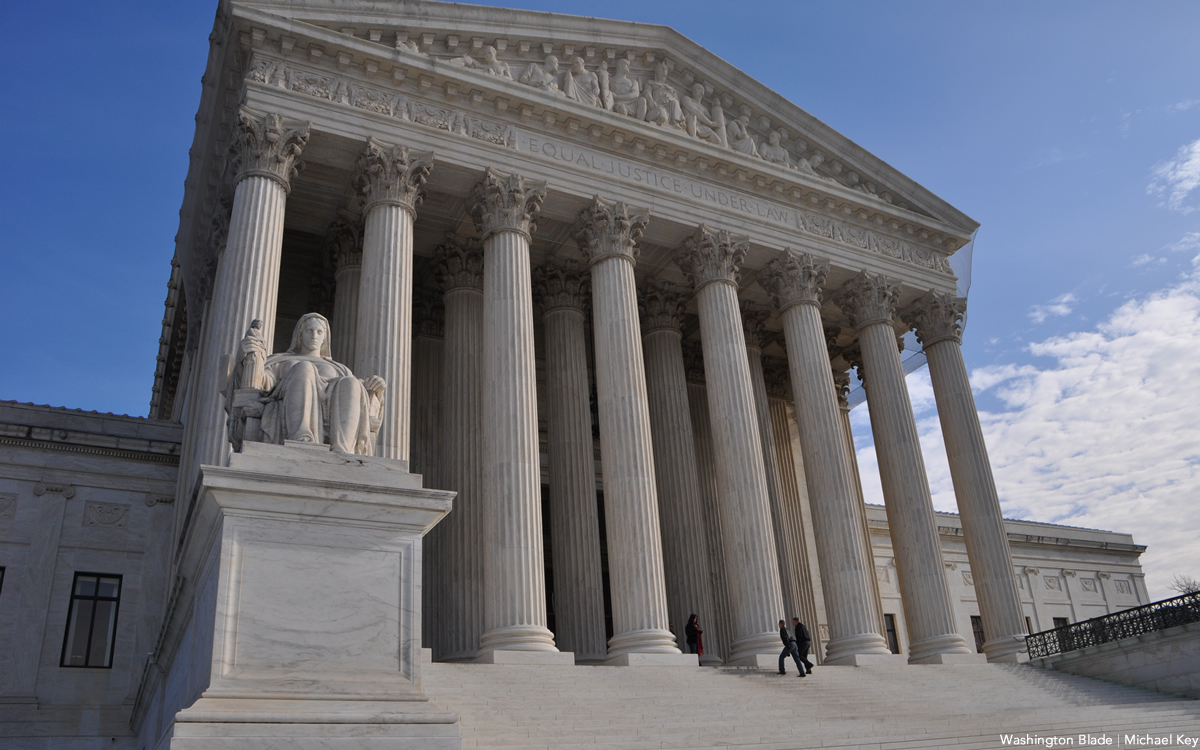

BY MIA MALDONADO | The U.S. Supreme Court has allowed Idaho to enforce House Bill 71, a law banning Idaho youth from receiving gender-affirming care medications and surgeries.
In an opinion issued Monday, the U.S. Supreme Court granted the state of Idaho’s request to stay the preliminary injunction, which blocked the law from taking effect. This means the preliminary injunction now only applies to the plaintiffs involved in Poe v. Labrador — a lawsuit brought on by the families of two transgender teens in Idaho who seek gender-affirming care.
Monday’s Supreme Court decision enforces the gender-affirming care ban for all other trans youth in Idaho as the lawsuit remains ongoing in the Ninth Circuit Court of Appeals.

The American Civil Liberties Union and the ACLU of Idaho, both of whom represent the plaintiffs, said in a press release Monday that the ruling “does not touch upon the constitutionality” of HB 71. The groups called Monday’s ruling an “awful result” for trans Idaho youth and their families.
“Today’s ruling allows the state to shut down the care that thousands of families rely on while sowing further confusion and disruption,” the organizations said in the press release. “Nonetheless, today’s result only leaves us all the more determined to defeat this law in the courts entirely, making Idaho a safer state to raise every family.”
Idaho Attorney General Raúl Labrador in a press release said the state has a duty to protect and support all children, and that he is proud of the state’s legal stance.
“Those suffering from gender dysphoria deserve love, support and medical care rooted in biological reality,” Labrador said. “Denying the basic truth that boys and girls are biologically different hurts our kids. No one has the right to harm children, and I’m grateful that we, as the state, have the power — and duty — to protect them.”
Recap of Idaho’s HB 71, and what led to SCOTUS opinion
Monday’s Supreme Court decision traces back to when HB 71 was signed into law in April 2023.
The law makes it a felony punishable for up to 10 years for doctors to provide surgeries, puberty-blockers and hormones to trans people under the age of 18. However, gender-affirming surgeries are not and were not performed among Idaho adults or youth before the bill was signed into law, the Idaho Capital Sun previously reported.
One month after it was signed into law, the families of two trans teens sued the state in a lawsuit alleging the bill violates the 14th Amendment’s guarantee of equal protection under the law.
In late December, just days before the law was set to take effect in the new year, U.S. District Judge B. Lynn Winmill blocked the law from taking effect under a preliminary injunction. In his decision, he said he found the families likely to succeed in their challenge.
The state of Idaho responded by appealing the district court’s preliminary injunction decision to the Ninth Circuit, to which the Ninth Circuit denied. The state of Idaho argued the court should at least enforce the ban for everyone except for the plaintiffs.
After the Ninth Circuit’s denial, the Idaho Attorney General’s Office in February sent an emergency motion to the U.S. Supreme Court, the Idaho Press reported. Monday’s U.S. Supreme Court decision agrees with the state’s request to enforce its ban on trans health care for minors, except for the two plaintiffs.
******************************************************************************************

Mia Maldonado joined the Idaho Capital Sun after working as a breaking news reporter at the Idaho Statesman covering stories related to crime, education, growth and politics. She previously interned at the Idaho Capital Sun through the Voces Internship of Idaho, an equity-driven program for young Latinos to work in Idaho news. Born and raised in Coeur d’Alene, Mia moved to the Treasure Valley for college where she graduated from the College of Idaho with a bachelor’s degree in Spanish and international political economy.
******************************************************************************************
The preceding piece was previously published by the Idaho Capital Sun and is republished with permission.
The Idaho Capital Sun is the Gem State’s newest nonprofit news organization delivering accountability journalism on state politics, health care, tax policy, the environment and more.
We’re part of States Newsroom, the nation’s largest state-focused nonprofit news organization.

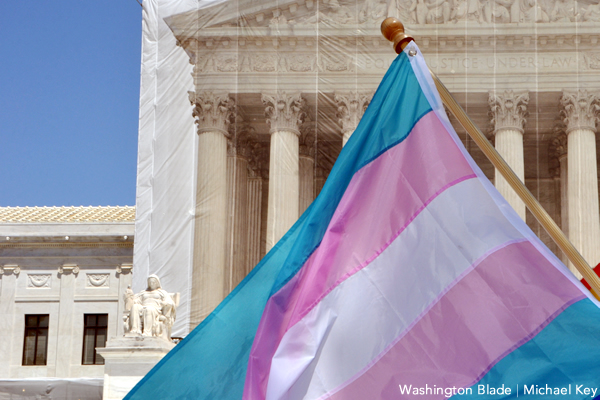
U.S. Supreme Court
Supreme Court rules against Colo. law banning conversion therapy for minors
8-1 decision could have sweeping impact
The U.S. Supreme Court on Tuesday ruled against a Colorado law that bans so-called conversion therapy for minors.
The justices last October heard oral arguments in Chiles v. Salazar. Today they ruled 8-1 in favor of Kaley Chiles, a Christian therapist who challenged the 2019 law.
In the case, which was heard by the justices in October 2025, Chiles successfully argued to the court that the law restricting this type of therapy was unconstitutional, leading to it being struck down.
The Supreme Court ultimately found that lower state and federal courts has “erred by failing to apply sufficiently rigorous First Amendment scrutiny,” ultimately reversing the widely discredited “medical” treatment that has support by a very narrow margin of mental health specialists — specifically religious and socially conservative ones. This is despite the fact that Colorado state officials have never enforced the measure in practice, and included a religious exemption for people “engaged in the practice of religious ministry.” The now moot law carried fines of up to $5,000 for each violation and possible suspension or revocation of a counselor’s license.
In the ruling, the court said the law, that specifically applies to talk therapy “impermissibly” interferes with free speech rights of Americans, and despite it being “regard[ed] its policy as essential to public health and safety, but the First Amendment stands as a shield against any effort to enforce orthodoxy in thought or speech in this country,” Justice Neil Gorsuch wrote for himself and seven other justices from across the ideological spectrum who overturned the low court’s ruling. He went on to add that the original ban “trains directly on the content of her speech and permits her to express some viewpoints but not others.”
Only Justice Ketanji Brown Jackson dissented, which included an in depth summary of her departure from the other eight justices, explaining her fears about the verdict — and its eventual chilling effect on legislation that could attempts to restrict regulatory speech for religious attitudes— despite that these regulations are often made as a direct creation of years of essentially unanimous research, and are vetted though regulatory boards for specific jobs.
“This decision might make speech-only therapies and other medical treatments involving practitioner speech effectively unregulatable,” Jackson wrote on page 32 of the 35-page opinion issued by court in response to her opposing eight members comments on the bench.
Since the ruling late Tuesday morning, a slew of LGBTQ advocacy groups, as well as groups promoting LGBTQ discrimination, have issued statements on the direct impact this will have across the country for LGBTQ people.
Democratic Senator, running for reelection in Colorado, John Hickenlooper issued a condemnation of the practice on his X (formerly Twitter). “Conversion therapy is cruel and inhumane, plain and simple. This SCOTUS decision is dangerous for LGBTQ+ Americans,” Our LGBTQ+ community deserves safety, acceptance, and love. We won’t ever let up in our fight for a better nation.”
Conversion therapy is cruel and inhumane, plain and simple. This SCOTUS decision is dangerous for LGBTQ+ Americans.,” the former Governor said on the platform. “Our LGBTQ+ community deserves safety, acceptance, and love. We won’t ever let up in our fight for a better nation.”
Polly Crozier, director of family advocacy at GLBTQ Legal Advocates & Defenders (GLAD Law), provided a statement to the Washington Blade on the court’s decision.
“Today’s Supreme Court ruling limited Colorado’s statute that preemptively shielded minors from conversion therapy, but it leaves open avenues for states to protect families from harmful, unscrupulous, and misleading practices that divide parents from their children and put LGBTQ+ youth at risk,” Crozier wrote, pointing to the overwhelming evidence on conversion therapy that argues this type of regulatory legislation is helping those suffering rather than harming. “The evidence is clear that conversion practices lead to increased anxiety, depression, and suicidality. This is a dangerous practice that has been condemned by every major medical association in the country. Today’s decision does not change the science, and it does not change the fact that conversion therapists who harm patients will still face legal consequences, and that family advocates, mental health practitioners, and all of us who care about the wellbeing of youth will continue working to shield LGBTQ+ young people and their families from this dangerous practice.”
Human Rights Campaign President Kelley Robinson, who leads the nation’s largest LGBTQ advocacy group, also provided a statement, calling the courts choice a “reckless decision.” The statement also points out how their own data (from the group’s philanthropic arm of the organization) was cited in Brown Jackson’s dissent in the amicus brief.
“The court has weaponized free-speech in order to prioritize anti-LGBTQ+ bias over the safety, health and wellbeing of children,” her statement reads. “So-called ‘conversion therapy’ is pseudoscience, not real therapy. It has been condemned by every mainstream medical and mental health association and harms families, traumatizes children, and robs people of their faith communities. It is cruel and should never be offered under the guise of legitimate mental healthcare. To undermine protections that keep kids and families safe from these abusive practices is shocking — and our children deserve better.”
Liberty Counsel, a nonprofit, tax-exempt Christian ministry that uses litigation to promote evangelical Christian values and limit LGBTQ protections, which was designated as a hate group by the Southern Poverty Law Center, was also cited in the court’s amicus brief, but in support of overturning the law.
“The U.S. Supreme Court’s resounding decision in Chiles v. Salazar is a major victory for the integrity of the counseling profession,” Mat Staver, Founder and Chairman of Liberty Council said today. “This ruling ensures the government cannot strip the First Amendment away from licensed counselors and dictate a state-mandated ideology between counselor and client. Talk therapy is speech, and the government has no authority to restrict that speech to just one viewpoint. Counseling bans can now be struck down nationwide so that people can get the counseling they need.”
GLAAD, one of the nation’s oldest non-profit organizations focused on LGBTQ advocacy and cultural change issued a statement pon the verdict, emphasizing what multiple advocate groups have said – this decision will impact an already vulnerable youth population at an elevated high risk.
“The Court once again prioritized malice over best practice medicine,” Sarah Kate Ellis, President and CEO of GLAAD said in a statement. “In the face of this harmful decision, we need to amplify the voices of survivors of this dangerous and disproven practice, and continue to hold anyone who peddles in this junk science liable.”
Truth Wins Out, an organization that works towards “advancing liberty and democracy through protecting the rights of LGBTQ people and other minorities” called out the court’s majority opinion for its potential for religious extremism and spread of disinformation.
“This ruling is a profound failure of both logic and moral responsibility that confuses ‘free speech’ with ‘false speech’,” Wayne Besen, the Executive Director of Truth Wins Out said in a comment. ” It opens the door for quackery to flourish and allows practitioners of a thoroughly debunked practice to continue harming LGBTQ youth under a thin veneer of legitimacy
Adrian Shanker, the former Deputy Assistant Secretary for Health Policy at Health and Human Services under President Biden, who also led LGBTQI+ policy at the agency spoke about the detrimental impact this will have on rules and regulations within the healthcare field that are supposed to be inherently secular by nature.
“No matter what the Supreme Court decided today, it is irrefutable that conversion therapy is harmful to the health and wellbeing of LGBTQI+ youth,” Shanker told the Blade, continuing the Trump Administration’s choice to no longer formally support LGBTQ inclusive policy. “That’s why in the Biden administration we advanced policies to safeguard youth from this harmful practice.”
In an consistently updated document started in 2018 that cites the major harms risks conversion therapy poses to LGBTQ people, the Trevor Project, the leading suicide prevention and crisis intervention organization for LGBTQ young people, included that the federal government’s own research proved the practice at best questionable and at worst deadly.
In a 2023 report entitled Moving Beyond Change Efforts: Evidence and Action to Support and Affirm LGBTQI+ Youth, the U.S. Department of Health and Human Services’ Substance Abuse and Mental Health Services Administration stressed that “[sexual orientation and gender identity] change efforts are harmful practices that are never appropriate with LGBTQI+
youth, and efforts are needed to end these practices,” the summary of the fight against conversion therapy in the U.S. reads.
More than 20 states and D.C. banned the widely discredited practice for minors prior to the Supreme Court’s ruling.
The Blade last October spoke to conversion therapy survivors after the justices heard oral arguments in the Chiles case.
U.S. Supreme Court
Competing rallies draw hundreds to Supreme Court
Activists, politicians gather during oral arguments over trans youth participation in sports
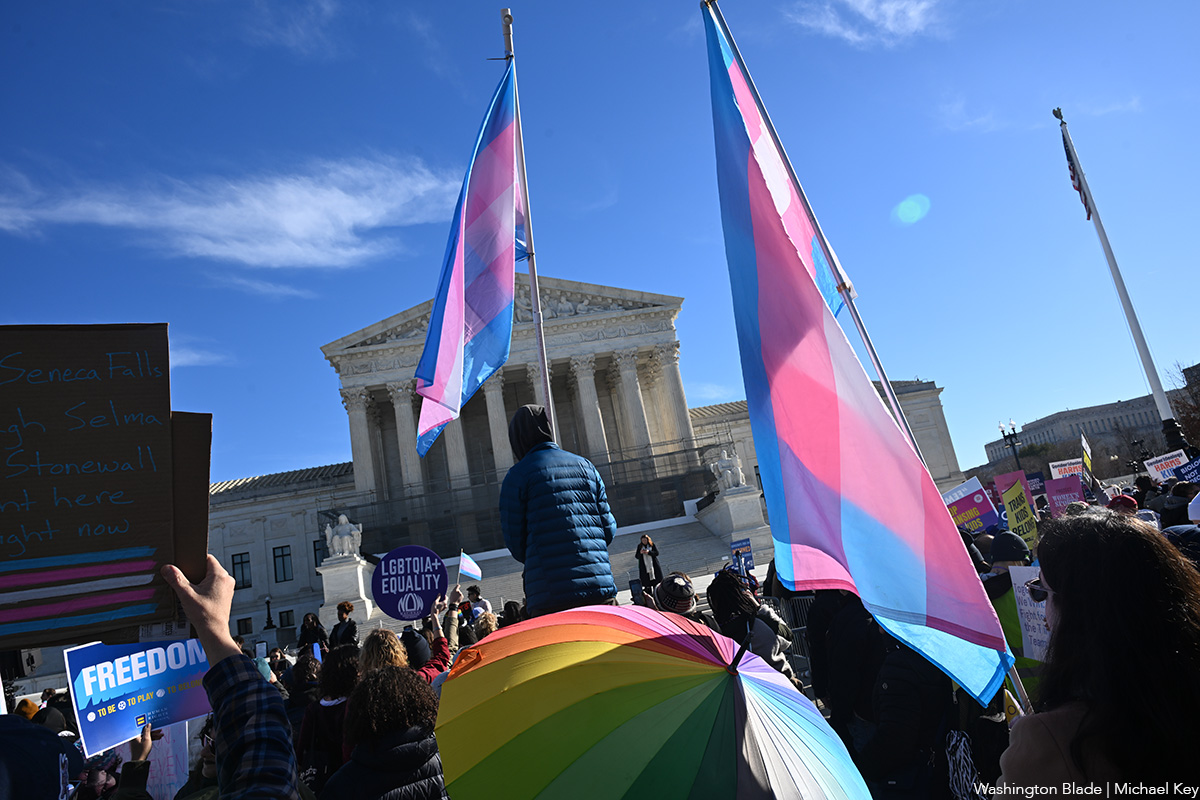
Hundreds of supporters and opponents of trans rights gathered outside of the United States Supreme Court during oral arguments for Little v. Hecox and West Virginia v. B.P.J. on Tuesday. Two competing rallies were held next to each other, with politicians and opposing movement leaders at each.
“Trans rights are human rights!” proclaimed U.S. Sen. Ed Markey (D-Mass.) to the crowd of LGBTQ rights supporters. “I am here today because trans kids deserve more than to be debated on cable news. They deserve joy. They deserve support. They deserve to grow up knowing that their country has their back.”
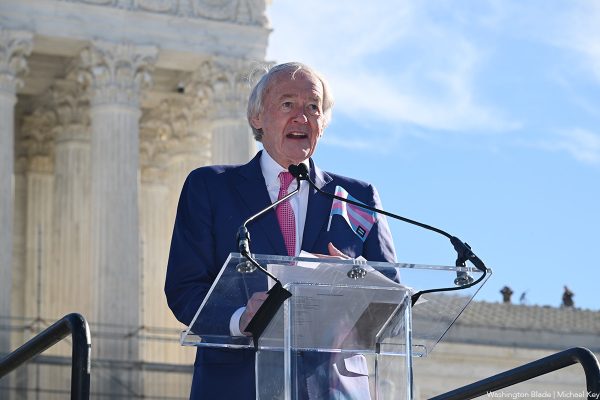
“And I am here today because we have been down this hateful road before,” Markey continued. “We have seen time and time again what happens when the courts are asked to uphold discrimination. History eventually corrects those mistakes, but only after the real harm is done to human beings.”
View on Threads
U.S. Education Secretary Linda McMahon spoke at the other podium set up a few feet away surrounded by signs, “Two Sexes. One Truth.” and “Reality Matters. Biology Matters.”
“In just four years, the Biden administration reversed decades of progress,” said McMahon. “twisting the law to urge that sex is not defined by objective biological reality, but by subjective notion of gender identity. We’ve seen the consequences of the Biden administration’s advocacy of transgender agendas.”
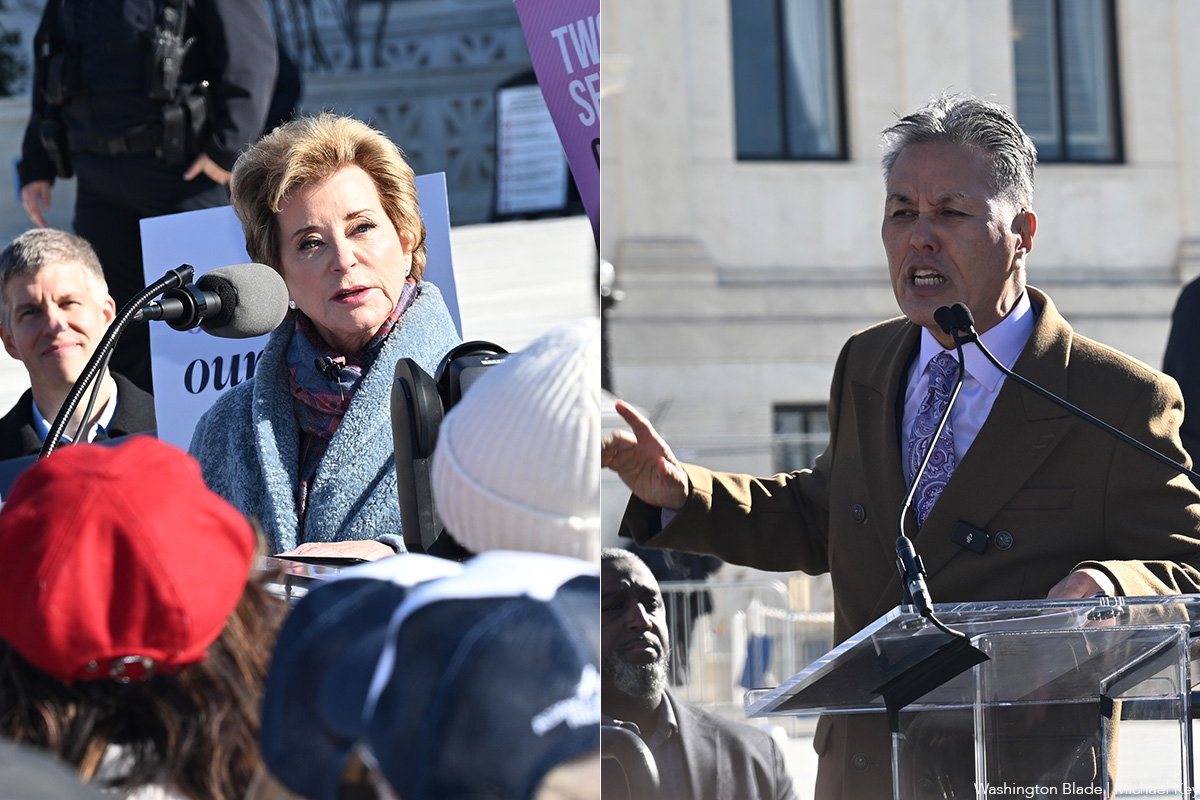
U.S. Rep. Mark Takano (D-Calif.), chair of the Congressional Equality Caucus, was introduced on the opposing podium during McMahon’s remarks.
“This court, whose building that we stand before this morning, did something quite remarkable six years ago.” Takano said. “It did the humanely decent thing, and legally correct thing. In the Bostock decision, the Supreme Court said that trans employees exist. It said that trans employees matter. It said that Title VII of the Civil Rights Act protects employees from discrimination based on sex, and that discrimination based on sex includes discrimination based on gender identity and sexual orientation. It recognizes that trans people have workplace rights and that their livelihoods cannot be denied to them, because of who they are as trans people.”
“Today, we ask this court to be consistent,” Takano continued. “If trans employees exist, surely trans teenagers exist. If trans teenagers exist, surely trans children exist. If trans employees have a right not to be discriminated against in the workplace, trans kids have a right to a free and equal education in school.”
Takano then turned and pointed his finger toward McMahon.
“Did you hear that, Secretary McMahon?” Takano addressed McMahon. “Trans kids have a right to a free and equal education! Restore the Office of Civil Rights! Did you hear me Secretary McMahon? You will not speak louder or speak over me or over these people.”
Both politicians continued their remarks from opposing podiums.
“I end with a message to trans youth who need to know that there are adults who reject the political weaponization of hate and bigotry,” Takano said. “To you, I say: you matter. You are not alone. Discrimination has no place in our schools. It has no place in our laws, and it has no place in America.”
U.S. Supreme Court
Supreme Court hears arguments in two critical cases on trans sports bans
Justices considered whether laws unconstitutional under Title IX.
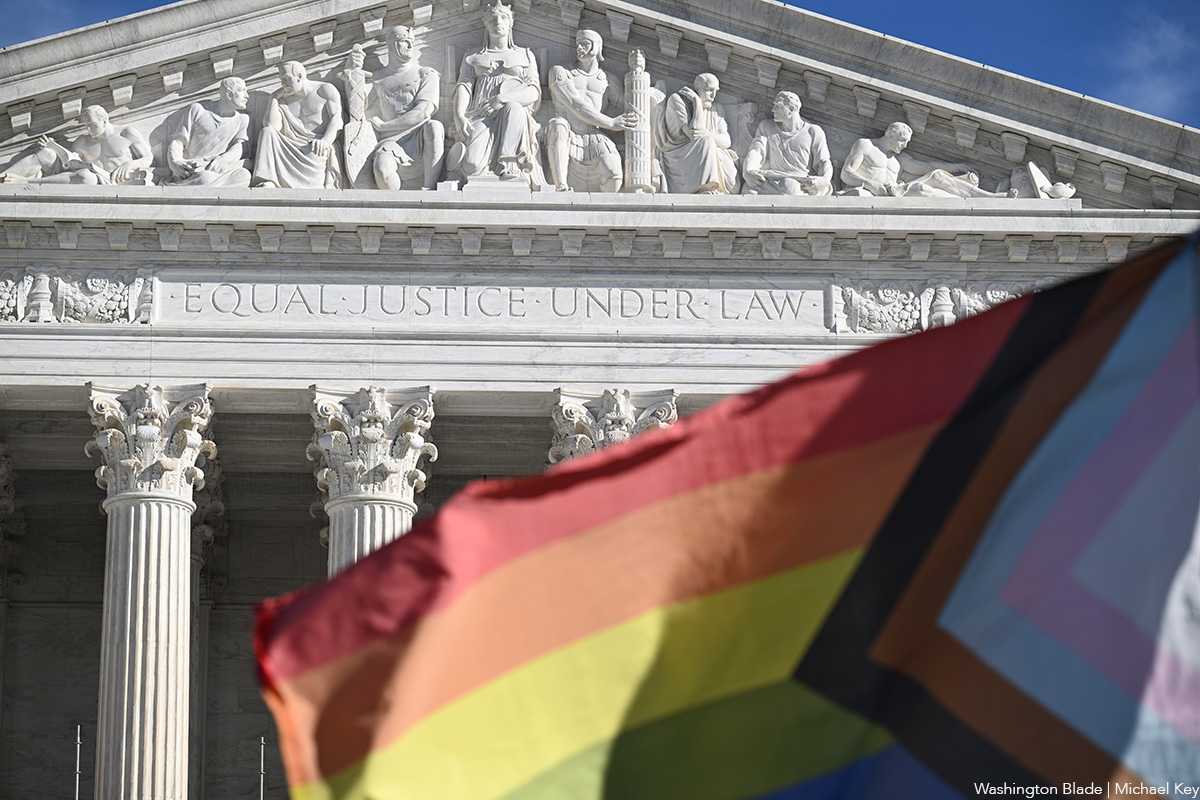
The Supreme Court heard two cases today that could change how the Equal Protection Clause and Title IX are enforced.
The cases, Little v. Hecox and West Virginia v. B.P.J., ask the court to determine whether state laws blocking transgender girls from participating on girls’ teams at publicly funded schools violates the 14th Amendment’s Equal Protection Clause and Title IX. Once decided, the rulings could reshape how laws addressing sex discrimination are interpreted nationwide.
Chief Justice John Roberts raised questions about whether Bostock v. Clayton County — the landmark case holding that Title VII of the Civil Rights Act of 1964 protects employees from discrimination based on sexual orientation or gender identity — applies in the context of athletics. He questioned whether transgender girls should be considered girls under the law, noting that they were assigned male at birth.
“I think the basic focus of the discussion up until now, which is, as I see it anyway, whether or not we should view your position as a challenge to the distinction between boys and girls on the basis of sex or whether or not you are perfectly comfortable with the distinction between boys and girls, you just want an exception to the biological definition of girls.”
“How we approach the situation of looking at it not as boys versus girls but whether or not there should be an exception with respect to the definition of girls,” Roberts added, suggesting the implications could extend beyond athletics. “That would — if we adopted that, that would have to apply across the board and not simply to the area of athletics.”
Justice Clarence Thomas echoed Roberts’ concerns, questioning how sex-based classifications function under Title IX and what would happen if Idaho’s ban were struck down.
“Does a — the justification for a classification as you have in Title IX, male/female sports, let’s take, for example, an individual male who is not a good athlete, say, a lousy tennis player, and does not make the women’s — and wants to try out for the women’s tennis team, and he said there is no way I’m better than the women’s tennis players. How is that different from what you’re being required to do here?”
Justice Samuel Alito addressed what many in the courtroom seemed reluctant to state directly: the legal definition of sex.
“Under Title IX, what does the term ‘sex’ mean?” Alito asked Principal Deputy Solicitor General Hashim Mooppan, who was arguing in support of Idaho’s law. Mooppan maintained that sex should be defined at birth.
“We think it’s properly interpreted pursuant to its ordinary traditional definition of biological sex and think probably given the time it was enacted, reproductive biology is probably the best way of understanding that,” Mooppan said.
Justice Sonia Sotomayor pushed back, questioning how that definition did not amount to sex discrimination against Lindsay Hecox under Idaho law. If Hecox’s sex is legally defined as male, Sotomayor argued, the exclusion still creates discrimination.
“It’s still an exception,” Sotomayor said. “It’s a subclass of people who are covered by the law and others are not.”
Justice Elena Kagan highlighted the broader implications of the cases, asking whether a ruling for the states would impose a single definition of sex on the 23 states that currently have different laws and standards. The parties acknowledged that scientific research does not yet offer a clear consensus on sex.
“I think the one thing we definitely want to have is complete findings. So that’s why we really were urging to have a full record developed before there were a final judgment of scientific uncertainty,” said Kathleen Harnett, Hecox’s legal representative. “Maybe on a later record, that would come out differently — but I don’t think that—”
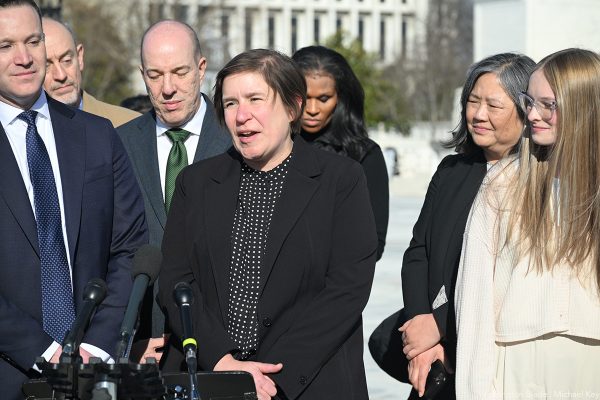
“Just play it out a little bit, if there were scientific uncertainty,” Kagan responded.
Justice Brett Kavanaugh focused on the impact such policies could have on cisgender girls, arguing that allowing transgender girls to compete could undermine Title IX’s original purpose.
“For the individual girl who does not make the team or doesn’t get on the stand for the medal or doesn’t make all league, there’s a — there’s a harm there,” Kavanaugh said. “I think we can’t sweep that aside.”
Justice Amy Coney Barrett questioned whether Idaho’s law discriminated based on transgender status or sex.
“Since trans boys can play on boys’ teams, how would we say this discriminates on the basis of transgender status when its effect really only runs towards trans girls and not trans boys?”
Harnett responded, “I think that might be relevant to a, for example, animus point, right, that we’re not a complete exclusion of transgender people. There was an exclusion of transgender women.”
Justice Ketanji Brown Jackson challenged the notion that explicitly excluding transgender people was not discrimination.
“I guess I’m struggling to understand how you can say that this law doesn’t discriminate on the basis of transgender status. The law expressly aims to ensure that transgender women can’t play on women’s sports teams… it treats transgender women different than — than cis-women, doesn’t it?”
Idaho Solicitor General Alan Hurst urged the court to uphold his state’s ban, arguing that allowing participation based on gender identity — regardless of medical intervention — would deny opportunities to girls protected under federal law.
Hurst emphasized that biological “sex is what matters in sports,” not gender identity, citing scientific evidence that people assigned male at birth are predisposed to athletic advantages.
Joshua Block, representing B.P.J., was asked whether a ruling in their favor would redefine sex under federal law.
“I don’t think the purpose of Title IX is to have an accurate definition of sex,” Block said. “I think the purpose is to make sure sex isn’t being used to deny opportunities.”
Becky Pepper-Jackson, identified as plaintiff B.P.J., the 15-year-old also spoke out.
“I play for my school for the same reason other kids on my track team do — to make friends, have fun, and challenge myself through practice and teamwork,” said Pepper-Jackson. “And all I’ve ever wanted was the same opportunities as my peers. But in 2021, politicians in my state passed a law banning me — the only transgender student athlete in the entire state — from playing as who I really am. This is unfair to me and every transgender kid who just wants the freedom to be themselves.”
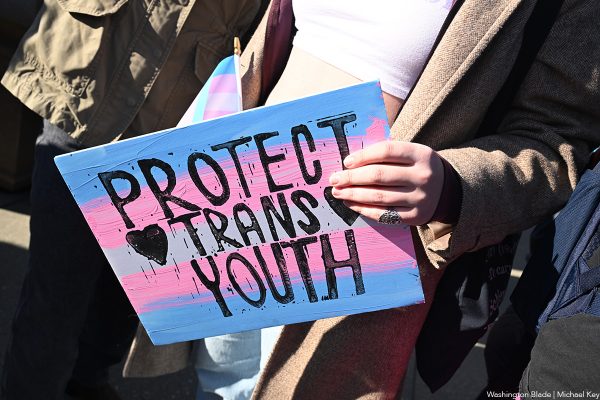
Outside the court, advocates echoed those concerns as the justices deliberated.
“Becky simply wants to be with her teammates on the track and field team, to experience the camaraderie and many documented benefits of participating in team sports,” said Sasha Buchert, counsel and Nonbinary & Transgender Rights Project director at Lambda Legal. “It has been amply proven that participating in team sports equips youth with a myriad of skills — in leadership, teamwork, confidence, and health. On the other hand, denying a student the ability to participate is not only discriminatory but harmful to a student’s self-esteem, sending a message that they are not good enough and deserve to be excluded. That is the argument we made today and that we hope resonated with the justices of the Supreme Court.”
“This case is about the ability of transgender youth like Becky to participate in our schools and communities,” said Joshua Block, senior counsel for the ACLU’s LGBTQ & HIV Project. “School athletics are fundamentally educational programs, but West Virginia’s law completely excluded Becky from her school’s entire athletic program even when there is no connection to alleged concerns about fairness or safety. As the lower court recognized, forcing Becky to either give up sports or play on the boys’ team — in contradiction of who she is at school, at home, and across her life — is really no choice at all. We are glad to stand with her and her family to defend her rights, and the rights of every young person, to be included as a member of their school community, at the Supreme Court.”
The Supreme Court is expected to issue rulings in both cases by the end of June.

Senegalese president signs bill that further criminalizes homosexuality

Md. lawmakers reaffirm legislative priorities

Supreme Court rules against Colo. law banning conversion therapy for minors

Thousands attend ‘No Kings’ protests in D.C.

Blade contributor, husband exchange vows in D.C.

Celebrate cherry blossoms the drag way

Lorato ke Lorato: marriage equality, democracy, and the unfinished work of justice in Botswana

Japanese Supreme Court to consider marriage equality

The outrage economy is not the LGBTQ community

Anti-trans visa ruling echoes Nazi regime destroying trans documents
-

 Out & About4 days ago
Celebrate cherry blossoms the drag way
-
Botswana4 days ago
Lorato ke Lorato: marriage equality, democracy, and the unfinished work of justice in Botswana
-
Japan4 days ago
Japanese Supreme Court to consider marriage equality
-
Opinions4 days ago
The outrage economy is not the LGBTQ community