Opinions
US hate groups fuel anti-LGBTQ rights movement in Africa
Anti-LGBTQ conference took place this month in Nairobi
“Protecting and Promoting Family Values in Challenging Times.” This was the theme of the 2nd annual Pan-African Conference on Family Values that concluded last week in Nairobi, Kenya.
For months, organizers have been inundating local media with advertisements, promising to equip participants with tools to “safeguard our values.” One highly circulated poster even boasts U.S. Secretary of State Marco Rubio as a special invited guest (though he did not attend.) And each mention sent chills down our spines.
This conference, one of several planned across Africa, was sponsored by U.S.-based anti-rights groups including the Family Research Council, the Political Network for Values and the Center for Family and Human Rights, each known for targeting LGBTQI+ and reproductive rights worldwide. To those of us in the LGBTQI+ community who’ve been fighting rising homophobia, this conference was more than a convening. A gauntlet is being thrown down, one that will fuel the momentum of anti-rights efforts in Kenya, one that threatens all of Africa.
To be sure, this burden is not ours alone to bear. The actors pushing their bigoted agenda in Kenya and beyond are the same ones driving policies that block abortion access, whip up anti-immigration sentiments and spread transphobia in the U.S. and beyond. It is imperative that all communities (local and international) jealously guard against such maneuvering. These hatemongers are taking aim at our sovereignty and social constructs. They seek to woo with the proverbial beads and cloth, while simultaneously annexing that which we hold dear. This is not just an LGBTQI+ issue. This is about our inherent human rights and dignity. We need to hold the line.
In Kenya, we knew our hard-won gains for the LGBTQI+ community were in jeopardy when President William Ruto came into office in 2022. He has since been very vocal about his conservative views, perhaps reluctant to alienate himself from his predominantly Christian religious leader sycophants. Nevertheless, we’ve won significant legal battles in recent years, including in 2023 when the Kenyan Supreme Court ruled that LGBT organizations can legally register with words like “gay” and “lesbian” in their names.
Over the years, however, the anti-rights movement has been cultivating allies across Africa to further their agenda. Organizations like Family Watch International, Center for Family and Human Rights and the World Congress of Families (all deemed hate groups by the Southern Poverty Law Center) have made inroads with influential political leaders with talk of the “natural family,” a narrative that espouses the Western ideal of a nuclear family. In reality, these views run counter to traditional African communal views on family. It is ironic, therefore, that anti-rights actors accuse the gay rights movement of importing Western ideas even as they are readily adopting Western cultural norms.
Our political leaders are being indoctrinated into a culture of hate and division. And global convenings, like the Pan-African Conference on Family Values, are chief among their propaganda tools. In fact, it was after attending one such gathering, the “V Transatlantic Summit” in New York in 2023, that Kenyan MP Peter Kaluma proposed the Family Protection Bill which seeks to ban same-sex relationships and curtail sexual and reproductive health rights, among other measures.
In the past, we could count on the U.S. to keep our political leaders in check. Not anymore. President Trump’s attacks on the queer community in the U.S. have only emboldened the anti-queer movement in Kenya. Anti-rights groups are coming back with renewed vigor to amend our constitution and dismantle all human rights protections. They are already instigating violence and stirring anti-gay sentiment, particularly on social media. Kenyans are losing their jobs or being overly scrutinized at work. An ever-increasing number of LGBTQ+ community members access our online mental health services in deep distress and anxiety about the future.
We will not back down, however. Ahead of the conference, we delivered a petition signed by more than two dozen human rights activists and groups lambasting Kenya Red Cross for allowing the Pan-African Conference on Family Values to be held at its property, the Boma Hotel. How can an organization dedicated to the health and wellbeing of marginalized groups be complicit in an event that stigmatizes and incites harm against the very same people? We’ve also been organizing and strategizing with our allies around community safety, legal rights, hate crime monitoring, and resource mobilization.
Make no mistake, this hate will not stop with Kenya. This conference was part of a larger playbook, and any victories here will propel the anti-right’s cruel campaign throughout Africa. We only need to look to our neighbor Uganda and their Anti-Homosexuality Act as proof. It is widely known that Family Watch International influenced the drafting of this law. The same language that criminalizes homosexuality and imposes the death penalty in certain cases was copied and pasted into Kenya’s proposed Family Protection Bill.
Life and liberty as we all know it is very much in jeopardy. Some may be living too much in survival mode to see it. But without a doubt, we are all on a rollercoaster ride to a place where no one is safe.
Lorna Dias is the outgoing executive coordinator of galck+, a coalition of 18 LGBTQ+ organizations defending human rights and fighting for equality and justice for all in Kenya. Melody Njuki is a communications officer at Initiative for Equality and Non-Discrimination (INEND).

Botswana
The rule of law, not the rule of religion
Bonolo Selelo and Tsholofelo Kumile are challenging the Botswana Marriage Act

Botswana was in a whole frenzy as religious and traditional fundamentalists kept mixing religion and constitutional law as if it were harmless. It is not. One is a private matter of belief between you and God, while the other is the framework that protects and governs us all. When these two systems get fused, the result is rarely justice. It results in discrimination.
The ongoing case brought by Bonolo Selelo and Tsholofelo Kumile challenging provisions of the Botswana Marriage Act has reignited a familiar debate in Botswana. Some commentators insist that marriage equality violates religious values and therefore should not be recognized by law. It is a predictable argument. It is also fundamentally incompatible with constitutional governance.
Botswana is not a Christian state. It is a constitutional democracy governed by the Constitution of Botswana. That distinction matters. In a constitutional democracy, laws are interpreted in accordance with constitutional principles such as equality, dignity, protection, inclusion and the rule of law, rather than the doctrinal beliefs of any particular religion.
Religion has no place in constitutional law and democracy
The central problem with religious arguments in constitutional disputes is simple in that they divide, they other, they contest equality and they are personal. Constitutional law by contrast, must apply equally to everyone.
Botswana’s Constitution guarantees fundamental rights and freedoms under Sections 3 and 15, including protection from discrimination and the right to equal protection of the law. These provisions are not conditional on religious approval. They exist precisely to protect minorities from the preferences or prejudices of the majority.
Legal experts, such as Anneke Meerkotter, in her policy brief in Defense of Constitutional Morality, point out that constitutional rights function as a safeguard against majoritarian morality. If rights depended on whether the majority approved of a minority’s identity or relationships, they would not be rights at all. They would merely be privileges.
This principle has already been affirmed in Botswana’s jurisprudence. In the landmark decision of Letsweletse Motshidiemang v Attorney General, the High Court held that criminalizing consensual same-sex relations violated constitutional protections of liberty, dignity, privacy, and equality. This judgment noted that constitutional interpretation must evolve with society and must be guided by human dignity and equality. The court emphasized that the Constitution protects all citizens, including those whose identities, expressions or relationships may be unpopular. That ruling was later upheld by the Court of Appeal of Botswana in 2021, reinforcing the principle that constitutional rights cannot be restricted on grounds of moral disapproval alone. These decisions were not theological pronouncements. They were legal determinations grounded in constitutional principles.
The danger of religious majoritarianism
When religion is used to justify legal restrictions, the result is what constitutional scholars call “majoritarian moralism.” It allows the dominant religious interpretation in society to dictate the rights of everyone else. That approach is fundamentally incompatible with constitutional democracy. Botswana is religiously diverse. While Christianity is the majority faith, there are also Muslims, Hindus, traditional spiritual communities, Sikh and people who practice no religion at all. If the law were to follow the doctrines of one religious group, which interpretation would it adopt? Christianity alone contains dozens of denominations with different views on love, equality, marriage, sexuality, and gender. The moment the state begins to legislate on the basis of religious doctrine, it implicitly privileges one belief system over others. That undermines both religious freedom and constitutional equality. Ironically, keeping religion separate from constitutional law is what protects religious freedom in the first place.
Judicial independence is the cornerstone of Botswana’s governance system
The current case involving Bonolo Selelo and Tsholofelo Kumile is before the judiciary, where it belongs. Courts exist to interpret the Constitution and determine whether legislation complies with constitutional rights. Political and religious lobbying, as well as public outrage, must not influence that process.
Judicial independence is the cornerstone of Botswana’s governance system. According to the International Commission of Jurists, judicial independence ensures that courts can make decisions based on law and evidence rather than political or social pressure.
When governments, political, religious, or traditional actors attempt to interfere in constitutional litigation, they weaken the rule of law. Botswana has historically prided itself on having one of the most stable constitutional systems in Africa. The judiciary has played a critical role in safeguarding rights and maintaining legal certainty. The decriminalization case demonstrated this. Despite strong public debate and political sensitivity, the courts assessed the law according to constitutional principles rather than moral panic. The same standard must apply in the current marriage equality case.
This article was first published in the Botswana Gazette, Midweek Sun, and Botswana Guardian newspapers and has been edited for the Washington Blade.
Bradley Fortuin is a consultant at the Southern Africa Litigation Center and a social justice activist.

My strawberry muumuu was about the ugliest thing I could have picked for our muumuu-themed movie night.
Really, it’s just an excuse to cross-dress while the sun’s still up; these themed movie nights are concocted by a teammate of mine on the Washington Scandals, D.C.’s LGBT and mens-plus rugby club.
The team is hosting an informational event on Saturday, March 21st, for those interested in testing the waters on inclusive rugby. We have a lot of fun with a lot of balls, and then we head out for a drink at Kiki.
Events like these Rugby “101s” are a blast because the joys of queer camaraderie are on full display – no experience is necessary. If you’re interested in learning more, check out our socials for more info in our bio. Back to the muumuu night, because someone will make a good point that bears repeating.
After settling in with some pizza and homemade cream puffs, I asked my friend and teammate, Theo, on my left, what it’s been like in a rugby club.
“Flooded with love,” he told me, him wearing a thin-striped but soft cotton muumuu. Theo often prioritizes comfort in clothing, always dressed for the weather. Eyes as soft and fuzzy as a warm bunny, he recounted his journey here to LGBT rugby as the life of the party shifted from food to entertainment.
Theo and I both prefer the quiet to the crowd, which is odd, given our shared passion for rugby — famously loud, infamously tough on the body.
The details are irrelevant, here; it’s Theo’s passion that caught my eye. Passion, I thought; it wasn’t particularly familiar to me, especially in sport. Profession, yes, but social pursuits? Passion seemed so foreign to me there.
That’s because it’s nurtured through culture, not inherited as a personality trait. This is a familiar place for much of D.C.’s LGBT culture and community; ‘chosen’ or ‘found’ family is the common phrase, but this is too simplistic, is it not? It makes it sound like you washed ashore and stumbled effortlessly into family. It’s not like that, not in real life.
It’s work and work requires passion to keep showing up.
Adult friendships are hard, Mary. It’s not light and airy, like when we were kids. It’s hard enough in adulthood, and to carve a space out for men’s-plus LGBT rugby in a city literally built on compromise is an act of defiance in itself.
Taking a chance on LGBT rugby is not for the casual observer – it’s a tough sport (but safer than football) with some big personalities. But as Theo pointed out, when I asked him about the magnetic draw between the LGBT community and rugby, that all body types are welcome in the sport; anyone can imagine themselves wearing a jersey and still fit in.
If you are to take anything from this, dear reader, it’s that when you show up for rugby, you belong.
The team’s hosting an informational Rugby 101 on Saturday, March 21, at Harry Thomas Rec Center, at 2 p.m. Our home match the next Saturday, March 28, is also at Harry Thomas, at 1 p.m.
Opinions
Protecting D.C.’s promise: why Kenyan McDuffie deserves our support
Former Council member is longtime ally
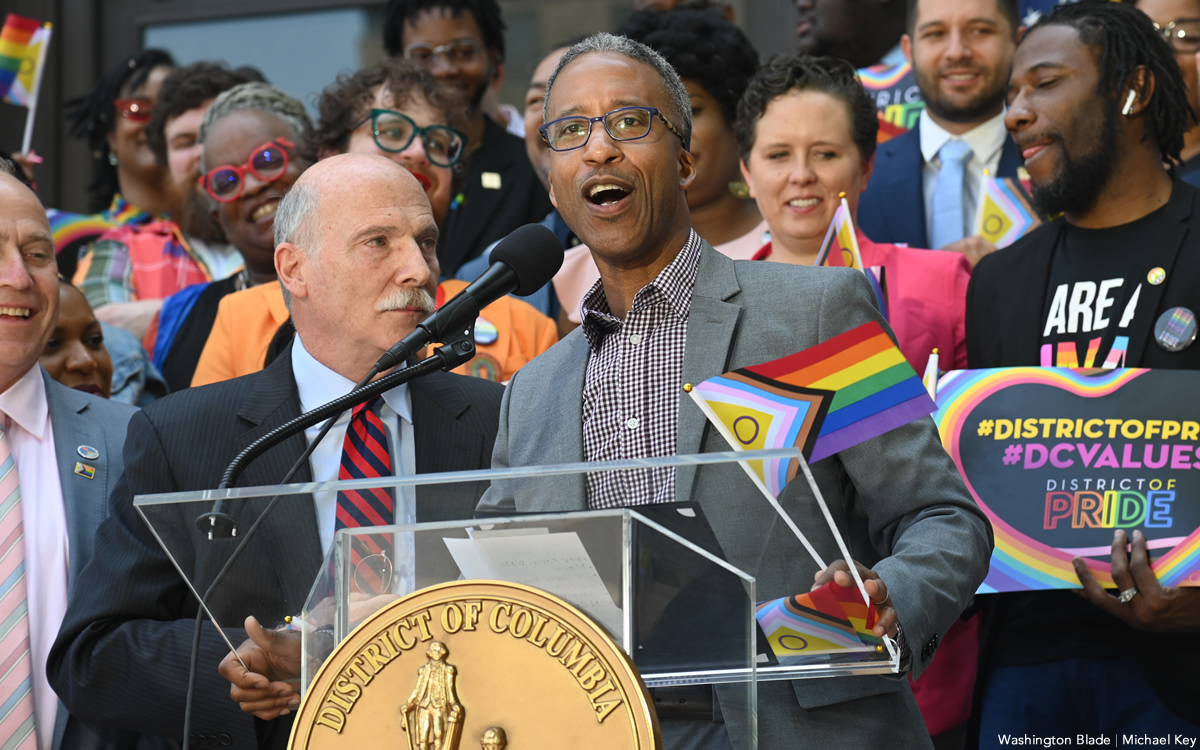
For generations, LGBTQ+ people have come to DC searching for something simple: the freedom to love who they love. I was one of them.
Washington, D.C., is the gayest city in the world. This didn’t happen by accident; It’s the result of generations of organizing, advocacy, and leadership from elected officials who championed the movement for equality, a movement that drew people like me to this city in search of safety and acceptance.
Now, as we approach the June 16 mayoral primary, the LGBTQ+ community will play a decisive role in shaping the city’s future. I believe the candidate our community should rally behind is Kenyan McDuffie, a longtime ally with a proven track record.
Kenyan’s relationship with the LGBTQ+ community began long before it was politically fashionable. In 2012, when he ran for the Ward 5 D.C. Council seat, he sought and earned the support of the Gertrude Stein Democratic Club, the city’s largest LGBTQ+ political organization. At a time before marriage equality was the law of the land, Kenyan stood with us and went on to support the banning of conversion therapy.
But what has always stood out to me about Kenyan’s leadership is his willingness to tackle issues head-on that deeply impact queer families and young people.
As someone who was recently engaged and is currently navigating pathways to parenthood, I was moved by Kenyan’s leadership to modernize D.C.’s outdated surrogacy laws. For more than two decades, the District criminalized surrogacy agreements, threatening families with fines of up to $10,000 and even jail time. Kenyan helped lead the effort to repeal that law, opening a legal pathway for LGBTQ+ couples and others to build families through surrogacy. Thanks to advances in medicine and policy changes like this one, more LGBTQ+ families are now able to pursue parenthood.
Kenyan has also been a champion for some of the most vulnerable members of our community: LGBTQ+ young people experiencing homelessness. In DC, LGBTQ+ youth represent nearly 40 percent of the city’s homeless youth population. Early in his time on the Council, Kenyan worked with fellow members to dedicate housing beds for LGBTQ+ youth and to strengthen the capacity of the Mayor’s Office of LGBTQ+ Affairs to support community programs. Those investments helped ensure that young people facing rejection or instability had a safer place to turn.
Leadership like this matters, especially as our city faces unprecedented challenges. In addition to being a champion for our community, the next mayor will need to navigate threats from the federal government, a massive reduction of the federal workforce of over 20,000 jobs, an unprecedented wave of restaurant closures, and year-after-year billion-dollar budget shortfalls.
Today, our city needs a leader whose values never waver and who has delivered real results for all our neighbors. Kenyan McDuffie has shown that kind of leadership throughout his public service career.
D.C. has always been a safe haven for the queer and trans community seeking opportunity, safety, and belonging. That promise is worth protecting and ensuring the next generation can find the same refuge and opportunity we have.
As voters prepare to make an important choice about the city’s future, I believe Kenyan McDuffie is the leader best prepared to carry that promise forward.
That’s why I’m proud to join him and countless others in launching the Out for Kenyan coalition this Thursday, March 26, at Number Nine.
Cesar Toledo is a first-generation queer Latino and an Out Magazine Out100 honoree who has spent over a decade advancing LGBTQ+ equality, equity, and social justice.

Report: US to withhold HIV aid to Zambia unless mineral access expanded

‘They took him!’ Gay married couple torn apart by ICE

Man charged with carjacking, kidnapping after having sex in D.C. park pleads guilty

The rule of law, not the rule of religion

Meet the Scandals, D.C.’s LGBT rugby team

Trump proclamation targets trans rights as State Dept. shifts visa policy

Adolescentes trans en Ecuador podrán cambiar datos en su cédula, pero con condicionamientos

Gay Venezuelan man ‘forcibly disappeared’ to El Salvador files claim against White House

BMA celebrates enduring influence of Henri Matisse

Ensuring safer drinking water
-

 The White House5 days ago
Trump proclamation targets trans rights as State Dept. shifts visa policy
-
Ecuador5 days ago
Adolescentes trans en Ecuador podrán cambiar datos en su cédula, pero con condicionamientos
-
Federal Government5 days ago
Gay Venezuelan man ‘forcibly disappeared’ to El Salvador files claim against White House
-
Galleries4 days ago
BMA celebrates enduring influence of Henri Matisse