Local
Rehoboth’s Clear Space Theatre regroups after commissioners reject new buildings
Opponents say officials failed to submit ‘code compliant’ application
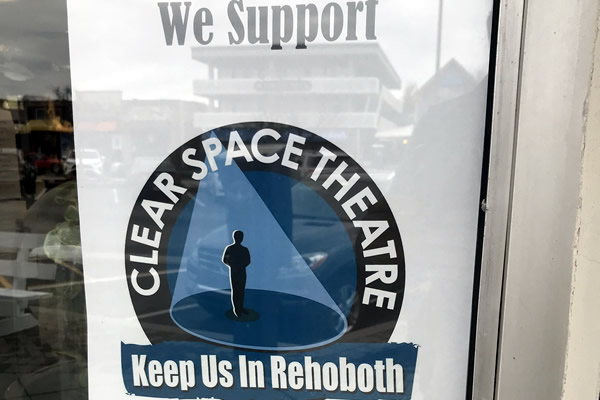
The Rehoboth Beach Board of Commissioners voted for the second time in eight months on June 30 to overturn a decision by the beach resort city’s Planning Commission to approve plans by the Clear Space Theatre Company to build a larger theater and adjacent rehearsal theater in a new location.
Supporters of the theater project, including many of Rehoboth’s LGBTQ residents and summer visitors, expressed outrage over the Board of Commissioners 4 to 3 vote to reject the Planning Commission’s approval and deny the Clear Space application to build its proposed new theaters on Rehoboth Avenue, which serves as the city’s main commercial boulevard.
The four commissioners voting to overturn the theater’s approval were Rehoboth Mayor Stan Mills, gay Commissioner Patrick Gossett, and fellow Commissioners Susan Gay and Jay Lagree. The three who voted against overturning the approval were gay Commissioner Edward Chrzanowski, lesbian Commissioner Pat Coluzzi, and Commissioner Richard Byrne.
The controversial vote to overturn the theater project approval came in response to an official appeal against the Planning Commission’s Feb. 26 approval of the project filed by 63 Rehoboth homeowners or renters, including D.C. gay attorney Harvey Shulman, who owns one of the homes near where the new theater buildings were to be built.
Shulman said at least 15 percent of those who signed on as appellants are gay. He and other opponents have said the two proposed theater buildings — a 14,949-square-foot main theater and a 9,950-square-foot rehearsal theater — are unsuitable in the three lots on Rehoboth Avenue where they were proposed to be built. Opponents say the two theater buildings would abut a residential neighborhood that would suffer undue noise, traffic congestion, and parking problems caused by the theaters.
Clear Space submitted the two-theater building proposal after the Board of Commissioners refused to approve an exception to the zoning code requested by Clear Space for an earlier plan for one larger 25,599-square-foot theater building. City officials noted the zoning code required any building larger than 15,000 square feet to provide 100 or more indoor or onsite parking spaces, which Clear Space said it did not have the financial resources to fulfill.
In a development that angered the opponents, Clear Space submitted a new plan for the two smaller buildings, which under the zoning code does not require Clear Space to provide any parking spaces for the project.
Clear Space has said its site plan would address noise and parking issues and it complies with the city’s zoning code. Others supporting the theater have argued that anyone who chose to buy a home adjacent to a busy commercial street like Rehoboth Avenue should expect to deal with some noise and parking issues, which for years residents of the popular beach resort town have managed to deal with.
The commissioners who voted to overturn the Planning Commission’s approval of the project cited as their main concern the contention by Shulman and the other appellants that the Planning Commission approved the project without ever having received or seen a code-complaint application, including a code-compliant set of drawings or plans for the project. The appellants said the Planning Commission allegedly only had in its possession an earlier application that was not in compliance with the city’s zoning code.
Wesley Paulson, executive director of Clear Space Theatre Company, and Commissioner Chrzanowski each told the Washington Blade that the Planning Commission was informed by the city’s building inspector that the Clear Space application and building site plans fully complied with all city codes.
The two pointed out that the building inspector, in consultation with the Planning Commission, set several conditions based on an earlier Clear Space application that had a minor code violation related to ceiling heights in one or more stair wells that should be corrected. Paulson and Chrzanowski pointed out that those changes were made.
Chrzanowski said he and his fellow commissioners who voted against overturning the project’s approval strongly disagree with the rationale by Mills, who serves as mayor, and the other three commissioners that the Planning Commission acted in an “arbitrary and capricious” manner in its decision to approve the theater’s application.
“It is my opinion that they were not acting any way in that fashion,” Chrzanowski said of the Planning Commission. “The fact of the matter is these appellants, they don’t care whether or not a drop ceiling in a stairwell needed to be reduced by six inches or not,” he said.
“They just oppose the project because they don’t want it in their back yard,” he told the Blade. “It has nothing to do with a process or a code. They just don’t want it in town, and it’s unfortunate.”
Shulman disputes that claim, saying existing Rehoboth law requires that the Planning Commission could not legally approve an application that never came before it and never became available to the public for review.
“This is not a question of whether you like the theater or you don’t like the theater,” he said. “There is a process that has to be followed. And the public has a right to have input. And that didn’t happen here.”
Among the Clear Space supporters who have criticized the Board of Commissioners who voted against the theater is longtime D.C. LGBTQ rights advocate Peter Rosenstein, who has a residence just outside the Rehoboth city boundary. Among other things, Rosenstein dismisses Shulman’s claim that a significant number of gay residents wanted the Board of Commissioners to overturn the theater’s approval.
“He’s got 20 gays that don’t support it and there are 3,000 that support it,” said Rosenstein. “They can find any excuse they want,” Rosenstein said in response to claims that the Planning Commission never received the theater’s final, revised application.
“The Planning Commission didn’t make any mistake,” he said. “The theater was code compliant. They met every condition the Planning Commission wanted. Technicality or not, they were going to find an excuse to turn it down.”
Paulson, the Clear Space executive director, said he remains hopeful that Clear Space will be allowed to resubmit its final, fully code complaint application to the Planning Commission for another quick and legally mandated approval without having to start the application process over again from scratch.
Supporters say starting over could take six months or more to obtain another round of approval from multiple city agencies and inspectors, a process that would add to Clear Space’s financial burden. They note that the application process has already taken three years since Clear Space first proposed to move from its current location in a rented former church on Baltimore Avenue near the city’s boardwalk.
Paulson said another option under consideration is to take the matter to court in a lawsuit to challenge the legality of the Board of Commissioners action. But he said he would prefer not to take that action if another option becomes available.
Paulson points to Board of Commissioners member Susan Gay, who voted to overturn the Planning Commission’s approval of the project but who stated in an interview on a Rehoboth radio show the day following the Board of Commissioners’ vote that she didn’t believe the theater would have to begin a new application process.
“So, Susan, do they have to go back and start this process all over like a six-month plan again,” Radio Rehoboth talk show host Jeff Balk asked Gay in an early morning interview on July 1.
“No,” Gay replied. “So, part of Plan B is they can submit code compliant plans today,” she said. “I understand they do exist. If that’s the case, submit them. And at that point, I would hope the Planning Commission would expeditiously review it in compliance with the site plan review and it would result in a unanimous approval,” Gay said in the radio interview.
But both Chrzanowski, who wanted the city to approve the theater’s application, and Shulman, one of the lead opponents, each said that under existing Rehoboth law, a project like this must start the application process over again from scratch if it has been rejected twice by the Board of Commissioners.
“When you reject a decision by the Planning Commission for a second time, it’s dead,” Chrzanowski told the Blade. “You need to start from scratch,” he said. “There may be an administrative thing the city could do to help move it along faster, but that certainly is not Commissioner Gay’s decision,” he said. “So, she very much misspoke when she made those statements.”
Shulman told the Blade that if Clear Space chooses to start the application process over again, he believes the opponents of the project would be open to favorably consider the new application.
“If they come back with a new application, everyone will see whether it is code compliant,” he said. “I believe and the opponents have always said this – we will sit down with Donna West, who is the chair of the [Clear Space Theatre Company] board, and try to reach some agreement on what a code compliant application would be, so there is no opposition or, so the opposition is minimized.”





The Comings & Goings column is about sharing the professional successes of our community. We want to recognize those landing new jobs, new clients for their business, joining boards of organizations and other achievements. Please share your successes with us at [email protected].
The Comings & Goings column also invites LGBTQ+ college students to share their successes with us. If you have been elected to a student government position, landed an exciting internship, or are graduating and beginning your career with a new job, let us know so we can share your success.
Congratulations to Jaime Christopher Pierce on their appointment to serve as a member of the Virginia Governor’s LGBTQ+ Advisory Board. Pierce was sworn in on Sept. 3 by Greg Parks, clerk of the Alexandria Circuit Court.
Pierce currently serves as vice chair of the Alexandria City LGBTQIA+ Task Force and as a member of the Alexandria Pride planning committee. They previously served on the board of directors of Equality Virginia.
Upon being sworn in, Pierce said, “Public service has been a central part of my life for more than 30 years, and this appointment gives me an opportunity to serve the Commonwealth in a different and very personal way. My career has allowed me to work with people and communities throughout Virginia, and I hope to bring that experience, along with my own lived experience and my involvement in the LGBTQ+ community, to the work of the Board.” They added, “Having Greg administer the oath makes the occasion even more meaningful because of his own historic role as Virginia’s first openly gay elected circuit court clerk.”
Pierce also serves as Circuit Court Services Manager for the Department of Judicial Services, at the Office of the Executive Secretary of the Supreme Court of Virginia. They began their career in Virginia’s judiciary in 1994 as a deputy clerk with the Virginia Beach Circuit Court and have since held several professional and leadership positions within the court system. Pierce is a member of the National Association for Court Management (NACM) and the Mid-Atlantic Association for Court Management. At the national level, Pierce participated in the workgroup that developed the National Association for Court Management’s Diversity, Equity, and Inclusion Guide, a resource designed to help court professionals advance inclusive practices and strengthen access, fairness and belonging within the justice system.
Pierce earned a degree in Criminal Justice from Liberty University, and a certificate in Paralegal Studies from Norfolk State University.
Maryland
Md. groups receive state grants to fight hate crimes
Pride Center of Maryland among recipients
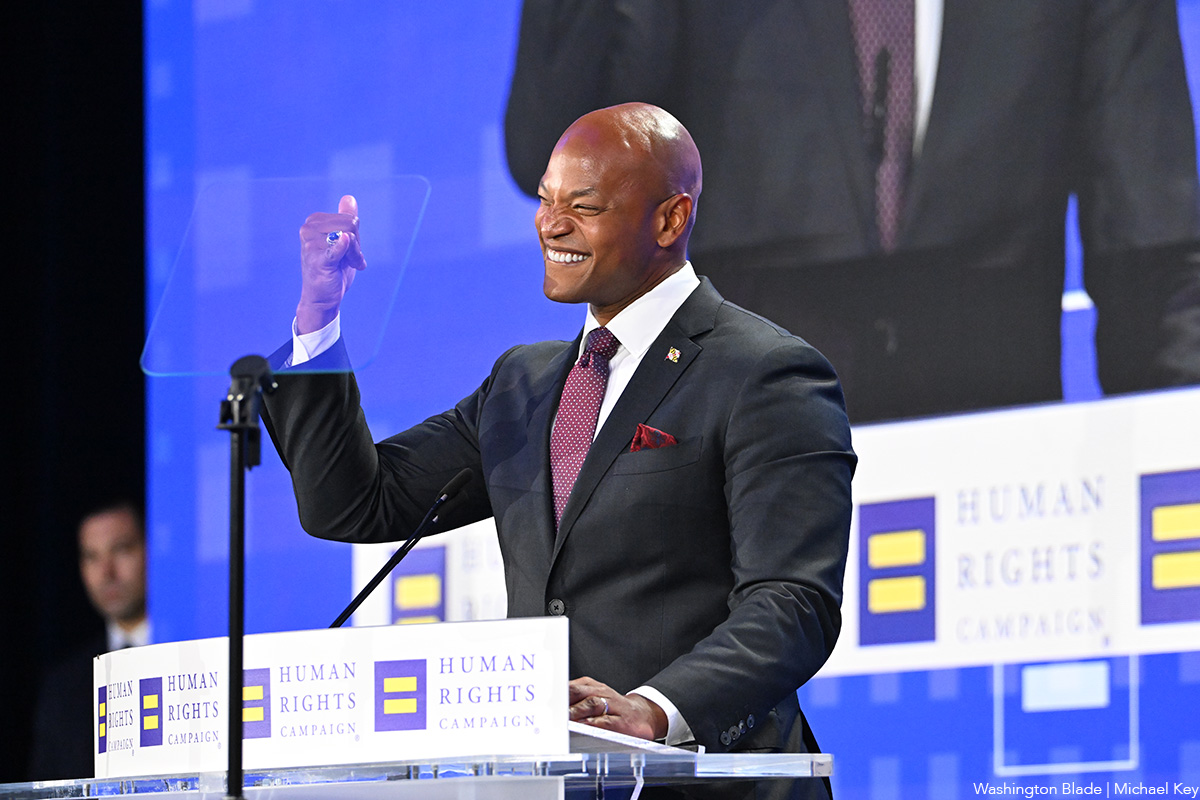
Maryland Gov. Wes Moore and the Governor’s Office of Crime Prevention and Policy are awarding a total of $10 million in grants in the 2027 fiscal year to nonprofit organizations that work to prevent hate crimes in the state.
The funds will be used to support those who feel targeted or discriminated against because of their race, religion, sexual orientation, gender identity, or disability status.
The Pride Center of Maryland is among the recipients. Churches, synagogues, mosques, and LGBTQ organizations are all eligible to receive grants
“The safety and security of all Marylanders is my top priority, so we are drawing a hard line because we have no tolerance for hate,” said Moore, according to media reports. “We are committed to protecting and ensuring safe and sacred spaces stay that way by investing in non-profit organizations, houses of worship, and community centers to protect and honor every community that makes our state so diverse and special.”
“Protection Against Hate Crime funding has strengthened the Pride Center of Maryland’s ability to protect, educate, and support the communities we serve … at a time of heightened concern associated with the Trump administration’s anti-LGBTQ/SGL (same-gender-loving) policies and pressures,” Pride Center of Maryland CEO Cleo Manago said. “PAHC funding helps us do more than improve physical security — it strengthens our community’s knowledge, preparedness, connection to resources, and ability to respond to hate with greater awareness and support.”
Maryland’s hate crimes law includes both sexual orientation and gender identity. The state’s nondiscrimination statute is also LGBTQ-inclusive.
District of Columbia
Blade welcomes fall intern
Alexis McLean is student at University of North Florida
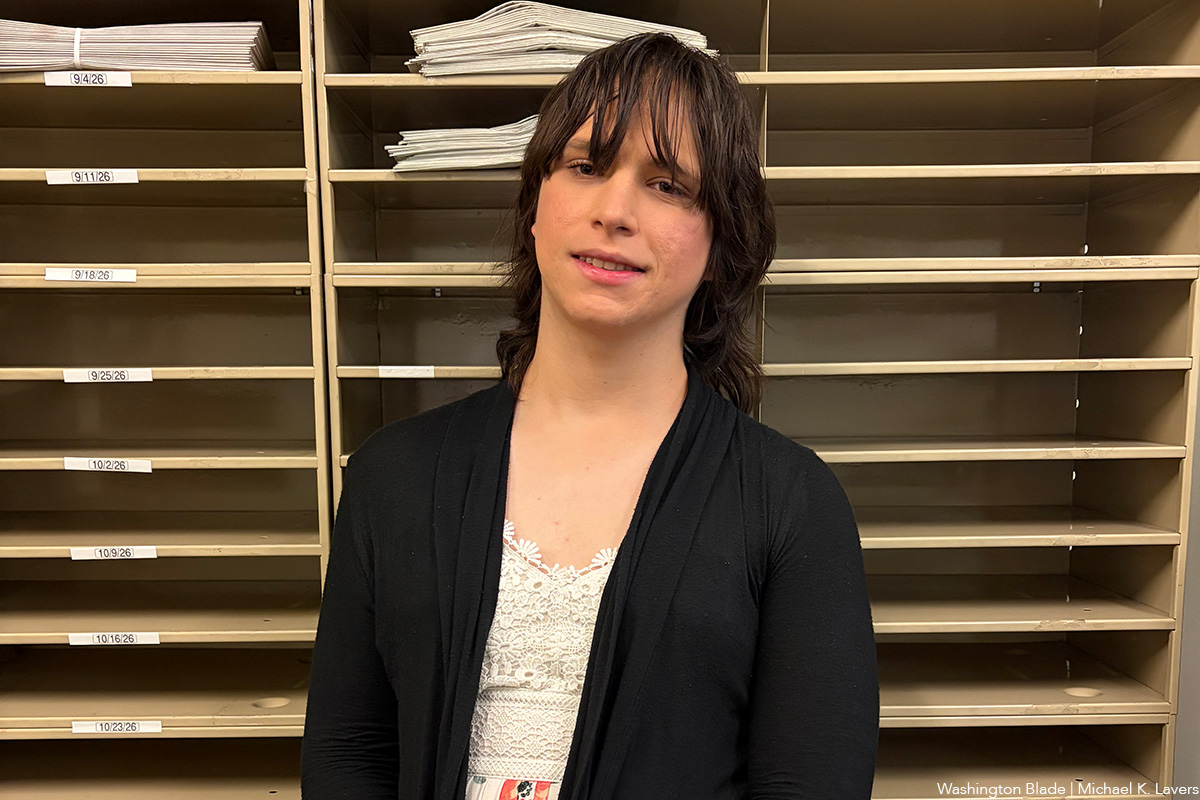
The Washington Blade this week welcomed Alexis McLean as its fall intern.
Alexis is studying political science at the University of North Florida in Jacksonville, Fla. She is interning with the Blade as part of a continued partnership with the Washington Center.
“I am looking forward to spending my time in the fall with the Washington Blade, as this is a new experience for me,” said Alexis. “I have not experienced any journalist jobs in the past so this would be my first time, and I am excited to better my writing and communications skills with this internship.”
Alexis’s internship with the Blade ends in early December.

‘Thelma and Louise’ remains landmark of unspoken queer rebellion

Comings & Goings

LGBTQ Military Happy Hour set for Sept. 15

Calendar: September 11-17

Multi-billion-dollar 9/11 Victim Compensation Fund to continue until 2090

Md. groups receive state grants to fight hate crimes

Nominate your favorites for the Blade’s 25th annual Best Of LGBTQ DC Awards

Gloria Steinem’s life of substance and consequence

PHOTOS: SUNFESTIVAL