Maryland
Howard County executive announces plans for LGBTQ commission
Calvin Ball made announcement at Wednesday press conference in Columbia
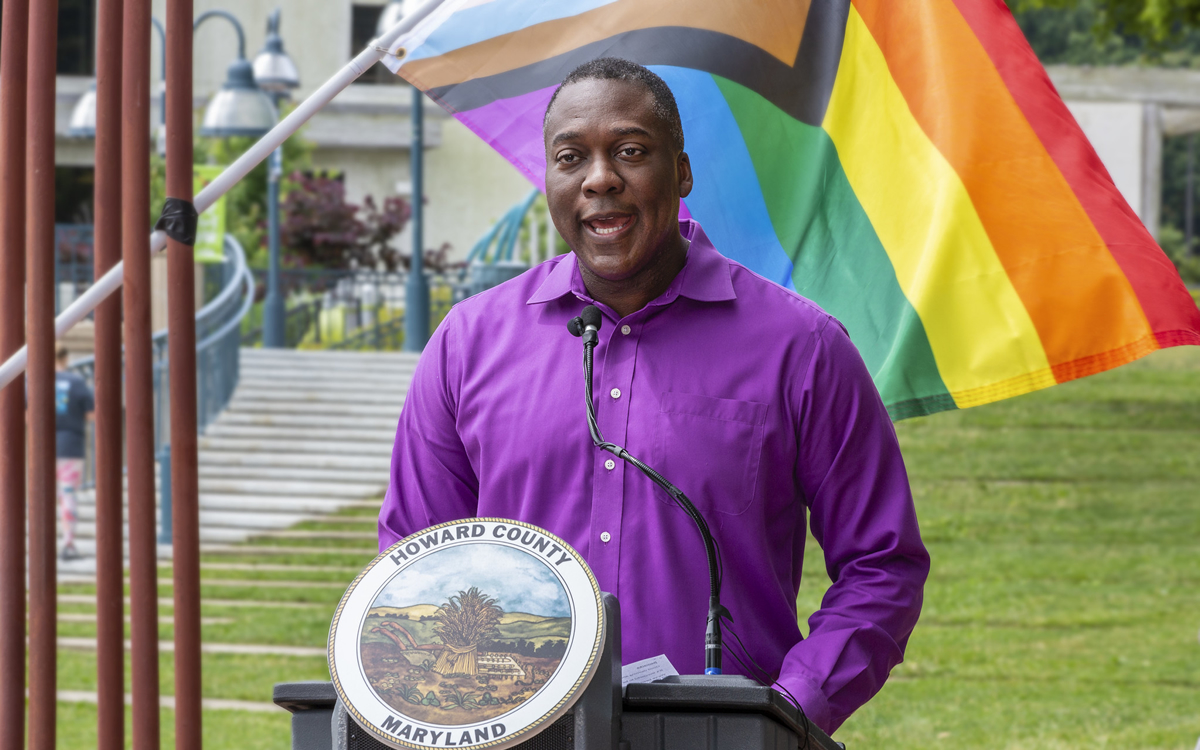
Under the “People’s Tree” sculpture near the Columbia lakefront, Howard County Executive Calvin Ball announced at a press conference on Wednesday the filing of legislation that would permanently establish the current LGBTQ Workgroup as a formal commission.
The new commission would follow the work of the LGBTQ Workgroup launched in 2019 by Ball.
“This commission will help move Howard County forward and will identify best practices to affirm members of the gay and transgender community; recommend initiatives to support LGBTQIA+ families and children; and advise us on policy and programs that impact our gay and transgender community, and on how to improve outcomes for underserved and at-risk members of the LGBTQIA+ population,” said Ball in his opening remarks in front of a crowd that included members of the LGBTQ Workgroup, county employees, members of the county’s Human Rights commissioners and LGBTQ activists and allies as well as elected officials and candidates.
He added, “The commission will support, plan, and help execute events, like PRIDE, to celebrate and affirm our community.”
Ball, speakers at the event included Human Rights and Equity Administrator Yolanda Sonier; Register of Wills Byron Macfarlane; Howard County Human Rights Commissioner Bob Ford; PFLAG-Howard County President Jumel Howard and community member Vicki Weiss Vivrette.
“Howard County and Maryland have always led the way on LGBTQ+ rights,” said Macfarlane, a lifetime Howard County resident and the first openly gay elected official in the county. “From Howard County’s anti-discrimination law passed many decades ago, to hate crime and anti-discrimination laws at the state level, to Maryland becoming one of the first states to pass marriage equality — not by judicial fiat — but by popular vote. Our community and our allies have achieved so much, but we know our hard-fought rights are under siege as we speak.”
Ford, the only out member of the county’s Human Rights Commission, continued that point.
“From a failed attempt to disrupt a Pride celebration in Idaho, to storming into a drag queen storytelling session in California, to over 200 bills in state legislatures aimed at stripping the rights of LGBTQ people especially trans kids — these are wake-up calls. Moreover, at one political party’s convention in Texas this past weekend, language was added to their platform that ‘homosexuality is an abnormal lifestyle choice’ and that party opposes ‘all efforts to validate transgender identity.’”
Ford pointed out that recent Pride flag burnings in Baltimore and that Pride flags have been banned in neighboring Carroll County schools, the chopping down and theft of a welcoming sign from a local church, and a vocal group of parents trying to ban LGBTQ content from books to curricula in schools indicate Howard County is not immune to hate.
The plan for the establishment of the new commission requires the approval of the county council and will be filed in July.
The George Howard Building, the headquarters for Howard County government, was bathed in rainbow lights after Wednesday’s event.




Maryland
Md. groups receive state grants to fight hate crimes
Pride Center of Maryland among recipients
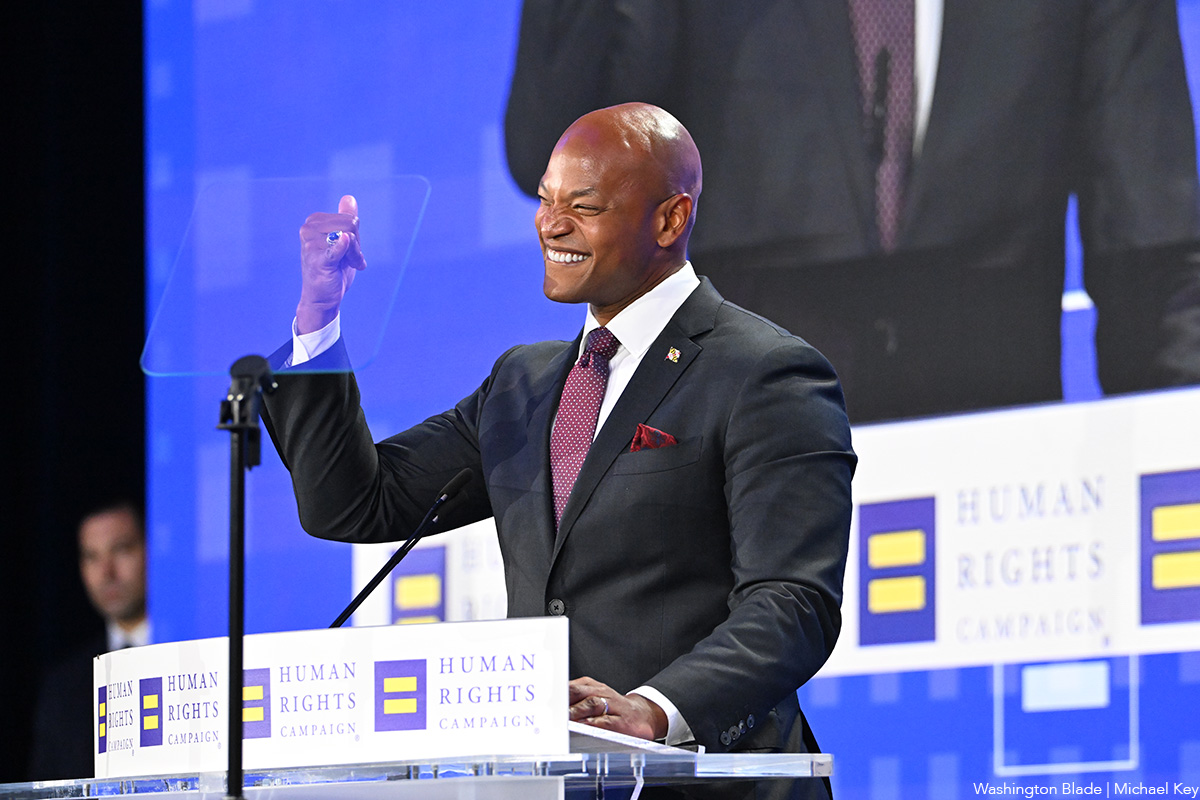
Maryland Gov. Wes Moore and the Governor’s Office of Crime Prevention and Policy are awarding a total of $10 million in grants in the 2027 fiscal year to nonprofit organizations that work to prevent hate crimes in the state.
The funds will be used to support those who feel targeted or discriminated against because of their race, religion, sexual orientation, gender identity, or disability status.
The Pride Center of Maryland is among the recipients. Churches, synagogues, mosques, and LGBTQ organizations are all eligible to receive grants
“The safety and security of all Marylanders is my top priority, so we are drawing a hard line because we have no tolerance for hate,” said Moore, according to media reports. “We are committed to protecting and ensuring safe and sacred spaces stay that way by investing in non-profit organizations, houses of worship, and community centers to protect and honor every community that makes our state so diverse and special.”
“Protection Against Hate Crime funding has strengthened the Pride Center of Maryland’s ability to protect, educate, and support the communities we serve … at a time of heightened concern associated with the Trump administration’s anti-LGBTQ/SGL (same-gender-loving) policies and pressures,” Pride Center of Maryland CEO Cleo Manago said. “PAHC funding helps us do more than improve physical security — it strengthens our community’s knowledge, preparedness, connection to resources, and ability to respond to hate with greater awareness and support.”
Maryland’s hate crimes law includes both sexual orientation and gender identity. The state’s nondiscrimination statute is also LGBTQ-inclusive.
Maryland
Anne Arundel schools now need parent permission to call trans students by preferred names
Conservative groups challenged system’s policy
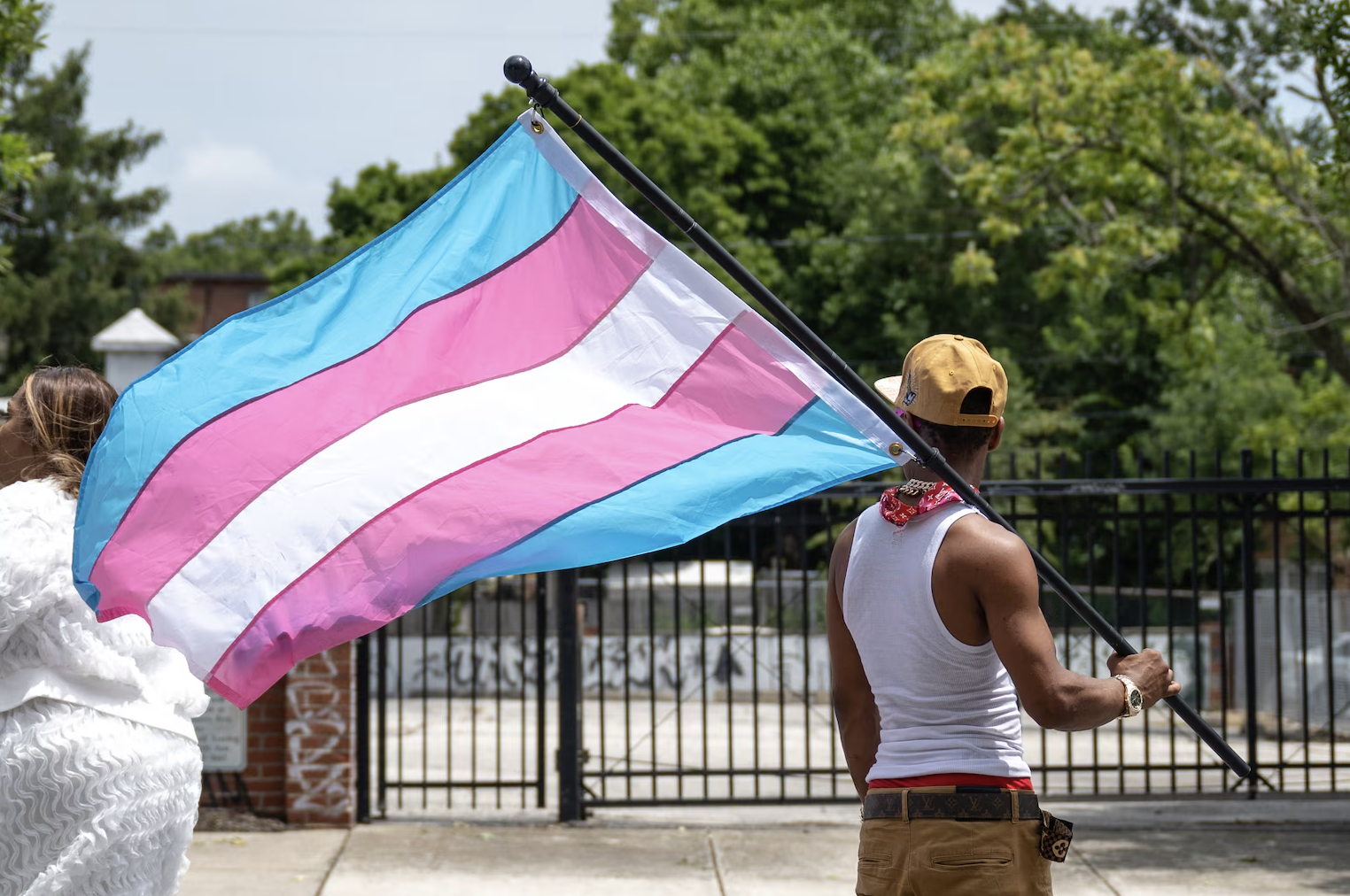
By JESSICA CALEFATI | Anne Arundel County Public Schools staff cannot use transgender students’ preferred names if their parents oppose it, according to an internal document reviewed by the Banner, a change that comes after conservative groups challenged the school system’s approach to gender identity.
Teachers union president Kristina Korona told members in an Aug. 20 email that the new guidance undermines district policy on acceptance and inclusivity and “will begin harming affected students immediately.”
Previously, the district didn’t require parental permission to use a high school student’s chosen name and pronouns corresponding to their gender identity, the internal document says. Now it does. The change comes as parents challenge the suburban school system’s gender identity policy and regulation in court and the Trump-Vance administration threatens the district’s funding.
The rest of this article can be found on the Baltimore Banner’s website.
Maryland
Girlfriends charged with Silver Spring murder to go on trial in 2027
Prosecutors charged both women with killing mother of one of them

Two women identified as a couple who are charged with the May 22, 2026, murder of the mother one of them in her Silver Spring home and who were arrested three weeks later in Ohio are scheduled to go on trial for murder April 19, 2027.
According to online records filed with Montgomery County Circuit Court in Rockville, Vanessa Tjongarero-Henderson, 29, of Clarksburg, Md., and Samantha Raebel, 36, of Phoenix are being held without bond in the Montgomery County Correctional Facility until the time of their trial.
Statements from Montgomery County police show the two women were arrested June 10 in Genoa, Ohio, after fleeing from the scene of the murder in Silver Spring. Police statements and court records show they were extradited back to Maryland in July, where prosecutors with the Montgomery County State’s Attorney’s Office obtained indictments against them for murder.
Earlier statements from Montgomery County police say their investigation into the murder led to their decision to initially charge the two women with first-degree murder for the death of Hilde Henderson, 67, who was Tjongarero-Henderson’s mother.
“Through the course of the investigation, detectives identified Henderson’s daughter, Vanessa Tjongarero-Henderson, and Vanessa’s girlfriend, Raebel, as the suspects,” one of the police statements says. It says police obtained arrest warrants for both women and launched a nationwide search seeking help from the public in in locating them.
One of the police statements says an autopsy determined the cause of Hilde Henderson’s death was blunt-force trauma injuries brought about by a murder. Police and the State’s Attorney’s Office, which is prosecuting the case, have yet to disclose whether they have determined a motive for the murder.
Court records show that prior to the start of the April 19, 2027, trial a “motion” hearing was scheduled for Oct. 30, 2026, a pre-trail conference was scheduled for Feb. 12, 2027, and another motion hearing and a status hearing were scheduled for March 12, 2027.
Court records also show that Tjongarero-Henderson is being represented by attorneys with the Montgomery County court system’s public defender service. The records show that Raebel initially had been represented by a public defender service attorney, but updated records show Aug. 14 is listed as the “removal date” for that attorney.
The docket shows that on Aug. 20, two new attorneys with the prominent D.C. law firm of Covington & Burling made their official appearance as her attorneys in the murder case. One of them, Daniel Solomon, told the Washington Blade in response to an inquiry that the defense has no comment at this time on the case.
He confirmed that Covington & Burling is representing Raebel on a no-cost, pro bono bass.
The office of the Montgomery County public defender service didn’t immediately respond to a phone message from the Blade asking for a comment on the Tjongarero-Henderson case.

Ind. prosecutor declines to press charges over false Buttigieg child welfare complaint

Historiography with heart

Remembering the LGBTQ heroes of 9/11 terrorist attacks

How Dolly became a folk saint for Appalachian queers

Report: 90 percent of LGBTQ groups around the world have lost funding since 2025

‘Here the Whole Time’ delivers queer coming-of-age comedy

Blade Foundation to host fundraiser in Rehoboth on Sept. 12

New book examines fashionista Audrey Smaltz’s fabulous life

Actress takes on bisexual ‘Ma’ Rainey in new Round House production

Iceland implements gender-neutral blood donor rules
-

 Movies4 days ago
‘Here the Whole Time’ delivers queer coming-of-age comedy
-
Out & About3 days ago
Blade Foundation to host fundraiser in Rehoboth on Sept. 12
-
Books3 days ago
New book examines fashionista Audrey Smaltz’s fabulous life
-
Theater3 days ago
Actress takes on bisexual ‘Ma’ Rainey in new Round House production