White House
Biden signs executive order to protect abortion access
U.S. Supreme Court struck down Roe v. Wade last month
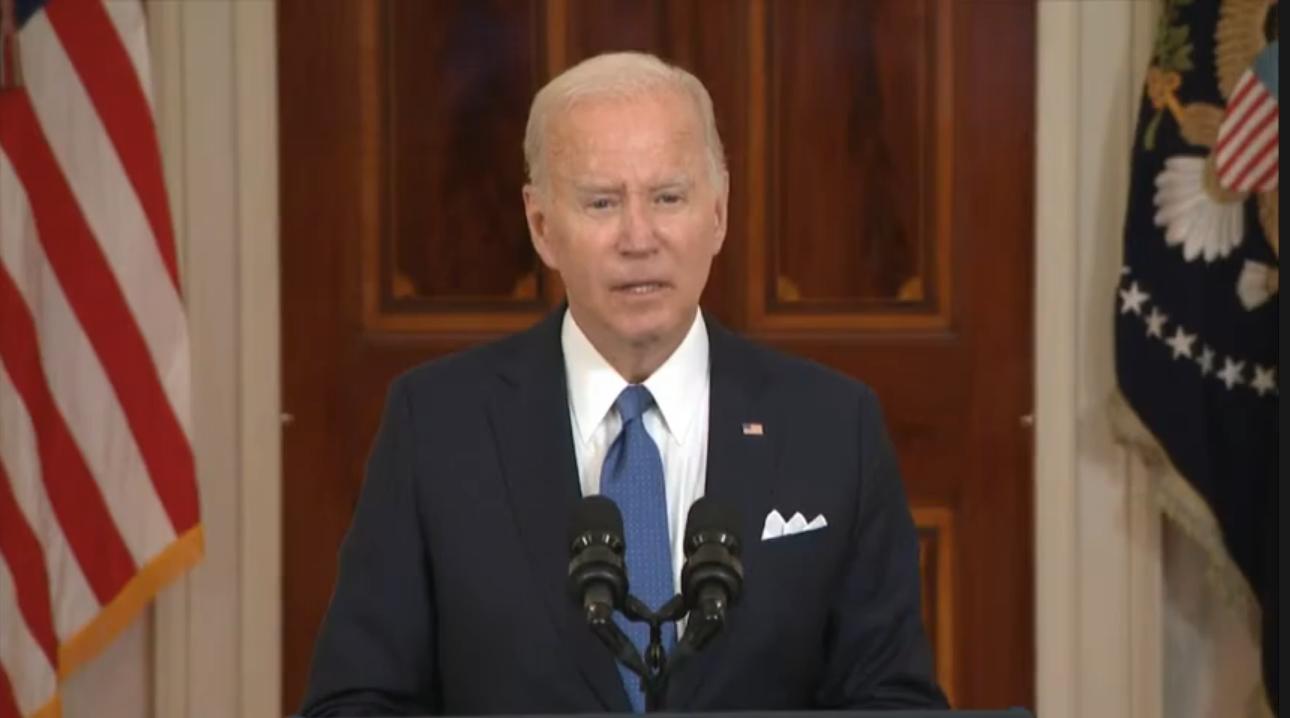
President Biden on Friday signed an executive order protecting access to reproductive health care services.
The president is under pressure from Democrats to step-up actions in the wake of the U.S. Supreme Court decision that overturned Roe v. Wade.
Biden made it clear that Congress needs to codify reproductive healthcare choices, however he also stated that he would continue to take actions on his own to to defend reproductive rights and protect access to safe and legal abortion.
Flanked by Vice President Kamala Harris and Health and Human Services Secretary Xavier Becerra in the Roosevelt Room, the president spoke about the order and the circumstances leading to the need for the executive order.
Biden referring to the Supreme Court ruling as “the wrong headed decision,” castigated the court for “playing fast and loose with the facts,” using the argument that abortion wasn’t rooted in historical precedent.
“The Supreme Court in Dobbs made a terrible, extreme and I think totally wrong-headed decision to overturn Roe v. Wade … This was not a decision driven by the Constitution […or] by history,” he said.
Biden then criticized the majority for reading the Constitution as frozen in the mindset of the 1800s, when women didn’t even have the right to vote.
Quoting the justice in dissent he then noted that the court decision was use of raw political power, saying that the court had finally a conservative majority to walk back the decision.
Biden urged that voters push out the Republicans in the upcoming mid-term elections labeling the Republicans as “extremist.” He then angrily cited the recent example of the 10-year-old rape victim in Ohio who was forced to travel to neighboring Indiana to have an abortion.
“Ten years old! … A 10 year old girl should be forced to give birth to a rapist’s child? What could be more extreme,” Biden said.
He warned that extremist Republicans even want to impose a national ban on abortion. As long as he’s president such a bill would be vetoed, he said.
The president also specified the need to have the Federal Trade Commission to regulate data brokers and others to enforce privacy for people using apps that expose them to the transfer and sales of sensitive health-related data.
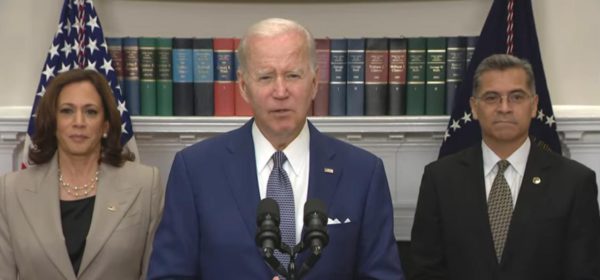
(Screenshot/YouTube White House Channel)
Biden then outlined that the Executive Order included:
- Safeguarding access to reproductive health care services, including abortion and contraception;
- Protecting the privacy of patients and their access to accurate information;
- Promoting the safety and security of patients, providers, and clinics; and
- Coordinating the implementation of Federal efforts to protect reproductive rights and access to health care.
The White House released the language of the executive order prior to Biden signing it:
The president has directed the secretary of Health and Human Services (HHS) to take the following actions and submit a report to him within 30 days on efforts to:
- Protect Access to Medication Abortion. HHS will take additional action to protect and expand access to abortion care, including access to medication that the FDA approved as safe and effective over 20 years ago. These actions will build on the steps the secretary of HHS has already taken at the president’s direction following the decision to ensure that medication abortion is as widely accessible as possible.
- Ensure Emergency Medical Care. HHS will take steps to ensure all patients – including pregnant women and those experiencing pregnancy loss – have access to the full rights and protections for emergency medical care afforded under the law, including by considering updates to current guidance that clarify physician responsibilities and protections under the Emergency Medical Treatment and Labor Act (EMTALA).
- Protect Access to Contraception. HHS will take additional actions to expand access to the full range of reproductive health services, including family planning services and providers, such as access to emergency contraception and long-acting reversible contraception like intrauterine devices (IUDs). In all 50 states and the District of Columbia, the Affordable Care Act guarantees coverage of women’s preventive services, including free birth control and contraceptive counseling, for individuals and covered dependents. The secretary of HHS has already directed the Centers for Medicare and Medicaid Services to take every legally available step to ensure patient access to family planning care and to protect family planning providers.
- Launch Outreach and Public Education Efforts. HHS will increase outreach and public education efforts regarding access to reproductive health care services — including abortion — to ensure that Americans have access to reliable and accurate information about their rights and access to care.
- Convene Volunteer Lawyers. The attorney general and the White House counsel will convene private pro bono attorneys, bar associations, and public interest organizations to encourage robust legal representation of patients, providers, and third parties lawfully seeking or offering reproductive health care services throughout the country. Such representation could include protecting the right to travel out of state to seek medical care. Immediately following the Supreme Court decision, the president announced his administration’s position that Americans must remain free to travel safely to another state to seek the care they need, as the attorney general made clear in his statement, and his commitment to fighting any attack by a state or local official who attempts to interfere with women exercising this right.
PROTECTING PATIENT PRIVACY AND ACCESS TO ACCURATE INFORMATION
The president’s executive order takes additional steps to protect patient privacy, including by addressing the transfer and sales of sensitive health-related data, combatting digital surveillance related to reproductive health care services, and protecting people seeking reproductive health care from inaccurate information, fraudulent schemes, or deceptive practices. The executive order will:
- Protect Consumers from Privacy Violations and Fraudulent and Deceptive Practices. The president has asked the chair of the Federal Trade Commission to consider taking steps to protect consumers’ privacy when seeking information about and provision of reproductive health care services. The president also has directed the secretary of HHS, in consultation with the attorney general and chair of the FTC, to consider options to address deceptive or fraudulent practices, including online, and protect access to accurate information.
- Protect Sensitive Health Information. HHS will consider additional actions, including under the Health Insurance Portability and Accountability Act (HIPAA), to better protect sensitive information related to reproductive health care. The secretary of HHS has already directed the HHS Office for Civil Rights to take initial steps to ensure patient privacy and nondiscrimination of patients, as well as providers who provide reproductive health care, including by:
- Issuing new guidance to address how the HIPAA Privacy Rule protects the privacy of individuals’ protected health information, including information related to reproductive health care. The guidance helps ensure doctors and other medical providers and health plans know that, with limited exceptions, they are not required – and in many cases, are not permitted – to disclose patients’ private information, including to law enforcement.
- Issuing a how-to guide for consumers on steps they can take to make sure they’re protecting their personal data on mobile apps.
- Issuing new guidance to address how the HIPAA Privacy Rule protects the privacy of individuals’ protected health information, including information related to reproductive health care. The guidance helps ensure doctors and other medical providers and health plans know that, with limited exceptions, they are not required – and in many cases, are not permitted – to disclose patients’ private information, including to law enforcement.
PROMOTING SAFETY AND SECURITY
The executive order addresses the heightened risk related to seeking and providing reproductive health care and will:
- Protect Patients, Providers and Clinics. The administration will ensure the safety of patients, providers, and third parties, and to protect the security of other entities that are providing, dispensing, or delivering reproductive health care services. This charge includes efforts to protect mobile clinics, which have been deployed to borders to offer care for out-of-state patients.
COORDINATING IMPLEMENTATION EFFORTS
To ensure the federal government takes a swift and coordinated approach to addressing reproductive rights and protecting access to reproductive health care, the president’s executive order will:
- Establish an Interagency Task Force. The president has directed HHS and the White House Gender Policy Council to establish and lead an interagency Task Force on Reproductive Health Care Access, responsible for coordinating federal interagency policymaking and program development. This task force will also include the attorney general. In addition, the attorney general will provide technical assistance to states affording legal protection to out-of-state patients as well as providers who offer legal reproductive health care.
EXECUTIVE ORDER BUILDS ON ADMINISTRATION’S ACTIONS TO PROTECT ACCESS TO REPRODUCTIVE HEALTH CARE
In addition to the actions announced today, the Biden-Harris administration has taken the following steps to protect access to reproductive health care and defend reproductive rights in the wake of the Supreme Court decision in Dobbs. On the day of the decision, the president strongly denounced the decision as an affront to women’s fundamental rights and the right to choose In addition to action mentioned above, the Biden-Harris administration is:
- Supporting Providers and Clinics. The secretary of HHS directed all HHS agencies to ensure that all HHS-funded providers and clinics have appropriate training and resources to handle family planning needs, and announced nearly $3 million in new funding to bolster training and technical assistance for the nationwide network of Title X family planning providers.
- Promoting Access to Accurate Information. On the day of the Supreme Court’s decision, HHS launched ReproductiveRights.gov, which provides timely and accurate information about reproductive rights and access to reproductive health care. This includes know-your-rights information for patients and providers and promoting awareness of and access to family planning services, as well as guidance for how to file a patient privacy or nondiscrimination complaint with its Office for Civil Rights.
- Providing Leave for Federal Workers Traveling for Medical Care. The Office of Personnel Management issued guidance affirming that paid sick leave can be taken to cover absences for travel to obtain reproductive health care.
- Protecting Access to Reproductive Health Care Services for Service members, DoD Civilians, and Military Families. The Department of Defense issued a memo to the Force, DoD civilians and military families on ensuring access to essential women’s health care services. The memo reiterates that the department will continue to provide seamless access to reproductive healthcare for military and civilian patients, as permitted by federal law. Military providers will continue to fulfill their duty to care for service members, military dependents and civilian personnel who require pregnancy termination in the cases of rape, incest, or to protect the life of the mother.



White House
Trump-Vance administration’s LGBTQ brain drain: what you need to know
Several high profile figures have left government since January 2025

Uncloseted Media published this article on Aug. 21.
By SPENCER MACNAUGHTON and HOPE PISONI | Since President Donald Trump regained office in January 2025, he and his administration have waged an all-out war against the LGBTQ community.
This has led queer Americans to move to other countries at unprecedented rates — Rainbow Railroad, a Canadian nonprofit that supports LGBTQ asylum seekers, reported receiving a huge increase in inquiries from the U.S. last year.
The same pattern is playing out within the government. And it’s leading to a brain drain of competent queer employees and allies who are either resigning or being fired, often because of their LGBTQ identity or their belief that queer people deserve basic human rights.
Here are six examples of federal workers who had a messy exit from Trump 2.0:
Demetre Daskalakis
- WHAT HE DID: Dr. Daskalakis is one of the foremost LGBTQ health professionals in the U.S. Under Trump’s first term, he was appointed director of the Division of HIV/AIDS Prevention at the Centers for Disease Control and Prevention. Under Biden, he also served as the deputy response coordinator for mpox at the White House.
- WHAT HAPPENED: While he continued a lot of this work under Trump 2.0, he didn’t last long. In August 2025, he resigned from the CDC, writing in his resignation letter that he was “unable to serve in an environment that treats CDC as a tool to generate policies and materials that do not reflect scientific reality and are designed to hurt rather than to improve the public’s health.”
- BOTTOM LINE: I recently interviewed Daskalakis, where he told me that leadership from RFK Jr.’s Health and Human Services Department justified HIV cuts by saying the virus is “just too woke.”
Julia Curlee
- WHAT SHE DID: Julia Curlee worked in intelligence for nearly two decades between the CIA and the National Security Council. Earlier this week, she wrote an article in The Atlantic explaining how she had served as Mike Pence’s daily briefer and the NSC’s director for intelligence programs. During Trump 1.0, she briefed the president on Air Force One.
- WHAT HAPPENED: Curlee told CNN this week that in Trump’s second term, her treatment by the federal government transformed. She was no longer allowed to use the women’s bathroom on federal property and had to leave her workplace to relieve herself. Her passport was also reissued to read “male,” which led to complications when traveling abroad. In March 2025, less than 70 days into Trump’s second term, Curlee says she received a call while at a rib joint in Virginia with her family informing her that her White House tour was over and that they couldn’t tell her why. She continued to work for the CIA for some months, but she later resigned.
- BOTTOM LINE: Curlee wrote that moments after she learned she was fired from the White House, she saw a post from right-wing political activist Laura Loomer that read “A transgender, Biden holdover who hates President Trump is still working in the NSC intel office. I’m told there are several NSC staffers who have complained that this trans Biden holdover hasn’t been fired yet, but nothing is being done about it.”
Marc Seawright
- WHAT HE DID: Marc Seawright worked for more than eight years at the U.S. Equal Employment Opportunity Commission. Most recently, he served as the EEOC’s director of information governance and strategy, where he oversaw tech policy to help combat workplace harassment and discrimination.
- WHAT HAPPENED: During Trump 2.0, Seawright was ordered to develop technology that would erase any mention of LGBTQ identities from EEOC outreach materials. “[My expertise] was being leveraged to perpetuate discrimination against people like me,” he told the Associated Press. In that article, Seawright and other transgender and gender nonconforming federal employees described their “fear, grief, frustration, and distress working for the federal government at a time when it rejects them — often with no clear path for recourse or support.”
- BOTTOM LINE: Seawright quit in June, citing a hostile work environment. “It became overwhelming. It felt insurmountable,” he told the AP. He has now hired lawyers at Katz Banks Kumin and has filed a discrimination complaint.
David Maltinsky
- WHAT HE DID: Until 2025, Maltinsky worked for more than 16 years at the FBI as an intelligence specialist. In 2025, he was training to become a special agent, but three weeks ahead of graduation, he was fired.
- WHAT HAPPENED: On Oct. 1, he was delivered a letter from FBI Director Kash Patel informing him that he was being fired for an “inappropriate display of political signage.” The signage in question, according to Maltinsky, was a Pride flag displayed in his work station at a previous post in Los Angeles. The flag had been given to him by the FBI’s LA Field Office, and Maltinsky says he had been told by multiple supervisors that displaying it would not be a violation.
- BOTTOM LINE: Maltinsky is currently suing the FBI and the Department of Justice, arguing that his firing constituted unlawful discrimination.
Mary Brinkmeyer
- WHAT SHE DID: Brinkmeyer had been working as a psychologist for the Department of Veterans Affairs since 2008. She held multiple leadership roles, including the LGBTQ veteran care coordinator at the Hampton VA Medical Center. She established the first military support group for trans servicemembers and was awarded Navy Psychology Civilian Psychologist of the Year in 2016.
- WHAT HAPPENED: Following an early Trump executive order directing the federal government to purge any practices promoting “gender ideology,” Brinkmeyer says staff at her workplace were told to remove all LGBTQ-affirming materials from both public and private areas, as well as to identify “anything in medical records, training materials, or patient resources that could be considered ‘gender ideology.’” When she refused to comply and confronted her supervisor, she says her concerns were dismissed.
- BOTTOM LINE: Brinkmeyer resigned in February 2025, stating that she “didn’t want to be complicit in something that I knew was wrong.”
Amy Paris
- WHAT SHE DID: Paris was the second-highest ranking trans woman in the federal government, serving as a deputy digital services lead in the HHS Department, where she oversaw the safety of organ donations. Prior to that, she worked in a number of tech-related roles across the federal government since the Bush administration. She helped create cross-agency spending trackers, streamlined unemployment insurance during the pandemic and implemented trans-inclusive policies like gender-neutral passports.
- WHAT HAPPENED: Paris was fired as part of a string of mass layoffs across the federal government in February 2025. While the HHS did not publicly comment on why she was fired, Paris says she was told it was because of her performance, despite the fact that she got a 4.75 out of five on her last performance review and was praised for her work by multiple Biden administration officials.
- BOTTOM LINE: Paris told the 19th she suspected her firing was politically motivated, saying the Trump administration is “trying to sow discord and disrupt confidence in the workings of the federal government.”
White House
White House targets gender-affirming care funding, states fight back
Attorneys general from Md. and elsewhere are fighting directives
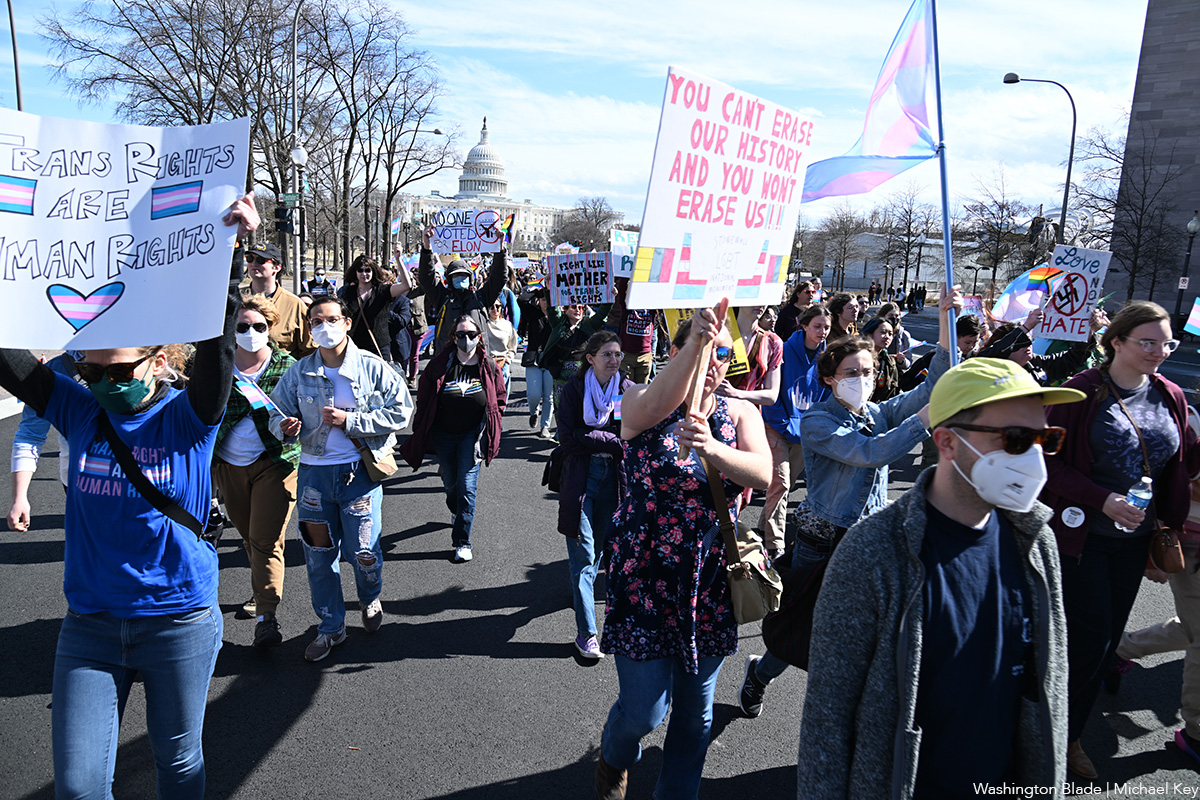
The Centers for Medicare and Medicaid Services announced last week that federal funding could no longer be used to pay for gender-affirming care through Medicaid or the Children’s Health Insurance Program.
The rule prohibits federal Medicaid dollars from covering puberty blockers, hormone therapy, and rare instances of surgery for enrollees under the age of 18 in the Medicaid program and under the age of 19 in CHIP. It does not prohibit coverage of counseling or psychotherapy as part of gender-affirming care.
The decision to restrict what healthcare is covered by federal dollars is part of a longer, more aggressive stance the Trump-Vance administration is taking toward LGBTQ healthcare.
Since taking the White House back for his second term, Trump has signed three executive orders that directly target transgender Americans. They include Executive Order 14168, “Defending Women From Gender Ideology Extremism and Restoring Biological Truth to the Federal Government” that requires the federal government to recognize only a person’s sex at birth, not their gender identity; Executive Order 14183, “Prioritizing Military Excellence and Readiness,” which attempts to remove transgender service members from the military and prevent them from enrolling; and an executive order that helped spur this change by restricting gender-affirming care.
The administration’s choice to villainize gender-affirming care, despite it being considered a best medical practice recommended by nearly every major medical group for gender dysphoria or gender incongruence, including the American Medical Association, American Academy of Pediatrics, and American Psychological Association, comes as KFF, a source for health policy research and polling data, estimates about 130,000 young trans people with Medicaid or CHIP coverage could be impacted by the policy.
“Today, we are ending federal taxpayer funding for sex-rejecting procedures on children,” U.S. Department of Health and Human Services Secretary Robert F. Kennedy, Jr., said last week when announcing the change. “These interventions carry serious risks and can cause irreversible harm. The federal government will no longer use Medicaid and CHIP dollars to fund procedures that fail to meet the evidentiary standard our children deserve.”
“Children deserve our protection, not experimental interventions that pose serious risks and convey no proven benefits,” said CMS Administrator Mehmet Oz. “By cutting off federal funds for these sex-rejecting procedures, we’re following the science, saving taxpayer dollars, and, most importantly, protecting children from potentially irreversible harm so they can truly flourish.”
The administration’s push is having a chilling effect on state healthcare legislation — more states now prohibit gender-affirming care than ever before. States with gender-affirming care restrictions jumped from four in 2023 to 27 states today.
The funding change has been met with fierce pushback from LGBTQ advocates, health experts, and government officials across the country before the rule goes into effect.
Some of the first actions against this policy began in July 2025.
Twenty-one states have attempted to restrict this effort in some fashion from going through as the White House intends. They include Arizona, California, Colorado, Connecticut, Delaware, Illinois, Maryland, Massachusetts, Maine, Michigan, Minnesota, Nevada, New Mexico, New Jersey, New York, Oregon, Rhode Island, Vermont, Washington, and Wisconsin, as well as Pennsylvania Gov. Josh Shapiro on behalf of his state.
The coalition of attorneys general filed lawsuits challenging nine separate provisions of the final rule, arguing that they would make it harder for consumers to get coverage through the ACA, increase costs for states, and weaken key ACA protections.
The U.S. District Court for the District of Massachusetts on Aug. 15 struck down a key provision of a Trump-Vance administration final rule that would have excluded coverage of certain types of gender-affirming care as essential health benefits under the Affordable Care Act. Essential health benefits are subject to the ACA’s financial protections, including limits on out-of-pocket costs.
“Everyone deserves access to health coverage,” said California Attorney General Rob Bonta. “The Trump administration tried to exclude gender-affirming care from qualifying as an essential health benefit. We fought back, and the court’s ruling means this care can — and in many states must — qualify for the ACA’s financial protections, ensuring transgender people have an equal opportunity to benefit from the ACA.”
“The Trump administration tried to make essential care unaffordable for transgender Marylanders by stripping it out of the ACA’s cost protections,” said Maryland Attorney General Anthony Brown. “We fought to keep that care covered, and we won. My Office will always defend Marylanders’ right to the care they need.”
The final rule at issue — the “Marketplace Integrity and Affordability” rule — was proposed by the Trump-Vance administration in March 2025, purportedly to “curb ACA enrollment fraud” and reduce federal spending on subsidies that help consumers afford ACA coverage. Among other changes, the rule would have removed certain types of gender-affirming care from the ACA’s 10 essential health benefit categories.
“This president would rather target young people than lower costs or expand access to health care. It is reprehensible that our federal government is intent on hurting and isolating the adolescents it is supposed to protect. I will use every tool at my disposal to fight this proposal and protect transgender Americans and their families,” said New York Attorney General Letitia James in December after the policy was announced.
In addition to state government resistance to the change, multiple LGBTQ advocates have committed to protecting the right to healthcare for LGBTQ children.
Rocky Mountain Equality CEO Mardi Moore affirmed those in Colorado would continue to help people most at risk if the change goes through.
“First, to the families impacted by this news: you will not be cut off immediately. The rule takes effect Oct. 13, 2026, and providers can continue to bill Medicaid and CHIP for youth already receiving gender-affirming care for up to six months after that. Rocky Mountain Equality is here, and we can help you understand your options to continue your child’s care.
“This is discrimination dressed up as rule-making. Government healthcare policy should expand what people can access, not strip away care that families and doctors have already determined is medically necessary,” Moore added. “We’ve seen this pattern before with other kinds of essential care, and it rarely stops with just one restriction. Any effort to ban or limit care opens the door for more restrictions on more kinds of care.”
The Human Rights Campaign, the largest LGBTQ lobbying group in the U.S., issued multiple statements following the announcement, and has filed a similar lawsuit against the federal government for prohibiting gender-affirming care to federal employees using federal health plans.
HRC President Kelley Robinson said taking a hard stance against what the administration is presenting as a win for the American people that will ultimately restrict healthcare options for thousands of Americans.
“Every young person is entitled to the health care that they, their parents, and their medical providers agree that they need, without politicians interfering with these important and highly personal decisions. And yet, rather than working to make healthcare more affordable and accessible, the Trump administration continues to obsess over the healthcare needs of trans youth, this time by cutting off health insurance coverage for those who rely on Medicaid and CHIP to access that care,” Robinson said. “The Trump administration is terrorizing trans youth and their families with these kinds of actions, and it has to stop.”
White House
HRC files class action over federal ban on gender-affirming care coverage
Lawsuit filed Monday challenges White House effort to restrict care

The Human Rights Campaign Foundation, the nonprofit sister organization to the largest LGBTQ human rights lobbying and advocacy organization in the U.S., along with law firms Correia & Puth and Cohen Milstein Sellers & Toll, filed a class action lawsuit against the government as it attempts to restrict gender-affirming healthcare for federal employees.
The suit, filed on Monday, alleges that the Office of Personnel Management, run by Trump appointee Scott Kupor, is discriminating against LGBTQ federal employees (and their families and retired employees) by prohibiting health insurance coverage for gender-affirming care under the Federal Employees Health Benefits and Postal Service Health Benefits plans. There are five plaintiffs named in the complaint, but it extends to others who have those healthcare plans.
The document asserts that OPM’s prohibition on coverage for “gender transition” care in the FEHB and PSHB programs violates Title VII, the federal law that prohibits discrimination based on sex, race, color, religion, or national origin.
The policy, which was implemented on Jan. 1 following the 2025 issuing of Program Carrier Letter, mandated that insurance providers in these programs deny any coverage for gender-affirming care. In February, HRC filed a federal complaint with OPM over the change in healthcare policy, which was ultimately passed to the Equal Employment Opportunity Commission for review. That complaint is now an officially filed class action lawsuit in the U.S. District Court for the District of Columbia.
Research from the Williams Institute at UCLA Law, a think tank that collects data and conducts research on issues related to sexual orientation and gender identity, indicates that this policy denying gender-affirming care will impact healthcare access for at least 39,400 current and former federal employees and their dependents.
Human Rights Campaign President Kelley Robinson released a statement following the lawsuit’s filing.
“Our message to the Trump administration is simple: we’ll see you in court,” said Robinson. “Healthcare access should never be weaponized to advance discrimination — and the denial of coverage for critical healthcare based simply on who you are blatantly violates the rights of all of us.”
Gender-affirming care has been under constant attack by the Trump-Vance administration since its return to the White House, despite the practice being considered as extensively evidence-based but also supported by nearly every major medical organization. This type of care is provided to all people—not just transgender people—and includes things such as social affirmation, including using correct names and pronouns and wearing clothing that matches a person’s gender identity; mental health support, such as counseling to reduce depression and anxiety; and, in some cases, medical interventions such as reversible puberty blockers or hormone therapy when deemed medically appropriate.
“Federal employees have been through the wringer with the Trump administration,” said Cathy Harris, partner at Correia & Puth. “We draw the line at blatant discrimination to deny healthcare to our nation’s dedicated civil servants.”
“This odious policy is the latest example of the Trump administration’s obsession with targeting transgender people, using shameful and cruel tactics to threaten their employment, their health, and the well-being of themselves and their families,” Robinson added. “OPM’s actions will not go unchallenged, and we’ll continue to fight so that federal employees and their families receive the dignity they deserve.”
This is not the first time the White House has directly attacked gender-affirming care.
In January 2025, the administration issued Executive Order 14187, titled “Protecting Children from Chemical and Surgical Mutilation.” The order directs federal agencies to restrict gender-affirming medical care — including puberty blockers, hormone therapy, and surgeries — for individuals under the age of 19.
For more information on how to get involved with the lawsuit, visit hrc.org.

Ind. prosecutor declines to press charges over false Buttigieg child welfare complaint

Historiography with heart

Remembering the LGBTQ heroes of 9/11 terrorist attacks

How Dolly became a folk saint for Appalachian queers

Report: 90 percent of LGBTQ groups around the world have lost funding since 2025

‘Here the Whole Time’ delivers queer coming-of-age comedy

Blade Foundation to host fundraiser in Rehoboth on Sept. 12

New book examines fashionista Audrey Smaltz’s fabulous life

Actress takes on bisexual ‘Ma’ Rainey in new Round House production

Iceland implements gender-neutral blood donor rules
-

 Movies4 days ago
‘Here the Whole Time’ delivers queer coming-of-age comedy
-
Out & About3 days ago
Blade Foundation to host fundraiser in Rehoboth on Sept. 12
-
Books3 days ago
New book examines fashionista Audrey Smaltz’s fabulous life
-
Theater3 days ago
Actress takes on bisexual ‘Ma’ Rainey in new Round House production