FERNANDO’S CLEANING
Federal Government
Protesters say SAVE Act targets voters, transgender youth
Bill described as ‘Jim Crow 2.0’
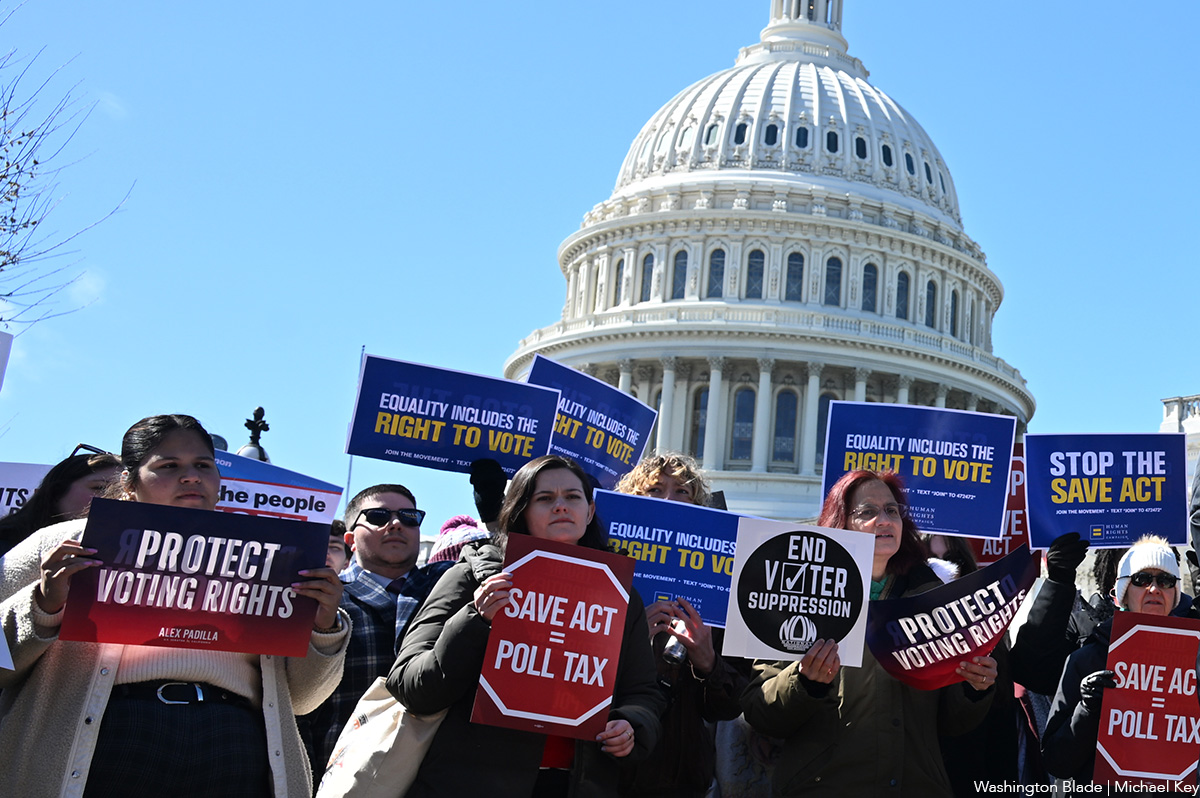
Members of Congress, advocates, and people from across the country gathered outside the U.S. Capitol on Tuesday to protest proposed federal legislation that voting rights activists have deemed “Jim Crow 2.0.”
The Safeguard American Voter Eligibility (SAVE) Act would amend the National Voter Registration Act of 1993 to require in-person proof of citizenship for anyone seeking to vote in U.S. elections.
President Donald Trump has also pushed for the proposed legislation to include a section that would ban gender-affirming medical care for transgender minors, even with parental consent, and prohibit trans people from participating in school or professional sports consistent with their gender identity rather than their sex assigned at birth.
In addition to changing voter registration requirements, the bill would limit acceptable forms of identification to documents such as a birth certificate or passport — records that the Brennan Center for Justice estimates more than 21 million Americans do not have — effectively restricting access to the ballot. It would also ban online voter registration, DMV voter registration efforts, and mail-in voter registration.
A 2021 investigation by the Associated Press found that fewer than 475 people voted illegally or improperly, a tiny fraction of the estimated 160 million Americans who voted in the 2020 election.
Senate Minority Leader Chuck Schumer (D-N.Y.) spoke at the event.
“It will kick millions of American citizens off the rolls. And they don’t even require you to be told,” the highest-ranking Democrat in the Senate told protesters and reporters outside the Capitol. “If this law passes — and it won’t — you’re gonna show up in November … and they’ll say… sorry, you’re no longer on the voting rolls.”
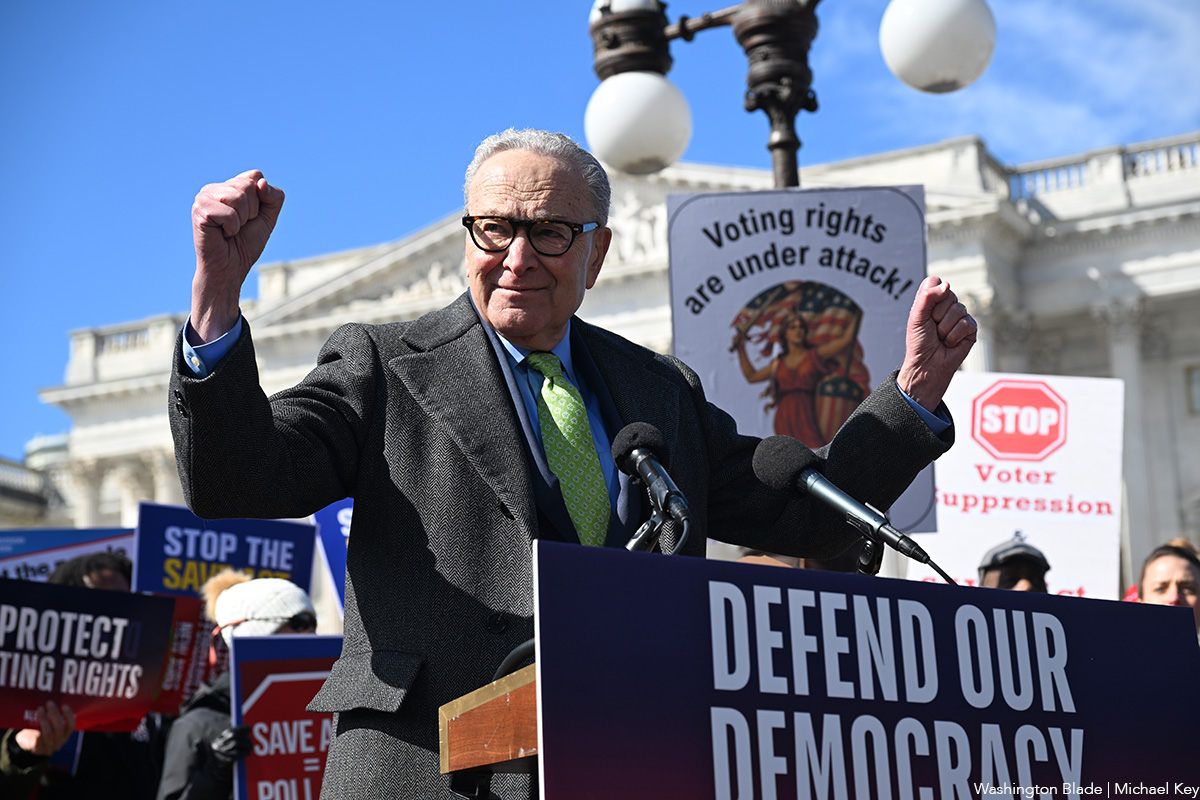
He, like many other speakers, emphasized the bill in the context of American history, pointing to what he described as its racist roots and its impact on Black and brown Americans.
“I have called this act, over and over again, Jim Crow 2.0 … because they know it’s the truth.”
U.S. Sen. Alex Padilla (D-Calif.) was one of the lawmakers leading opposition to the legislation and spoke at the rally.
“It’s not just voting rights that are on the line — our democracy is on the line,” the California lawmaker said. “It’s not a voter I.D. bill. It’s a bait and switch bill.”
He added historical context, noting the significance of voting rights legislation passed more than 60 years ago. In 1965, Alabama civil rights activists marched to protest barriers to voter registration. Alabama state troopers violently attacked peaceful demonstrators at the Edmund Pettus Bridge in Selma, using tear gas, clubs, and whips against more than 500 — mostly Black — protesters.
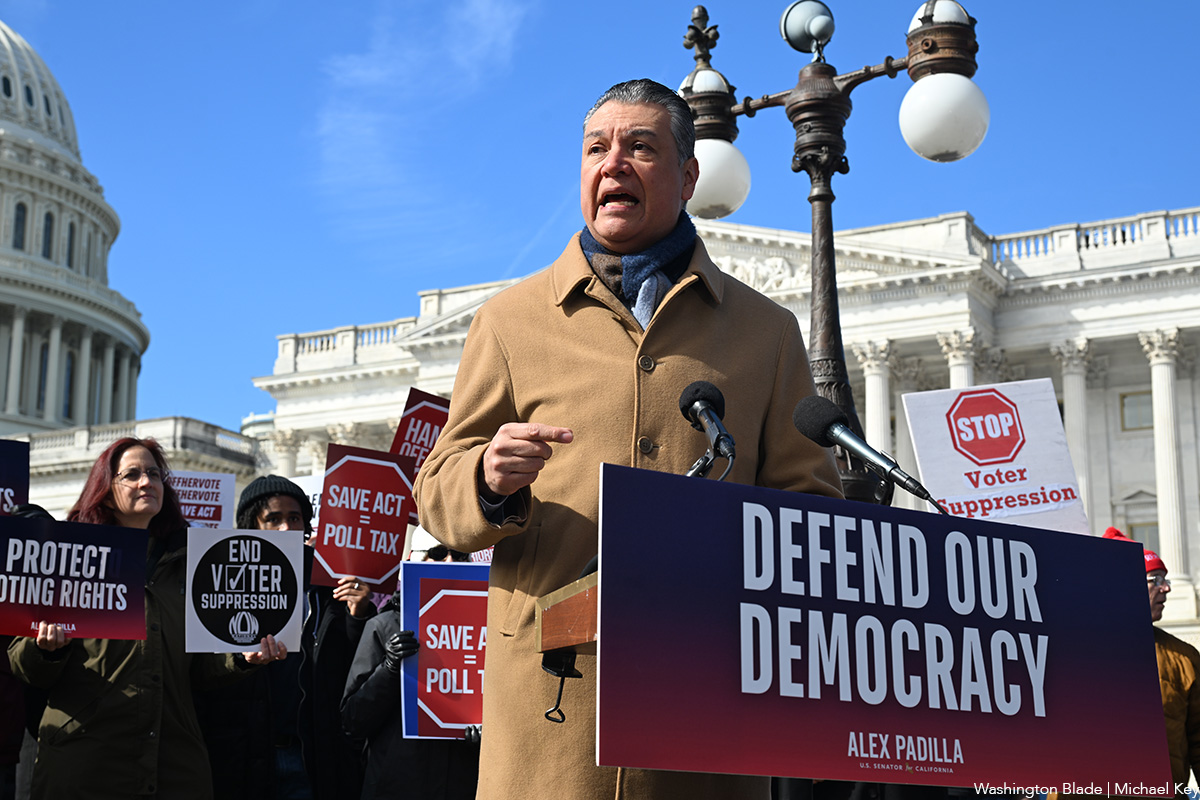
“61 years ago — not to the day — but this week, President Lyndon Johnson came to the Capitol and addressed a joint session of Congress in the wake of Bloody Sunday and pushed Congress to pass the Voting Rights Act,” Padilla said. “61 years later, Donald Trump and this Republican majority wants to take us backwards. We’re not gonna let that happen.”
U.S. Sen. Ben Ray Luján (D-N.M.) also spoke, emphasizing that he views the effort as a Republican-led and Trump-backed attempt to restrict voting access, particularly among Black, brown, and predominantly Democratic communities.
“President Trump told Republicans when they were meeting behind closed doors that ‘The SAVE Act will guarantee Republicans win the midterms and ensure they do not lose an election for 50 years,’” Luján said. “The first time I think Donald Trump’s been honest … This voter suppression bill is only that. Taking away vote by mail? I hope my Republican colleagues from states that voted for Donald Trump or where vote by mail is popular have the courage and the backbone to stand up and say no to this nonsense, because their constituents are going to push back.”
U.S. Sen. Lisa Blunt Rochester (D-Del.) also spoke.
“Our Republican colleagues have already cut Medicaid, Medicare, people don’t know how they’re gonna be able to afford energy,” she said, providing context for the broader political moment. “We’re in the middle of a war that they can’t even get straight while we’re in it and don’t have a way to get out of it. And we are now faced with defending our democracy?”
She then showed the crowd something that she said has been with her throughout her political journey in Washington.
“I brought with me something that I carried on the day that I was sworn into the House of Representatives when I was elected in 2016, and I carried it with me on the day that I was sworn in as United States senator. And I also carried it with me when I was trapped up in the gallery on Jan. 6 and all I could think to do was pray … This document allowed my great great great grandfather, who had been enslaved in Georgia, to have the right to vote. We took this and turned it into a scarf. It is the returns of qualified voters and reconstruction code from 1867. This is my proof of what we’ve been through. This is also our inspiration.”
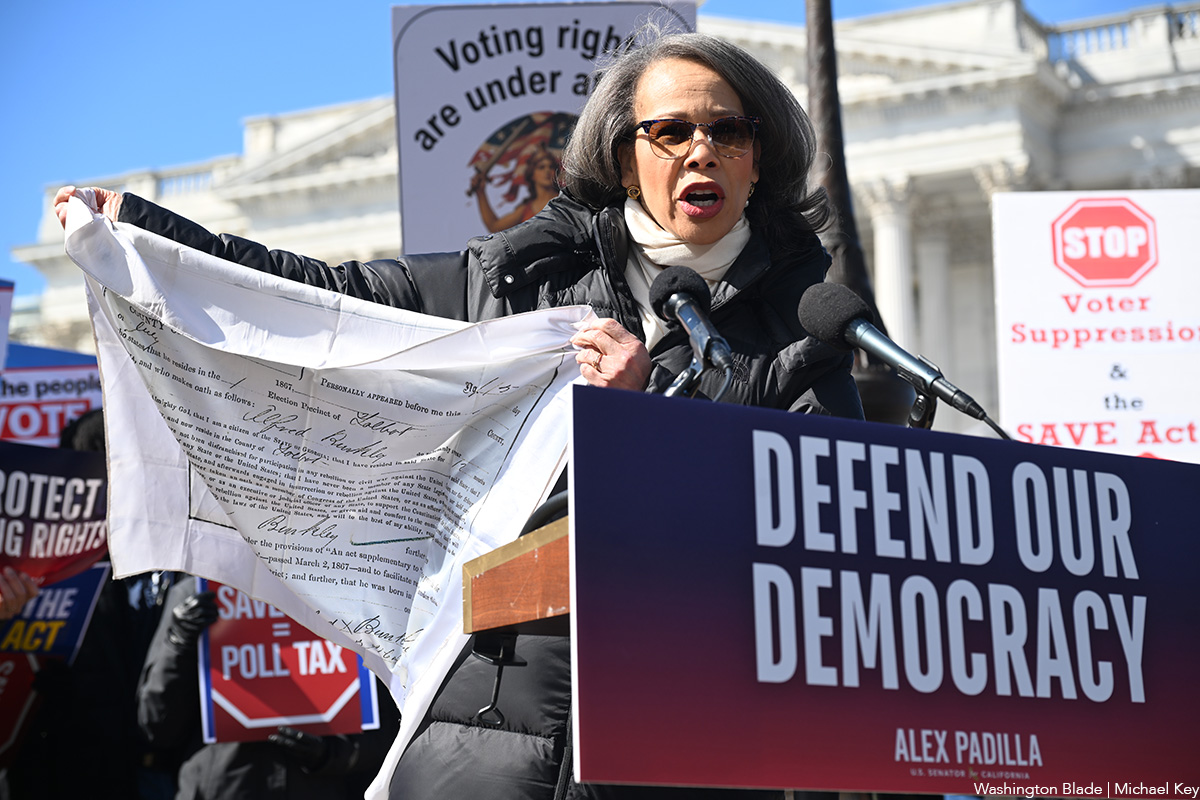
“I got to travel between the Edmund Pettus Bridge two times. And even as I thought about this moment, I recognized that while we wish we weren’t in it, while we don’t know why we’re in it, I do know we were made for it … So I came today to tell you that, um, just like the leader said, that he calls it Jim Crow 2.0. I call it Jim Crow 2.NO.”
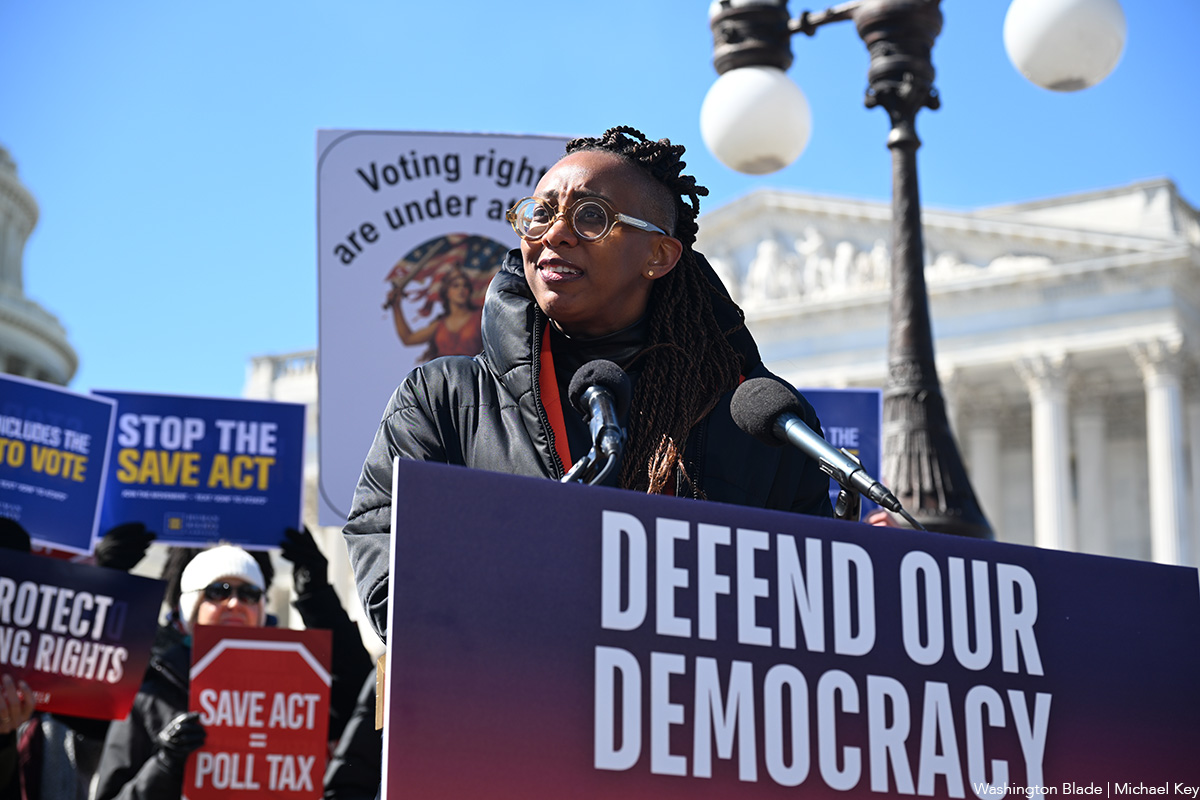
Kelley Robinson, president of the Human Rights Campaign, the largest LGBTQ advocacy organization in the U.S., also spoke, highlighting the impact of the bill’s proposed provisions affecting trans people.
“This bill is not about saving America. This bill is about stealing an election. This bill is about suppressing voters,” Robinson said. “This bill not only tries to disenfranchise voters that deserve their right to vote, it also tries to criminalize trans kids and their families … It tries to criminalize doctors providing medically necessary care for our trans youth.”
The SAVE Act passed the U.S. House of Representatives on Feb. 11 but has not yet been considered in the U.S. Senate.
Movies
‘It’s Dorothy’ traces lasting influence of a cultural icon
Thoughtful and scholarly with a celebratory tribute to the character
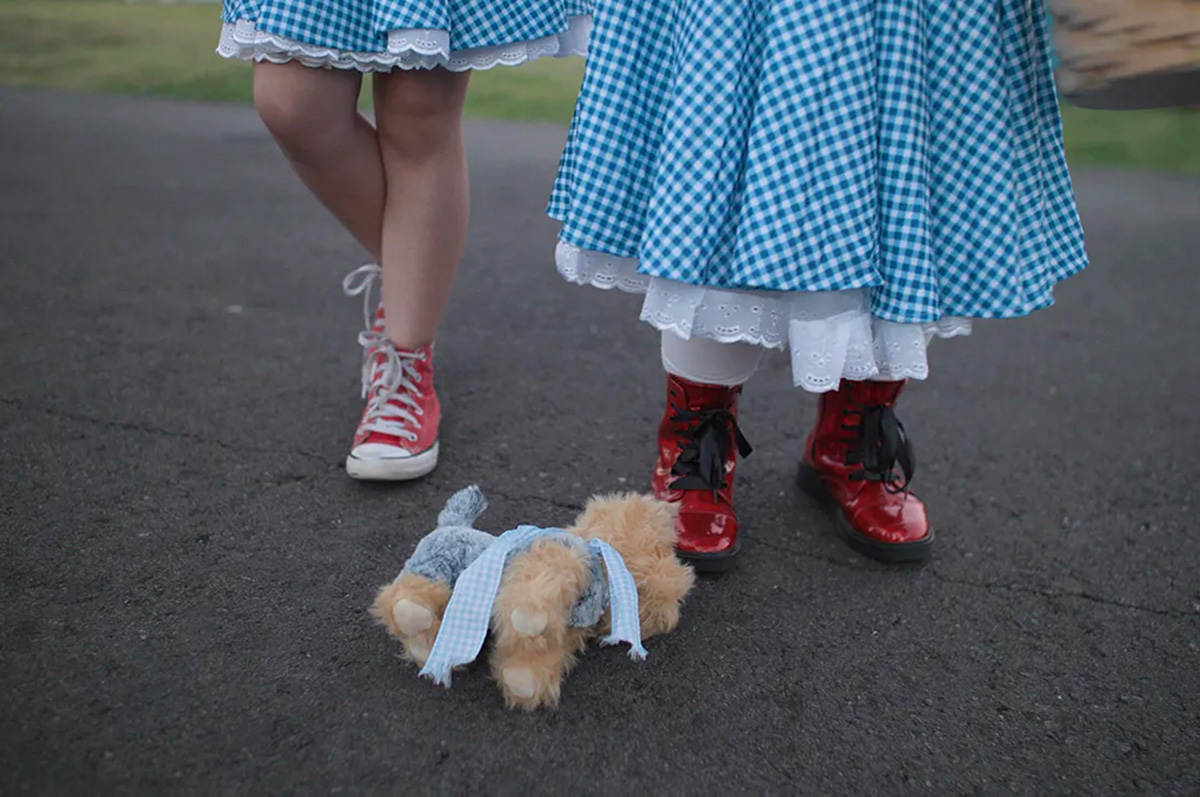
There was a time, according to queer lore, when gay men referred to themselves as a “Friend of Dorothy” as a coded way of communicating their sexual orientation to each other without fear of “the straights” catching on. The reference, of course, is a winking nod to the love and affinity felt by the community toward the main character of L. Frank Baum’s 1900 novel “The Wonderful Wizard of Oz” – especially as personified by Judy Garland in the classic 1939 big screen musical version from MGM.
It may be that the origins of this phrase have been mythologized, exaggerated and/or retro-fitted to convey the underground nature of the queer community – as, indeed, is suggested in “It’s Dorothy!” (the new documentary from filmmaker Jeffrey McHale, now streaming on Peacock), which concerns itself with the enduring cultural legacy of this quintessentially American fictional heroine. But regardless of whether it truly served as a sort of “secret password,” it has come to be embraced as a part of the LGBTQ lexicon. As “campy” as the reference may be, being a “Friend of Dorothy” is now a proudly held communal watchword not just for gay men, but for an entire rainbow community – and McHale’s fizzy-yet-reverential exploration taps into all the reasons how and why this fictional Kansas farm girl has come to be a touchstone for so many by tracking her journey across popular culture over the 125 years since she first sprung to life in the pages of Baum’s timeless literary fantasy.
Calling on the commentary of cultural figures – writers, performers, and other artists whose paths have been, by fate or by personal design, have become associated with Dorothy’s legacy across pop culture, as well as the observations of scholars and historians that provide insight on the appeal that has made her into a sort of avatar for anyone who feels marginalized in a wild and self-contradictory world – and enriched by a plentiful trove of clips from the myriad incarnations through which she has become embedded into the American pop culture imagination, it’s a documentary that leans heavily into the notion that Baum’s timeless heroine remains relevant through her relatability. Given a minimum of descriptors by the author who created her and portrayed in the public imagination through a widely divergent array of social viewpoints, she represents a kind of “blank page” on which we can imprint ourselves; but at the same time, there is something about her – her nebulous status as presumed orphan, raised by an aunt and uncle who don’t quite understand her and thrust without warning into a world of contradictory rules and unfair expectations – that speaks directly to those who feel like outsiders, or who dream of freedom, acceptance, and personal agency beyond the proverbial rainbow.
Naturally, McHale imprints on Dorothy’s most iconic incarnation off the pages of Baum’s books; the cultural legacy of Dorothy cannot be separated from that of her most iconic representative – Garland, of course – and his documentary easily makes the case that, through her association with the character, this beloved actress who was constantly judged and frequently stigmatized throughout a career that took her through the heights of public success to the depths of personal heartbreak, all while living under the constant scrutiny of Hollywood’s publicity-and-propaganda machine. As a result, she somehow merged identities with her most famous role: Judy was Dorothy, but Dorothy was Judy, too. “It’s Dorothy” takes advantage of this almost mystical transfiguration to reflect on the qualities that make this pairing of actress and character so deeply complementary, while also using it to illuminate why the empathy which binds her with the queer community is so tightly connected to the qualities she shared with the non-descript but unforgettable character that would make her into an undisputed icon.
As famous as Garland’s Dorothy is, however, it’s not the end-and-be-all of Baum’s beloved heroine, and much of McHale’s movie turns its attention to the numerous other performers who have taken on the role throughout the decades, in various incarnations of the “Wizard of Oz” mythos – particularly through “The Wiz,” the 1974 Broadway musical that reframes and remolds the story (and Dorothy) through the lens of Black culture and experience, and other iterations that have emerged throughout pop culture as a testament to her enduring appeal. Indeed, the movie brings illumination to the way that Dorothy – and the “Oz” mythos in general – has become a touchstone within Black community culture as well, and how artists (like musician Rufus Wainwright, gay counterculture icon John Waters, comedian/actor Margaret Cho, comedian/writer/director Lena Waithe, and “Wicked” author Gregory Maguire, all of whom participate in the film’s conversation) have found inspiration in the character and her story, which has helped to shape their own creative lives.
Thoughtful and scholarly while also delivering a celebratory tribute to the character (and the outsider qualities which make her beloved by so many who can relate to her sense of longing and the call she feels to journey “Somewhere Over the Rainbow”), “It’s Dorothy” provides a respectful yet candid examination of the lasting impact of Baum’s iconic character and the world he created around her in our popular imagination, not just as queer people but as a larger American community. It’s an entertaining journey into cultural history, which connects the dots to give us insight on why Dorothy and her adventures continue to speak to us with such profound resonance. It’s also entertaining in a way that feels like a “guilty pleasure” but is validated by the reverence it exudes for its subject, and loaded with memorably evocative clips from movies, shows, and performances from across the decades; and while it may begin to feel a bit repetitive, at points, as it examines the various actresses who have played Dorothy over the years (and the meaning they have found in her that connects her to their own lives), it nevertheless maintains a sincerity of feeling that keeps us invested.
And just in case you might feel like the times are too somber for a nostalgic stroll down the “yellow brick road” of cultural memories, be aware that McHale also explores the ominous presence of the Wizard himself in these tales, a phony who pretends at power while hiding behind a benevolent mask to maintain it.
As if the “Wicked” movies didn’t make the point clearly enough, we’re in a world that’s a lot more Oz-like than we would like to imagine, and it’s hard not to wish we had the ability to go “home” simply by tapping our heels together in fabulous footwear. “It’s Dorothy!” conveys that longing in a way that feels light-hearted and joyful, and reminds us why being a “friend of Dorothy” has been and continues to be a resonant way of identifying ourselves in a world full of wizards, witches, and “twisters” that can carry us far away from home.
And if you want to follow it up with an impromptu rewatch of the 1939 classic, we wouldn’t blame you. It’s a movie that feels, to so many of us, like home – and there’s no place like it.
Opinions
SAVE Act could silence millions of trans voters
New administrative barriers pose threat to voting rights
In Washington, debates over voting rights usually arrive loudly — through court rulings, protests, or sweeping legislation that captures national attention.
The Safeguard American Voter Eligibility (SAVE) Act, now under debate in Congress, may reshape voting access in a quieter way — through paperwork. The bill would require Americans registering to vote in federal elections to present documentary proof of citizenship, such as a passport or birth certificate. Supporters argue the measure would strengthen election integrity and restore public confidence in the voting process. But for millions of eligible voters, particularly transgender Americans, the practical consequences could be far more complicated.
According to Gallup, about 1.3% of U.S. adults identify as transgender, representing roughly 3.3 million Americans. Far from disengaged politically, transgender voters participate in elections at high rates. Data released by Advocates for Trans Equality shows 75% of transgender respondents reported voting in the 2020 election, compared with 67% of the general population. Registration rates are also higher.
This is a community that shows up for democracy. Yet the SAVE Act could place new administrative barriers directly in its path. Birth certificates, the document many supporters believe should verify citizenship are among the most difficult identity records for transgender Americans to update. According to data released by The Williams Institute at UCLA Law School and the U.S. Transgender Survey, 44% of transgender adults had updated their name on government identification, but only 18% had successfully updated their birth certificates.
That gap matters.
If birth certificates become a central requirement for voter registration, millions of eligible transgender Americans could face bureaucratic obstacles that other voters rarely encounter.
History offers a warning. According to the Bipartisan Policy Center, Kansas implemented a similar proof-of-citizenship law that blocked more than 30,000 eligible voters from registering before the Kansas Supreme Court struck it down as unconstitutional.
At the same time, evidence suggests voter fraud remains extraordinarily rare. Research cited by the American Immigration Council estimates fraud at roughly 0.0001% of votes cast.
The question before lawmakers is not whether election security matters. It clearly does. The question is whether policies designed to solve a rare problem could intentionally disenfranchise legitimate voters.
The broader cultural debate surrounding gender identity often becomes emotionally charged, particularly when conversations turn to pronouns or language. Yet polling suggests the issue remains unfamiliar to many Americans. A 2022 YouGov poll found only 22% of Americans personally know someone who uses gender-neutral pronouns.
Meanwhile, the problems weighing on everyday Americans are far larger: rising grocery prices, health care costs, housing shortages, and economic struggles in both rural towns and urban neighborhoods. Yet, many conservatives choose to focus unnecessary time, energy, and resources litigating the use of pronouns.
A healthy democracy should be able to debate cultural questions without allowing them to become barriers to the ballot box.
So, what should transgender Americans, and allies, do in this moment? First, stay engaged politically. Contact legislators and explain how identification requirements affect real voters. Personal stories often reach policymakers in ways statistics alone cannot.
Second, document the impact. Write letters to local newspapers, share experiences publicly, and ensure the real-world effects of voting policies are visible.
Third, consider running for office. Local school boards, city councils, and state legislatures shape many of the rules governing elections. Finally, protest with discipline and purpose. The most transformative movements in history — from Mahatma Gandhi to Dr. Martin Luther King Jr. — were rooted in peaceful persistence and moral clarity.
The SAVE Act may ultimately pass, fail, or change significantly as Congress debates it. But the larger principle at stake should guide the conversation. America’s democracy has always grown stronger when more citizens can participate, not when the path to the ballot becomes harder to navigate. For transgender voters, and for the country as a whole, that principle remains the quiet foundation of the republic.
James Bridgeforth, Ph.D., is a national columnist on the intersection of politics, morality, and civil rights. His work regularly appears in The Chicago Defender and The Black Wall Street Times.

Protesters say SAVE Act targets voters, transgender youth

‘It’s Dorothy’ traces lasting influence of a cultural icon
SAVE Act could silence millions of trans voters

The frightening rise of antisemitism, Islamophobia

Thomas A. Decker of Arlington dies at 73

BMA celebrates enduring influence of Henri Matisse

Ensuring safer drinking water

A season of renewal for D.C. theater

PHOTOS: Awesome Con