FERNANDO’S CLEANING
Movies
‘It’s Dorothy’ traces lasting influence of a cultural icon
Thoughtful and scholarly with a celebratory tribute to the character
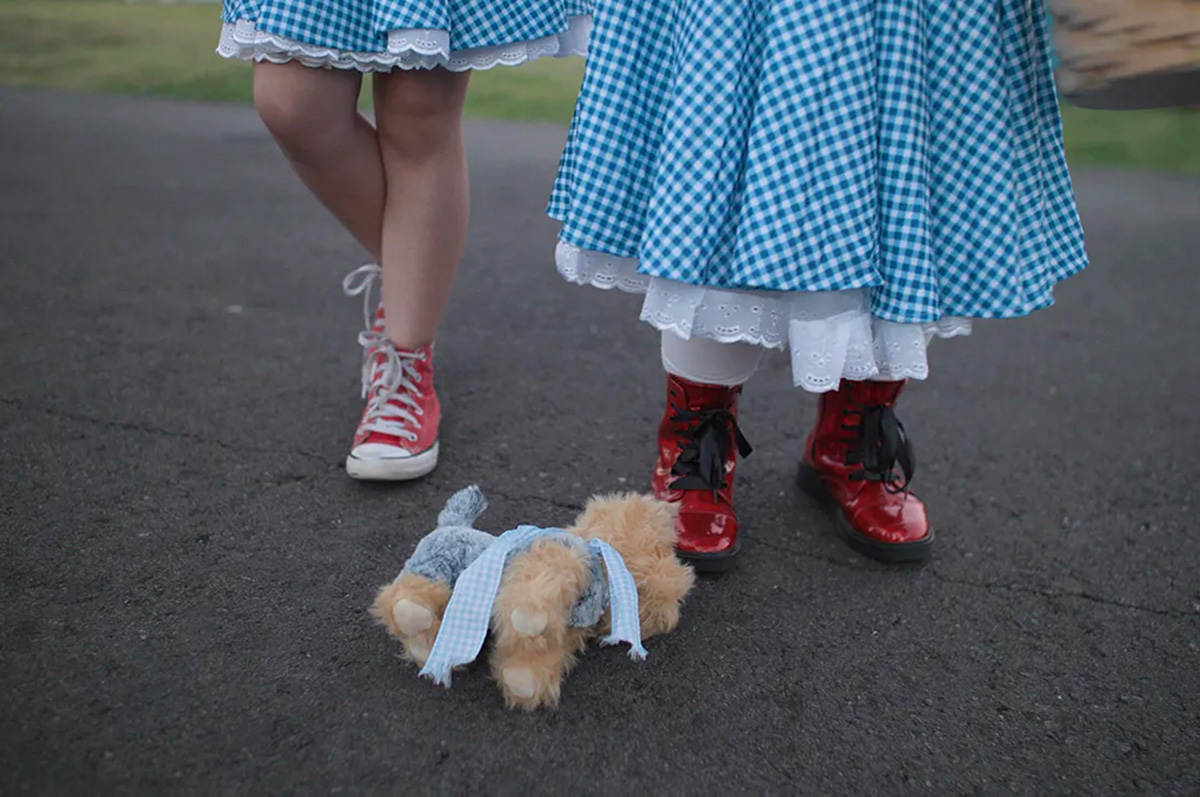
There was a time, according to queer lore, when gay men referred to themselves as a “Friend of Dorothy” as a coded way of communicating their sexual orientation to each other without fear of “the straights” catching on. The reference, of course, is a winking nod to the love and affinity felt by the community toward the main character of L. Frank Baum’s 1900 novel “The Wonderful Wizard of Oz” – especially as personified by Judy Garland in the classic 1939 big screen musical version from MGM.
It may be that the origins of this phrase have been mythologized, exaggerated and/or retro-fitted to convey the underground nature of the queer community – as, indeed, is suggested in “It’s Dorothy!” (the new documentary from filmmaker Jeffrey McHale, now streaming on Peacock), which concerns itself with the enduring cultural legacy of this quintessentially American fictional heroine. But regardless of whether it truly served as a sort of “secret password,” it has come to be embraced as a part of the LGBTQ lexicon. As “campy” as the reference may be, being a “Friend of Dorothy” is now a proudly held communal watchword not just for gay men, but for an entire rainbow community – and McHale’s fizzy-yet-reverential exploration taps into all the reasons how and why this fictional Kansas farm girl has come to be a touchstone for so many by tracking her journey across popular culture over the 125 years since she first sprung to life in the pages of Baum’s timeless literary fantasy.
Calling on the commentary of cultural figures – writers, performers, and other artists whose paths have been, by fate or by personal design, have become associated with Dorothy’s legacy across pop culture, as well as the observations of scholars and historians that provide insight on the appeal that has made her into a sort of avatar for anyone who feels marginalized in a wild and self-contradictory world – and enriched by a plentiful trove of clips from the myriad incarnations through which she has become embedded into the American pop culture imagination, it’s a documentary that leans heavily into the notion that Baum’s timeless heroine remains relevant through her relatability. Given a minimum of descriptors by the author who created her and portrayed in the public imagination through a widely divergent array of social viewpoints, she represents a kind of “blank page” on which we can imprint ourselves; but at the same time, there is something about her – her nebulous status as presumed orphan, raised by an aunt and uncle who don’t quite understand her and thrust without warning into a world of contradictory rules and unfair expectations – that speaks directly to those who feel like outsiders, or who dream of freedom, acceptance, and personal agency beyond the proverbial rainbow.
Naturally, McHale imprints on Dorothy’s most iconic incarnation off the pages of Baum’s books; the cultural legacy of Dorothy cannot be separated from that of her most iconic representative – Garland, of course – and his documentary easily makes the case that, through her association with the character, this beloved actress who was constantly judged and frequently stigmatized throughout a career that took her through the heights of public success to the depths of personal heartbreak, all while living under the constant scrutiny of Hollywood’s publicity-and-propaganda machine. As a result, she somehow merged identities with her most famous role: Judy was Dorothy, but Dorothy was Judy, too. “It’s Dorothy” takes advantage of this almost mystical transfiguration to reflect on the qualities that make this pairing of actress and character so deeply complementary, while also using it to illuminate why the empathy which binds her with the queer community is so tightly connected to the qualities she shared with the non-descript but unforgettable character that would make her into an undisputed icon.
As famous as Garland’s Dorothy is, however, it’s not the end-and-be-all of Baum’s beloved heroine, and much of McHale’s movie turns its attention to the numerous other performers who have taken on the role throughout the decades, in various incarnations of the “Wizard of Oz” mythos – particularly through “The Wiz,” the 1974 Broadway musical that reframes and remolds the story (and Dorothy) through the lens of Black culture and experience, and other iterations that have emerged throughout pop culture as a testament to her enduring appeal. Indeed, the movie brings illumination to the way that Dorothy – and the “Oz” mythos in general – has become a touchstone within Black community culture as well, and how artists (like musician Rufus Wainwright, gay counterculture icon John Waters, comedian/actor Margaret Cho, comedian/writer/director Lena Waithe, and “Wicked” author Gregory Maguire, all of whom participate in the film’s conversation) have found inspiration in the character and her story, which has helped to shape their own creative lives.
Thoughtful and scholarly while also delivering a celebratory tribute to the character (and the outsider qualities which make her beloved by so many who can relate to her sense of longing and the call she feels to journey “Somewhere Over the Rainbow”), “It’s Dorothy” provides a respectful yet candid examination of the lasting impact of Baum’s iconic character and the world he created around her in our popular imagination, not just as queer people but as a larger American community. It’s an entertaining journey into cultural history, which connects the dots to give us insight on why Dorothy and her adventures continue to speak to us with such profound resonance. It’s also entertaining in a way that feels like a “guilty pleasure” but is validated by the reverence it exudes for its subject, and loaded with memorably evocative clips from movies, shows, and performances from across the decades; and while it may begin to feel a bit repetitive, at points, as it examines the various actresses who have played Dorothy over the years (and the meaning they have found in her that connects her to their own lives), it nevertheless maintains a sincerity of feeling that keeps us invested.
And just in case you might feel like the times are too somber for a nostalgic stroll down the “yellow brick road” of cultural memories, be aware that McHale also explores the ominous presence of the Wizard himself in these tales, a phony who pretends at power while hiding behind a benevolent mask to maintain it.
As if the “Wicked” movies didn’t make the point clearly enough, we’re in a world that’s a lot more Oz-like than we would like to imagine, and it’s hard not to wish we had the ability to go “home” simply by tapping our heels together in fabulous footwear. “It’s Dorothy!” conveys that longing in a way that feels light-hearted and joyful, and reminds us why being a “friend of Dorothy” has been and continues to be a resonant way of identifying ourselves in a world full of wizards, witches, and “twisters” that can carry us far away from home.
And if you want to follow it up with an impromptu rewatch of the 1939 classic, we wouldn’t blame you. It’s a movie that feels, to so many of us, like home – and there’s no place like it.
Opinions
SAVE Act could silence millions of trans voters
New administrative barriers pose threat to voting rights
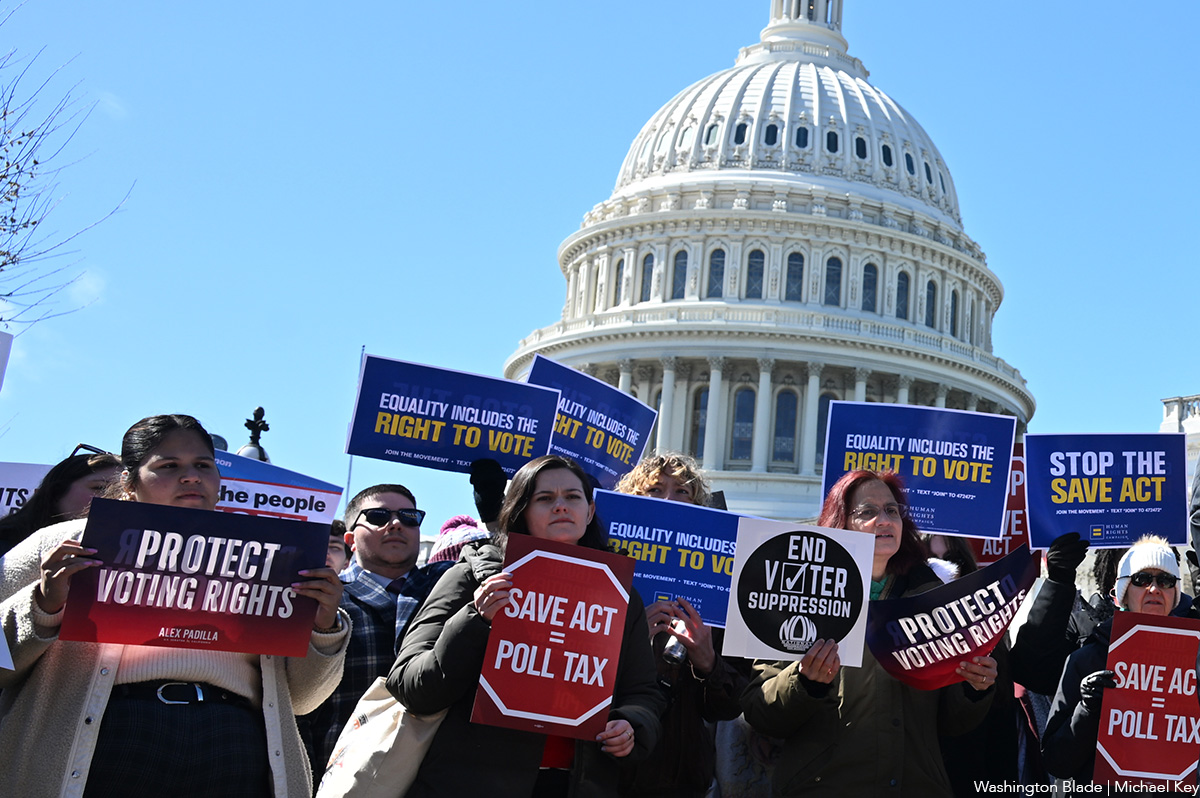
In Washington, debates over voting rights usually arrive loudly — through court rulings, protests, or sweeping legislation that captures national attention.
The Safeguard American Voter Eligibility (SAVE) Act, now under debate in Congress, may reshape voting access in a quieter way — through paperwork. The bill would require Americans registering to vote in federal elections to present documentary proof of citizenship, such as a passport or birth certificate. Supporters argue the measure would strengthen election integrity and restore public confidence in the voting process. But for millions of eligible voters, particularly transgender Americans, the practical consequences could be far more complicated.
According to Gallup, about 1.3% of U.S. adults identify as transgender, representing roughly 3.3 million Americans. Far from disengaged politically, transgender voters participate in elections at high rates. Data released by Advocates for Trans Equality shows 75% of transgender respondents reported voting in the 2020 election, compared with 67% of the general population. Registration rates are also higher.
This is a community that shows up for democracy. Yet the SAVE Act could place new administrative barriers directly in its path. Birth certificates, the document many supporters believe should verify citizenship are among the most difficult identity records for transgender Americans to update. According to data released by The Williams Institute at UCLA Law School and the U.S. Transgender Survey, 44% of transgender adults had updated their name on government identification, but only 18% had successfully updated their birth certificates.
That gap matters.
If birth certificates become a central requirement for voter registration, millions of eligible transgender Americans could face bureaucratic obstacles that other voters rarely encounter.
History offers a warning. According to the Bipartisan Policy Center, Kansas implemented a similar proof-of-citizenship law that blocked more than 30,000 eligible voters from registering before the Kansas Supreme Court struck it down as unconstitutional.
At the same time, evidence suggests voter fraud remains extraordinarily rare. Research cited by the American Immigration Council estimates fraud at roughly 0.0001% of votes cast.
The question before lawmakers is not whether election security matters. It clearly does. The question is whether policies designed to solve a rare problem could intentionally disenfranchise legitimate voters.
The broader cultural debate surrounding gender identity often becomes emotionally charged, particularly when conversations turn to pronouns or language. Yet polling suggests the issue remains unfamiliar to many Americans. A 2022 YouGov poll found only 22% of Americans personally know someone who uses gender-neutral pronouns.
Meanwhile, the problems weighing on everyday Americans are far larger: rising grocery prices, health care costs, housing shortages, and economic struggles in both rural towns and urban neighborhoods. Yet, many conservatives choose to focus unnecessary time, energy, and resources litigating the use of pronouns.
A healthy democracy should be able to debate cultural questions without allowing them to become barriers to the ballot box.
So, what should transgender Americans, and allies, do in this moment? First, stay engaged politically. Contact legislators and explain how identification requirements affect real voters. Personal stories often reach policymakers in ways statistics alone cannot.
Second, document the impact. Write letters to local newspapers, share experiences publicly, and ensure the real-world effects of voting policies are visible.
Third, consider running for office. Local school boards, city councils, and state legislatures shape many of the rules governing elections. Finally, protest with discipline and purpose. The most transformative movements in history — from Mahatma Gandhi to Dr. Martin Luther King Jr. — were rooted in peaceful persistence and moral clarity.
The SAVE Act may ultimately pass, fail, or change significantly as Congress debates it. But the larger principle at stake should guide the conversation. America’s democracy has always grown stronger when more citizens can participate, not when the path to the ballot becomes harder to navigate. For transgender voters, and for the country as a whole, that principle remains the quiet foundation of the republic.
James Bridgeforth, Ph.D., is a national columnist on the intersection of politics, morality, and civil rights. His work regularly appears in The Chicago Defender and The Black Wall Street Times.
Opinions
The frightening rise of antisemitism, Islamophobia
Trump, Netanyahu to blame for inflaming tensions

We can lay the rise in antisemitism and Islamophobia directly at the feet of the felon in the White House, and the criminal at the head of the Israeli government. Both Trump and Netanyahu belong in jail, not leading their governments.
I am a proud Jewish, gay man, and the homophobia and antisemitism the felon in the White House is generating are truly frightening. I am assuming my Muslim friends are feeling the same way about the Islamophobia he is causing to rise. While people have always been racist, homophobic, Islamophobic, and antisemitic, Trump has given tacit permission, with his statements, actions, and now his war on Iran, for those feelings to be shouted in the public square, and in the worst-case scenarios, acted on with violent attacks.
We can clearly attribute the rise in antisemitism around the world, to the actions of the right-wing, war criminal, leader of the Israeli government, Benjamin Netanyahu, and what he is doing to destroy Gaza, murdering innocent Palestinians, and now again bombing innocents in Lebanon.
This is all seeping into the politics of our nation. One organization promoting antisemitism and expecting it of the candidates they endorse, is the Democratic Socialists of America (DSA). They went so far as to take away an endorsement at one point, from one of their most ardent supporters, Rep. Alexandria Ocasio-Cortez (D-N.Y.), because she refused to fully support their anti-Zionist platform and their support of BDS. The DSA took issue with “[Ocasio-Cortez’s] votes, including a vote in favor of H.Res.888, conflating opposition to Israel’s ‘right to exist’ with antisemitism,” and a press release in April she co-signed that “support[s] strengthening the Iron Dome and other defense systems.” In their 2025 platform DSA called for a single state from the ‘river to the sea’ as the Palestinian right to resist, thereby eliminating the State of Israel. It goes with their support of BDS and anti-Zionist positions. It is fair to see that as antisemitism.
I am a Zionist, in the sense of the term as coined by Theodor Herzl. I am a believer in, and supporter of, the State of Israel. I am also for a Palestinian state. I am opposed to what Israel’s current government, led by a war criminal, is doing. I had hoped he would have abided by what former President Biden said to him immediately after Oct. 7. “Don’t make the same mistake we did after 9/11. Temper your response.” But instead, Netanyahu has murdered Palestinians by the thousands, destroying Gaza. He was rightfully declared a war criminal and should be brought to justice. He has made things worse both for the people of Israel, and Jews around the world. He has been responsible for antisemitism around the world once again rearing its ugly head. Now, two and a half years after Hamas’s attack on Israel, he is still murdering Palestinians, and now again more people in Lebanon and Iran. He still denies the Palestinian people need a home, a state of their own. He promotes settlements on the West Bank that should be part of a Palestinian state and refuses to prosecute settlers who commit crimes against the Palestinian people there.
My parents and relatives had to flee Hitler. Some came to the United States, and some immigrated to Israel. My father’s parents were killed in Auschwitz. I believed it could never happen again. But the felon in the White House, and criminal in Israel, are abusing me of that notion. Their policies of greed and corruption are leading to danger for all the people of the world. They are leading us into a third world war. The felon is attempting to steal, yes steal, billions through his phony ‘Board of Peace’ where he is screwing the Palestinian people out of their homes in Gaza. It is insanity, and we are all suffering for it; Jews, Muslims, and the rest of the world, as we are thrown into war none of us wants.
Now as I wrote, the DSA, tells people all Zionists are the enemy, without a definition of what a Zionist is. They expect their supporters not to recognize the State of Israel. They create antisemitism, and now in D.C. we have a candidate running for mayor, Janeese Lewis George, asking for, and getting their support. They also have in their platform to defund the police. Those things should frighten all the people of D.C. Any candidate who can run on the DSA platform must be deemed unacceptable to anyone who opposes prejudice and discrimination of any kind. One prejudice leads to others and gives rise to people feeling they can be open about not only their antisemitism, but their Islamophobia, racism, and sexism, as well.
We need all the good voters in the District of Columbia to find these DSA positions unacceptable, and reject any candidate who solicits, and takes their endorsement.
Peter Rosenstein is a longtime LGBTQ rights and Democratic Party activist.

‘It’s Dorothy’ traces lasting influence of a cultural icon

SAVE Act could silence millions of trans voters

The frightening rise of antisemitism, Islamophobia

Thomas A. Decker of Arlington dies at 73

Gay candidate running for D.C. congressional delegate seat

BMA celebrates enduring influence of Henri Matisse

Ensuring safer drinking water

A season of renewal for D.C. theater

PHOTOS: Awesome Con