Local
Rapper Wale appears at Black Pride, apologizes
Booking agent fired for ‘miscommunication’
In an unexpected turn of events, rapper Wale appeared for a brief performance at Sunday’s D.C. Black Pride festival and apologized for an earlier decision to cancel his scheduled booking as the event’s lead entertainer.
The nationally recognized rapper and D.C. native told Black Pride organizers through a spokesperson May 28 that his decision to cancel his appearance for Sunday’s festival at the Washington Convention Center was due to a “miscommunication” on the part of one of his agents.
“The one thing I stand for is hip-hop music, and hip-hop music knows no race, no color, no age, no gender, no sexual orientation — none of that,” he told a cheering crowd after arriving on the festival stage.
“So the most important thing about it is the music, and it makes the people happy. That’s why we’re here.
“But I will say sometimes in this business you’re aligned with people who don’t understand that and don’t necessarily have the same beliefs as you do. And I apologize for not having my best foot forward … and I’m going to do better, as we all do.
“Every day we’ve got to do better. So I apologize on behalf of my team for not being the way they are supposed to be. Now with that said, can we have some fun right now?”
In response, people in the audience shouted, “Yea!”
Wale’s appearance was followed by J. Holiday, an R&B singer who was booked after Wale’s announcement that he had cancelled his appearance at Black Pride.
Holiday said he was pleased to be performing at the event and welcomed his fans from the LGBT community.
Earlier in the day, other local entertainers performed at the festival as several dozen local and national LGBT organizations and various commercial vendors interacted with attendees in booths set up in the convention center’s large exhibit hall, where the festival was held.
Among those attending the event was D.C. City Council Chairman Vincent Gray (D-At Large), who is challenging Mayor Adrian Fenty in the September Democratic primary. Fenty did not attend the event, but his Office of LGBT Affairs set up a festival booth.
Other officials to attend were Council members Kwame Brown (D-At Large), who is running for Gray’s Council chairman seat, and Harry Thomas (D-Ward 5). Council members Phil Mendelson (D-At Large), David Catania (I-At Large), and Jim Graham (D-Ward 1) attended a separate reception May 28 kicking off Black Pride weekend.
Longtime participants in the event noted that attendance was down this year compared to previous Black Pride festivals.
Earl Fowlkes, a board member and spokesperson for Black Pride, said the drop in attendance might have been due to the economic downturn, which likely made it harder for people to attend from throughout the mid-Atlantic region. Out-of-town participants have long made up a large percentage of D.C. Black Pride’s crowds.
Fowlkes, who is president of the International Association of Black Prides, said the recent trend of holding Black Pride festivals in other cities, including Atlanta, also was a factor in the lower attendance at D.C.’s event. D.C. was the first U.S. city to hold a Black Pride celebration.
Wale had initially been billed as the lead entertainer at the 20th annual D.C. Black Pride Legacy Festival & Wellness Expo.
But Fowlkes said event organizers were startled last month when they received two e-mails from Wale’s agent, one saying the rapper had to cancel due to “family obligations,” and another saying he didn’t know Black Pride was a gay-related event when he agreed to appear.
According to Fowlkes, Black Pride organizers made it clear from the start that Black Pride is an LGBT event and most of the attendees would be LGBT people.
“Black Pride now believes that as a result of failed communications between the booking agent and the artist, Wale was booked for an event after notifying management that he would be taking a few weeks off to focus on family issues,” says a statement Black Pride organizers released May 28.
“D.C. Black Pride regrets that these communications (or lack thereof) resulted in the community perception that the artist did not appreciate nor want to perform for his gay and lesbian fans,” says the statement. “The principal agent responsible for the miscommunication has been terminated.”
Upon learning that Wale had cancelled his appearance at Black Pride, organizers arranged for Holiday to replace Wale as the headliner performer. Holiday took to Black Pride’s stage after Wale delivered his remarks to the crowd and performed two songs.
As planned after the mix-up surrounding Wale’s appearance, Holiday gave a full performance as the day’s lead entertainer, including some of his songs that rose to the top of the Billboard Top 100 Chart.
Wale became a nationally recognized rapper in 2006, when his song “Dig Dug (Shake It)” led to his record company contracts and appearances on MTV.
“It was very apparent that Wale was sincere about wanting to clear up any misconceptions that he was homophobic,” said Jimma Elliott-Stevens, a D.C. Black Pride board member and attorney who represented Black Pride in its negotiations with Wale’s representatives.
“This experience was very important for the LGBT community as it showed that we will not be invisible within and outside the black community,” said Fowlkes.





The Comings & Goings column is about sharing the professional successes of our community. We want to recognize those landing new jobs, new clients for their business, joining boards of organizations and other achievements. Please share your successes with us at [email protected].
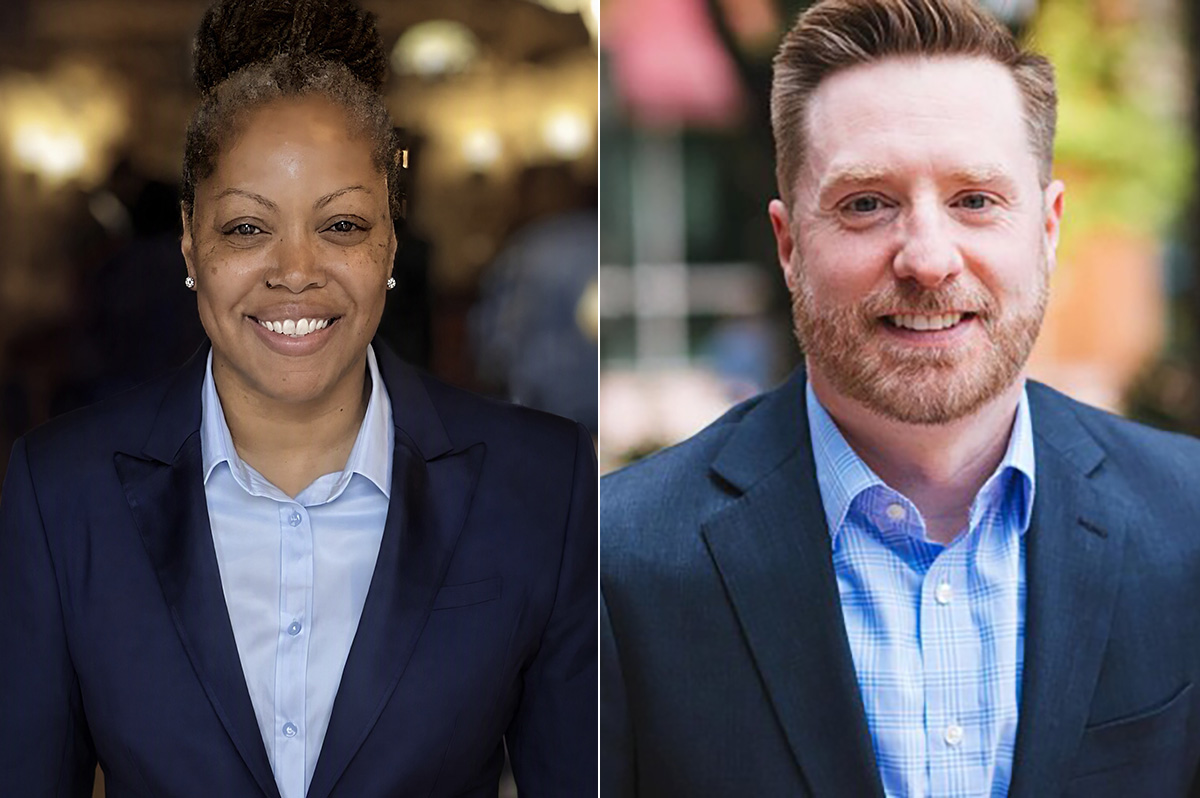
Congratulations to Carla Lester, LICSW on her new position as Chief Program Officer with SMYAL. Upon accepting the position she said, “SMYAL deeply aligns with my passion for honoring, protecting, and upholding the rights of all individuals, particularly LGBTQ+ youth and others who have been historically underserved, to belong to communities that affirm their identities, treat them with dignity and respect, and support their well-being. At this point in my career, I was ready to transition to an organization whose mission more closely reflected my values and was rooted in the community. SMYAL offered the opportunity to serve both an organization and a population whose mission not only resonates deeply with me but also intersects with my own multiple identities.”
Lester is a healthcare and human services executive with more than 20 years of experience in behavioral health, federal and state health insurance programs, housing, health care, education, and community-based services. She has held senior roles at Carelon Behavioral Health, Pathways to Housing and N Street Village, leading clinical programs, Housing First initiatives, homeless outreach, trauma-informed services, and integrated case management.
She earned master’s degrees in Social Work and Divinity, and maintains active clinical social work licenses in D.C. and Maryland.
Congratulations also to Tad Czyzewski on his new position as Chief Development Officer at SMYAL. On accepting the position, he said, “While I’ve spent much of my nonprofit career in the arts, the current social and political environments made me want to apply my skills and passion more directly toward supporting and strengthening our community. SMYAL and this role felt like the right place to do that.”
Czyzewski brings more than two decades of experience in nonprofit leadership and strategy, fundraising, and business development. Prior to joining SMYAL, he served for eight years as executive director of The Choral Arts Society of Washington, where he led fundraising, financial management, and community engagement. During his tenure, he helped raise more than $15 million in contributed revenue. He guided the organization through a major rebrand and the COVID-19 pandemic.
Prior to that Czyzewski served as Business and Development Director for Washington Revels, and held leadership and advisory roles with Chorus America, the DC Commission on the Arts and Humanities, and the National Endowment for the Arts. He began his career in the corporate sector, including at Capital One, where his work in product development and marketing contributed to new financial products and more than $2 billion in deposits.
Czyzewski is a lifelong musician, has performed professionally as a classical singer, including with the Washington National Opera and the National Symphony Orchestra.
District of Columbia
Gay ANC commissioner sues D.C. over police ‘failure’ to pay reward money
Lawsuit says information led to conviction in murder, armed robbery cases

Gay D.C. Advisory Neighborhood Commissioner Tom Donohue on Aug. 11 filed a lawsuit in D.C. Superior Court charging that D.C. police acted improperly and violated a local law by not paying him $30,000 in reward money for his role in helping police identify and arrest — and obtain the subsequent conviction — of one man charged with murder and another man charged with armed robbery in separate cases.
Although the lawsuit alleges improper action by D.C. police in carrying out the city’s Crime Solvers reward program, it names as defendants the District of Columbia and the Office of the Attorney General for D.C., which, among other things, defends the city against lawsuits.
Donohue, who is a member of the city’s ANC Rainbow Caucus consisting of LGBTQ elected ANC members, held a news conference outside the D.C. Superior Court building on Aug. 11 to talk about the lawsuit before entering the courthouse to officially file it.
The lawsuit states that Donohue “provided key video evidence that led to the arrest and conviction” of a man initially charged with first degree murder for allegedly running over a bicyclist with his car after the two got into an argument.
The lawsuit states that police had offered a $25,000 reward for information leading to the arrest and conviction of the defendant in that case, but police “arbitrarily slashed the payment to $5,000 without prior notice or policy justification.”
Court records show that D.C. resident Eric Beasley was charged with first degree murder for killing David Farewell, 45, by hitting him with his car on Sept. 4, 2020, on the 2100 block of Young Street, S.E. The records show the evidence for the case was based in large part on video camera footage of the incident obtained by police. Donohoe has said he provided that video camera evidence.
The records show that during Beasley’s October 2023 trial a jury was unable to reach the required unanimous verdict, and the judge declared a mistrial.
According to the records, Beasley later agreed to an offer by prosecutors to plead guilty to a lesser charge of involuntary manslaughter and was sentenced in September 2024 to eight years in prison, a development that angered the victim’s family members who called it a “slap on the wrist,” according to a Fox 5 News report.
Donohue’s lawsuit says the second case in which he provided police with pivotal information involved a series of armed robberies known as the Fairlawn Serial Armed Robbery Spree that occurred in the Fairlawn neighborhood in Southeast D.C. in 2023 near where Donohue lives.
The lawsuit says evidence consisting of video surveillance footage provided by Donohue to police enabled police to determine they initially wrongfully arrested an 18-year-old male for the robberies. “Using Plaintiff’s security video, MPD identified, arrested, and convicted the actual robber, David Crocker, who was sentenced to 18 years in federal prison,” the lawsuit states.
It says one of the detectives investigating the case recommended a $10,000 reward for Donohue’s help in the case based on the police Crime Solvers reward program. The detective’s recommendation was approved by then-Assistant D.C. Police Chief Kyle Ramey on Aug. 4, 2025, according to the lawsuit.
But it adds, “Nevertheless, MPD improperly withheld payment.”
When contacted by the Washington Blade for comment on Donohue’s lawsuit allegations, a D.C. police spokesperson said “MPD does not comment on pending or ongoing litigation.”
Gabriel Shoglow-Rubenstein, who serves as press secretary for the D.C. Office of the Attorney General, which will be defending the city against the Donohue lawsuit, said he would look into obtaining a possible comment but said the office has a similar longstanding policy of not commenting on pending litigation.
“This action arises from the District of Columbia Metropolitan Police Department’s arbitrary, bad-faith, and legally unsupportable failure to honor its public reward promises and administrative obligations to Plaintiff,” the lawsuit states.
It says the MPD violated the city’s Freedom of Information Act or FOIA law by not responding to Donohue’s request for information and documents related to the decision not to pay him the full reward money.
“MPD’s reduction of Plaintiff’s homicide reward from $25,000 to $5,000, and its withholding of his approved $10,00 robbery reward, were undertaken completely devoid of written standards, making such decisions inherently arbitrary, capricious, and an abuse of administrative discretion,” it says.
It calls for Donohue to be awarded $30,000 in compensatory damages consisting of the $20,000 “unpaid balance” for the homicide case reward and $10,000 for the robbery case reward. It also calls for reimbursement for “reasonable” litigation costs and attorney’s fees. Donohue told the Washington Blade that at this time he is representing himself without an attorney.
Donohue told the Blade that the refusal by D.C. police to pay him the full reward money also limited his plans to donate some of that money to the family of murder victim David Farewell to help pay for a burial stone. He said that due to the family’s limited resources Farewell is buried in an unmarked grave
Delaware
New LGBTQ visitor center slated for Wilmington, Del.
The Collective to feature gift shop, queer museum, more

During Pride month this year, the Delaware Sexuality and Gender Collective (DSGC) announced plans for The Collective, which will become Delaware’s first LGBTQIA+ visitor center and Wilmington’s first dedicated LGBTQIA+ space in nearly 40 years.
“We’ve been talking about the concept of a brick-and-mortar space for a long time,” said Noah Duckett, co-founder of DSGC.
A licensed clinical social worker, Duckett co-founded DSGC with his mother, Julissa Coriano, in 2018. DSGC is an independent nonprofit organization that provides vital clinical and educational support, social programming and direct-need support to the LGBTQIA+ community.
Some of the programs DSGC offers include a free clothing closet for the trans community, meal support for people recovering from gender-affirming surgery, connections to pro bono legal services, a biannual Pride Market featuring over 100 LGBTQIA+-owned small businesses, and more.
“Our vision for The Collective is a place where our community can come to learn, create, work and be inspired,” said Coriano.
The Collective will feature a visitor center and gift shop highlighting LGBTQIA+-owned businesses in Delaware.
“I think that this is something that’s going to benefit our community so much,” said Duckett.
Some of the LGBTQIA+-owned businesses that DSGC has already partnered with include Stress Induced Art Attack, Moonbeam Art Collaborative, Voce Coffee, Groovy Gemini Co., Scout Cafe, Macaron Social and Huxley and Hiro.
“Specifically in Wilmington, we haven’t had an LGBTQIA+-dedicated space in almost 40 years,” said Duckett.
The Griffin Community Center, which operated from 1986 to 1990, was Delaware’s first LGBTQ+ community center. The Griffin was founded by Ivo Dominguez Jr. and James C. Welch and provided a range of community services during the height of the HIV/AIDS crisis, including AIDS hotlines, organizational offices and meeting space. The center ultimately closed because of a lack of financial support.
Duckett said DSGC hopes The Collective will carry on The Griffin’s legacy while building a sustainable space for the LGBTQIA+ community.
“I think now more than ever, there’s more and more spaces closing their doors. More and more spaces are losing funding, seeing reduced funding and reduced access, especially LGBTQ+ organizations and communities,” said Duckett.
The Collective will also feature Delaware’s first LGBTQ+ history museum, curated by LGBTQ+ historian Carolanne Deal.
“We don’t have any permanent displays in the state about Delaware’s queer history, and we want people to be able to access that history any day of the year, not just during Pride Month,” said Deal.
With a master’s degree in art history for museum professionals, Deal has more than seven years of experience in curatorial work and hands-on collections care.
“It’s mainly going to be a graphic display with photographs, articles and accessible text that draws people in and creates a story for the community,” said Deal.
Although the museum will not initially have an object collection, Deal said she hopes to add physical archival pieces in the future.
“Delaware has been at the forefront of a lot of queer civil rights, and it’ll be really amazing to have that enshrined in a permanent display that’s not only up for Pride Month,” said Deal.
Duckett said DSGC is currently raising funds with the goal of beginning construction this summer and opening by the end of the year.
Duckett told the Blade that fundraising efforts have reached just under $29,000 and that the organization is awaiting several major donations from community partner organizations.
However, he said DSGC continues to be denied many grants tied to federal or state funding because of restrictions on those funds being used for LGBTQ+-serving organizations.
“Private and corporate donations are absolutely vital,” said Duckett.
Anyone interested in supporting the construction and renovation of The Collective can donate online or contact [email protected] for more information.ose funds being used for LGBTQ-serving organizations.
“Private and corporate donations are absolutely vital,” said Duckett.
Anyone interested in supporting the construction of The Collective can donate online or contact [email protected] for more information.

Bros + romance + fantasy = ‘Bromantasy.’

National tour of ‘The Notebook’ retains its tearjerking power

Live music drag cabaret set for Shaw’s Tavern

Calendar: August 14-20

Comings & Goings

2 former NBA players launch cheap anti-trans stunt to exploit WNBA rules

Jason DePuy on coping with homophobia in ‘Big Brother’ house

New LGBTQ visitor center slated for Wilmington, Del.

Flanagan beats Craig in Minn. Senate primary after winning key LGBTQ endorsements

Gay ANC commissioner sues D.C. over police ‘failure’ to pay reward money
-

 Sports5 days ago
2 former NBA players launch cheap anti-trans stunt to exploit WNBA rules
-
a&e features4 days ago
Jason DePuy on coping with homophobia in ‘Big Brother’ house
-
Delaware4 days ago
New LGBTQ visitor center slated for Wilmington, Del.
-
Minnesota4 days ago
Flanagan beats Craig in Minn. Senate primary after winning key LGBTQ endorsements