2026 Midterm Elections
HRC endorses Va. ballot initiative to redraw congressional districts
Referendum to take place April 21
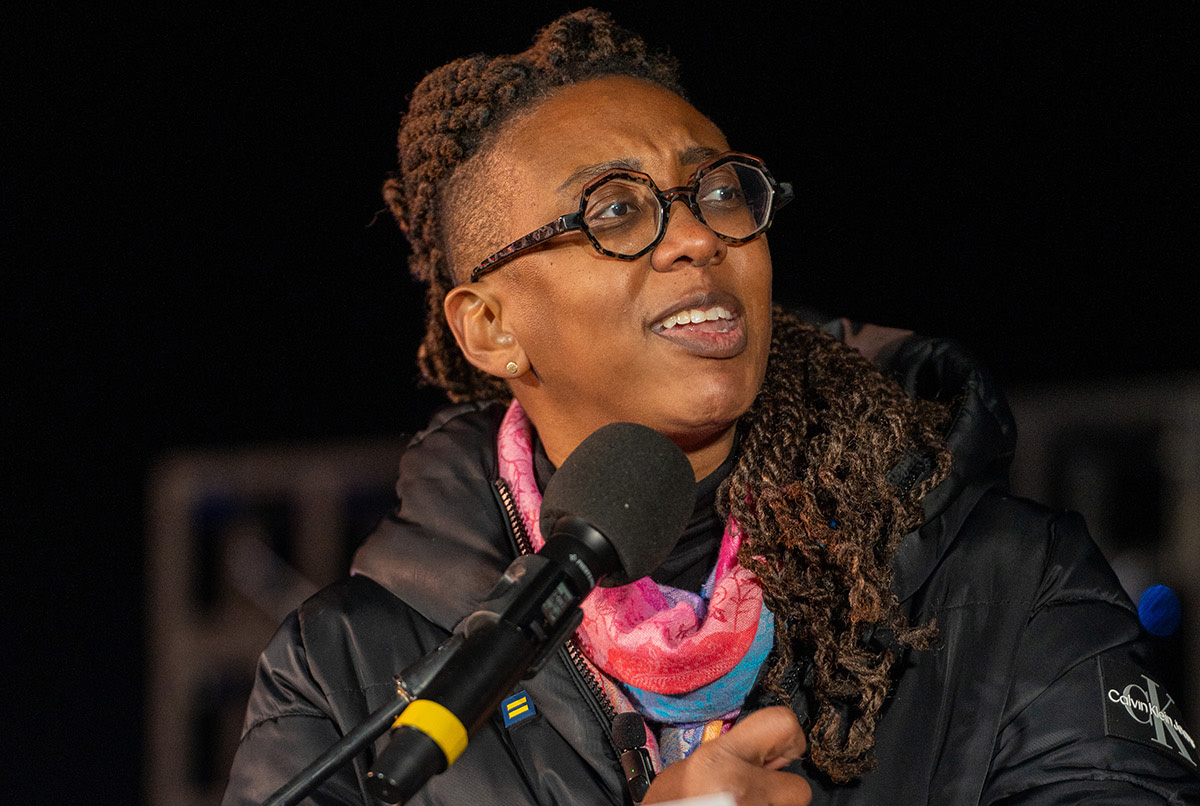
The Human Rights Campaign, the nation’s largest LGBTQ civil rights organization, has endorsed a Virginia ballot initiative that would allow the state to redraw its congressional districts this year, ahead of the 2030 Census.
Currently, Virginia’s Redistricting Commission — a legislative body made up of eight legislators and eight citizens, evenly split between Republicans and Democrats — is responsible for redrawing congressional districts every 10 years following the Census. The proposed amendment would temporarily shift that authority to the Virginia General Assembly through 2030, before returning it to the commission in 2031.
Supporters say the push for the amendment comes in response to anti-democratic moves by several Republican-led state legislatures following demands from President Donald Trump, which have resulted in newly gerrymandered congressional maps that advocates argue disenfranchise pro-equality voters.
Under the proposed map in Virginia, Democrats could gain as many as four of the five seats currently held by Republicans in this fall’s midterm elections, when control of the narrowly divided House is up for grabs.
Six states — including Texas, Missouri, and North Carolina on the GOP side — enacted new maps last year at Trump’s behest. The most significant Democratic counter-effort so far has come from California.
HRC President Kelley Robinson issued a statement backing the measure, encouraging Virginia voters who support democracy to vote “yes,” saying it would ensure “the will of the people is heard.”
“Voters should choose their leaders, not the other way around. But anti-equality lawmakers around the country, in service to Donald Trump’s assaults on democracy, are trying to undermine our elections and engineer their preferred outcome in the midterms,” Robinson said. “The American people are ready to take Congress back from the anti-equality, anti-freedom politicians that have been abusing their power to hurt all our communities and bend government to the will of a wannabe king.”
U.S. Rep. Don Beyer, who represents Virginia’s 8th Congressional District that encompasses much of Washington’s suburbs, including Alexandria, Arlington, Falls Church, and parts of eastern Fairfax County — has also voiced support for the measure. He has called Trump’s attempts to influence elections ahead of the November midterms a “betrayal of our democracy,” emphasizing that while the fight is ongoing, this effort is a step toward correcting the situation.
“It’s not a done deal by any means,” Beyer said in an op-ed for the Cardinal News. “We have to effectively make the case that even though this seems unfair in Virginia, it’s totally fair for America, for those of us who believe that taking back the House is the most significant thing we can do to stop Donald Trump.”
Virginia Gov. Abigail Spanberger is another staunch supporter of the amendment, arguing that it would, through bipartisan means, help counterbalance Trump’s efforts in what remains an uphill battle.
“As early voting begins tomorrow on Virginia’s redistricting amendment, voters should know that Virginia’s approach is different. It is temporary, directly responsive to what other states decide to do, and — most importantly — it preserves Virginia’s bipartisan redistricting process for the future,” the first female governor of the state said in a statement. “I supported the formation of Virginia’s bipartisan redistricting commission in 2020, and that support has not changed. What has changed is what we’re seeing in states across the country — and a president who says he is ‘entitled’ to more Republican seats before this year’s midterm elections.”
“Virginians have the opportunity to take action in response to this extraordinary moment in history,” she added. “That’s why, as a Virginia voter, I’m voting in favor of this amendment.”
Virginians for Fair Elections, the group responsible for marketing the initiative, has raised nearly $50 million dollars, according to the Virginia Public Access Project, a nonpartisan organization focusing on sharing public documents related to financial matters of the state. The ads notably feature former President Barack Obama, who supports the measure and has hailed it as a way to “level the playing field.”
In a recent Politico article, a person close to the White House, granted anonymity, suggested the outlook for Trump’s governing majority is weakening — particularly following the unraveling of the Iran war — underscoring why the administration is pushing Republican-led states to maximize their advantage ahead of the midterms.
“This war in Iran almost cements the fact that we lose the midterms in November — the Senate and House,” the person said.
According to The Economist, Trump holds a 37 percent approval rating, with 56 percent of respondents disapproving of his handling of the presidency.
This is not the first time Virginia has held a special election for a statewide ballot initiative. Most recently, in 1956, voters approved a measure that led to the use of public funds to provide tuition grants for students attending nonsectarian private schools.
Early voting is already underway in the Old Dominion, with Election Day set for April 21.



2026 Midterm Elections
Meet the LGBTQ candidates running for U.S. House, Senate
Pappas would become first out gay man elected to upper chamber

The midterm elections are often seen as a report card for the party in power, giving voters an opportunity to weigh in on the direction of the country after two years of unified control of the federal government. With Republicans controlling the White House, Congress and the Supreme Court, the 2026 elections could reshape the balance of power in Washington and determine what the next two years of federal policy will look like.
Among the candidates looking to shape that future are a large number of openly LGBTQ politicians running for federal office. All of the candidates listed below openly identify as members of the LGBTQ community and are running as Democrats, seeking seats in both the U.S. House of Representatives and the U.S. Senate. (See below for a list of LGBTQ incumbents.)
The New Candidates
U.S. Senate:
Chris Pappas — NH
The United States House of Representatives:
Cait Conley — NY-17
Jeremy Moss — MI-11
JoAnna Mendoza — AZ-06
Marni von Wilpert — CA-48
Scott Wiener — CA-11
Chris Gallant — NY-1
JD Ford — IN-5
Janelle Sarauw — U.S. Virgin Islands
If all of these candidates running for federal office win their seats, this would make the federal government the queerest legislative term for Congress ever.
Chris Pappas would become the first openly gay male senator if he wins the race against Republican John E. Sununu. Pappas is currently leading early polls 50% to Sununu’s 42%, and is seen as a fairly centrist Democrat with a slew of accomplishments passed through the House since his election in 2018 that make him a desired candidate for the purple “Granite State.”
Cait Conley is fighting to take two-term incumbent Republican Mike Lawler’s seat for New York’s 17th district, covering parts of Westchester, Rockland, Putnam and Dutchess counties. Conley has a long history of working as a public servant through her extensive military service, which includes six overseas deployments with the Army and work with the National Security Council. Current polling shows she has an advantage over her opponent, 64% to his 36%, making this one a race to watch.
Jeremy Moss is running for election in Michigan, after quickly rising in the ranks within the Great Lake state. Moss, who was elected to his city’s city council, then to the state House, then to state Senate has had a lengthy connection with state politics for someone so young. He also served as the state’s first gay president pro tempore. He is running in the Detroit suburbs, including Oakland County. Nearly all polling puts Moss in the lead with some already giving him 99%.
JoAnna Mendoza is a veteran of the U.S. Navy and U.S. Marine Corps running for a House seat for the Tucson and southeastern Arizona area. She has been outspoken about how the cost of everyday necessities under the current leadership of President Trump and Republicans in Congress has made people in her state less safe. She is currently locked in a tight race with her Republican counterpart, leading Juan Ciscomani 47% to 45%.
Marni von Wilpert is running to represent northern San Diego County. She has experience representing the area as a San Diego City Council member, former prosecutor, and Obama workers’ rights attorney. Von Wilpert holds a narrow lead over Republican Jim Desmond, 45% to 42%.
Scott Wiener is looking for a chance to take former House Speaker Nancy Pelosi’s seat in the San Francisco area. Weiner holds a narrow lead over the Pelosi-endorsed San Francisco supervisor Connie Chan. A New York Times poll has him leading 45% to Chang’s 40%.
Chris Gallant has a slew of federal accomplishments under his belt, from working as an FAA air traffic controller to serving in the U.S. Army and New York Army National Guard, including as a Black Hawk helicopter pilot, and is a volunteer firefighter on Long Island. Despite all of this dedication to public service, he’s running in a solidly red district with recent predictions favor LaLota 81 to 26.
JD Ford is fighting to represent the northern Indianapolis suburbs and north-central Indiana against Republican incumbent Victoria Spartz. He was the first and only openly LGBTQ person elected to the Indiana Legislature, running his campaign on making living more affordable. Polling puts him slightly behind Spartz 48% to 46%.
Janelle Sarauw is trying to win the U.S. Virgin Island’s seat in the U.S. Congress. While there is no voting power, the seat can participate in debates. Sarauw is likely to win the seat after sweeping the primary earlier this year, and will face off against Shelley Moorhead, an independent, in November.
The Incumbents
Becca Balint — VT-At Large
Emily Randall — WA-06
Eric Sorensen — IL-17
Mark Pocan — WI-02
Mark Takano — CA-39
Ritchie Torres — NY-15
Robert Garcia — CA-42
Sarah McBride — DE
Sharice Davids — KS-03
Becca Balint is running for reelection to represent all of Vermont, making her one of the few candidates on this list who represents an entire state rather than a congressional district. Balint, a former teacher and Vermont state senator, has made housing affordability, mental health, and protecting democracy central parts of her platform. Recent polling gives Balint a substantial lead over Republican challenger Gerald Malloy, 60% to Gerald’s 30%.
Emily Randall is running for reelection in Washington’s 6th Congressional District, which includes the Olympic Peninsula and parts of the Kitsap Peninsula across Puget Sound from Seattle. Randall, who previously served in the Washington state Senate, has made expanding access to affordable health care a major part of her platform. She appears to be in a relatively strong position for reelection where she won 60% of the vote in Washington’s August top-two primary, while her Republican opponent Teresa Fox received about 25%.
Eric Sorensen is running for another term representing western Illinois. The former television meteorologist has centered his congressional work on lowering costs for working families. There is no public polling in the race, but a current nonpartisan forecast gives Sorensen 59% of the vote compared to Republican Dillan Vancil, with 40%.
Mark Pocan is seeking to continue representing Madison and south-central Wisconsin. Pocan, who has served in Congress since 2013, has focused on issues including health care affordability, workers’ rights and LGBTQ+ equality. There is no public polling of the race, but the current field has no Republican candidate, and a nonpartisan forecast gives Pocan more than a 99% modeled chance of winning.
Mark Takano is running for reelection in California’s 39th congressional district, which includes Riverside and portions of the Inland Empire east of Los Angeles. Takano has made health care and veterans’ issues major parts of his congressional work. There is no public polling of the race, but in his primary he came in first with 61% of the vote compared to Republican Steve Manos’s 39%.
Ritchie Torres is running for another term representing New York’s 15th congressional district in the Bronx. Torres, who previously served on the New York City Council, has made housing, economic development, education, and public safety major parts of his platform. There is no current public polling of the race, but multiple prediction sites have it squarely his to win.
Robert Garcia is seeking another term representing California’s 42nd congressional district, which includes Long Beach and southeastern Los Angeles County. Garcia, the former mayor of Long Beach, has focused on issues including infrastructure, transportation, education, and LGBTQ+ rights while in Congress. There is no public polling of the race, but forecasting has Garcia winning the seat over Republican Brian Burley 99% to 1%.
Sarah McBride, is running for reelection to represent Delaware’s sole congressional district, meaning she represents the entire state. McBride, who made history as the first openly transgender member of Congress, has centered her campaign on lowering health care costs, protecting reproductive health care, and strengthening workers’ rights. There is no public polling of the general election, but a current nonpartisan forecast gives McBride a 99.1% modeled chance of winning against Republican Joseph Arminio.
Sharice Davids is seeking another term representing Kansas’ 3rd Congressional District, which covers the Kansas side of the Kansas City metropolitan area. Davids, a former White House fellow and attorney, has made agriculture, lowering costs, and health care central parts of her platform. There is no current public polling of the race, but prediction polling shows she has a 94% chance of winning her race.
2026 Midterm Elections
LGBTQ issues, attacks on Democrats dominate unusual RNC midterm convention
“Trumpapalooza” emphasized the gains Republicans need to maintain control of the federal government.

The Republican Party held an unusual midterm convention in Dallas last week, where President Donald Trump and other prominent GOP officials spoke in hopes of building enthusiasm and support ahead of the November elections.
The two-day gathering at the American Airlines Center was the first midterm convention of its kind for the Republican Party. Unlike a traditional presidential nominating convention, there was no official party business or nominations. Instead, the event was designed to energize Republican voters and unite the party behind its candidates and broader message heading into the midterm elections.
Trump, who spoke during both nights of the convention, repeatedly emphasized the importance of Republicans turning out to vote in the midterms — elections in which incumbent presidents and the parties in power have historically faced significant challenges.
“I’m asking you to pretend that I’m on the ballot,” the president implored attendees on the first day.
On the second night, Trump delivered another direct appeal to Republican voters.
“You know what happens if you don’t vote? You go to hell,” he said.
Trump also urged attendees at one point to “cheat like hell” to keep Republicans in control of Congress.
The president also used the event to promote Republican candidates, including Texas Attorney General Ken Paxton, the GOP nominee in the state’s closely watched Senate race against outspoken LGBTQ rights supporter James Talarico.
“He may not dress right, he may not talk exactly perfectly, and he may not be the best-looking guy I’ve ever seen, but he’s the greatest attorney general in America and he deserves to be your next senator,” Trump said when talking about Paxton.
Among those in attendance were gay Treasury Secretary Scott Bessent, Rep. Brandon Gill (R-Texas), North Carolina Senate nominee Michael Whatley, and Ohio Republican Sen. Jon Husted.
Both days, there were thousands of empty seats, including almost all of the upper level, despite Trump insisting the arena was “packed” with “thousands” more waiting outside.
The convention’s message frequently emphasized personal and political attacks on Democrats, often over detailed policy discussions. Speakers repeatedly targeted Democratic candidates and progressive figures, with Michigan Democratic Senate nominee Abdul El-Sayed among those mentioned throughout the event.
The first lady was notably absent from the event.
Five RNC officials described the scope of the party’s nationwide “election integrity” effort to Axios. They said strict enforcement of voting laws and preventing noncitizens from registering and voting are top priorities, even as analysts say voter fraud is rare and there is no evidence of any systemic or significant problem.
President Trump also proposed giving American adults $5,000 if Republicans retain control of the House and Senate, a proposal that immediately raised questions about its legality and implementation.
The Republican base has also fractured over several key issues during the last 18 months, including the war in Iran, the handling of the release of the Epstein files, surging gas prices, and rising costs driven by tariffs. The convention was organized as an effort to rally Republicans around the party and motivate turnout despite those divisions and broader concerns heading into the midterms.
A protester carrying a Mexican flag interrupted Vice President JD Vance’s speech on Sept. 10.
“It’s about sending a message to the Democratic Party that if you send your crazies, we’re going to send you packing,” Vance said of the stakes of November’s elections.
More than 100 protesters also marched through downtown Dallas during the RNC Midterm Convention, briefly blocking traffic near the American Airlines Center.
At the convention both nights, an image that can only be described as a thirst trap of Democratic socialist commentator and creator Hassan Piker was shown on the jumbotron, garnering attention on social media.
The social media star posted a video shortly after images of him, abs and all, appeared on the jumbotron, sitting at a desk and completely dumbfounded at the thought that “my meat pic was on the jumbotron at the republican midterm convention.”
Piker has been a frequent target of conservative and Republican figures because of his criticism of the Israel-Palestine war, the war in Iran, and his broader critiques of the establishment and political institutions of both parties. Piker and El-Sayed were two of the most targeted progressive figures during the convention.
Another figure from the other side of the aisle who made an appearance was Democratic Sen. John Fetterman, who in recent months has adopted more conservative positions on some issues and continued to voice strong support for Israel — an issue on which there are divisions within the Democratic Party.
“Yes, I’m a Democrat. Why am I here talking to you today? Because well, I’m a common sense Democrat,” Fetterman said in the prerecorded video that also aired on the American Airlines Center’s jumbotron. “I’m always going to stand with America. I’m always going to reject the extremes and socialism and that anti-American way of life.”
“We’ll work with President Trump to fight and defend the steel way of life right here in the steel valley,” he added.
Fetterman’s prerecorded appearance was a notable moment at an event otherwise dominated by Republican officials and speakers.
Also at the event, accusations began to spread online about alleged Grindr outages in the area of the convention — a juxtaposition with the anti-LGBTQ positions the Republican Party officially reflects and its emphasis on “family values.”
A spokesperson for Grindr told Snopes, “Grindr has not experienced recent outages. Third party sources that often make these claims rely on unreliable data such as self-reporting, while Grindr reports outages directly on its status page.” The status page showed no outages in August or September 2026.
Another person, who goes by the name of Nick Pringle online, garnered over eight million views on an Instagram video in which he claims he was about to start working “undercover as a male escort” at the convention.
In the video, he appears to be in a hotel bathroom and says he will post for the sake of exposing hypocritical Republican lawmakers who have used their power to champion what he described as hateful and divisively anti-LGBTQ legislation.
The Blade reached out to Pringle via Instagram to ask whether he ultimately carried out what he described in the video and whether he had any evidence or additional information to share about his experience at the convention, but did not hear back by the time of publication.
2026 Midterm Elections
Chris Pappas wins NH Democratic Senate primary
Gay congressman running to succeed retiring U.S. Sen. Jeanne Shaheen
New Hampshire Congressman Chris Pappas on Tuesday won the Democratic primary in the race to succeed retiring U.S. Sen. Jeanne Shaheen (D-N.H.) in the U.S. Senate.
Pappas defeated Karishma Manzur, who was his primary challenger, by a 61.8-36.1 percent margin.
The gay congressman will face off against former U.S. Sen. John E. Sununu, who defeated former U.S. Sen. Scott Brown in the Republican primary.
“Tonight’s victory sends a clear message that voters are looking for leaders who will fight for their rights, their freedoms, and to be treated with dignity and respect,” said Human Rights Campaign President Kelley Robinson in a statement.
She campaigned for Pappas in Manchester, New Hampshire’s largest city, on Aug. 30.
“Chris Pappas has delivered results, stood up for equality, and showed up for the people he serves,” said Robinson in her statement. “HRC was proud to mobilize Equality Voters across New Hampshire to help power this win. We don’t have a second to waste between now and November. We look forward to continuing our work with Rep. Pappas as he drives toward victory in November so he can help return a pro-equality majority to the United States Senate.”
A poll the University of New Hampshire Survey Center released on Aug. 26 showed Sununu ahead of Pappas by a 45-43 percent margin if they were to face off in the general election. The margin of error is +/-2.1 percent.
Pappas would become the first openly gay man elected to the U.S. Senate if he were to win in November.

Annapolis Pride arrives this weekend

Calendar: October 2-8

Renee Good’s family files two federal lawsuits

House Democrats urge White House to confront Turkish government over anti-LGBTQ crackdown

988 restores crisis services for LGBTQ youth

HRC National Dinner 2026: A night of music, activism, LGBTQ history

Trump asks Supreme Court to allow restrictions on gender-affirming care in prisons

Lesbian Bar Project co-founder: purity politics could destroy our remaining spaces

529 openly LGBTQ candidates running in Brazilian election

HRC report: LGBTQ students face ‘far greater challenges’ in non-supportive states
-

 LGBTQ Non-Profit Organizations4 days ago
HRC National Dinner 2026: A night of music, activism, LGBTQ history
-
U.S. Supreme Court5 days ago
Trump asks Supreme Court to allow restrictions on gender-affirming care in prisons
-
Bars & Parties4 days ago
Lesbian Bar Project co-founder: purity politics could destroy our remaining spaces
-
Brazil4 days ago
529 openly LGBTQ candidates running in Brazilian election